
Remote Factory Audit Guide: Verify Bag OEM Suppliers Without Visiting China
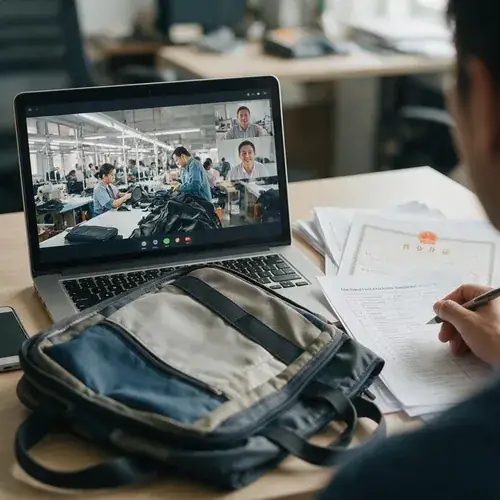
A remote factory audit is a structured assessment of a bag or luggage manufacturer done through document verification, a live video walkthrough, and technical questioning — no plane ticket required. For B2B buyers who can't visit China, this is one of the most practical ways to answer the one question that matters before sending an RFQ or paying a sample deposit: is this supplier a real OEM factory, or a trading company that will outsource the order?
The risk is commercial, not theoretical. If the factory on the other end has no pattern-making room, no cutting capacity, no in-house QC area, and no control over the production floor, the sample can look fine while the bulk order drifts: wrong stitching density, substituted fabric, delayed delivery, inconsistent logo placement, or a supplier who goes quiet when quality issues surface. A disciplined remote audit before the first sample lowers that risk.
This guide gives you a four-step executable workflow: verify the legal identity first, then run a continuous live video walkthrough, then check the QC system, then pressure-test technical depth with questions that only a production person can answer quickly. You'll finish with a request list you can paste into an audit email and a clear view of what a remote audit can — and cannot — replace.
Quick Answer: How to Run a Remote Factory Audit
The remote factory audit workflow works because it combines three kinds of evidence that a trading company finds hard to fake at the same time: legal documentation, live operational video, and technical conversation. The short version looks like this:
- Check documents before the call: business license scope, ISO 9001 validity, social compliance report, and current China export record. Documents confirm legal identity, not production ability.
- Run a continuous live video walkthrough from the company signboard into the cutting room, sewing lines, and raw material warehouse. Reject pre-recorded or edited footage.
- Inspect the QC side: incoming material inspection, in-process checks, final inspection with a real AQL report, and bag-specific test equipment.
- Ask technical questions about fabric yield, needle control or metal detection, logo decoration setup, and how the factory would hold color tolerance. Vague answers are the red flag.
- Do not mistake a remote factory audit for a pre-shipment inspection. The audit vets the factory; the later inspection vets the actual products.
If you only have time for one thing, make it the continuous live video walkthrough. Few checks expose a supplier's real role faster than asking them to walk from their own front sign into a working sewing floor without stopping the feed.
What Is a Remote Factory Audit in a Bag or Luggage Project?
A remote factory audit — also called a virtual factory audit — is a structured assessment of a manufacturing facility carried out through digital documents and live video interaction when the buyer cannot visit the site. In bag and luggage sourcing, the goal is not to "see everything." It is to verify three overlapping facts: the supplier legally exists as a manufacturing entity, the production floor matches the claims they made, and the quality system is real enough to survive a bulk order.
There is a clear difference between a desktop audit and a full remote factory audit. A desktop audit reviews paperwork only: business license, certificates, registration records. That covers legal identity but says nothing about who actually sews the product. A full virtual audit adds live video and technical questioning. That is where you catch the trading company that has a legitimate registration, an office, and a sample room — but no production floor.
For the broader supplier-verification framework around this tactic, including legal checks, factory-role assessment, and on-site logic, start with the practical guide to verifying bag and luggage manufacturers. The remote audit below is the field-execution piece.
The overall audit logic borrows from ISO 19011, the international guideline for auditing management systems. It organizes an audit around evidence collection rather than impressions: plan the scope, collect verifiable evidence, compare it against criteria, and document findings. You don't need to be a certified lead auditor to apply that. You just need to replace "I liked the sales rep" with "the evidence matches the claim."
On cost and time: third-party virtual audits are quote-dependent. The fee can shift with factory size and location, audit depth, language support, and whether you need a formal written report or just a live review. Some buyers use a third party mainly to remove the language barrier and the social awkwardness of pushing a supplier themselves. Whatever the route, confirm scope, pricing, and report timing in writing before booking.
Step 1: Desktop Document Verification — Prove the Legal Identity First
Before you spend one minute on a video call, you want to know who you are actually talking to. Document verification is the cheapest part of a remote factory audit, and it is where a surprising number of shell suppliers fall apart. The point is not to collect certificates for decoration. It is to check that the name, scope, and history match what the sales team claims.
Business License and Registered Business Scope
What trips up buyers: a supplier can show a license for a legally real company and still not be a factory. The scope matters more than the company merely existing. "Manufacturing of bags and leather products" in scope is a stronger signal than "wholesale trading; import and export of general merchandise." Don't ask "are you a factory?" — ask for the license, then read the scope line yourself.
Ask for the simplified Chinese legal name, not just the English trade name. The English name is often a marketing alias. The Chinese name is the entity you would actually have recourse against in a dispute.
ISO 9001 and Social Compliance Audit Reports
For quality systems, ISO 9001:2015 is the baseline certificate you will see most. Two checks matter most: confirm the certificate's validity dates — certificates have a defined validity window and require ongoing surveillance, so a document can look current but have lapsed or been suspended — and confirm the certification scope actually covers bag, backpack, or luggage manufacturing at the same facility address as the license. A certificate for "trading services" or a different company name does not protect your order. For a detailed breakdown of which audit matters for your retail channel, read the side-by-side comparison of BSCI vs Sedex vs ISO 9001.
On social compliance, precise language matters. BSCI is an audit initiative, and Sedex is a platform where a SMETA audit report is hosted — neither is a simple logo you collect. Ask for the audit report cover page or report number, audit date, validity or re-audit date, and the facility name in English and Chinese, then check that it matches the license. If a report is past its validity window or names a different address, treat it as unverified. Social audits usually matter when your buyer is a retailer or marketplace with a compliance policy; they do not prove bag-making skill.
Export Qualification and Material Compliance Documents
Export qualification can verify that the entity can legally export, separate from manufacturing identity, but the exact document has changed over time in China. Ask the supplier or your forwarder to confirm the current proof for your product and destination — usually a China customs import/export consignee registration or an equivalent current export record. Do not treat a historical filing as valid evidence for your order.
Material compliance documents matter only when the product category requires them: REACH for the EU, relevant phthalate or Prop 65 documentation for certain US channels, and OEKO-TEX for textile linings when buyers request it. Don't default to demanding every certificate. Ask only for what your target market and end-user group legally require. A factory that can quickly explain which document applies to your specific bag type is more credible than one that dumps an unrelated folder of paperwork.
Send this document request list before the call:
- Chinese Business License with registered business scope visible
- ISO 9001:2015 certificate plus certification scope and facility address
- Social compliance report: BSCI, Sedex or SMETA, or SA8000
- China customs import/export consignee registration or equivalent current export record
- Blank final inspection report or AQL template
- Material compliance documents for the target market, if applicable
Step 2: The Continuous Live Video Walkthrough
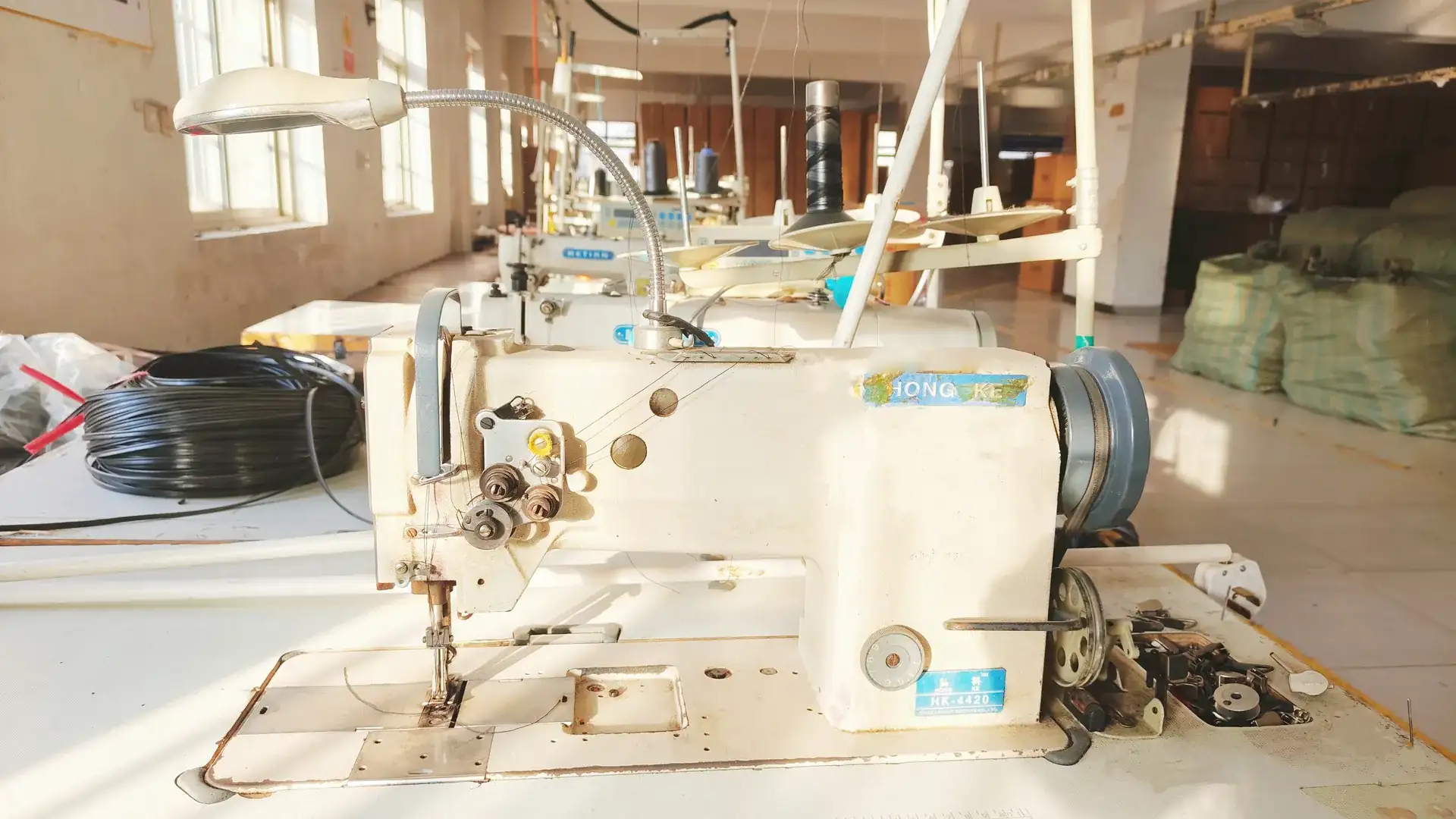
Documents verify who they are. The live video walkthrough verifies where they actually produce. This step is the heart of a remote factory audit because it is one of the harder scenes to fake on short notice — if you run the call properly.
The Continuous Walk Test
Ask the salesperson to go outside to the company signboard or building entrance and hold the phone so you can see it. Then ask them to walk without stopping or cutting the feed into production: office or entrance, cutting room, sewing lines, assembly and finishing, and finally the raw material warehouse. The reason is simple: a "borrowed factory" scam often uses a pre-recorded clip or a friendly neighboring factory for a short walkthrough. A continuous walk from a sign that matches the license, through working departments, is much harder to arrange on demand.
Hold them to the word "continuous." If the feed drops, cuts, or pauses exactly when it would move between rooms, say so and ask them to start again from the signboard. One clean interruption is not automatically fraud — connection quality varies — but repeated cuts at structural transitions should reduce your confidence. A skilled cheater can still arrange a loaned floor, so treat this as strong evidence, not a guarantee.
What a Real Bag OEM Floor Shows
You are not looking for machinery in general. You are looking for machinery that only a producing bag factory needs:
- Pattern-making or sampling area: paper patterns, cardboard templates, and a sample bag mid-construction show real development capability.
- Cutting area: cutting tables, fabric spreading, and a straight knife or band knife cutter. A trading company has photos of cutting tables; a factory has the actual tables.
- Sewing lines with workers on real operations. Look for bartack machines — the specialized machines that reinforce shoulder strap attachment points — and cylinder-bed or postbed machines for curved seams. Ask "which machine do you use to bartack the shoulder straps?" rather than "do you have machines?"
- Raw material warehouse: fabric rolls, zipper boxes, and hardware bins. If they can't show one, ask why. Some small factories lease materials as needed, which is not automatically fatal for simple promotional orders, but for OEM programs it raises the outsourced-everything question.
The table below turns those points into a scoring aid.
| Audit checkpoint | Trading company red flag | Real OEM factory green flag |
|---|---|---|
| Company signage | Missing, generic, or doesn't match license name | Sign matches the Chinese legal name on the license |
| Walkthrough continuity | Cuts, pre-recorded clips, or stops between rooms | Continuous walk from office into production floor |
| Machinery | Only basic sewing machines or sample-room displays | Cutting tables, pattern-making area, bartack machines, postbed machines |
| Staff interaction | Rep cannot name workers or floor managers | Rep talks naturally to line supervisors and knows who runs each section |
| Material inventory | No visible raw material storage and no clear material-sourcing plan | For larger OEM programs: fabric rolls, zipper boxes, and hardware visible; for small runs, a credible per-order material plan |
If the floor looks right, you have useful production evidence. If it looks staged, you still need the technical questioning later to settle it. For a fuller explanation of why the machine mix matters, see this guide to backpack manufacturer vs supplier vs factory.
Step 3: Remote QC Process Audit — Do They Actually Inspect the Bags?
You can have a real factory with weak process control, and that still hurts you as much as a fake one. The QC portion of a remote factory audit measures whether the supplier can hold the quality bar without you standing behind them. You are looking for a system, not a shelf of impressive tools — but the tools matter because they reveal whether testing is even possible on site.
IQC, IPQC, and Final Inspection Flow
Ask the supplier to show the incoming quality control (IQC) area where fabrics, zippers, and hardware arrive. You want to see fabric rolls and zipper bags being checked against approved swatches, plus a way to record incoming defects. The reason is supply-chain control: if incoming materials are not inspected, the factory cannot consistently prevent color shifts or weak zippers from entering production. Then ask about in-process QC (IPQC) — what line checkers look for at sewing and assembly. A real answer names things: stitch density, seam alignment, logo position, handle attachment tension.
Bag-Specific QC Equipment to Ask to See
Ask to see the QC corner or lab. In a bag factory, look for a zipper cycle testing machine, a load tester for handles and straps, a color-matching light box, and calibrated measuring tools. A zipper cycle tester means the factory has thought about zipper fatigue, not just "it opens now." A load tester means they can pull a shoulder strap to a defined force. If their "lab" is a corner desk with a tape measure, that's not fatal for a simple promotional tote, but for a laptop backpack meant to carry weight every day it's a problem. Then ask them to actually run one test on a current bag, not just point at the machine.
The AQL Report and Defect Handling
Request a blank copy of the standard final inspection report. A factory that runs AQL-based inspections will have a structured report with defect classifications — critical, major, minor — sample size logic, and accept/reject thresholds. Some bag buyers use AQL 2.5 for major defects, but the right level is buyer-defined by target market and channel. Ask: "What AQL level do you propose for major defects, and what happens if a lot fails?" The answer tells you as much as the document itself. For the technical background on how AQL levels shape the final decision, see the AQL inspection guide for bags.
One more question that separates a production-quality system from a shell: ask how they handle rejected units and whether they run needle control or metal detection. Needle control is the practice of accounting for every sewing needle before, during, and after production, then running finished bags through a metal detector to catch broken fragments. A broken needle piece left inside a bag is a critical safety defect — especially for children's products. Not every general bag factory runs metal detection on every run, so if the answer is "we do it only when requested," ask whether it becomes mandatory for their line, how it's verified, and whether it affects the quote.
Step 4: Technical Questioning — Expose the Middleman
A trading company can memorize a specification sheet. It is far harder for one to answer production-level questions without calling the factory after your meeting ends. A strong remote factory audit ends with a short, targeted technical interview. You are not testing the salesperson's English; you are testing whether the person on the call actually owns the production process.
Ask these questions and listen for process-based answers, not adjectives:
- "Walk me through how you calculate fabric utilization and cutting waste for this bag." A factory that cuts fabric has a yield-calculation answer. A reseller gives you a price and a pause.
- "How do you handle logo decoration setup charges and MOQ on this model?" A real OEM supplier distinguishes stock-model decoration from true OEM development, and can explain placement limits, setup charges, artwork approval, and material compatibility. A middleman promises "no problem" without detail.
- "What bartack stitch count and thread specification do you use at the shoulder strap attachment?" The mechanism: bartack density and thread spec determine whether straps tear out under load. A factory answers with a number or a test result; a reseller repeats "reinforced stitching."
- "How do you hold color tolerance between the sample and bulk production?" A real answer involves lab dips, lightbox evaluation, batch control, and approved color standards. An empty answer is "we control quality strictly."
- "If my order gets outsourced because of capacity, who takes QC responsibility and how would I know?" This surfaces outsourcing risk directly. The answer you want names accountability and disclosure.
- "What happens in production when final inspection finds a failed zipper?" This tests cause-and-effect defect handling. A system answer traces it back to incoming zipper inspection or supplier lot; a weak answer blames the worker.
One quick tell: push a follow-up "why." For example, "Why do you recommend that zipper gauge instead of a lighter one?" A factory person explains load, flex, and usage logic. A reseller repeats a catalog phrase.
Say you're running a laptop backpack program for the EU market. You'd ask about fabric yield on your polyester spec, needle control on the sewing line, and whether the factory holds the same zipper supplier across sample and bulk. If all three answers are specific, you've moved far beyond the sales page. If two of three deflect, keep shopping.
Common Mistakes That Make a Remote Factory Audit Useless
More remote audits fail from buyer shortcuts than from supplier deception. Here are the mistakes that waste the entire exercise:
- Accepting a pre-recorded video. Recorded loops can be cut, stitched together, or shot in someone else's factory. Ask for a screen-share of the live feed, or ask the person to show something that changes in real time — a wall clock, a worker you just asked to walk past, today's order on the worktable.
- Not matching the English trade name to the Chinese legal name. The English alias can sound established while the Chinese entity has different ownership, scope, or address. This one mismatch quietly removes your legal leverage.
- Skipping the raw material warehouse. For larger OEM programs, visible fabric and hardware inventory is strong supporting evidence that the supplier controls materials. For small or promotional runs, some suppliers buy just-in-time against the order, so a thin warehouse is not automatically a fail. Ask for the warehouse anyway and judge it together with the machine mix, QC records, and continuity of the live floor.
- Treating the audit as a one-call event. The strongest verification comes when the live call shows the same machines, same lines, and same QC room that appeared in earlier photos or documents. Reconfirm, don't assume.
- Assuming the remote audit replaces a pre-shipment inspection. It doesn't. The audit verifies the factory system; the later inspection verifies the actual cartons that leave. A first bulk order needs both.
- Not recording the walkthrough or writing down the call date, participants, and findings. Memory is not evidence when a defect dispute starts later.
If the audit clears, the next de-risking step is the sample. Do not skip it — use a structured bag sample approval checklist before mass production so the approved sample becomes the binding reference, not a vague memory.
Remote Factory Audit Request List: Paste Into Your Email
You don't need to dance around it. Send this list as a structured request before the call. It signals that you are a serious buyer and gives you a scorecard to run against the supplier.
| Audit request item | Why it matters / acceptance check |
|---|---|
| Chinese business license copy | Confirm legal name, unified social credit code, and scope includes bag or luggage manufacturing |
| ISO 9001:2015 certificate plus certification scope | Verify validity window and that scope matches bag production at the same facility address |
| Social compliance report (BSCI, Sedex or SMETA, or SA8000) | Confirm audit date, facility name, validity, and that it matches the license |
| China customs import/export consignee registration or equivalent current export record | Verify the entity can legally export under current China customs practice |
| Blank final inspection report or AQL template | Confirm defect classification and accept/reject logic |
| Material compliance documents if applicable (REACH, Prop 65, OEKO-TEX) | Confirm the supplier knows which standard applies to your target market |
| Live video walkthrough date and time | Require a continuous walk from signboard to sewing lines to warehouse |
| QC lab and test equipment live view | Require one actual test run, not equipment pointing |
| Similar product experience reference for the exact bag category | Confirm they have made a comparable product, not just any bag |
| Artwork or logo method feasibility note for your product | Confirm setup charges, placement limits, and material compatibility |
If a supplier accepts the document and video items without pushback, that's a good sign — but it's evidence, not proof. If they dodge the continuous walk or the QC lab, move on. Most legitimate factories understand why a remote buyer needs this level of evidence.
FAQ: Remote Bag Supplier Verification
These are the questions buyers ask most often when deciding whether a remote audit is worth the effort, and what it should replace in their sourcing process.
How much does a third-party remote factory audit cost?
Fees for a third-party remote factory audit are quote-dependent. Providers usually price based on scope, depth, language support, factory location and size, and whether you need a formal report. Ask for a written breakdown covering document pre-review, the live call, report delivery, and any translator. A generalist auditor can be useful; a bag specialist usually catches material and seam issues faster.
Can a remote factory audit replace a pre-shipment inspection?
No. The audit vets the factory system, while the pre-shipment inspection vets the actual finished goods. The audit answers "does this supplier have the capability and control to make my bags?" The pre-shipment inspection answers "did the specific cartons that just came off the line meet the approved spec?" For a first bulk order, run both.
How long does a remote factory audit take?
Document collection and pre-review usually depend on how quickly the supplier responds, but a few working days is a realistic planning assumption for a single small-to-medium factory. The live video walkthrough plus technical Q&A usually fits into one structured call. A formal third-party report adds further writing and review time after the call. Treat these as planning ranges, not fixed commitments — confirm the timeline with the auditor or supplier in advance.
How do I know the factory on the video is really theirs?
You can't be absolutely certain, but the continuous-walk test makes borrowing far harder. Ask them to start at the outside signboard and walk without cutting the feed into the cutting room, past the sewing lines, and into the raw material warehouse. Cross-check the sign, license address, machine layout, and staff interactions. If the feed cuts, the sign is missing, or the representative can't name the floor workers, treat the evidence as weaker.
What documents should I request before the remote call?
Request the Chinese business license with registered scope, ISO 9001:2015 certificate plus scope, a social compliance report (BSCI, Sedex or SMETA, or SA8000) if your channel requires it, current China export qualification evidence such as the China customs import/export consignee registration or equivalent current export record, a blank final inspection report or AQL template, and material compliance documents for your target market. Verify each document's validity dates and facility name against the license.
What if the supplier refuses a live video walkthrough?
For a small promotional stock-model order with a safe payment method and a small sample first, a refusal is not automatically fatal — but it raises risk. For custom OEM or ODM production with tooling, high order value, or channel compliance exposure, a refusal to show the floor should be treated as close to a fail. At minimum, document the refusal, ask why, and redirect risk to a sample approval plus a third-party pre-shipment inspection before increasing order value.
Official Sources and Compliance References
These are the reference points behind the remote audit logic. They are not a substitute for verifying the current version and applicability to your specific product and target market.
- ISO 19011 — Guidelines for auditing management systems. Used here conceptually for audit planning, evidence collection, criteria comparison, and documented findings. It does not certify your factory or your audit.
- ISO 9001:2015 — Quality management systems. The certificate you will most often review; confirm scope and validity through the issuing body or current register.
- National Enterprise Credit Information Publicity System (China) — Official public registry for checking the legal name, unified social credit code, registered capital, business scope, and operating status of Chinese-registered companies.
- AQL (ISO 2859-1) — Sampling and acceptance framework behind inspection report logic. The specific AQL level for an order is buyer-defined by market and channel; it is not a universal default.
- BSCI, Sedex or SMETA, and SA8000 — Social compliance audit schemes. Confirm which is accepted by your retail channel, and verify the specific facility report rather than relying on a logo.
Conclusion: Run the Audit, Then Let the Sample Decide
A remote factory audit is not a magic shield. It is a structured way to stack evidence so you are not deciding on the basis of a catalog photo and a friendly sales chat. Do the documents first, run the continuous live video walkthrough, inspect the QC equipment and AQL report, and finish with the technical questions. That sequence usually exposes the weakest suppliers before any real money moves.
If the audit clears, don't jump straight to bulk. Order a pre-production sample against a written specification, then use a structured bag sample approval checklist to sign off before mass production. When the sample comes back correct and the factory showed a real floor, a real QC system, and production-level answers, you have built a sourcing decision you can defend.
If you are evaluating OMASKA for a bag or luggage program, use the pre-audit request list above and state your target bag type, target market, and order quantity. That gives both sides a concrete scope to verify — which is exactly how a professional sourcing conversation should start.
Get A Quote

Get A Quote
0 Comments