
Pizza Delivery Bag Design Guide: Thermal, Stack Capacity & Cleaning Specs
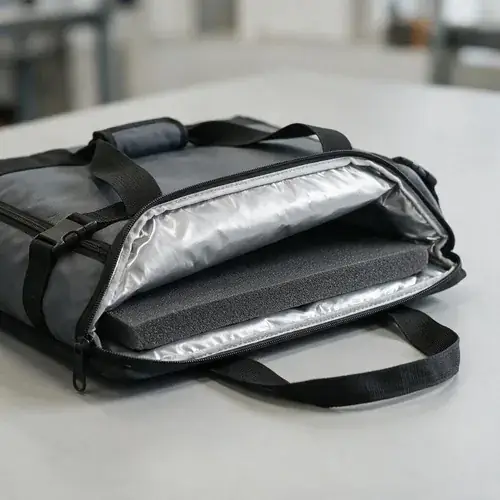
A commercial pizza delivery bag earns its keep only when five variables work together: heat retention over the real route time, steam balance that protects crust texture, stack clearance with a rigid bottom, seam and liner survival through repeated cleaning, and batch-to-batch dimensional consistency. Thick insulation alone will not fix a soggy pizza or a collapsed stack.
When those variables are not specified before sampling, buyers get bags that pass a showroom test and fail on a motorcycle rack in daily route use. A weak bottom insert lets a tall stack sag; a fully sealed liner traps steam; a low-grade hook-and-loop flap loses grab or warps after repeated sanitizer cycles. The commercial cost shows up later as product complaints, reissued purchase orders, and inconsistent franchise rollout.
This guide is written for restaurant chains, distributors, private-label buyers, and delivery-platform equipment teams. It gives a supplier-side framework for comparing samples, challenging an insulated pizza bag manufacturer, and writing an RFQ that returns comparable quotes instead of guesses.
Quick Answer: What Makes a Commercial Pizza Delivery Bag Perform Well?
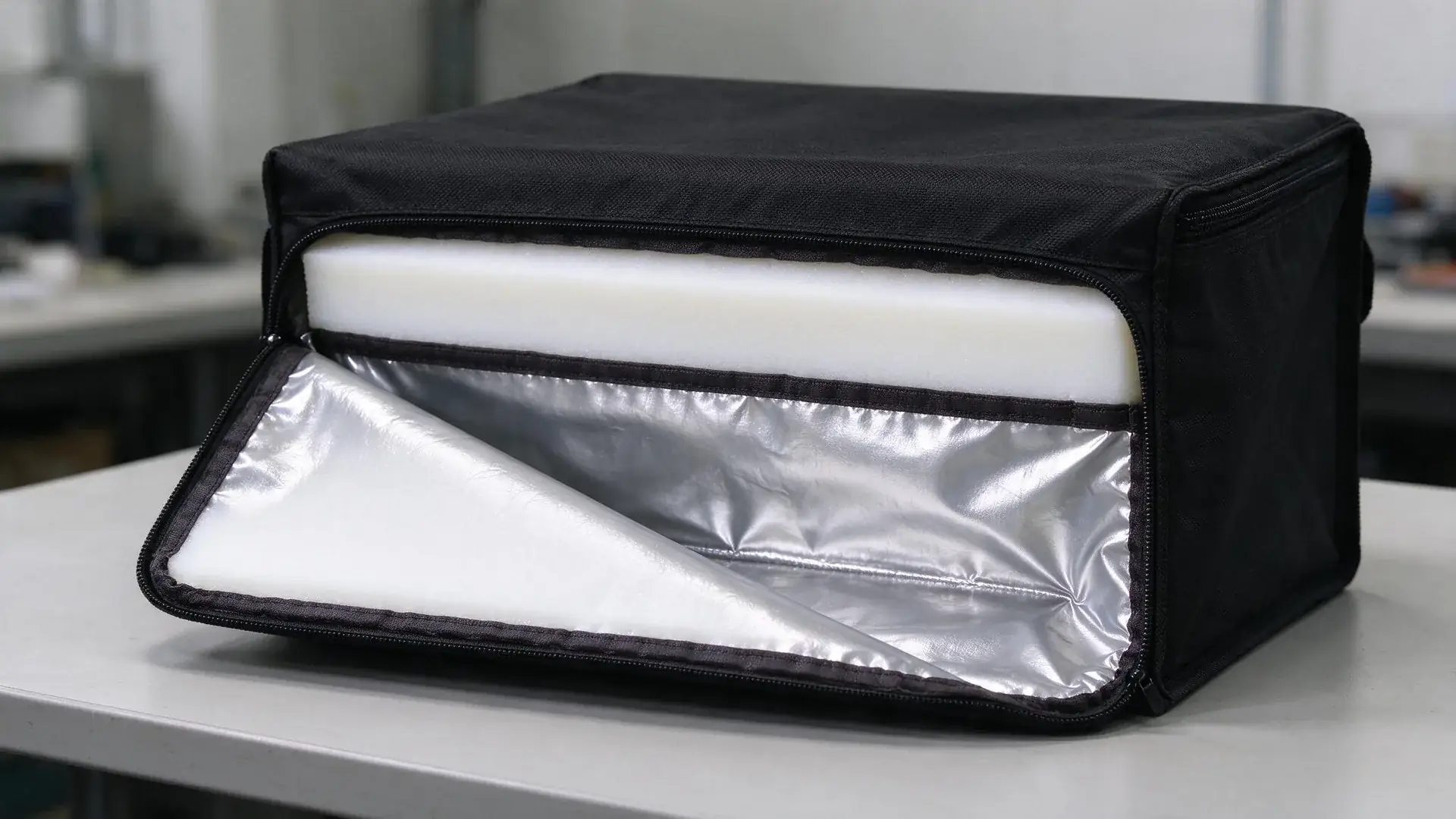
A commercial pizza thermal bag performs when it is specified around the route, not around a catalog description. Before you request quotes, pin down five things:
- target pizza box dimensions and the highest stack height per delivery;
- longest realistic route time and staging temperature exposure;
- closure type and whether drivers need fast one-hand access;
- cleaning frequency and the sanitizer the restaurant or distribution center actually uses;
- packaging, branding, and carton constraints for storage or distributor rollout.
Once you know those inputs, the bag structure falls into place. A single-order short-route bag can use a simpler closed-cell foam build with a reliable hook-and-loop flap. A multi-stack fleet bag may require a reinforced bottom panel and stronger sidewall geometry, depending on stack height, vehicle compression, and box weight. A high-sanitation chain program typically leans toward RF-welded or edge-bound PEVA liner surfaces with fewer trapped seams. Don't start from a premium material label; start from the failure mode you cannot afford for the specific operation.
That's the difference between a sourcing decision and a purchasing accident.
Define the Delivery Environment Before Specifying the Bag
The same foam and closure spec can pass one route and fail another. That is usually not a manufacturing defect; it's a spec mismatch. A bag built for a short urban loop with gentle trunk handling behaves differently from one compressed into a food-delivery backpack rig or strapped flat against a motorcycle rack on a long freeway run.
Start with the operation, then translate each variable into a supplier requirement.
| Operational variable | Why it changes the bag spec | What to confirm with supplier |
|---|---|---|
| Route duration | Longer exposure increases the need for six-sided coverage and closer closure fit | Longest route time, plus any pre-staging hold time |
| Pizza box format | Side dimensions and lid style determine interior clearance and tilt risk | Exact box length, width, height, and corrugated-board thickness |
| Stack height | Tall stacks concentrate load on the bottom panel and lower side seams | Maximum box count per trip or total vertical stack height |
| Delivery vehicle | Motorcycle racks, bicycle bags, and car trunks apply different compression and vibration | Rack type, strap position, and whether bags rest flat on a floor |
| Restaurant cleaning process | Daily sanitizer spray or wet wipe-down changes liner and seam survival | Cleaning chemical, frequency, wipe method, and available drying time |
| Branding and distribution | Print placement, labels, and folded carton packing can affect cleaning zones and seam stress | Print method, label location, carton pack count, and distributor requirements |
Single-Order Delivery vs Multi-Stack Fleet Operations
Single-order delivery prioritizes closure fit and thermal retention because no vertical load sits on the bag. A soft-sided bag with a clean hook-and-loop flap can be perfectly adequate. The failure risk is usually a poor seal at the opening, not a collapsed floor.
Multi-stack fleet operations reverse the priority. A smaller stack may work inside many insulated bags; a taller stack creates a different structural problem. The bottom box becomes the load-bearing layer. If the base panel is only a piece of foam sewn into a soft shell, the stack can tilt, the top box leans against the closure, and heat escapes through an opening the bag never had when empty.
Franchise Standardization vs Independent Restaurant Flexibility
A franchise buyer usually needs dimensional consistency across regions. The pizza box, rack, and delivery bag should repeat the same internal clearance in every location, which makes the specification more rigid. That pushes buyers toward a controlled interior dimension rather than a supplier's generic "large pizza bag" label.
An independent restaurant has more flexibility. The operator may accept a local box format and adjust the bag over time. However, that flexibility can become a procurement problem if the buyer reorders and receives a different internal height or narrower closure because the original spec was never documented. For both groups, the fix is the same: send the supplier the box dimensions, not just the marketing size.
How Pizza Box Dimensions and Stack Height Affect Bag Design
Size the bag around the box, never around the product name. A "large" pizza is not a dimensional standard, and a "16-box bag" is not a meaningful spec until the buyer defines the box thickness and lid style. Two operators can use the same nominal pizza size with different corrugated packaging, and that difference changes how many boxes fit and how easily a driver can pull one out.
| Box or stack input | Specification consequence | Supplier question to answer |
|---|---|---|
| Box length and width | Determines minimum internal floor dimensions | What interior clearance is recommended for quick box insertion? |
| Box height, including lid | Drives vertical clearance and closure reach | Is the closure opening tall enough for a domed-lid or top-handle box? |
| Stack height | Determines bottom panel and sidewall stiffness | How much vertical stack weight can the bag support without sag? |
| Corner shape of boxes | Affects liner wear at the lower internal corners | Does the liner need extra corner protection or edge binding? |
| Vehicle compression | Increases the need for perimeter structure | Does the sidewall retain shape under strap tension or vertical stacking? |
Clearance Tolerance for Different Pizza Box Sizes
Interior clearance should not equal the pizza box exactly. A tight fit may look thermally efficient, but in service it forces drivers to fight the bag at the door, slows handoff, and increases the chance that a box corner drags against the liner. That repetitive corner contact is exactly where foil liners can crack and PEVA liners abrade. Specify a small, supplier-confirmed clearance allowance around the box, based on the actual dimensions and whether drivers leave extra packaging or supply napkins on top.
Why Tall Stack Loads Need Reinforced Bottom Panels
A rigid bottom panel does more than stop sag. It spreads the stack load across a larger area so the lower sidewall seams do not carry the full weight of a tall stack. Common approaches include a removable rigid insert, an integrated PE/EVA reinforcement board, or a stiffer bonded base panel. Removable inserts usually simplify cleaning and replacement; integrated panels often offer better shape retention and reduce the chance that a driver installs the insert incorrectly.
If the bottom is soft, the stack leans in transit, the top box contacts the closure, and the seal gap erases some of the thermal work done by the foam. Buyers should specify the bottom support method, not just demand a strong bag.
Compression Risk During Motorcycle or Bicycle Delivery
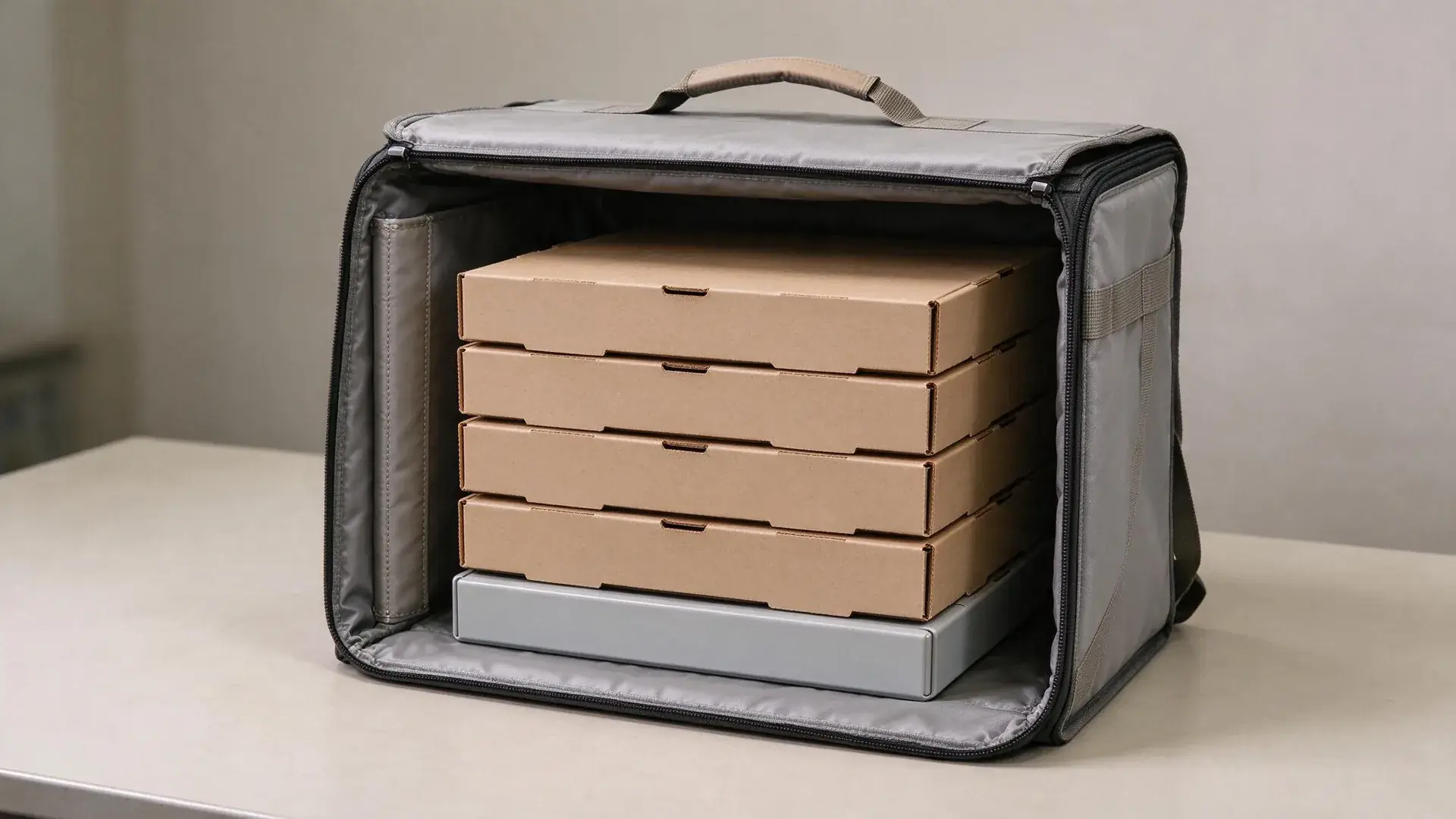
Motorcycle and bicycle delivery add a failure mode that restaurant countertop use rarely tests. A large bag stuffed into a rack, strapped across the side, or pressed against a food-delivery backpack structure may be squeezed at the side panels, corners, or closure edge. Sidewall deformation changes the internal volume and can push the closure apart. That's why some pizza delivery bags benefit from a semi-rigid side structure or perimeter edge binding, not just extra foam in the lid.
Thermal Retention Depends on More Than Insulation Thickness
Thermal retention in a pizza delivery bag is a system, not a single foam spec. Heat leaves through the floor, the side seams, the closure gap, and the lid just as much as through the face fabric. If the lining is reflective on five sides but not the bottom, heat sinks through the floor. If the closure leaves a visible gap, the most expensive foam still leaks.
| Construction choice | What it does | Operational tradeoff or failure mode | Verify with supplier |
|---|---|---|---|
| PE closed-cell foam | Lightweight insulation with good moisture resistance | Thicker foam adds weight, stiffness, and drying time | Foam type, density, thickness, and closed-cell confirmation |
| EPE insulation | Expanded polyethylene cushioning and thermal barrier | Compression recovery can vary by density and supplier | EPE density, compression set, and thickness tolerance |
| Multi-layer thermal construction | Shell, foam, reflective liner, and sometimes an air gap | Bulkier and harder to sew cleanly; only worth it on hard routes | Layer sequence, cross-section sample, and edge binding quality |
| Reflective foil or PEVA liner | Wipeable surface and extra radiant reflection where present | Foil can crease and crack after repeated folding; PEVA can delaminate | Cleaning compatibility, fold test, and liner adhesion after cycles |
| Hook-and-loop closure | Fast opening and fewer zipper breakages | Holds heat only if full contact and no warped gap remains | Hook/loop width, pull strength, and cleaning-cycle behavior |
| Zipper closure | Tighter barrier when the mouth is fully closed | Slow, prone to slider damage in high-frequency operations | Zipper gauge, slider pull strength, and closure-cycle confirmation |
PE Foam vs EPE Foam vs Multi-Layer Thermal Construction
PE foam and EPE insulation both work in pizza bag construction, but they are not interchangeable as marketing terms. Closed-cell PE foam can offer thin, consistent insulation and predictable stitching behavior, but these properties are supplier-dependent; confirm foam type, density, and thickness from the cross-section sample. EPE, expanded polyethylene, often brings more cushioning and can feel softer, but its compression recovery depends on the specific density the supplier uses. A multi-layer cross-section adds more thermal resistance and more failure points: extra layers introduce extra seam complexity, extra weight, and more places for moisture to collect if the edge is poorly finished.
The practical rule: compare the supplied cross-section sample first. Don't accept a supplier saying "EPE foam" and assume the actual performance matches a colleague's bag from another factory.
Why Steam Venting Matters for Pizza Texture
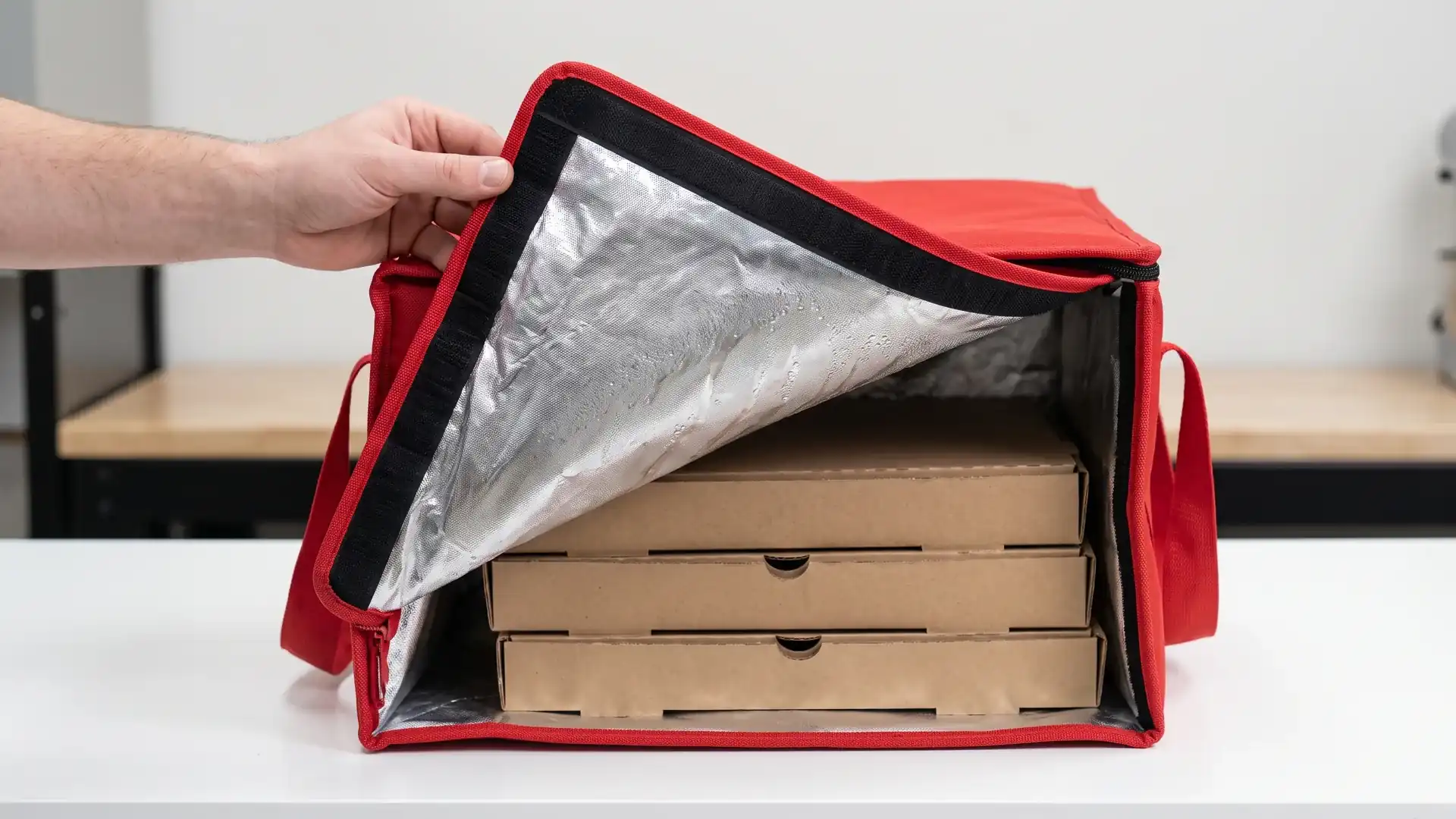
Pizza needs heat retention without full moisture entrapment. A completely sealed delivery bag can hold steam from the hot crust until it condenses and visibly softens the top of the box. In real delivery, that's the soggy-box complaint operators fear most. On the other hand, a bag with too much open ventilation loses heat faster on a long route.
The balance is usually a small moisture release path: a vented panel, a partial closure fit, a breathable edge section, or a flap designed with a deliberate small gap. The buyer should define acceptable moisture buildup with a route test rather than assuming every insulated bag is supposed to be airtight.
Hook-and-Loop Closures vs Zippers in High-Frequency Use
Zippers may provide a tighter closure when fully seated, depending on tape alignment, closure geometry, and wear condition, but they can fail in a predictable way: the slider jams, the tape tears at the end stop, or a strand of thread eventually catches a tooth. For a driver making dozens of stops, that's dozens of cycles a shift. Hook-and-loop closure avoids that failure mode, but it holds its performance only when the tape stays clean and the contact area is wide enough to resist warping.
A mixed closure makes sense in many commercial designs: a wide hook-and-loop flap for speed and cleaning, with the option of a partial corner seal or top cover for heat control. Closure choice is not a question of better or worse. It's a question of opening frequency, cleaning method, and whether the seal gap can create visible heat loss.
Liner and Seam Construction Affect Cleaning Lifespan
In high-volume delivery operations, cleaning is a common lifecycle failure point. Sanitizer sits in the seam holes, liner edges peel away, and foam begins to absorb moisture once the surface barrier is damaged. A buyer who only checks thermal performance on day one misses the failure that appears after repeated closing-shift cleaning. For restaurant chains and high-volume distributors, cleaning durability should be evaluated with the same weight as heat retention.
| Construction approach | Typical cleaning behavior | Likely failure mode | Verify before production |
|---|---|---|---|
| PEVA liner | Smooth, low-absorbency, wipeable surface | Delaminates at edges, punctures at box corners | Liner adhesion and sanitizer compatibility |
| Reflective foil liner | Low moisture pickup, good radiant reflection | Crease cracking, foil peeling from fold lines | Repeated bend and wipe test after cleaning |
| RF-welded seams | No stitch holes, stronger moisture barrier in the seam zone | Harder to repair in the field; can be damaged by aggressive cleaning tools | Peel test on sample and repair/replacement policy |
| Sewn seams with binding tape | Easier to repair, simpler construction | Stitch holes can wick moisture; binding tape may lift or peel | Seam load test and edge binding adhesion after washing cycles |
RF-Welded Seams vs Sewn Construction
RF-welded seams bond liner layers without creating the needle holes that a stitched seam leaves behind. For moisture resistance, that's often the cleaner choice when the liner and foam are compatible with welding. The downside is repair. A stitched bag can often be mended at a local sewing bench; a welded seam that splits under extreme abuse may be harder to repair cost-effectively.
Neither is automatically superior. A restaurant with a low cleaning frequency and a repair-friendly maintenance culture may prefer sewn construction. A chain that wants less moisture trapping at the seams may accept the harder repair profile of RF welding.
Cleaning-Cycle Stress and Delamination Risk
Cleaning stress is more than the chemical type. It includes high-temperature water, repeated wiping pressure, folding while the bag is damp, and sanitizer sitting in the folds overnight. Delamination often begins at the corner fold or the top edge where moisture pools. Buyers should test the exact sanitizer the operator uses, not just water, because some cleaner types break down certain liner coatings faster than suppliers expect.
Ask the supplier how the liner is bonded, what cleaning agents they have confirmed compatibility with, and whether the bag should be dried open or closed. Don't assume a "wipe-clean" surface survives every commercial sanitizer.
Leak-Resistant vs Liquid-Containment Construction
Most pizza delivery bags only need leak resistance, not liquid containment. The cargo is a boxed pizza, not free liquid. Calling a standard pizza bag "leakproof" is over-spec unless the construction has been validated for free-liquid transport, with sealed seams and a closure system designed to hold liquid inside. That's a different product category.
A practical spec is: keep condensation, sauce seepage from a cracked box, or melted ice out of the liner with a wipe-clean surface. Confirm with the supplier whether the construction is intended only for boxed food or also for loose containers and open liquid; this distinction changes seam sealing, inspection, and cost.
For a broader look at how insulated seams and food-safe liners are evaluated on cold-side bags, see the Cooler Bag Manufacturing Guide: Insulation, Seams & Food-Safe Materials.
QC Checks Restaurant Chains Should Require Before Bulk Orders
Sample approval is not quality assurance. The bag a buyer approves in the office must match what arrives in the container months later. For commercial pizza delivery programs, the acceptance criteria should be written before production, not after the first complaint. That means dimensional stability, seam stress, handle load, closure retention, and cleaning simulation all get pass/fail definitions.
Sample Approval vs Production Approval
A pre-production sample answers one question: does this construction match the intended spec? A production approval answers another: will the supplier repeat that sample at scale without drift in dimensions, foam thickness, or closure strength? Buyers who approve only one sample and then issue the order are assuming production consistency rather than verifying it.
The minimum reference structure is a signed pre-production sample, a documented set of approved materials, and an agreed inspection method for production lots. Keep the approved sample intact; do not send it back and then argue over a later visual mismatch.
Buyer-Defined Heat Retention and Cleaning Tests
Heat retention should be tested against the buyer's own route condition, not a supplier's marketing video. A practical method uses a pre-heated boxed pizza or controlled hot load, places it in the sealed bag, and records the temperature response at the buyer-defined route time. The pass/fail threshold is the point where product quality becomes unacceptable, which the restaurant team should define before the test.
Cleaning testing is equally important. Run the liner through the sanitizer and wipe process several times, then inspect for delamination, peeling, odor hold, or closure grab loss. The test should mimic closing-shift behavior: wipe the liner, fold the flap, leave the bag partially closed, and inspect the next morning.
Carton and Packaging Checks for Distributor Programs
If the bag ships folded or compressed inside a carton, ask how that compression affects foam recovery, liner fold lines, and the bottom panel shape after unpacking. The bag that sits compressed for weeks can show different shape retention than the sample shown flat. This matters for distributor programs that hold inventory and deliver repeatedly to restaurants.
Carton pack count, polybag protection, shipping marks, and any barcode/FNSKU requirement should be confirmed before bulk packaging approval. If a bag is destined for e-commerce or marketplace distribution, packaging becomes part of the product, not just logistics.
When the same team also sources a backpack-style food delivery unit, the QC burden expands to harness stitching, back panel padding, and zipper alignment. The Food Delivery Backpack Sourcing Guide: Insulation, Leakproof QC & Comfort covers those additional checks.
RFQ Checklist for Sourcing a Pizza Delivery Bag
A good RFQ gives a supplier enough engineering context to say yes, no, or suggest a better alternative. A bad one says only "quotation for insulated pizza bags." The second one produces wide price spreads, irrelevant samples, and a mismatch discovered too late.
Use this table as the structure for a supplier-ready RFQ. Leave any uncertain value as "to confirm with supplier" rather than inventing a spec.
| RFQ field | What to specify or confirm with supplier |
|---|---|
| Bag category and use | Commercial pizza delivery bag for boxed pizza; not free-liquid transport unless separately specified |
| Target market / route | City, delivery vehicle type, longest route duration, staging conditions, ambient temperature range |
| Pizza box dimensions | Exact length, width, height, lid style, and corrugated-board thickness |
| Maximum stack height | Number of boxes per trip or total internal vertical clearance required |
| Outer shell material | Polyester/nylon type, denier or weight, color, coating, abrasion expectation |
| Insulation structure | Foam type, thickness, layer sequence, five-sided vs six-sided coverage |
| Liner material | PEVA, foil, or supplier option; confirm sanitizer compatibility and wipe-clean behavior |
| Closure system | Zipper, hook-and-loop, mixed closure, opening frequency, one-hand access |
| Bottom support | Removable rigid insert, integrated reinforced panel, or soft foam base |
| Handles and carry access | Handle length, attachment point, reinforcement, shoulder/carry requirement |
| Cleaning requirement | Sanitizer type, cleaning frequency, drying time, odor-control expectation |
| Branding | Method, placement, whether print area is cleaned daily, label type |
| Packaging | Polybag, carton pack count, shipping marks, barcode/FNSKU if marketplace distribution applies |
| Target price / landed cost | If defined, state the budget range against the required spec rather than as a hidden number |
| Minimum order / setup charges | Confirm supplier MOQ, setup charges for branding, and any low-quantity constraints |
| Sample process | Pre-production sample, approval criteria, lead time assumption, production reference |
| Inspection standard | Agreed AQL or sampling level, dimension tolerance, seam/load/cluster checks |
| Replacement and repair | Spare handle or bottom panel availability, repair policy, return-tier logic |
Common Sourcing Mistakes in Commercial Pizza Bag Programs
The same avoidable mistakes repeat across restaurant chains, franchises, and distributors. Most come from writing an incomplete spec and then blaming the bag when a known operational risk appears.
- Over-spec insulation without solving steam. The thickest foam can hold heat but trap moisture. Buyers who demand only "better insulation" often create a soggier box, heavier bag, and longer drying time.
- Ignoring the bottom panel. A soft base is the fastest way to turn a tall stack into a tilted, gap-open delivery bag. The bottom is structural, not cosmetic.
- Using nominal pizza sizes instead of box dimensions. Manufacturers cannot guarantee fit when the RFQ says "large pizza" and the real box has a domed lid or taller corrugated edge.
- Testing only one fresh sample. One article that looks clean on day one tells little about cleaning-cycle failure at day ninety. Production consistency needs separate verification.
- Specifying "leakproof" without defining the liquid condition. A standard pizza bag made for boxed food is usually leak-resistant, not free-liquid leakproof. Mislabeling the requirement can lead to the wrong seam, liner, and cost.
- Leaving cleaning chemicals out of the RFQ. The same bag may survive one sanitizer and fail another. If the supplier doesn't know the chemical, the liner selection is a guess.
- Buying on price before locking the reference sample. Without an approved reference, a lower quote may bring a different foam density, thinner liner, or narrower hook-and-loop tape.
These errors overlap with broader supplier-selection risks. The Top 12 Mistakes to Avoid When Sourcing Bags from China covers production control and supplier verification beyond the pizza bag category.
FAQ: Pizza Delivery Bag Design and Sourcing
These are the questions restaurant chains, distributors, private-label buyers, and delivery-platform equipment teams ask before contacting a manufacturer.
What is the best insulation material for a pizza thermal bag?
There is no single best material; the correct answer depends on route time, stack height, and cleaning. Closed-cell PE foam, EPE insulation, and multi-layer constructions all appear in commercial pizza thermal bag design. A closed-cell PE foam build can work well for short routes when the closure fits tightly. A multi-layer construction with shell, foam, reflective liner, and air space may be appropriate for longer delivery times, but it adds weight and seam complexity. Ask the supplier for a cross-section sample and confirm foam type, density, and thickness before trusting the label.
Are pizza delivery bags supposed to be airtight?
No. A well-designed pizza delivery bag resists heat loss but still allows enough moisture release to reduce the risk of soggy crusts. A fully sealed bag can trap steam, condense it on the box, and create exactly the texture complaint operators want to avoid. The practical design is usually a small venting path, a breathable edge section, or a closure fit that accepts a minor gap without losing too much heat. Buyers should define the moisture balance with a route test rather than assume airtight construction is always better.
How should restaurant chains test delivery bags before rollout?
Run a test that resembles the real shift, not a showroom demo. Load the bag with boxed pizza at normal serving temperature, close it, and leave it for the longest realistic route time. Record temperature and box condition at the end. Then run a cleaning-cycle test using the sanitizer the restaurant actually uses. After several wipe or spray cycles, inspect the liner for peeling, odor hold, and closure grab loss. A pilot deployment with a small subset of busy locations often reveals compression, handle, and seam issues that a single office test misses.
What liner materials are easiest to clean?
PEVA liners and reflective foil liners are common because both offer wipeable surfaces and low moisture pickup. PEVA usually performs well against everyday condensation and sauce contact, but it should be checked for edge delamination under the operator's sanitizer. Reflective foil also wipes quickly, but it can crease and crack in fold zones. The cleaning method matters as much as the material: wet wipe-down, spray sanitizer, and overnight drying all place different stress on the seam and liner bond.
Can one bag size fit every pizza box format?
A single bag cannot reliably fit every format if the buyer skips dimensional review. Boxes differ in side length, height, lid style, and corrugated thickness. A bag sized for one format may be too tight or too tall for another. The safer approach is to specify the interior clearance around the actual box dimensions and then test the maximum stack height. If multiple box formats exist, bring that list to the supplier and verify which formats the chosen design can serve.
What should distributors confirm with an insulated pizza bag manufacturer?
A distributor should confirm dimensional tolerance, foam type and density, liner construction, closure method, cleaning compatibility, carton packing, and the approval sample process. Also ask how the manufacturer controls production consistency between the pre-production sample and bulk lots, and what replacement or repair options exist for seam, handle, or bottom-panel failures. If branding or marketplace packaging applies, confirm print method, label placement, carton pack count, and barcode requirements before final pricing.
Official Sources and Compliance References
For a commercial pizza delivery bag project, official documentation usually comes from supplier technical sheets and buyer-defined test protocols rather than a fixed industry citation. Request the following reference documents to make the spec defensible:
- Supplier material technical sheets: foam type and density, outer fabric denier or weight, liner composition, coating details, and seam-sealing method.
- Liner/cleaner compatibility statement: identifies which sanitizers the supplier has confirmed against the liner and closure materials.
- Buyer-defined heat retention test protocol: states the pre-heated load, holding time, recording method, and pass/fail condition agreed before sampling.
- Pizza box packaging specification: supplied by the restaurant or box packaging source, giving exact dimensions and corrugated-board thickness.
- Transit or carton test reference: used only if the distributor network, e-commerce distribution, or carrier requires a specific transit test method.
- Food-contact documentation: required only if the liner is expected to directly contact unpackaged food; boxed pizza transport generally does not trigger the same requirement.
Conclusion
The first priority in a pizza delivery bag program is operational fit, not a generic premium label. Define the route, the box, the stack height, the cleaning process, and the distribution format before comparing materials. Then use those inputs to request a cross-section sample, approve a pre-production reference, and agree the production inspection criteria.
That sequence moves you from a vague quote request to a repeatable sourcing decision. Once the pizza box dimensions, stack requirement, closure preference, and sanitizer are specified, the bag should almost design itself around the operation. For a factory-side review of those inputs, the OMASKA team can confirm what is feasible in the shell, insulation, liner, seam, and carton structure for your specific rollout.
Get A Quote

Get A Quote
0 Comments