
Food Delivery Backpack Sourcing Guide: Insulation, Leakproof QC & Comfort
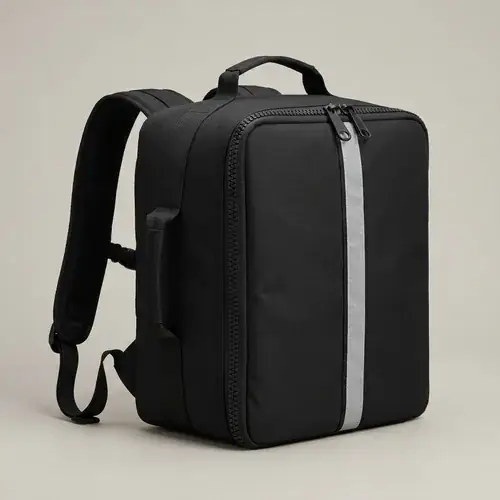
The sourcing question behind a commercial food delivery backpack is not “which bag is cheapest.” It is: which construction will keep food at a safe serving temperature, survive repeated drops and liquid spills, and keep riders comfortable across a shift. In my experience, most cheap insulated backpacks fail first at the liner and seam design, not the outer fabric.
Fleet buyers usually underestimate the total cost of bag replacement. A bag that loses thermal performance early in service, leaks soup into the insulation, or hurts a rider’s back creates food refunds, rider churn, and avoidable replacement orders. Unit price is only one cost driver. The seam method, foam density, frame plate, harness geometry, and liner weld quality are the real cost controls — and they need to be locked before the RFQ, not after the first bulk shipment.
The sections below follow the order you should use when specifying a fleet bag: thermal stack first, leak-resistant construction second, rider structure third, then branding and QC. If you are rolling out units to restaurant drivers or delivery riders, make the supplier prove each layer with a pre-production sample and a test report, not a datasheet claim.
Quick Answer: The Food Delivery Backpack Sourcing Decision
If you need to shortlist quickly, use these five decision rules.
- For hot and cold transport, specify a closed-cell foam thermal stack — not just “insulated fabric.” Ask for foam type, thickness, and density.
- For liquid spills, require a welded, sealed, or removable liner. Stitched liners can let liquid into the foam once the seams flex with heat, cleaning, and load.
- For rider safety, specify a semi-rigid frame or structural board plus a padded, load-bearing harness. Soft unstructured bags crush food and fatigue riders.
- For fleet branding, choose a logo method matched to the outer fabric coating and cleaning chemical exposure.
- Before mass deployment, run a loaded, wet, thermal, and zipper-cycle test on the exact pre-production sample.
A serious delivery bag manufacturer should be able to explain how each of those layers behaves in service. If the supplier only talks about “waterproof material” and “insulated liner” without seam and frame details, treat that as a warning sign.
Scope: Commercial Fleet Bags, Not Promotional Cooler Bags
This guide covers food delivery backpacks used daily by restaurant chains, catering fleets, grocery delivery teams, and delivery platform riders. The requirements are different from a promotional cooler bag handed out at an event.
Use these stricter criteria when:
- the bag carries hot liquids, oily foods, pizza boxes, stacked containers, or cold drinks on the same route
- the rider wears the bag for a full shift, not a 20-minute trip
- the bag is cleaned and sanitized regularly
- the logo must survive sun, rain, abrasion, and cleaning agents
- a failed seam or zipper creates a visible customer complaint or food safety risk
If you are buying lightweight promotional coolers, some of these structural requirements will be overkill. But for daily commercial duty, they are the baseline.
Core Thermal Construction: Insulation Layers & Temperature Retention
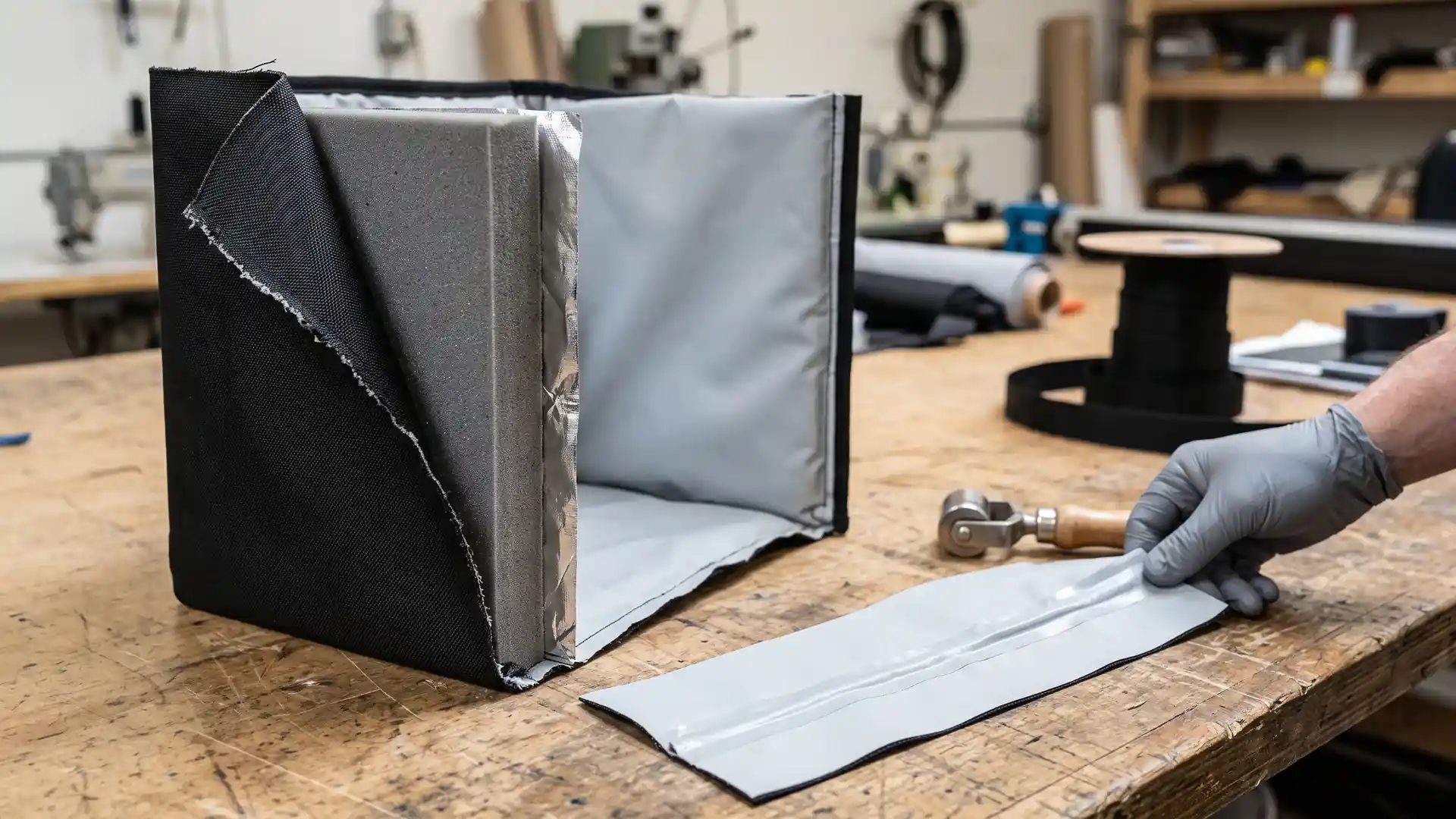
Thermal performance in a food delivery backpack is not decided by one material. It is a stack. Heat moves through conduction, radiation, and air gaps. A functional bag usually needs more than a foil-looking liner.
The typical stack-up buyers should specify:
- Outer shell: woven polyester or nylon with a water-repellent or coated finish. This is the abrasion surface and brand carrier.
- Structural/insulation foam: closed-cell PE or EVA foam. Many commercial hot food designs specify roughly 9–10 mm thick, but the right thickness depends on route length and packing density. Thinner foam may work for short one-drop runs; longer multi-stop routes need more thermal mass or denser foam.
- Reflective barrier: aluminum film laminate between foam and liner or between foam and shell. It reduces radiant heat loss but does not replace foam.
- Liner: a cleanable, weldable film or coated material, covered in the next section.
The most important distinction is closed-cell vs. open-cell foam. Closed-cell foam does not soak up condensation or spilled liquid in the same way an open-cell foam can. Once an open-cell foam becomes wet, it loses insulation value and starts trapping odor. Ask the supplier to confirm the foam is closed-cell and to provide the density or compression specification.
Thermal retention is also controlled by how the bag is used. A half-empty bag loses heat faster because air can circulate around the food. A full bag with hot containers packed tightly holds temperature longer. The containers themselves are part of the thermal system. If you are testing retention, test with the same container size, fill volume, lid condition, and packing density your riders will actually use.
One practical acceptance test: heat sealed containers of water to a defined starting temperature, place them in the fully loaded bag, and record the interior air temperature or probe temperature at intervals that match your longest actual delivery route. For example, some buyers run a hot fill starting around 90°C and check that the load stays above roughly 45°C over their route window. The exact start and end temperatures should be buyer-defined and supplier-confirmed, not copied from a catalog.
Insulation and Liner Material Comparison
| Layer | Common options | Key benefit | Sourcing check | Relative cost driver |
|---|---|---|---|---|
| Outer shell | 600D–1680D woven polyester or nylon with PU coating | Abrasion resistance, water shedding, branding surface | Denier, coating adhesion, seam finish | Medium to high |
| Insulation | Closed-cell PE foam | Thermal barrier, moisture resistance | Density, thickness, compression set | Low to medium |
| Insulation | Closed-cell EVA foam | Thermal barrier plus rebound and shape retention | Density, rebound, compression set | Medium |
| Insulation | EPE foam | Lightweight, lower-cost thermal layer | Thickness, durability under repeated compression | Lower |
| Reflective barrier | Aluminum film laminate | Reduces radiant heat loss | Adhesion to foam, crack resistance after flexing | Low to medium |
| Liner | TPU, PEVA, or PVC film/coating | Leak resistance, wipe-clean surface | Weld compatibility, puncture resistance, odor | Medium to high |
Do not spec only “9 mm foam.” Spec the foam type, closed-cell requirement, density or compression resistance, and the test method. That is what lets you compare two insulated delivery backpack quotes honestly.
Leakproof Design & Easy-Clean Liners
The biggest sourcing mistake in commercial food delivery is treating “water-resistant” and “leakproof” as the same thing. They are not.
A stitched liner has needle holes along every seam. With time, heat, cleaning, and flexing, those holes open enough for soup, oil, or condensation to reach the foam. Once the insulation is contaminated, the bag smells and loses thermal performance. You may not see the damage from the outside.
For a genuinely leak-resistant leakproof delivery bag, the liner should be welded, not stitched. Even then, commercial delivery backpacks should be specified as leak-resistant over their service life, not permanently liquid-tight, because zippers, closures, wear, and cleaning eventually create potential leak points. Radio frequency (RF) welding or high-frequency welding fuses the liner material without needle holes. This is the most practical mass-production method for film liners such as TPU, PEVA, and certain PVC grades.
Liner material comparison:
- TPU: flexible, usually better low-temperature performance, can be easier to weld to itself. Higher cost than PVC and often a better choice for food service because it avoids plasticizer concerns.
- PEVA: lighter and lower odor than many PVC films, but thin gauges may be less puncture-resistant. Ask for the gauge and puncture test result.
- PVC: low cost and weldable, but can stiffen or crack in cold weather and may have odor or market compliance issues. Confirm the latest regulatory position for your destination market.
Even with a welded liner, the zipper is still a leak point. A conventional zipper opening can allow liquid to splash through if the bag tips. More robust designs use a storm flap over the zipper, a roll-down or folded closure on a separate liner compartment, or a shielded zipper interface. Some fleets use a removable welded liner tray so the pressure is not solely on the outer bag. That tray approach adds cost and can be left out by riders, but it simplifies cleaning and replacement.
Cleaning must be part of the specification. Delivery bags are exposed to food residue, sanitizing wipes, and hot water. A liner that cleans easily but cracks after repeated chemical exposure is still a failure. Ask the supplier for the liner’s cleaning compatibility and whether the welded seam remains intact after repeated flexing and hot washing.
For a deeper technical explanation of seam failure, insulation, and food-safe liner compliance, see the Cooler Bag Manufacturing Guide: Insulation, Seams & Food-Safe Materials.
Rider Ergonomics & Structural Integrity
A food delivery backpack is a load-bearing tool, not a laptop bag with a reflective patch. Riders carry hot, awkward, sometimes liquid-heavy loads on uneven roads. Back pain and shoulder strain become retention and safety problems for the fleet.
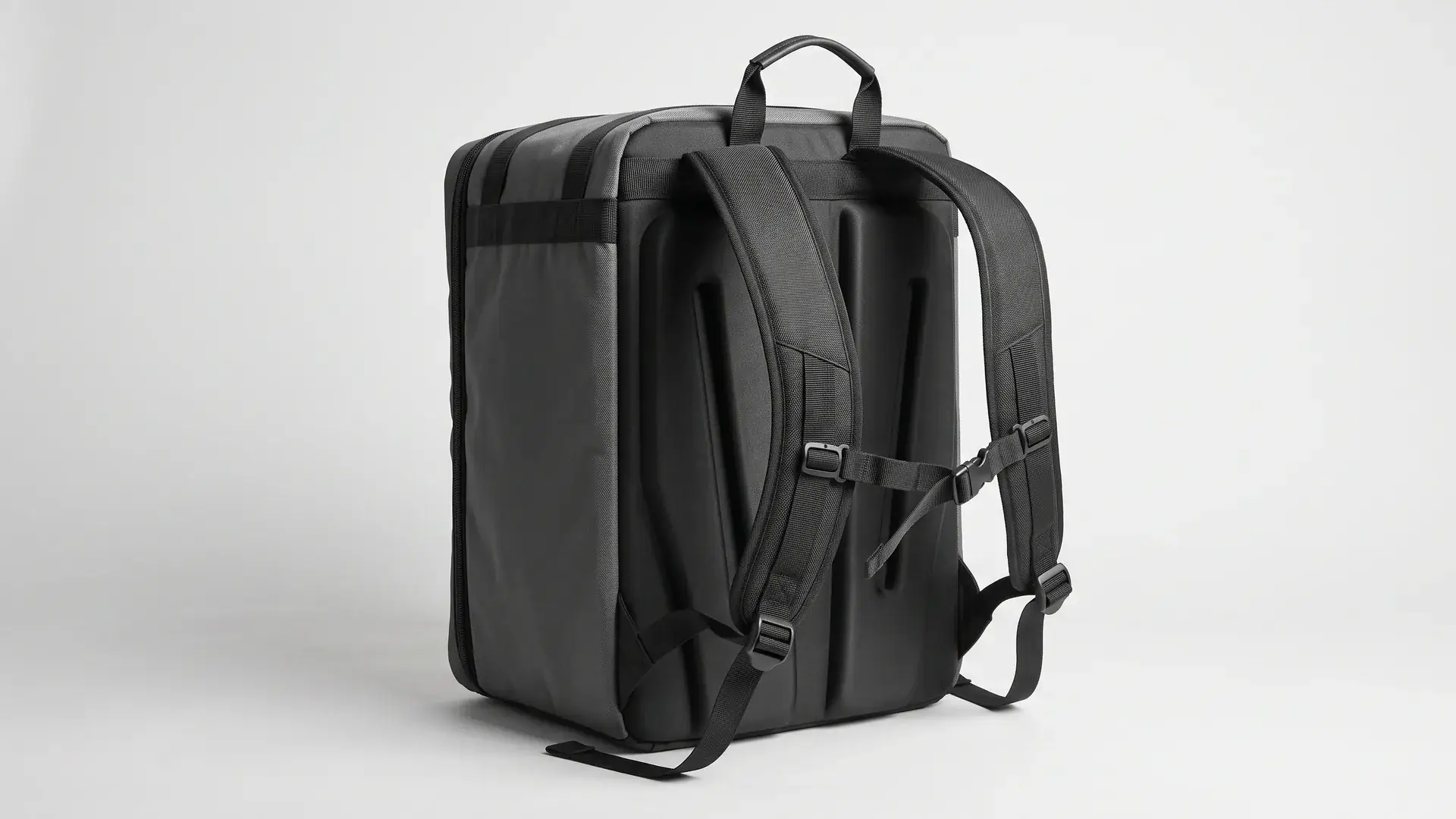
The first structural requirement is a rigid or semi-rigid body. Without a frame, the bag collapses under the load, pizza boxes get crushed, stacked containers shift, and the thermal cavity changes shape. Most practical commercial bags use:
- a PP board or fiberglass rod/frame in the back panel
- a reinforced bottom board
- optional side boards or corner battens for squarer, more protective walls
A full rigid frame usually protects food best but adds weight and makes the bag bulkier to pack and ship. A PP back sheet is lighter and cheaper but may flex under very heavy loads. The right choice depends on the load and how much the rider carries on their back vs. a bike rack.
The harness should be specified just as carefully. Look for:
- wide, contoured shoulder straps with high-density foam
- EVA back panel with deep airflow channels
- sternum strap
- waist belt for heavier routes or when riders regularly carry stacked meal containers and drinks
- reinforced top handle for one-hand lifting
- strap anchors bartacked or box-stitched at both ends
The waist belt matters more than most buyers expect. When the bag is heavy, it transfers load from the shoulders to the hips and stops the bag from swinging sideways during turns. A sternum strap alone will not do that.
Buyers often accept a stiff back panel but forget that the panel is only useful if the straps stay tight. Request a loaded fit test on the sample using your actual meal container weight. Have the supplier confirm the foam density and air-channel depth, not just “EVA back panel.” For more detail on strap geometry and load distribution, read the Backpack Ergonomics Guide: How to Source and Design for Maximum Comfort.
Fleet Branding & Outdoor Durability
The exterior of a commercial food delivery backpack is your rolling billboard, but it is also the first barrier against abrasion, rain, road grime, and sanitizing chemicals. Choose it as a working surface, not just a color.
Common shell options include woven polyester or nylon, often specified from around 600D up to 1680D; 900D is sometimes used as an intermediate weight. Higher denier generally means better abrasion resistance, but the coating and weave matter just as much. A heavily coated 600D can outperform a loose 1680D in some water-shedding tests. Ask the supplier to list the fabric weight, denier, weave density, and coating type. If the shell is too stiff, it becomes noisy and hard to fold. If it is too soft, it wears through at the bottom corners and rack straps. The trade-off is part of the sourcing decision.
Logo durability is a separate issue. On coated textile panels, screen printing can crack if the ink and coating do not match. Heat transfer can look clean at first but peel if applied to a water-repellent coating without the right adhesive system. Embroidery is durable but should be placed on the outer shell carefully; putting dense embroidery through a waterproof coated panel creates leakage points. Molded or debossed rubber/TPU patches can survive outdoor use better when welded or mechanically attached correctly. If you are choosing between a raised or recessed logo, compare the material limits in the Debossed vs Embossed Logo: Cost, Durability & Material Guide for Bag Sourcing.
For night visibility, do not accept a silver strip that only looks reflective. Ask whether the strip is retroreflective, where it is placed on the bag, and whether it remains visible from the rear when the rider is pedaling with a jacket or rain cover. Some markets have visibility or high-visibility equipment rules; confirm your local requirement with a compliance specialist rather than assuming a strip is enough.
Also ask about cleaning compatibility. Fleet bags get wiped with disinfectants, degreasers, or hot water. The shell coating, printed logo, and reflective film should all be tested with the same cleaning products your operations team will use. If the supplier cannot answer, request a cleaning compatibility test on the sample before rollout. For more on how shell fabric and structural components affect long-term cost, see the backpack structure sourcing guide.
Pre-Deployment QC & Supplier Verification
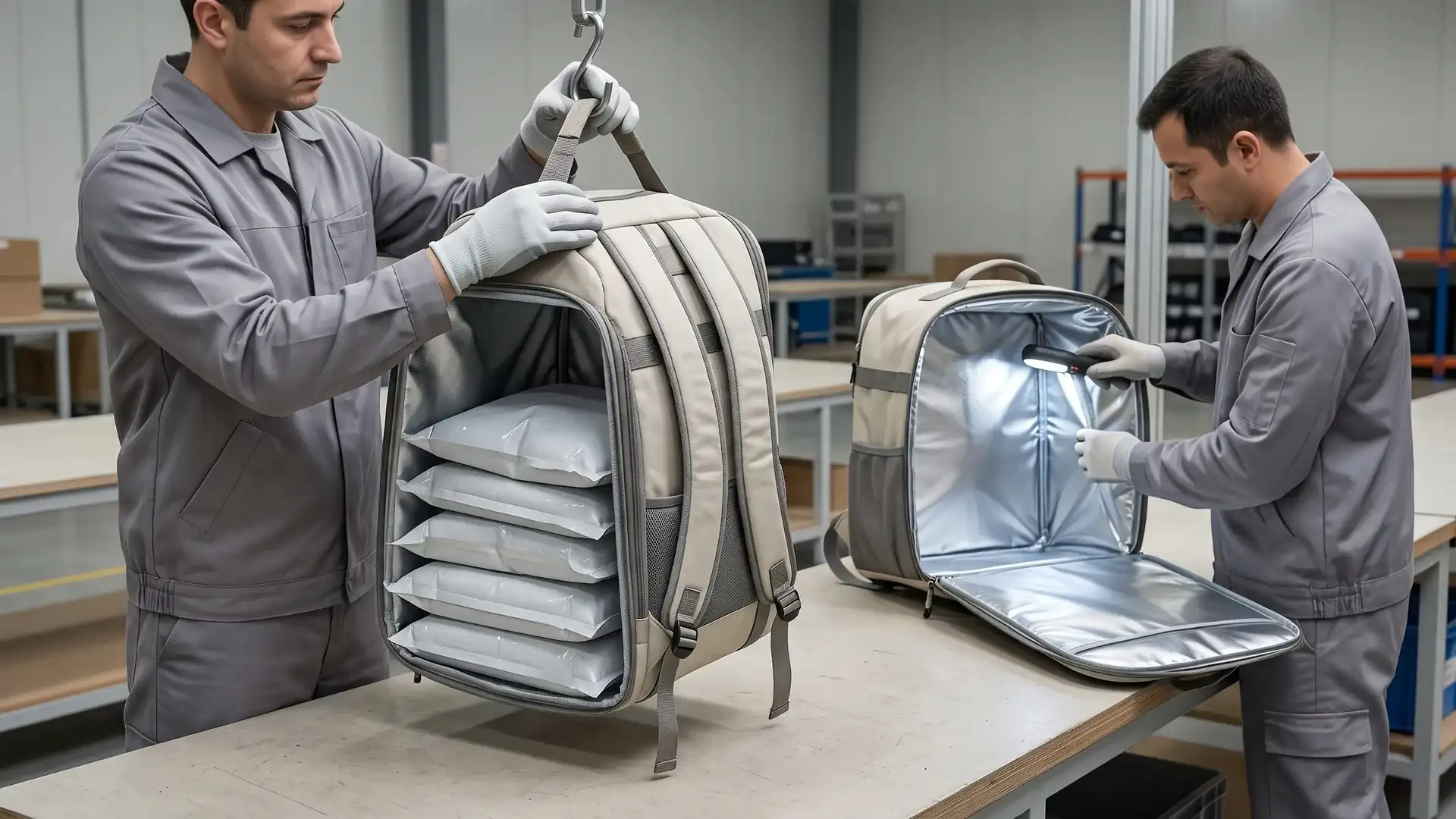
This is where most commercial rollouts go wrong. The sample looks right, the quote looks acceptable, and then bulk production arrives with softer foam, a thinner liner, or stitch holes where the welded seam should be.
Before a full fleet rollout, run the following checks on the pre-production sample and require the same acceptance criteria in the bulk order.
- Thermal retention test: load sealed heated containers into the bag and log temperature over the actual route window. Use a buyer-defined starting temperature and minimum end temperature.
- Leak test: pour a measured amount of water into the welded liner, close the bag, tilt and rotate it, and inspect the outer shell and foam after the test. This should only be done on a liner designed for liquid containment.
- Loaded stress test: load the bag to your specified maximum weight and, if you don’t have a target yet, start from your heaviest typical delivery load plus a margin for drinks and packaging. Lift, drop, and shake the bag; then check top handles, shoulder strap anchors, side webbing, and bottom seams.
- Zipper cycle test: open and close the main closure repeatedly under load. Zippers are often among the first field failures after liner leaks.
- Structure check: after the loaded test, confirm the frame or board has not cracked and the bag still returns to its intended shape.
- Logo and reflective check: rub or wash a branded swatch according to the supplier’s recommended cleaning procedure and check for cracking, peeling, or reflective loss.
Pre-Deployment QC Test Matrix
| Test type | Method | Acceptance criteria |
|---|---|---|
| Thermal retention | Heated sealed containers, temperature datalogger at intervals | Buyer-defined end temperature after route-specific time |
| Liquid leak | Measured water in liner, tilt/rotate and inspect shell | No moisture transfer into insulation after test |
| Load stress | Loaded bag lifted, dropped, or shaken at specified weight | No strap, anchor, handle, or seam failure |
| Zipper cycle | Repeated open/close under load | No jam, skipped teeth, or slider failure within agreed cycles |
| Structure retention | Inspect frame/board after load test | No crack or permanent collapse |
| Branding durability | Rub, wash, or exposure test on logo swatch | No unacceptable cracking, peeling, or fade |
Do not accept a supplier that only offers a final visual inspection. Visual checks catch loose threads, but they do not catch poor foam density, liner weld weakness, or zipper fatigue.
Supplier verification should also include responsibility mapping. Ask who controls the stock bag, who welds the liner, who installs the frame, who applies the logo, and who is responsible when bulk production differs from the approved sample. If the supplier is using a stock shell and decorating it, that is not automatically a problem — but the responsibility for seam quality and material consistency must be clear. A supplier that can explain the production routing and QC ownership is far more useful than one that says “quality guaranteed.”
RFQ Checklist for Food Delivery Backpacks
A detailed RFQ saves time and reduces pricing surprises. The factory needs more than “large red delivery backpack.”
| Field | What to specify or ask |
|---|---|
| Bag type | Food delivery backpack, thermal box, or rack-mounted delivery bag |
| Target market | Country or region, platform/fleet context |
| Quantity band | Estimated order quantity by SKU, not necessarily an exact final MOQ |
| Use scenario | Hot food, cold drinks, pizza, grocery, multi-stop route |
| Internal dimensions | Length × width × height, or required container/pizza box size |
| Load capacity | Maximum expected weight the rider will carry |
| Outer shell | Fabric type, denier, coating, color, and cleaning requirement |
| Insulation | Foam type, thickness, density, closed-cell requirement |
| Reflective barrier | Required or not, placement |
| Liner | Material type, gauge, weld method, cleanability |
| Seam method | RF welded, stitched plus taped, or removable liner tray |
| Closure | Zipper type, storm flap, roll-down, or combined closure |
| Frame/structure | PP board, fiberglass frame, bottom board, side battens |
| Harness | Strap width, foam density, back panel channeling, sternum/waist strap |
| Branding | Logo method, location, size, reflective strips, color matching |
| Packaging | Polybag, carton strength, barcode, shipping mark, e-commerce requirements |
| Sampling | Pre-production sample deadline and approval workflow |
| Bulk delivery | Required delivery window, shipment terms, quantity split |
| QC | AQL level, critical defect definition, thermal/leak/load test criteria |
| Compliance | Target-market requirements for the specific use scenario |
A good RFQ for an insulated delivery backpack also asks the supplier what they will change if the buyer wants a lower target cost: thinner foam, stitched liner, lighter shell, or a smaller frame? That tells you whether the supplier protects the commercial structure or quietly downgrades it.
FAQ: Food Delivery Backpack Sourcing
These are the questions fleet buyers ask after the first spec review, when they are comparing samples or preparing rollouts.
How long do insulated food delivery backpacks last in commercial use?
There is no fixed lifespan because daily use, load weight, cleaning chemical exposure, and storage conditions vary. The first things to fail are usually the zipper, the shoulder strap anchors, and the welded liner at high-flex corners. Foam can also lose rebound and insulation value through repeated compression. A better question is: which parts are replaceable, and what replacement rate should the fleet expect? Ask the supplier for the expected high-wear points and a spare-parts or repair recommendation. Then track replacement data after deployment.
Can a food delivery backpack keep hot food hot and cold drinks cold at the same time?
Not effectively in a single undivided compartment. Thermal mass will move toward equilibrium: the hot food cools while the cold drink warms. A divided thermal compartment or separate thermal divider can slow that cross-transfer, but it does not fully separate the two. If hot and cold loads are common, specify dual compartments with separate thermal envelopes or plan for two bags.
Do delivery bags need FDA food-contact certification?
Usually not for the whole bag. Food-contact requirements may apply only to materials that directly touch food or are reasonably expected to contact food. In many food delivery situations, the food is already inside sealed restaurant packaging, so the bag is secondary packaging. If your meal containers, raw ingredients, ice, or unpackaged food may touch the liner, ask a compliance specialist and the supplier for the specific food-contact documentation for that liner. Do not accept a generic “FDA approved bag” statement.
Should I choose RF-welded liners or stitched liners?
For commercial food delivery, choose RF-welded liners when the bag will carry soups, sauces, oily foods, or any free liquid. Stitched liners may be acceptable for dry packages and short promotional use, but they are a predictable source of moisture ingress and odor once heat, cleaning, and flexing begin. If budget forces a stitched construction, at least ask for a removable welded liner tray so the contaminated layer can be cleaned or replaced without destroying the thermal cavity.
What insulation thickness should we request?
There is no universal number. Many commercial hot food designs use a closed-cell PE or EVA foam around 9–10 mm thick, but the correct thickness depends on your route length, starting food temperature, container thermal mass, and ambient weather. A shorter route with tightly packed hot containers may perform well with less foam. A long multi-drop route may need thicker or denser foam. Specify the thickness, closed-cell requirement, density, and a retention test with your actual packaging rather than just requesting “thick insulation.”
Conclusion: Roll Out Fewer, Better Bags
A food delivery fleet should not buy backpacks by color and price. Buy the thermal stack, the welded liner, the structural frame, and the load-bearing harness first. Then put branding and packaging on top.
Before you commit to a bulk order, make the supplier show you a pre-production sample with the same foam density, liner weld, zipper, and harness you approved. Run a wet test, a loaded drop test, and a temperature retention test that matches your actual route. If you are preparing the RFQ, start from the checklist above and ask OMASKA to confirm which stock or customized construction fits your delivery radius, load profile, and branding requirements.
The goal is not the cheapest food delivery backpack in the first purchase order. It is the fewest replacements and the fewest failed deliveries across the fleet. Spec it that way, and the unit cost follows the performance instead of hiding future losses.
Get A Quote

Get A Quote
0 Comments