
Food Delivery Backpack Sourcing Guide: Insulation, Rider Comfort & QC
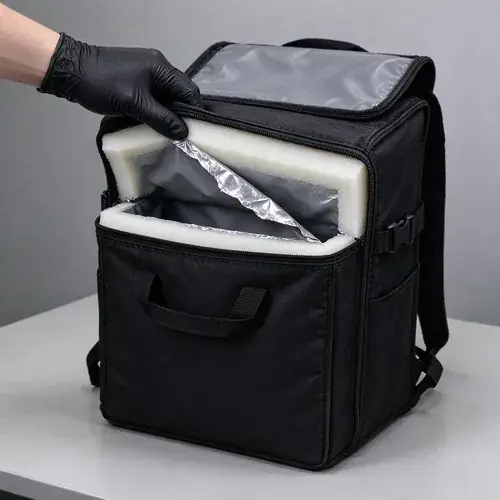
A commercial food delivery backpack is not a bigger cooler bag. It is a multi-layer thermal system, a load-bearing harness, and a cleanable container that has to survive months of daily opening, wiping, rain, and scooter vibration. The sourcing decision should be based on four things: the insulation stack, the liner and seam construction, rider ergonomics under load, and the QC plan you can enforce before mass deployment. If a supplier cannot show all four in a pre-production sample, don't approve the order.
The commercial risk is real. A rider who receives a sagging, leaking bag transfers the problem to the restaurant or delivery platform: spilled containers, temperature complaints, rider back pain, logo peeling after repeated sanitizing, and replacement costs that were never in the original budget. Most failures trace back to ordering consumer-grade cooler backpacks or approving a sample without a loaded road test.
This guide breaks down the thermal layer logic, closed-cell foam choices, RF-welded versus stitched liners, rider comfort trade-offs, branding durability, and rollout QC. Use it to build your RFQ and to challenge suppliers on the exact points that fail in deployment.
Quick Answer: What Actually Decides a Food Delivery Backpack Sourcing Deal
If you are sourcing a food delivery backpack for a restaurant chain, delivery platform, or dark kitchen operation, stop comparing bags by the word "insulated." Ask every delivery bag manufacturer to define the layers that create heat retention, the liner material and seam method that control leakage, and the harness structure that lets a rider carry food for an entire shift.
Five checks separate a deployable commercial bag from a decorative insulated backpack:
- Require a written thermal stack: outer shell material, closed-cell foam type and thickness, reflective layer, and liner material.
- Require close-up photos or physical samples of side seams, corner seams, and zipper ends before approving any liner.
- Choose RF-welded or fully taped liner seams for orders where liquids, condensing steam, or wipe-downs are expected; do not accept exposed needle holes in the main leak path.
- Ask for a loaded rider test using at least one shift-length ride with realistic order weight before bulk production.
- Lock the logo method only after a cleaning or sanitizer contact test, not after looking at a marketing mock-up.
A supplier that pushes back on these points is telling you something useful: the bag was built for a retail shelf, not a rider.
Scope of This Guide
This guide is written for restaurant chains, delivery platform operators, dark kitchen buyers, fleet managers, private-label delivery bag brands, and B2B sellers preparing a commercial rollout. It covers food delivery backpack construction for hot and cold meal transport, rider movement, cleaning, branding, and pre-deployment quality control.
The guide does not drift into home lunch bags, generic backpack fashion, cold-chain pharmaceutical compliance, or unsupported "100% waterproof" claims. It also does not promise a fixed temperature-holding time. Thermal retention is project-specific: it depends on starting food temperature, bag fill level, ambient temperature, route duration, opening frequency, and closure type.
What Restaurant Chains and Delivery Platforms Should Evaluate Before Sourcing a Food Delivery Backpack
The first procurement question should not be "what does this bag cost?" It should be "what happens during a real delivery shift?" A restaurant chain rolling out bags across multiple locations has a different risk profile from a marketplace seller shipping a brand-labeled bag into retail.
A commercial food delivery backpack must hold structure while a rider accelerates, brakes, shoulder-checks, and swings off a scooter. It must resist repeated opening, steam condensation, sanitizer wiping, and occasional rain. The bag also has to be cleanable enough that yesterday's sauce does not become tomorrow's odor complaint.
The main risk factors in deployment are:
- Delivery duration variability: short urban trips tolerate simpler insulation better than long suburban routes.
- Opening frequency: every zipper opening exchanges warm air with outside air and creates condensation points.
- Cleaning cycles: a bag wiped daily with food-service sanitizer ages faster than a weekend consumer cooler.
- Replacement risk: a bag that collapses at the base or tears at the strap anchor creates a replacement order you did not plan for.
Before comparing suppliers, agree internally on expected route time range, average order weight, cleaning method, and fleet rollout schedule. These four choices drive the construction spec more than any brand name does.
Why Consumer Cooler Bags Often Fail in Commercial Delivery Use
Consumer cooler backpacks are usually designed for low-frequency leisure use: a few lunches, a beach trip, maybe a short grocery run. In practice, a delivery rider puts far more stress on the same bag in one shift than a consumer does in a season.
Consumer bags fail for specific reasons:
- Thin closed-cell foam or loose insulation lining loses structure when the bag is only half full, so containers shift and create air gaps.
- Stitched liners with needle holes allow condensation, soup, or sauce to migrate into the insulation layer, where it becomes an odor and hygiene problem.
- Narrow shoulder straps and soft back panels cause pressure points when the bag carries several meals plus drinks.
- Fabric-only bases often collapse under tall containers, tipping the load in turns.
- Standard coil zippers on highly tensioned openings often fail faster when riders overstuff the main compartment.
That's why a commercial bag isn't simply a consumer bag with a logo. The construction, materials, and failure points are different.
How the Thermal Structure of an Insulated Delivery Backpack Works
A commercial insulated delivery backpack reduces heat transfer, but it does not stop time. The thermal stack works by slowing three mechanisms: conduction through the bag walls, convection from air movement, and radiation from hot food surfaces.
A useful thermal stack in a delivery bag usually includes:
- Outer shell: polyester or nylon, chosen for abrasion resistance, structure, and optional water-resistant coating. The shell protects the insulation, not the food.
- Closed-cell foam layer: the main conductive barrier. Closed cells trap air better than open-cell foam because they do not absorb water or collapse as easily.
- Reflective film or foil layer: reduces radiant heat loss. This layer does not generate heat, so it only works if the food is already hot and the layer remains clean and intact.
- Liner: the inner surface that contacts food containers, steam, and cleaning chemicals. It must be smooth, cleanable, and compatible with the chosen seam method.
- Air space management: hot food containers packed tightly insulate each other, while a half-empty bag leaves more air for convection to work against you.
Ask the supplier to identify every layer in the approved sample. If the answer is "insulated fabric," request a cut-listing or material specification sheet that names each layer and its role.
For a deeper teardown of how this translates into an acceptance spec, see the Food Delivery Backpack Sourcing Guide: Insulation, Leakproof QC & Comfort.
Closed-Cell PE Foam vs EVA Foam for Delivery Bags
Insulation foam choice is not just about heat. It also affects weight, structure, whether the bag stands up, and how it feels on a rider's back. Two common directions are closed-cell PE foam and EVA foam.
| Decision factor | Closed-cell PE foam | EVA foam |
|---|---|---|
| Typical role | Thermal insulation layer inside shell | Back panel, base reinforcement, or structural padding |
| Weight | Generally lighter, with less structural rigidity | Generally denser and heavier |
| Structure and shape memory | Flexible, easier to fold or stuff | More rigid, helps hold the bag open and support flat panels |
| Moisture behavior | Resists water absorption if cells remain closed | Usually low water absorption, but confirm density and formulation |
| Cost driver | Often lower material cost per thickness | Often higher due to density and processing |
| Best fit | Bags where rider weight and bulk are critical | Bags needing stronger base, back panel, or reinforced side walls |
Foam thickness should be project-specific. A very thin insulation layer keeps the bag light but does little for long routes or uneven loading. A very thick layer adds bulk, reduces rider mobility, and increases cost. Ask the supplier for foam density and thickness on the sample record, then test it loaded rather than on the sales table.
Why Half-Empty Bags Lose Heat Faster
A full thermal food delivery bag holds temperature differently from a half-empty one, even when the insulation stack is identical. This is one of the most misunderstood points in food delivery bag sourcing.
The mechanism is simple. Hot food in a tightly packed bag has more thermal mass and less air circulation. A half-empty bag contains more air, and every time the rider opens the zipper, that warm air is displaced by cooler outside air. The remaining hot food then has less help staying warm. In cold weather or on longer routes, this difference becomes visible to the customer.
This matters because it changes validation. A pilot test that uses a full bag on a short route tells you little about a half-full bag on a long route. Ask the supplier to confirm the bag's intended fill range, and test the bag under the worst realistic condition, not the easiest one. Never accept a blanket phrase like "keeps food hot for hours" without defined fill level, ambient temperature, and opening count.
Leak-Resistant Construction and Cleaning Requirements
Leak-resistant construction and leakproof construction are not interchangeable sourcing terms. This distinction will save you from warranty claims and rider complaints. Most bags can be made highly leak-resistant with the right liner and seam method, but truly leakproof is rare once you add a main zipper, flap, or worn handle area.
The leak path in a delivery bag usually runs through side seams, corner seams, the main opening, and zipper ends. Stitched liner seams create needle holes at every stitch. RF-welded or high-frequency welded seams melt the liner material together to create a continuous surface — but they only work when the liner material is compatible with welding. Closure interfaces still remain a leak-risk point.
For commercial food delivery, the practical approach is to specify leak-resistant construction with the fewest failure paths, then test the bag under the buyer-defined liquid scenario. Don't insist on the word "leakproof" without defining what liquid, how much, for how long, and at what orientation.
For more detail on liner and seam engineering, see the Cooler Bag Manufacturing Guide: Insulation, Seams & Food-Safe Materials.
RF-Welded Seams vs Stitched Liner Construction
The seam method determines whether leakage is a design feature or a design fault. For liquid-prone bags, RF welding is usually the better direction, but it depends on material type and cost.
| Criterion | RF-welded liner seam | Stitched liner seam |
|---|---|---|
| Leak resistance | High, no needle holes along the weld | Low to moderate, stitch holes create potential leakage |
| Cleaning practicality | Smooth, flat seam; less food residue retention | Thread and seam fold can trap residue and moisture |
| Repair difficulty | Harder to repair locally; may need full panel replacement | Easier to repair by re-stitching a local area |
| Material restriction | Requires weldable liner material and compatible coating | Works with most liner materials, including non-weldable ones |
| Cost implication | Usually higher tooling or process cost | Generally lower production cost |
A stitched seam is not automatically terrible. It may be acceptable for dry items or bags with an additional protection panel. But if the buying team expects liquid spills, condensation control, and daily sanitizing, RF-welded or fully taped seams are the more defensible specification. Regardless of method, ask for close-up photos of corner seams, zipper-adjacent seams, and the handle attachment area before sample approval.
PEVA, TPU, and PVC Liner Trade-Offs
Liner material determines cleaning behavior, odor risk, flexibility, and whether RF welding is feasible. The three common directions each have trade-offs.
| Liner criterion | PEVA | TPU | PVC |
|---|---|---|---|
| Wipe-clean surface | Good when prepared as a smooth sheet | Good, with durable flex resistance | Good on smooth surfaces, but formulation matters |
| Odor behavior | Typically lower odor when formulation is controlled | Generally low odor and more stable | Can have noticeable plasticizer odor in some formulas |
| Flexibility and cold weather | Moderate; confirm low-temperature performance | Usually more flexible across temperatures | Can stiffen in cold conditions |
| RF weldability | Often weldable depending on formulation | Often weldable and structurally durable | Weldable but may require ventilation and formulation control |
| Cost driver | Often lower cost | Often higher cost | Variable by grade and thickness |
Don't choose a liner by name alone. The same chemical family can behave differently by gauge, formulation, and supplier. Ask the supplier for the specific liner grade and whether the seam will be welded or stitched. If food can contact the liner directly, ask for the material manufacturer's food-contact documentation and confirm the applicable requirement with your compliance team. Many delivery bags only carry sealed containers, in which case food-contact liner documentation may not be required.
Rider Comfort and Structural Stability During Long Shifts
A rider backpack sourcing program should treat comfort as operational uptime. An uncomfortable bag doesn't stay on the rider's back — it gets hung on the handlebar, strapped to the rear rack, or crushed in the footwell. That defeats the insulation and creates spill, theft, and safety risks.
Comfort in a delivery bag comes from load distribution, not just padding. The important features are:
- Wide shoulder straps with high-density padding: spreads force over a larger surface and resists flattening under sustained daily use.
- Chest strap or waist stabilization: reduces sway during acceleration, braking, and shoulder checks.
- Shaped back panel with airflow channels: limits heat and sweat buildup on the rider's back, especially in tropical or hot-climate operations.
- Rigid or semi-rigid base panel: prevents the bag from collapsing when tall containers are loaded.
- Internal dividers: keep drinks and meal boxes from shifting to one side during turns.
A loaded road test should include short acceleration, hard braking, left and right shoulder checks, mounting, dismounting, and walking with the bag. If the bag swings excessively or the straps slide, the harness needs work regardless of how good the thermal stack is.
For structural reinforcement and load-distribution logic, see The Anatomy of a Backpack: A B2B Sourcing Guide to Structure, Materials, and Cost Breakdown.
Common Structural Failure Points in Delivery Fleet Use
Fleet failure is usually not random. It follows predictable stress points, and those stress points should become QC checkpoints.
- Strap anchor failure: single-line stitching at the top strap attachment can tear under dynamic load. Ask for bar-tacked or reinforced anchors and inspect both sides on every pre-production sample.
- Zipper stress at the main opening: riders overstuff the bag, pulling the zipper tape sideways. Require a wide, smooth-running zipper and inspect the zipper end stops for fraying.
- Base collapse: a fabric-only base folds when vertical containers sit inside. A rigid or semi-rigid insert should be specified and confirmed.
- Liner corner cracking: stiff liners can crack at folded corners or side seams, especially in cold weather. Check for flex marks and material stiffness in the sample record.
- Side seam slippage: when the bag is heavily loaded, stitching can separate along vertical seams. Ask for seam strength verification or load test evidence.
Build these failure points into the final inspection checklist, not as afterthoughts.
Branding, Cleaning, and Rollout Consistency
Branding on a food delivery backpack has to survive more than aesthetics. It must resist repeated wiping, sanitizer contact, abrasion, and outdoor exposure while staying legible across a fleet. Color consistency across multiple production batches is a separate but equally important rollout risk.
The main rollout risks are:
- Color batch drift: the first batch matches the reference, but the next batch is half a shade different under daylight.
- Logo placement variation: embroidery or print shifts by a few millimeters across products, which becomes obvious in rider photos.
- Mixed packaging: carton labels or barcodes change between shipments, creating warehouse and platform problems.
- Material substitution: a supplier changes the foam or liner grade to meet delivery timing, and the bulk stock no longer matches the approved sample.
The fix is a sealed approval sample reference plus a documented pre-production sample sign-off. Bulk production should be compared against that reference, not against a digital mock-up.
Which Logo Methods Survive Repeated Cleaning?
Logo durability depends on the decorating method, the shell fabric, and the cleaning chemicals used. A cleaning test should be part of pilot validation, especially if the fleet uses alcohol-based sanitizers or frequent surface wipes.
| Logo method | Cleaning durability | Operational fit | Confirm with supplier |
|---|---|---|---|
| Screen print | Moderate; can crack or fade with abrasion and strong cleaning agents | Works for controlled retail or light-fleet use | Ink system, cure condition, wipe test |
| Heat transfer | Depends heavily on bonding; edges can lift after repeated flexing | Works for detailed multicolor artwork | Adhesion, edge lift test, softening point |
| Embroidery | High mechanical durability; cleaning resistance is usually good | Good for logo recognition, but adds thread and perforations | Backing material, thread colorfastness, pucker control |
| Rubber or PVC patch | High durability and strong brand finish | Good when edges are reinforced and adhesive is correct | Edge lift, repeated flex test, cleaning compatibility |
| Debossed or embossed logo | Good durability, no added layer; visibility depends on material depth and contrast | Good for leather, EVA, or molded base panels | Material crush recovery, depth consistency, color contrast |
For a deeper comparison of debossed versus embossed options, see Debossed vs Embossed Logo: Cost, Durability & Material Guide for Bag Sourcing.
Food Delivery Backpack QC Before Mass Deployment
QC for a food delivery backpack should reflect how the bag actually fails in a delivery operation, not only how it looks on a table. That means the inspection plan must include structure, thermal materials, leak-prone seams, harness anchors, zipper function, and packaging.
A practical deployment QC sequence has four points:
- Pre-production sample sign-off: lock material, color, logo, liner, seam, and construction reference before cutting bulk.
- Inline inspection: check stitching, zipper installation, liner placement, and logo during production.
- Final random inspection: inspect against AQL sampling; AQL 2.5 is often applied as a starting point for major defects in bag inspection, but confirm the chosen level with the supplier for your actual product and risk profile.
- Carton and labeling inspection: verify carton strength, count, barcode, and shipping marks before release.
Don't treat "factory has done QC" as enough. The buyer must define the acceptance criteria and receive the inspection records or approval photos.
Pre-Production Sample Approval Checklist
Before mass production starts, lock every detail that can cause a sample-to-bulk mismatch:
- Outer shell material, color, and coating finish.
- Insulation foam type, thickness, and density.
- Liner material and surface finish.
- Seam method for side, corner, and bottom joints.
- Main zipper type, size, and operation feel.
- Strap width, padding, and attachment reinforcement.
- Base panel material and whether it holds the bag upright.
- Logo method, placement, thread or ink color, and size.
- Internal divider layout and whether it matches the intended container mix.
- Cleaning test result with the fleet's actual cleaning product.
- Carton label, barcode, and packing configuration.
- One sealed approval sample kept by the buyer as the bulk comparison reference.
If the pre-production sample does not match the approved reference, don't approve production with a note "will fix later."
RFQ Checklist for Restaurant Chains and Delivery Platforms
A useful food delivery backpack RFQ doesn't start with "send me your best price." It starts with the delivery operation. Buyers should send enough information that two suppliers are quoting the same product, not two different interpretations of "insulated bag."
| RFQ field | Your input or options |
|---|---|
| Bag type | Meal delivery backpack, multi-cavity food carrier, rider backpack |
| Dimensions and capacity | Confirm external size, internal volume, and container compatibility |
| Hot or cold use | Hot meals, cold drinks, mixed orders, or single-category delivery |
| Route and carrying duration | Short urban trips, long suburban routes, peak-hour shift length |
| Average load weight | Confirm the total weight range riders carry |
| Opening frequency | High-frequency zipper access or flapless pass-through |
| Cleaning method | Damp wipe, food-service sanitizer, rinse-down frequency |
| Outer shell material | Polyester, nylon, heavy-duty shell, optional coating |
| Insulation type and thickness | Closed-cell PE foam, EVA, thickness target |
| Liner material | PEVA, TPU, PVC, or other supplier-proposed option |
| Seam construction | RF-welded, taped, or stitched |
| Zipper requirement | Main closure size, water resistance, stress tolerance |
| Logo method and placement | Screen print, embroidery, patch, deboss, or other |
| Color reference | Pantone or buyer-approved swatch |
| Packaging requirement | Polybag, hangtag, carton count, barcode |
| Inspection requirement | AQL level, inline inspection, final inspection records |
| Pilot quantity | Quantity for loaded rider test and fit validation |
| Sample deadline | Buyer-defined sample delivery date |
| Bulk delivery deadline | Buyer-defined PO delivery window |
| Destination market | Country and any applicable product compliance |
The more clearly you describe the operation, the fewer surprises you get in sampling. A supplier cannot engineer around rider movement, cleaning frequency, or route length unless you tell them those conditions.
FAQ
These are the questions restaurant chains, delivery platforms, and B2B sellers most often ask before deciding whether a food delivery backpack specification is ready for pilot testing.
How long can an insulated delivery backpack keep food hot?
There is no single fixed duration. Heat retention depends on starting food temperature, bag fill level, ambient temperature, route length, closure type, and how many times the rider opens the main zipper. A hot pizza stack in a tightly packed bag on a short route behaves differently from two meal boxes in a half-empty bag on a cold evening. Instead of asking the supplier for a guaranteed time, run a pilot test with the actual food containers, route pattern, and opening frequency your operation uses. Then measure the food temperature at the delivery moment with a defined acceptance limit based on the local food safety code.
What is the difference between leak-resistant and leakproof construction?
Leak-resistant means the bag resists liquid intrusion or escape under normal use but still has possible leak paths, especially at the main zipper or worn stress points. Leakproof usually means a continuous barrier with no needle holes in the liner and reliable closure interfaces. A strap-on rider bag with a zipper opening may be highly leak-resistant but rarely truly leakproof. Ask the supplier to show seam close-ups and define the actual liquid test conditions. Never accept "waterproof" as a synonym for leakproof without the construction drawings and buyer-defined test method.
Which liner material is easiest to clean?
A smooth, welded PEVA or TPU liner generally cleans more easily than a textured stitched liner because there are no needle holes or seam folds to trap food residue. PVC can also be wipe-clean but may carry more odor and stiffen differently depending on the formulation. The real answer is seam method plus surface texture. A welded seam with a smooth surface is easier to sanitize than a stitched seam. Confirm the liner surface and whether the fleet cleaning product is compatible with the chosen grade.
What should buyers test during pilot deployment?
A delivery fleet pilot should test the bag under loaded ride conditions, not on a workbench. Use riders to check strap comfort, sway, back panel heat, and zipper access while moving. Use actual food containers and route times to check thermal behavior and condensation. After each shift, inspect for liquid pooling, liner cracks, seam separation, logo lift, and odor. Then wipe the bag with the operation's real cleaning product and repeat. A useful pilot exposes the failure that a photo review will not show.
Can a stock model be customized with branding?
Yes, on selected stock models when the supplier accepts the setup charge and the decoration method works on the bag material. But don't assume every stock bag can take any logo. Print, embroidery, patches, and deboss each have different surface requirements and durability limits. Confirm the decorator's minimum order, placement limits, color match process, and whether the decoration will survive your cleaning procedure. Stock-model decoration is usually a smaller commitment than full OEM development, but it still needs sample approval.
What causes odor buildup inside delivery bags?
Odor usually comes from food residue, condensation, and inadequate drying. Liquids can travel into stitched seams, folded liner corners, or the gap behind the liner and stay there. Once organic material sits in a warm, closed bag, odor becomes difficult to remove. A smooth, welded liner reduces hiding places. But operation matters too: bags should be emptied, wiped, and opened to dry after service. If odor is a known problem, choose the cleanest liner geometry and add a cleaning protocol to rider training.
Official Sources and Compliance References
Sourcing teams should not take thermal, food-contact, or compliance claims from the bag supplier alone. The supplier can confirm materials, seam structure, and testing capability, but the buyer must verify the compliance standard that applies to the actual use case.
- Food holding temperature: follow the local food safety authority in the destination market. For example, a U.S. operation should check the applicable state or county food code and local health department guidance for hot-holding expectations; other markets should use the equivalent national or local food safety authority. The bag supplier should not be treated as the food safety reference.
- Food-contact materials: if unpackaged food, ice, or liquids may contact the liner, request material food-contact documentation from the liner manufacturer. The applicable reference may be a destination-market food-contact materials regulation or listing — such as a U.S. food-contact substance listing, an EU food-contact materials framework, or the buyer-selected equivalent — supported by a material technical datasheet, supplier declaration, or migration test report. If the bag only carries sealed containers, food-contact liner documentation may not be required.
- Children's product rules: rider delivery backpacks are generally commercial adult-use products, so children's product safety rules usually do not apply. However, if the same bag is sold through a consumer retail channel, the buyer should confirm destination-market requirements.
- Import and labeling: confirm carton marking, packaging list, and any destination-market labeling requirements with the freight forwarder or compliance team.
The supplier's job is to prove construction. The buyer's job is to verify the use-case compliance boundary.
Conclusion
The right food delivery backpack is the one that survives your actual route, not the one with the thickest marketing description. Before you pay a deposit, make the supplier demonstrate four things in writing and on samples: a named thermal stack with defined foam and liner materials, a leak-resistant seam method appropriate to your liquid risk, a harness system that holds the bag stable under load, and a QC plan that catches the failure points before mass rollout.
Send suppliers an RFQ that describes the delivery operation, not just a photo and a target price. Then run a loaded pilot with the real riders, real containers, real cleaning products, and a defined acceptance limit. A clean sample photo is not proof of deployment reliability. A signed pre-production sample, a sealed reference, and a documented final inspection are the closest thing to it.
Get A Quote

Get A Quote
0 Comments