
Cold Chain Delivery Bag Sourcing Guide for Grocery & Pharmacy Programs
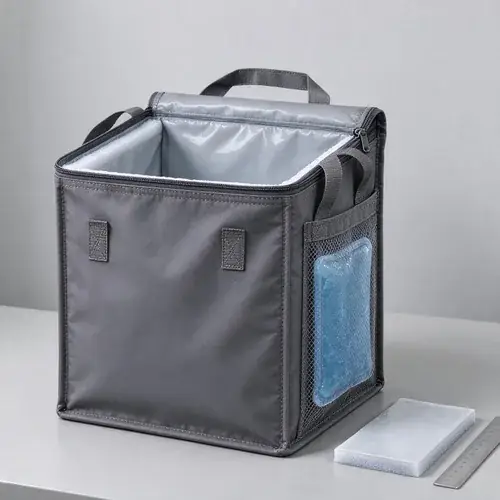
A cold chain delivery bag is not just a cooler with a zipper. In grocery and pharmacy delivery programs, it is a reusable insulated transport bag whose outer shell, insulation layer, wipe-clean liner, coolant pockets, and closure system all have to hold up under daily route use. The real buying decision is not simply "how many hours does it keep cold" — it's whether the bag's materials, packing method, coolant choice, cleaning workflow, and claim language can protect product temperature and sanitation consistently across a defined route.
In many delivery programs, buyers underestimate two things. First, the bag is only one part of a three-party system: the bag supplier controls the structure, the coolant supplier controls the ice pack or PCM performance, and the delivery operator controls loading density, pre-conditioning, and route time. Second, the compliance risk sits mostly in the words you print on listings, RFQs, and agreements — not just in the liner.
This guide gives you a procurement and operations framework, not a consumer cooler list. You'll be able to specify liners, evaluate coolant compatibility, write safer compliance claims, build a QC checkpoint list, and prepare an RFQ that filters out suppliers who overpromise.
Quick Answer / 30-Second Buyer Decision
I usually start with three questions: What product is being carried, under what route duration and ambient conditions, and who will clean and inspect the bags between deliveries?
If you can answer those three, the sourcing decision becomes much simpler. For grocery programs, prioritize a smooth wipe-clean liner, reinforced handles, a closure that tolerates frequent opening, and a packing SOP that keeps chilled product separated from ambient product. For pharmacy programs, add a tighter documentation trail: material specification sheets, defined temperature-range assumptions, coolant type, and written confirmation that the bag is not being presented as a validated pharmaceutical shipping system.
Ask for these before approving a supplier:
- Material swatches, liner samples, and insulation layer samples — not just a photo of the finished bag.
- A written description of seam construction at the base, handle attachment, and zipper area.
- Coolant pocket dimensions, closure method, and whether coolant packs sit against product or against the liner.
- Cleaning chemical compatibility confirmation for the liner and zipper.
- A golden sample approval process before bulk production.
If a supplier says "leakproof," "FDA-approved bag," "medical-grade," or "keeps cold all day" without a defined test condition and scope, stop the conversation and ask for the document that supports the exact wording.
Scope of This Guide
This page covers reusable cold chain delivery bags for operational grocery and pharmacy programs. That means last-mile transport of chilled dairy, meat, produce, meal-kit ingredients, temperature-sensitive health products, and similar goods where route time is commonly measured in hours rather than days.
It does not cover consumer camping cooler reviews, vaccine transport validation, laboratory-grade cold-chain engineering, or detailed pharmaceutical regulatory consulting. It also does not cover mechanical refrigerated vehicles or active temperature-controlled containers.
The word "insulated" matters here. An insulated bag slows heat transfer. It does not actively refrigerate. That distinction drives most buying, testing, and compliance decisions you'll make.
What Is a Cold Chain Delivery Bag in Grocery and Pharmacy Operations?
A cold chain delivery bag is an insulated reusable transport bag used to keep temperature-sensitive product within a buyer-defined range during short-haul delivery. In a B2B delivery program, it is operational equipment: it gets loaded, zipped, stacked, wiped down, folded or hung, and reused across many routes.
That definition matters because it changes the performance conversation. A consumer cooler may be opened once on a picnic. A pharmacy delivery bag may be opened multiple times on a route, loaded with pre-chilled packs, exposed to summer car heat, and wiped down at the end of a shift. Depending on the route duration, ambient conditions, and load configuration, insufficient insulation thickness or specification can be one failure factor alongside liner cracking, zipper failure, condensation pooling, or packing errors that leave product beside air gaps.
The bag is also not the same as a validated cold-chain shipping system. In a validated system, the shipper has defined temperature limits, duration, load configuration, coolant type, and repeatable test data. A standard grocery delivery bag may have none of that documented. It can still be useful for many short-route programs, but you should not assume equivalency.
Grocery Delivery vs Pharmacy Delivery Bag Requirements
Grocery and pharmacy programs look similar from the outside, but the sourcing priorities separate quickly.
A grocery program usually runs more units, heavier packages, wetter product, more stops, and tighter cost pressure per trip. A grocery bag is judged on whether the produce looks fresh, the dairy is still cool, the bag survives repeated cleaning, and the driver can load and unload quickly.
A pharmacy program often has fewer units per route, higher customer sensitivity, tighter temperature documentation expectations, and more risk if a package is damaged, wet, or visibly contaminated. The bag may not need to be full of coolant; it may need to be clean, narrow, organized, and documented.
| Use scenario | Grocery delivery bag | Pharmacy delivery bag |
|---|---|---|
| Primary product | Chilled/frozen/ambient groceries | Temperature-sensitive health-related products |
| Temperature sensitivity | Variable, often short-hold tolerance | May be narrower, product-specific |
| Liner priority | Wipe-clean speed, moisture tolerance | Contamination control, easy inspection |
| Documentation expectation | Lower; packing SOP and cleaning log | Higher; material specs, coolant type, route conditions |
| Operational risk | Spoilage, condensation, odor, return complaints | Temperature excursions, damaged packaging, trust/compliance risk |
| Typical failure mode | Liner cracking, zipper stress, wet base | Misstated claims, undocumented coolant, mixed loads |
One thing buyers miss: a pharmacy program does not automatically require a different bag. It may require the same bag with a better paper trail. The product category and storage requirement decide the documentation burden, not the word "pharmacy" printed on the label.
How Material and Insulation Choices Affect Delivery Performance
Material choice drives three separate outcomes: how long the bag resists heat gain, how easily it can be sanitized, and how long it survives in repeat service. A cheap bag with thick foam can still fail if the liner cracks after repeated cleanings or if the zipper tape stiffens in cold use.
When you evaluate a cold chain delivery bag, look at layers rather than one "quality" number.
The outer shell should resist abrasion from van floors, totes, and repeated handling. A coated polyester or similar woven shell is common, but the coating and base fabric need to survive wet exposure. If the shell absorbs water into a woven base, the bag gets heavier and can hold moisture near the insulation layer.
The insulation layer decides thermal resistance, but not by thickness alone. Closed-cell foam is common because it resists water absorption better than open-cell foam. Foil-faced insulation can reflect some radiant heat, but the sealed seams and air gaps around the liner often matter more than a shiny face layer.
The liner is the part your cleaning staff touches every shift. For grocery and pharmacy use, a smooth EVA or PEVA liner typically makes more operational sense than a woven fabric liner because it does not trap food residue, dairy film, or cleaning moisture. That reduces odor complaints and speeds turnarounds.
A broader sourcing and compliance decision path is covered in the Cold Chain Delivery Bags for Grocery & Pharmacy: Sourcing & Compliance Guide.
| Material / layer | Wipe-clean ability | Condensation behavior | Durability considerations | Sourcing risk |
|---|---|---|---|---|
| Smooth EVA/PEVA liner | High | Moisture pools on surface; easy to wipe | Can crack at fold creases if not specified for cold flex | Supplier must confirm cold-flex and cleaning compatibility |
| Woven fabric liner | Low to moderate | Absorbs and traps moisture | More fabric abrasion points | Higher odor/recovery risk if exposed to wet product |
| Closed-cell foam insulation | Not exposed | Supports thermal resistance with less water absorption | Compression and fold damage over time | Must be paired with intact liner and seam coverage |
| Foil-faced insulation layer | Not exposed | Reflects some radiant heat but does not make the bag watertight | Foil layer can crinkle at flex points | Do not overstate performance from a foil face alone |
| Coated outer shell | Wipeable exterior | Repels surface water if coating intact | Coating wears at base and corners | Confirm base reinforcement and coating adhesion |
Wipe-Clean Liners and Moisture Management
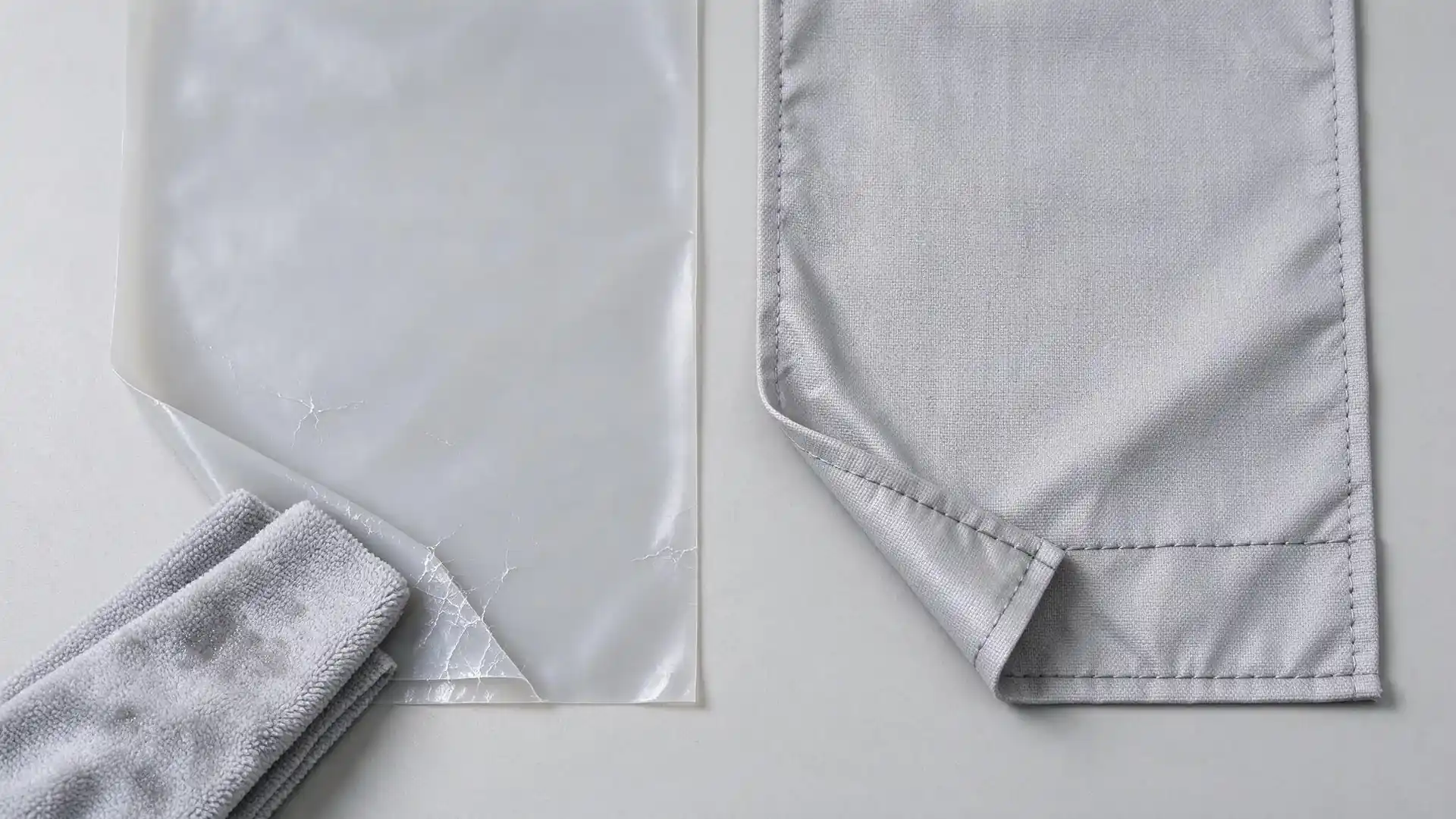
A practical way to reduce odor and sanitation complaints in reusable cold delivery bags is to choose a liner that can be wiped down between loads. That usually means EVA or PEVA, not a woven textile liner.
EVA and PEVA are flexible plastic-like liners that sit inside the bag and, when intact and properly sealed at the seams, help block liquid from soaking into the insulation. The advantage is practical: a stained textile liner may look clean after wiping but still hold residue inside the weave. A smooth liner gives the worker a visible surface to inspect.
That does not make the liner maintenance-free. The two common failure points are seam stress and fold stress. Water works into stitched seams, and repeated flexing at the fold line can open tiny cracks. Once a liner has a crack or a separated seam, liquid reaches the foam, and the bag becomes harder to dry and sanitize. For a deeper manufacturing view of seam construction and insulation-layer risk, see the Cooler Bag Manufacturing Guide: Insulation, Seams & Food-Safe Materials.
For a buyer, the leverage point is simpler choices, not more words: specify a smooth EVA or PEVA liner, confirm the cleaning chemicals your operation will actually use, and ask for a cold-flex behavior statement. A material-specific comparison is available in the PVC vs TPU vs EVA Bags: Waterproof Performance, Compliance Risks & Cost Trade-Offs page.
Why “Leak-Resistant” Is Safer Than “Leakproof”
In procurement language, leak-resistant is usually the honest claim; leakproof is usually the risky one.
Most flexible delivery bags have stitched seams, zipper openings, and fold corners. Those are not naturally watertight joints. A thermo-welded or seam-sealed structure may resist liquid better, but that still depends on the liner material, seam construction, zipper type, and whether the bag is crushed, folded, or overpacked.
If you write "leakproof" in a listing or supplier agreement, you are making a stronger claim than the structure may support. The safer path is to define the condition: "leak-resistant liner for short-term contact with condensation and minor spills," or "sealed base designed to contain a specific volume of liquid when upright." Even then, confirm the test method.
A buyer-defined acceptance test is more useful than a supplier's adjective. You can require a practical wet-towel test, a small-volume water standing test, or a condensation-observation test — but only if the structure and use case support it. Do not turn a grocery bag into a sealed tank unless the product truly requires it.
Ice Packs, PCM Packs, and Internal Packing Methods
Coolant choice is where most delivery programs underperform. The best bag structure cannot rescue a poorly packed load. Equally, the best PCM pack cannot save a bag with no packing discipline.
The key operational principle is this: insulation slows heat transfer, but coolant packs provide the cold that must offset heat entering through the shell, zipper, and frequent openings. If the product is warm when loaded, or if coolant packs sit on one side while large air gaps fill the opposite side, the internal temperature will vary more than the bag's material spec suggests.
PCM vs Standard Gel Ice Packs for Delivery Programs
A phase-change material, or PCM, is formulated to absorb heat while changing phase at a defined temperature. A standard gel ice pack may melt or warm across a broader range. That difference matters when the product cannot tolerate near-freezing contact or when a route needs more stable temperature control.
PCM packs are often specified to hold a product near a target band, such as above freezing but below room temperature. Standard gel packs are simpler, often more available, and may be fine for dairy or chilled produce where a few degrees of variation is acceptable.
The sourcing problem is that "PCM" itself does not guarantee performance. A PCM pack is only as useful as its confirmed phase-change temperature, fill weight, pre-conditioning method, and packaging. Ask the coolant supplier for the phase-change point, not just the product name.
| Coolant type | Typical operational use | Advantage | Key risk | What to confirm |
|---|---|---|---|---|
| Standard gel ice pack | Chilled grocery, short routes | Simple, reusable, widely available | May freeze or overcool products on contact | Pre-conditioning method, fill volume, freeze point |
| PCM cool pack | Temperature-sensitive grocery/pharmacy lines | Can hold a narrower temperature band | Higher complexity, must match route temperature | Phase-change temperature, conditioning and reuse limit |
| Dry ice | Non-default for flexible reusable delivery bags; frozen or long-dwell loads only if route-engineered | Very cold, active cooling | Carbon dioxide handling, ventilation, packaging damage risk | Supplier/operator confirmation of ventilation, containment, product compatibility, and transport rules |
| Wet ice | Non-default for flexible reusable delivery bags; simple short-use cooling only | Low cost and familiar | Leakage, weight, food-contact concern | Liner/seam compatibility and definite leak containment confirmation |
Pre-conditioning is often ignored. A gel pack pulled from a warm storage room and placed in the bag at the last minute contributes less cold than a pack properly frozen or chilled. The operator, not the bag supplier, controls that step.
Packing Mistakes That Reduce Thermal Stability
Many field failures are operational or packing-related, not only material failures. They are often packing failures that the bag was never designed to correct.
- Air gaps. Warm air pockets force coolant packs to work harder and create uneven temperature zones. Load product tightly enough to reduce warm air pockets and keep product and coolant packs in close surface contact, but not so tight that coolant packs or product are crushed, direct contact is lost, or the zipper is forced.
- Warm product loading. If you load room-temperature product into an insulated bag along with chilled product, the bag traps the heat. That can accelerate spoilage and make the coolant work longer.
- Overloading. A bag packed beyond its designed volume may not close fully at the zipper, creating a heat path and stressing the closure. The capacity should be a physical limit, not a suggestion.
- Coolant on one side only. Place coolant against the areas where heat gain is highest — usually the top, bottom, and sides — and keep it close to temperature-sensitive items rather than bunched in one corner.
- No route staging. Opening the bag at every stop lets external air in. If routes have many stops, organize the bag so the first-delivery items are nearest the opening, reducing open time.
- Wet product in fabric areas. Meat packaging, condensation, or loose ice should not rest directly against unsealed seams or zipper tape.
The buyer cannot control the driver's packing, but the buyer can reduce the risk by specifying coolant pocket placement, divider systems, and a packing diagram that ships with the bag or appears in the training material.
Compliance-Safe Claims for Grocery and Pharmacy Programs
Compliance risk in this category comes less from the bag and more from the claims written on it. A phrase like "food-safe" or "pharmacy-grade" can raise legal and customer expectations without adding any real protection.
The safe starting point is to describe the bag by what was specified and confirmed: "smooth EVA liner, wipe-clean interior, leak-resistant base, designed for short-route chilled transport." That is truthful even if the supplier changes a material or the route conditions shift.
The FDA FSMA Sanitary Transportation Rule can apply to certain food transport operations, but it does not make an individual thermal delivery packaging item "FDA approved." The rule assigns responsibility to shippers, loaders, carriers, and receivers to keep food safe during transportation, including temperature control and sanitation where applicable. A bag can support that obligation without carrying an approval sticker.
When Food-Contact Documentation May Apply
Not every insulated grocery bag requires food-contact documentation. Food-contact requirements generally apply to materials that directly contact food or may reasonably be expected to contact food. If the products are sealed in their own packaging, the transport bag's liner does not automatically become a food-contact surface.
That distinction matters for cost and sourcing. You can ask a supplier for a material declaration for the liner, but you should not demand an "FDA bag" for a carry vessel that never touches unpackaged food.
Check the likely contact path:
- Item is a sealed milk carton inside a bag → likely not a direct food-contact use.
- Item is loose produce or unwrapped meat sitting inside the same bag liner → direct-contact or indirect-contact questions may apply.
- Item is a pharmacy product in sealed unit-dose or retail packaging → the bag generally supports handling and temperature maintenance, not direct product contact.
If food-contact documentation is needed, ask the supplier to identify the specific liner or inner layer, the contact substance, and the applicable regulatory reference for the target market. Do not settle for a generic "food-grade" phrase.
What Buyers Should Ask Suppliers to Confirm in Writing
This is where a weak RFQ becomes a strong one. Use a written confirmation list rather than a supplier's marketing summary.
- The exact liner material, thickness, and whether it is stitched, heat-sealed, or otherwise bonded.
- The zipper construction, cold-flex behavior, and whether the zipper is exposed to internal moisture.
- The insulation type and whether it is closed-cell foam or another structure.
- The handle reinforcement method, including stitching or bar tack locations.
- The coolant pocket dimensions, closure style, and whether the pocket separates coolant from product.
- Whether the bag has a sealed or reinforced base for wet condensation.
- The cleaning chemicals and temperature range the liner is rated for, confirmed in writing.
- Any material compliance documents available for the liner, shell, or insulation layer.
- The intended temperature range or route condition the supplier is willing to support in writing — if any.
When possible, tie these to a physical golden sample so later production cannot shift without a written approval.
QC, Durability, and Repeat-Use Risk Control
Repeat-use cold chain delivery bags fail at predictable points: the zipper, the handle attachment, the base seam, the liner fold, and the coolant pocket stitching. Your QC plan should treat those as measurement points, not visual afterthoughts.
A practical incoming QC or final random inspection should focus on load-bearing and moisture-path areas. A general "check stitching" instruction is not enough; define which stitching, which direction, and what failure looks like.
| QC checkpoint | What to inspect | Buyer-defined acceptance example |
|---|---|---|
| Zipper stress | Zipper tape, slider alignment, cold-flex stiffness | Open/close under light tension a set number of cycles; no tape puckering or slider jam |
| Handle reinforcement | Bar tacks, bartack count/pull direction | Pull handle at defined load direction; no thread slippage or seam opening |
| Liner adhesion / seam | Liner-to-shell bonding, fold stress at corners | Inspect seams after flexing; no separation or crack at fold line |
| Coolant pocket | Stitching, closure, fit of gel pack | Insert specified gel pack; pocket should close without tearing |
| Condensation review | Interior surface after wet test | Moisten interior per buyer-defined test; check whether moisture seeps through liner into insulation |
| Base reinforcement | Base material, stitch/seam seal | Press and flex base; no delamination or gap |
| Color / logo / barcode | Production sample match | Compare to approved golden sample |
AQL sampling is one possible acceptance approach for major defects in some bag categories, but the exact level, defect definitions, and sample plan must be agreed before production. Do not assume the supplier's default inspection plan matches your intended marketplace return tolerance.
Sample Approval Before Bulk Production
The sample stage is the most practical moment to catch a material mismatch before it becomes a container full of inventory.
Ask for a pre-production sample, then approve it as the golden sample. That sample should include the exact liner, the exact color, the exact handle and zipper construction, the coolant pocket, and the final label or branding if applicable. If the sample is made with a substitute liner, write that down. A sample order mistake can quietly turn into a bulk production mistake.
The Sample Order Mistakes in Bags and Luggage: What B2B Buyers Should Avoid Before Bulk Production page covers the approval chain in more detail, but the core rule is simple: an approved golden sample becomes the binding quality reference only when the purchase order or supplier agreement defines it as such. Without that written commercial documentation, the sample is useful evidence of intent, but it may not be controlling if a dispute later arises.
RFQ Checklist for Cold Chain Delivery Bag Programs
Most cold-chain delivery bag quotes go sideways because the buyer sends a photo, a target price, and a vague size — then the supplier guesses the rest. A strong RFQ forces the supplier to quote against assumptions you can inspect later.
Prepare these fields before contacting OMASKA or any other supplier. The more route-specific data you provide, the fewer surprises arrive in the sample.
| Field | Your input |
|---|---|
| Bag type | Reusable cold delivery bag / grocery delivery bag / pharmacy delivery bag |
| Target market | Country, retail channel, marketplace or pharmacy program |
| Product category | Frozen, chilled, ambient, health-related, meal kit |
| Quantity | Buyer-defined quantity and any MOQ expectation to confirm |
| Size / capacity | Internal dimensions in mm/cm, weight capacity |
| Route duration | Typical minutes/hours from pack-out to final delivery |
| Ambient temperature range | Indoor, vehicle, outdoor, seasonal extremes |
| Target temperature range | Fahrenheit or Celsius, if defined |
| Coolant type | Standard gel pack / PCM cool pack / dry ice / wet ice |
| Coolant pocket position | Bottom, side wall, lid, removable, none |
| Liner material | EVA / PEVA / other, wipe-clean preference |
| Insulation layer | Closed-cell foam / foil-faced / other |
| Zipper / closure | Coil zipper, coated zipper, top-load, side-load, flap closure |
| Handle / carry system | Short handles, long handles, shoulder strap, bottom reinforcement |
| Branding / logo | Print method, placement, artwork approval |
| Packaging | Polybag, barcode label, carton strength, master carton configuration |
| Cleaning SOP | Cleaning chemicals, frequency, drying method |
| Inspection requirement | AQL level, defect definitions, sampling method |
| Compliance documents | Liner declaration, food-contact scope, material specs |
| Sample process | Pre-production sample, golden sample approval, coolant fit check |
| Delivery deadline | Buyer-defined, subject to supplier confirmation |
If you are shipping into a marketplace or retail fulfillment network, link the packaging field to the Packaging Mistakes in Bag and Luggage Orders: Cartons, Polybags, and FBA Checklist page before you send the carton specs.
FAQ
These are the questions buyers ask after they get past the brochure language and start planning real routes.
Can a reusable cold delivery bag replace refrigerated transport?
A reusable cold chain delivery bag can support short last-mile temperature maintenance, but it does not mechanically refrigerate or actively remove heat. It slows heat gain using insulation and coolant packs. Whether it can replace a refrigerated vehicle or active container depends on route duration, outside temperature, product sensitivity, coolant capacity, packing density, and the number of door openings. For high-risk products or long dwell times, do not assume equivalency. Run a buyer-defined thermal test under representative conditions before changing the transport method.
Are pharmacy delivery bags regulated differently from grocery delivery bags?
The bag itself is not automatically considered a regulated medical or pharmaceutical shipping system just because it carries pharmacy items. Regulations depend on the product class, storage requirements, destination market, and whether the transport step is part of a controlled distribution process. A pharmacy program may need stronger documentation and a more disciplined loading and cleaning SOP, but that does not mean the bag becomes "medical-grade" by default. Buyers should consult the responsible regulatory or quality function for the specific program.
How should reusable insulated bags be cleaned between deliveries?
For most programs, a wipe-clean liner should be wiped after visible spills or at the end of each route shift using a damp cloth and an approved mild cleaning agent. Harsh solvents, abrasive pads, and undiluted disinfectants can damage EVA or PEVA and strip seam coatings. Open the bag and allow it to air-dry completely before folding or stacking. Confirm the cleaning chemicals with the supplier in writing, and include the cleaning method in the RFQ so the sample is tested against the same process the operation will use.
What causes liner cracking or odor buildup over time?
Liner cracking usually comes from repeated flexing at fixed fold lines, cold-flexing a liner that was not specified for low temperatures, or cleaning with chemicals that attack the plastic surface. Odor buildup is more common with woven fabric liners that trap residue inside the weave or with stitched seams that hold moisture. Even smooth liners can develop micro-cracks at the fold corners. Specify a liner with confirmed cold-flex behavior, avoid storing the bag folded while wet, and inspect the corner folds and base seam during incoming QC.
What should marketplace or online grocery sellers confirm before bulk orders?
Online sellers should confirm carton strength, carton dimensions, polybag and barcode/label placement rules, inbound fulfillment labeling requirements, and whether the bag can be photographed consistently across colors. Also confirm that the packaging will not introduce moisture into the bag during warehouse storage or long-distance transport. A packaging failure, not the bag's thermal design, is often what triggers the first marketplace return or inbound rejection.
Official Sources and Compliance References
This section is for buyers who need a defensible starting point when writing RFQs or listing claims. These references support the compliance logic used above, but they are not substitutes for program-specific regulatory advice.
- FDA FSMA Sanitary Transportation of Human and Animal Food Rule, 21 CFR Part 1 Subpart O — establishes responsibilities for shippers, loaders, carriers, and receivers engaged in food transportation, including requirements related to temperature control and sanitation where applicable.
- FDA guidance on refrigerated food transport and food-contact materials — useful for separating direct food-contact material questions from sealed-product handling.
- 21 CFR Part 211 current Good Manufacturing Practice for Finished Pharmaceuticals — provides a highly scoped reference when storage and distribution activities may connect to pharmaceutical quality systems, but it does not mean a delivery bag is automatically part of those systems.
- Supplier material compliance documents — the buyer should request the liner declaration, insulation layer specification, and any applicable food-contact or REACH/other market-specific documents that a supplier can provide.
These references are starting points for buyer verification. Before relying on any citation in a listing, supplier agreement, or operating SOP, confirm the latest official text and current applicability for the specific product, use scenario, and target market.
Whenever a listing says "FDA-compliant" or "food-safe," ask for the specific reference and scope. If the supplier cannot produce one, the safest wording is a structural description: EVA liner, wipe-clean interior, leak-resistant base.
Conclusion
Cold chain delivery bag procurement is really a workflow decision, not a price-per-bag decision. The right bag for a grocery route may be the wrong bag for a pharmacy program — not because of the color or branding, but because the liner, coolant pocket, cleaning operation, and documentation trail no longer match the risk.
Before you approve a supplier, tie three things together: the material stack, the coolant and packing method, and the claims you plan to print. If any one of those three is vague, the sample will look fine and the field results will drift.
Send OMASKA a complete RFQ with route duration, product type, coolant choice, cleaning method, packaging requirements, and the exact wording you intend to use. A supplier that asks about those details is more useful than one that immediately promises "keep cold for X hours," because the first supplier is trying to protect the same three-way system you are buying.
Get A Quote

Get A Quote
0 Comments