
Cold Chain Delivery Bags for Grocery & Pharmacy: Sourcing & Compliance Guide

A cold chain delivery bag is a soft-sided thermal packaging system designed to hold a defined temperature band during last-mile delivery — such as 2–8°C for refrigerated pharmacy or grocery orders — when paired with the right Phase Change Materials (PCMs) or gel packs. Dry ice is not a default coolant for every soft-sided bag; it should be considered only when the bag materials and closure design are specifically rated for extreme low temperature and CO₂ gas venting. It is not a standard cooler bag with a foil liner, and treating it like one is how programs fail on temperature excursions, cross-contamination, and audit risk.
Buyers sourcing a cold chain delivery bag usually make two mistakes. They start with the bag alone instead of defining the full system — bag + coolant + payload + loading process. Then they spec the bag like a promotional tote: nice exterior, cheap foil interior, no thought to seams, coolant placement, or wipe-down sanitation. That leads to spoiled pharmacy shipments, rejected grocery deliveries, and customer complaints that cost far more than the bag.
This guide is written for procurement, operations, and product teams at grocery chains, pharmacy distributors, refrigerated last-mile providers, and B2B suppliers. It walks through the material, structure, hygiene, compliance, and RFQ decisions that separate a reusable cold chain delivery bag that works in daily rotation from a marketing giveaway that only keeps a can cold for a few hours.
Read it end to end if you're about to issue an RFQ or compare suppliers. The non-negotiable is this: you are sourcing a bag that must support system performance, not a bag that by itself achieves a temperature guarantee.
Quick Answer / 30-Second Buyer Decision
If you're sourcing a cold chain delivery bag for grocery or pharmacy delivery, specify these six things before you talk to a supplier:
- Target temperature band: controlled room temperature, 2–8°C refrigerated, or frozen — plus expected hold time and seasonal ambient conditions.
- Liner type: heat-welded TPU or heavy-duty PEVA with smooth, wipe-clean interior corners; not stitched foil or basic PEVA film.
- Insulation structure: high-density closed-cell EVA or PU foam with a radiant barrier layer, specified in the wall and base.
- Coolant integration: dedicated internal pockets, sleeves, or dividers sized to the ice packs or PCMs you'll use, kept away from direct product contact where necessary.
- Data logger access: a clear, accessible pocket or window so temperature recorders stay with the payload without being crushed.
- Seam and zipper approach: welded seams in the liner, plus a moisture-resistant zipper that closes consistently after repeated use.
Don't accept "it's the same as a cooler bag" from any supplier. That's a red flag, not an answer. The better starting question is: what happens to the bag after repeated delivery cycles, a leaking condensate pack, and a hot van afternoon? If the answer involves stitched seams, open-cell foam, or a foil liner, you're probably looking at the wrong product for most reusable cold chain delivery programs.
Scope of This Guide
This guide covers reusable soft-sided cold chain delivery bags for last-mile grocery and pharmacy programs. It focuses on the design and sourcing choices that affect temperature stability, hygiene, coolant handling, and compliance documentation. For context, cold chain logistics is the temperature-controlled supply chain that keeps products within a defined range from production to final delivery; the bag is one component of that system, not the whole solution.
It does not cover hard-sided refrigerated trucks, active plug-in refrigeration, medical devices that actively cool, or consumer picnic cooler bags. If you need a general primer on insulation and seam construction before you go deeper into cold chain design, see the Cooler Bag Manufacturing Guide: Insulation, Seams & Food-Safe Materials.
The Difference Between General Cooler Bags and Cold Chain Delivery Bags
A standard promotional cooler keeps drinks cool in moderate weather. A cold chain delivery bag has to do something much harder: maintain a narrower temperature band for a defined route time, day after day, while the operator loads and unloads it quickly and cleans it between runs.
The differences are structural, not just branding. Standard cooler bags often use thin expanded foam, a stitched foil lining, and a basic zipper. They have no dedicated coolant pockets, no data logger pocket, and no heat-welded seams. The foil lining may hide visible defects but does little to stop condensation from soaking into the bag structure.
A commercial cold chain delivery bag should have a heavier outer shell — usually tarpaulin, PVC, or a reinforced PES/PVC laminate — because delivery vans rub bags against shelves and crates. The insulation should be high-density closed-cell EVA or PU foam, because open-cell foam loses its thermal performance as it absorbs moisture. The liner should be wipe-clean and joined with high-frequency welded seams, not needle holes that let liquid into the insulation.
| Feature | Standard Cooler Bag | Cold Chain Delivery Bag |
|---|---|---|
| Insulation | Thin PE foam, often open-cell risk | High-density closed-cell EVA/PU foam, specified thickness |
| Liner | Stitched foil film or light PEVA | Heat-welded TPU or reinforced PEVA, smooth sealed corners |
| Seam construction | Stitched, small needle holes | Welded liner seams; reinforced outer stress points |
| Coolant storage | Loose ice packs dropped inside | Dedicated PCM/gel pack pockets, sleeves, or dividers |
| Data logging | Rarely supported | Clear outer or inner pocket for data loggers |
| Zipper | Basic nylon or plastic zipper, no water-control | Moisture-resistant coil or waterproof-spec zipper, often coated or molded |
| Primary use | Beverages, picnics, promotional giveaways | Refrigerated grocery/pharmacy last-mile delivery, repeat daily use |
| Cleaning | Hard to dry, foil liners tear | Wipe-clean liner designed for repeated sanitization |
Buyers switch to a specialized cold chain delivery bag when they realize the bag's real job is repeatability: same temperature outcome, route after route, without relying on the driver to pack perfectly every time. That repeatability comes from the bag structure — assuming the operator follows the specified coolant loading and packing procedure — not from a thicker graphic-printed exterior.
Core Temperature Zones & Material Insulation Requirements
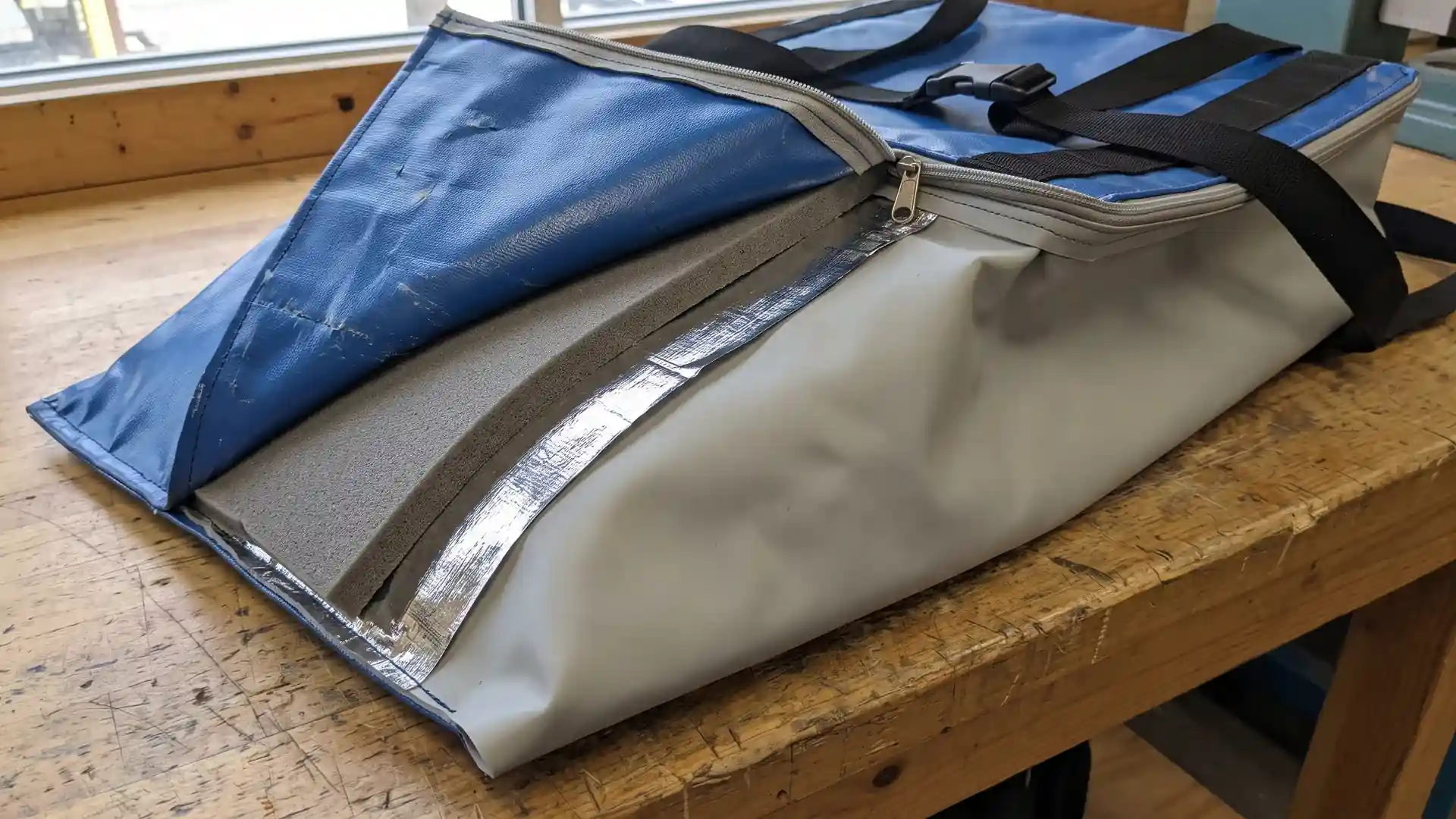
The first specification decision is not "what color" or "what logo." It's what temperature band must the bag support, for how long, and under what ambient conditions.
B2B cold chain programs typically operate in three zones:
- Controlled Room Temperature (CRT): should be taken from the product monograph, compendial definition, or SOP. Some pharmaceutical contexts define CRT as 20–25°C; other logistics programs may use a 15–25°C band for planning. Some pharmacy deliveries only need protection from extreme heat or cold, not active cooling.
- Refrigerated: commonly 2–8°C for many pharmacy items and fresh grocery products. This is the most common pharmaceutical cold chain band.
- Frozen: commonly specified between roughly -10°C and -25°C, with the precise threshold defined by the product or carrier requirement.
The bag alone does not create these zones. It must work with the right coolant load. But the insulation determines how much coolant you need and how long the system can resist the outside temperature.
For last-mile delivery, the two insulation materials you'll specify most often are high-density closed-cell EVA foam and closed-cell PU foam. EVA is durable, holds its shape, and resists water absorption. PU foam can offer excellent thermal resistance but must be closed-cell; open-cell PU absorbs moisture and loses performance quickly. Some specifications also add a radiant barrier layer — a metalized film — behind the liner to reflect heat and reduce radiative transfer through the bag wall.
Foam thickness is a design variable, not a universal guarantee. Some projects may use a planning range around 10–20 mm of closed-cell foam in the walls and base, but that is a project-specific reference point, not an industry-wide standard. The actual thickness must be supplier-confirmed and validated with the loaded kit based on your target temperature, route time, payload thermal mass, coolant volume, and summer/winter temperature profile. Don't quote a thickness without testing the assembled kit.
The exterior material matters too. For grocery and pharmacy delivery, tarpaulin or a reinforced PES/PVC laminate resists abrasion better than lightweight polyester. But since delivery bags are sometimes stored folded or hung in a van, consider how the outer shell and zipper behave in repeated use. If the route includes humid reefers or outdoor staging, a smooth wipe-clean exterior helps reduce dirt and contamination pickup between runs.
For a deeper look at why liner material controls both hygiene and condensation performance, the cooler bag manufacturing guide referenced earlier explains how seam construction and food-safe liner choices interact.
Structural Design: Ice Packs, PCMs, and Data Logger Integration
A cold chain bag that has no place for its coolant shouldn't be expected to perform consistently. Drivers improvise — they throw ice packs on top, or against the product, or pile them in one corner. The result is freezing damage to refrigerated products, uneven temperature distribution, or coolant that slides away during transit.
The bag structure should force good packing behavior without needing a written procedure. That means:
- Dedicated PCM or gel pack sleeves: internal mesh, welded TPU, or reinforced fabric pockets sized for your specific ice pack brand and dimensions. Ask the supplier to confirm the pocket dimensions against your coolant specification, not against a "standard gel pack."
- PCM selection: Phase Change Materials can be tailored to hold a specific melting point, such as around 4°C for refrigerated delivery, rather than simply being "cold." Specify what PCM range you intend to use before finalizing the bag, because it affects how much coolant mass fits and where it sits.
- A barrier or partition where required, to prevent direct contact between sub-zero coolant and refrigerated product. A mesh or TPU divider can stop the freeze-damage failure that often shows up in customer complaints but is rarely caught during supplier QC because the bag itself looks fine.
- Data logger pocket: a transparent, accessible pocket on the inside or outside that holds a temperature data logger securely and keeps it readable. If the logger is buried under frozen packs, the temperature record is misleading. If it's exposed outside the bag, it records the van, not the payload.
- Square or rectangular form factor: delivery programs usually pack crates, totes, or modular shelving. Avoid deep unstructured shapes that make coolant wick moisture and collapse under the weight of stacked bags.
Coolant compatibility note: Dry ice is not a default coolant for all soft-sided cold chain delivery bags. If dry ice is part of the specified system, confirm that the liner and closure materials are rated for extreme low temperature and that the bag allows CO₂ gas venting. Standard sewn zippers may allow some venting, but airtight, waterproof, or fully sealed closure designs can trap CO₂, embrittle TPU/PEVA/PVC, or create an in-vehicle asphyxiation hazard. The buyer must confirm material rating, ventilation, and carrier or safety approval before specifying dry ice.
Internal dimension matters more than external dimension here. A bag with a bulky external footprint can lose a meaningful share of its internal volume once you subtract thick foam walls, liner, and coolant pockets. Spec internal payload volume separately from external crate footprint.
Hygiene & Maintenance: Wipe-Clean Interiors and Cross-Contamination
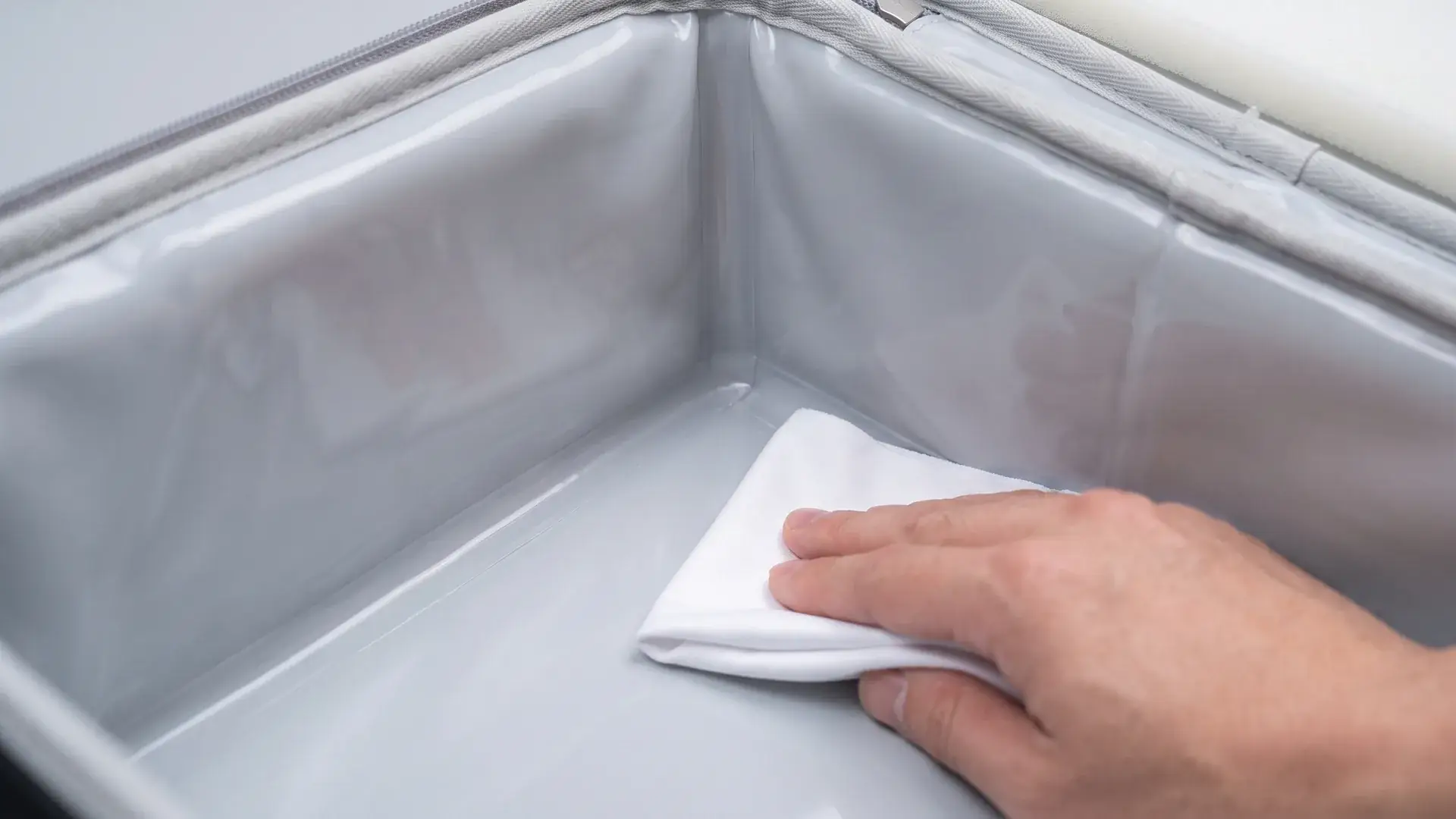
Grocery and pharmacy delivery bags get dirty — condensation, spilled produce, cracked gel packs, dust from the van floor. A stitched foil liner traps that moisture in the needle holes and behind the insulation, which is exactly where bacteria and odors grow.
Specify heat-welded seams in the liner. High-frequency welding or RF welding fuses the TPU/PEVA panels without needle pores, leaving a smooth interior corner you can actually wipe down. Welded seams also reduce the chance of liquid seeping into the insulation, which preserves thermal performance over many cycles.
Three liner materials come up most often:
- TPU: flexible, cold-tolerant, strong, and often the best choice for cold-chain-grade wipe-clean performance. It welds well and stays flexible at refrigerator temperatures.
- Heavy-duty PEVA: lower cost than TPU, easy to weld, but you need to verify thickness and cold-flexibility for frozen programs.
- PVC: durable and weldable, but usually heavier and can raise compliance questions in certain markets. The PVC vs TPU vs EVA Bags Guide covers those trade-offs in more detail.
Do not call the bag leak-proof unless the supplier has engineered and tested it for inverted liquid retention. For most delivery bags, leak-resistant is the defensible claim. Even a welded liner can leak if a zipper is left partially open or the bag is overfilled.
For daily sanitation, wipe the bag with a commercial disinfectant or detergent solution compatible with the liner material, then air-dry or wipe dry before the next route. Machine washing is usually the wrong choice because submerging the bag can saturate the insulation and break down welded seams over time. If someone claims the bag is machine washable, ask how the insulation is protected from water ingress.
Cross-contamination is another program-level concern. A bag used for raw grocery items should not be used for pharmacy orders without a controlled cleaning step. Some programs solve this by color-coding outer shells or by using removable, replaceable liners. But even color-coding fails if the cleaning protocol is not documented and monitored. The bag design should support the sanitation plan, not be expected to replace it.
Compliance & Testing: ISTA Standards and FDA FSMA
This is where most sourcing programs get confused. A cold chain delivery bag is not an "FDA-approved bag." FDA regulates the food or drug product, the sanitary conditions of transportation, and certain food-contact materials — not the insulated bag as a stand-alone certificate. Materials can be food-contact compliant, but that claim must come from the supplier's material documentation, not from a printed marketing stamp.
For temperature performance, the International Safe Transit Association (ISTA) provides useful development and validation standards. Two important ones are ISTA 7D, often used during development and screening of thermal transport packaging, and ISTA 7E, which is based on real-world ambient temperature profiles for parcel and last-mile shipments. ISTA 20 is a broader design and qualification framework for insulated shipping containers. The key point is that the buyer should test the final loaded system — bag, coolant, payload, dunnage, and routing duration — under a defined thermal profile. The bag supplier provides consistent bag construction so the test result is repeatable, but supplier consistency is not a substitute for validation.
The FDA Food Safety Modernization Act (FSMA) adds another layer. The Sanitary Transportation rule applies to certain food shipments and focuses on avoiding contamination and temperature abuse during transport. It covers suitable temperature control, sanitary conditions, and training. FSMA 204 recordkeeping requirements add traceability obligations for certain foods, with staged compliance dates beginning in 2026 for many covered entities. Buyers should confirm their own compliance deadline and scope with counsel rather than relying on a bag supplier to define it.
Your supplier documents should include:
- Liner material composition and food-contact compliance documentation, if the liner directly touches food or open product.
- Confirmation of welded-seam construction and whether the liner is tested for liquid resistance.
- Insulation material type and closed-cell designation.
- Zipper and hardware material details, especially if they contact the liner or condensate.
- Any relevant material regulation statements for target markets, such as REACH or RoHS for European programs.
The bag itself does not create a "compliant cold chain" simply by existing. It is part of a system that the buyer validates, controls, and documents.
RFQ Checklist for Custom Cold Chain Delivery Bags

A good RFQ doesn't ask for "a cold chain bag." It gives the supplier enough information to choose the right insulation, construction, hardware, and testing approach. Rather than making every parameter a guess, send this kind of detail:
| Specification Category | Buyer Input Required | Why It Matters |
|---|---|---|
| Bag type and format | Rectangle, square, vertical tote, zip-top, fold-flat, shoulder/hand carry | Determines structure, foam paneling, and how it fits the delivery crate |
| Target market and use | Grocery, pharmacy, frozen, refrigerated, mixed | Affects hygiene, compliance, temperature band, and documentation |
| Temperature target | CRT, 2–8°C, frozen, or custom band | Sets insulation density and thickness expectations |
| Hold time and route duration | Expected hours from packing to final delivery | Determines coolant volume and insulation performance |
| Ambient conditions | Summer/winter, hot van, cold dock, direct sun | Needed for thermal testing and material choices |
| Payload | Type, weight, dimensions, heat sensitivity | Helps set payload volume and coolant placement |
| Internal vs external dimensions | Internal payload volume plus external crate footprint | Avoids specifying a bag that looks big but carries little |
| Coolant type and size | Gel pack, PCM, or mixed; dry ice only if material-rated and CO₂-vented | Dictates pocket size, placement, liner compatibility, and closure safety |
| Coolant layout | Sleeves, dividers, removable partitions, direct contact allowed? | Reduces freezing damage and uneven cooling |
| Liner material | TPU, PEVA, PVC, or supplier proposal | Controls cleanability, cold flexibility, and compliance |
| Seam construction | High-frequency welded liner seams; no stitching in wet area | Prevents moisture ingress and bacterial harborage |
| Insulation type | High-density EVA, PU, radiant barrier layer | Delivers thermal resistance and repeatability |
| Data logger need | Transparent pocket, sleeve, or routing window | Keeps temperature records with the payload where they matter |
| Exterior material | Tarpaulin, reinforced PES/PVC, or lighter fabric | Balances durability, cleaning, and cost |
| Zipper and hardware | Moisture-resistant coil, coated zipper, number of pulls | Must survive repeated daily use without jamming |
| Branding | Logo method, placement, routing labels, barcode panel | Avoids decoration that compromises the insulated shell |
| Packaging | Polybag, carton, shipping marks, barcode or FBA requirements | Protects structure and supports receiving |
| QC and inspection | Defect criteria, liner inspection, seam check, sample approval | Prevents bulk surprises after a passing prototype |
| Sample stage | Pre-production sample deadline and approval owner | Protects against the classic sample-to-bulk mismatch |
Before you pay for a prototype, review the Sample Order Mistakes in Bags and Luggage guide. A recurring failure point in cold chain bag development is the sample stage — wrong liner thickness, missing internal pockets, or a supplier substituting a lighter foam after the quote is accepted. Your sample approval should cover liner welding, insulation density, coolant pocket dimensions, and zipper closure quality, not just the exterior color and logo.
Also confirm with the supplier:
- That they can perform or arrange high-frequency welding of the liner, not only stitching.
- That they can source and document the liner material's food-contact compliance if needed.
- That they will provide material swatches and construction samples before full production.
- That they can hold the insulation thickness and density consistent across all batch panels.
- That they can pack the bags to avoid deformation during sea or air freight.
The supplier builds the bag. You own the system test. The RFQ needs to make both responsibilities explicit.
Common Mistakes That Sink Cold Chain Delivery Programs
Even experienced buyers make these same errors, and they usually don't show up until the first thermal test or the first customer complaint:
- Specifying the bag like a cooler. A standard insulated grocery bag with stitched foil lining and thin foam is not a program-grade cold chain delivery bag, no matter how good the logo looks.
- Quoting external dimensions only. Thick insulation and coolant pockets eat internal volume. If the bag doesn't hold the expected number of pharmacy totes or grocery units, the whole route plan changes.
- Allowing loose ice packs inside the main compartment. Loose packs slide during transport, freeze the wrong products, and obstruct the data logger. Dedicated sleeves are cost-effective to include when specified early.
- Writing "leak-proof" without a test. Most bags are leak-resistant at best. If you market leak-proof, you're creating a return risk with zero test evidence to back it up.
- Skipping the seasonal profile. A bag that works in a mild spring climate may fail in a hot summer van. The supplier's material claim is not the same as your end-to-end thermal test result.
- Ignoring zipper failure as a QC item. Delivery bags often fail at the zipper first. A cheap zipper that jams after repeated route use reduces the bag to a tarp.
- Treating FDA compliance as a bag sticker. Materials may be food-contact compliant, but the sanitary transportation process, coolant handling, and data documentation are your responsibility.
- Assuming machine washable = more sustainable. Submerging an insulated bag can destroy its thermal performance and weld integrity. Wipe-clean interiors are the maintenance standard for repeated use.
- Blending grocery and pharmacy fleets without a sanitation control. A bag that carried raw produce should not transport temperature-sensitive medication until it has been cleaned and documented under a controlled SOP.
The biggest mistake of all is skipping a full loaded-system test. Buy the bag from one supplier, the coolant from another, and don't validate them together until customers start reporting problems. That's the expensive way to learn that the bag was never the weak point — the system was.
FAQ About Sourcing Cold Chain Delivery Bags
Here are the questions buyers ask most often when they're moving from a general cooler-bag search to a real cold chain sourcing decision.
How long do cold chain delivery bags keep items cold?
There is no fixed answer for every bag. Hold time depends on the insulation thickness and density, coolant type and volume, payload thermal mass, how full the bag is, how often it's opened, and the ambient temperature along the route. A bag that holds 2–8°C for several hours in moderate weather may fail in a hot van if it has insufficient coolant. Buyers should validate the loaded kit under a defined thermal profile — not rely on a supplier's generic "keeps cold for X hours" statement.
Are cold chain delivery bags machine washable?
Usually no. Machine washing can force water into the insulation through zipper edges, closure gaps, or seam stress points, reducing thermal performance and encouraging mold. The better maintenance method is a wipe-down with a compatible sanitizer or detergent solution, followed by wiping dry and air drying if needed. If a supplier claims machine washable, ask for the waterproofing method and insulation protection details — and test one bag before rolling it out to a fleet.
How do buyers validate thermal delivery packaging for pharmacy or grocery programs?
Start with a development test such as ISTA 7D during prototype screening, then perform a full validation using a standard such as ISTA 7E based on the real delivery lane's ambient profile. The validation should include the actual bag model, coolant configuration, payload simulant, data loggers in the right positions, and the same packing procedure drivers will use. The bag supplier supplies consistent construction; the buyer or a third-party lab provides test evidence. For FDA-regulated food or medical products, confirm the specific current compliance requirements with regulatory counsel rather than treating the bag supplier's marketing language as sufficient.
Official Sources and Compliance References
These references support the sourcing decisions in this guide. Buyers should verify the current versions before using them in a specification or compliance file:
- International Safe Transit Association (ISTA): publishes standards for insulated shipping and transport packaging, including thermal profile testing and development screening methods referenced in this guide.
- FDA Food Safety Modernization Act (FSMA): includes sanitary transportation and traceability rules that may apply to certain food and temperature-controlled shipments. Confirm scope, deadlines, and recordkeeping requirements with your own compliance team.
- FDA food-contact material requirements: apply to liner materials that contact food in a way that could reasonably make contact. Request material-specific compliance documentation from your supplier, and do not treat the bag itself as a certified medical or food-safety device.
Conclusion: From Spec Sheet to Confident Sourcing Decision
A cold chain delivery bag for grocery and pharmacy delivery is not a commodity. It's an engineered soft-shell system that must hold up under daily cleaning, repeated zipper cycles, coolant condensation, and real-world temperature swings.
The sourcing decision becomes much clearer when you stop asking "what bag keeps things cold?" and start asking "what bag will support my validated system repeatably?" That question leads to thick closed-cell insulation, welded wipe-clean liners, dedicated coolant and logger placement, and supplier documentation you can audit.
If you're ready to spec a custom reusable cold delivery bag for your pharmacy or grocery program, send OMASKA the details from the RFQ checklist above. Include your internal payload volume, target temperature band, coolant type and size, liner preference, data logger requirement, and sample approval date. A precise RFQ will save you more than comparing generic thermal delivery packaging quotes ever will.
Get A Quote

Get A Quote
0 Comments