
Bag Hardware Testing Guide: Plating Standards, Sweat Resistance & Bulk QC
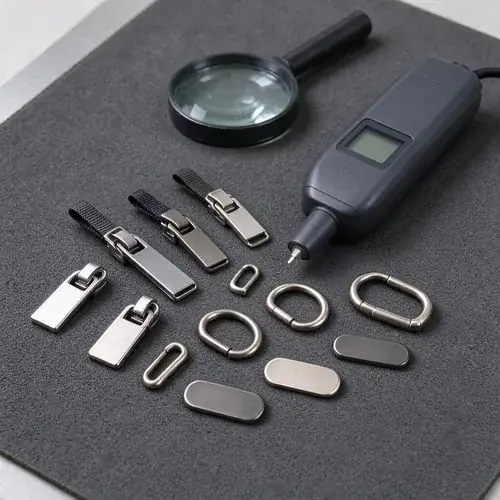
Bag hardware testing should answer one practical question before you approve mass production: will the plated zipper pullers, D-rings, buckles, and logo plates still look acceptable after months of sweat, sunscreen, humidity, storage, and daily handling? The failure most buyers face isn't a missing test report—it's approving nice-looking sample hardware with a thin decorative plating stack, then watching bulk production tarnish in customers' hands.
For branded bags sold through online retail, tarnished hardware turns into returns, negative reviews, and stranded inventory. The real cost isn't the small unit-cost saving on a cheaper plated puller; it's the landed cost of goods you can no longer sell at full margin. This guide connects plating structure, chemical exposure, abrasion behavior, and batch QC into one approval decision.
You'll come away with a test list, a supplier question set, and a bulk QC workflow so the approved reference sample is what actually ships—not a nicer version of production reality.
Quick Answer: The Buyer's 30-Second Decision
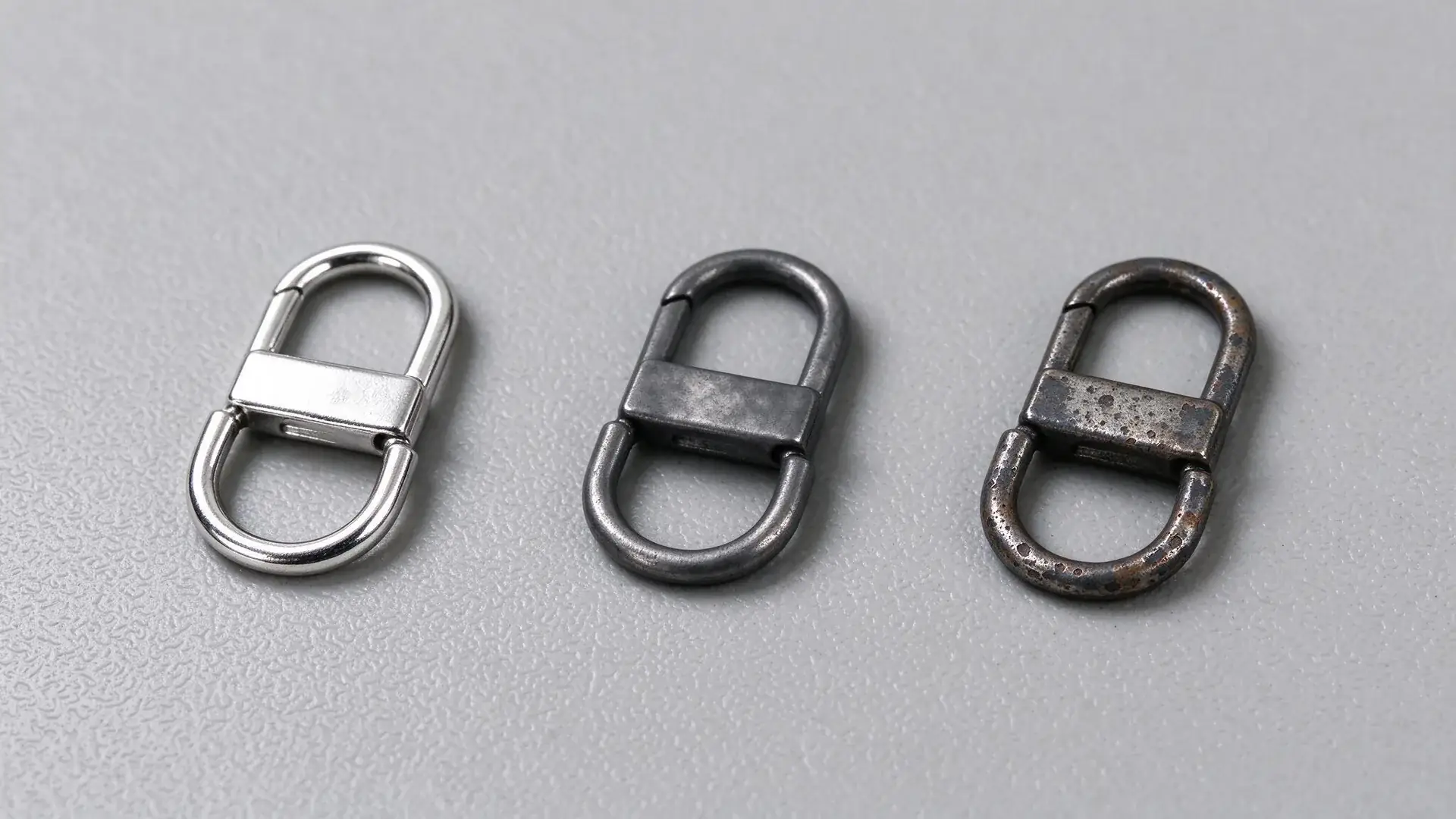
The safest bag hardware testing approach is a written plating specification, a retained golden sample, a small set of real-use simulation tests, and batch inspection controls. Don't rely on a single salt spray report or on approving a glossy sample by eye.
Here's the decision frame:
- Confirm the base metal and full plating stack in writing, including nickel underlayer thickness and top color layer thickness in microns.
- Require salt spray testing as one input, not the whole story, and agree acceptance criteria and exposure duration with the supplier.
- Add sweat or perspiration simulation for gym bags, backpacks, travel bags, and anything that will touch hands and cosmetics.
- Add abrasion and adhesion checks for zipper pullers, logo plates, and frequently touched hardware.
- Test material compatibility when hardware contacts PU-coated fabric, synthetic leather, or chemically treated leather.
- Retain a golden sample and compare every incoming batch against it before assembly.
Tests are useful when they simulate the real failure path; they're misleading when they pass a part the actual product will destroy.
Scope: What This Guide Covers
This guide is written for bag and luggage brand owners, sourcing managers, and QC teams working with electroplated metal bag hardware: zinc alloy and brass zipper pullers, D-rings, buckles, rivets, logo plates, and trolley handle trim. It covers why decorative plating fails in the field, how to read a plating specification, which tests to require before mass production, and how to lock in consistency during bulk production.
It doesn't cover full zipper engineering (slider mechanics, coil vs. metal chain design) or general metalworking metallurgy. It also won't promise universal pass/fail standards for plating thickness: acceptable micron thresholds are project-specific and depend on base metal, use environment, and the buyer's target market requirements.
Why Bag Hardware Fails After Bulk Production
The root cause behind most post-shipment tarnish complaints is a mismatch between the approved sample's plating stack and the actual production hardware's exposure conditions. A showroom sample lives in a dry, climate-controlled sample room for long stretches. The shipped product gets handled daily, packed in humid polybags, shipped by sea, stored in warehouses, and exposed to lotion, hand sanitizer, sunscreen, and sweat.
Table 1 maps the failure symptoms to root causes and the verification action that catches them.
| Failure Symptom | Likely Root Cause | Typical Exposure Condition | Buyer Verification Action |
|---|---|---|---|
| Dull, foggy finish on zipper pullers | Thin decorative top layer wearing through | Repeated finger contact and coin/key abrasion in pockets | Cross-hatch adhesion test or handling simulation before approval |
| Blackening around logo plate edges | Moisture trapped at plate-to-material interface | High humidity during sea shipment and storage | Material compatibility and humidity exposure test |
| White or gray powdery corrosion on zinc alloy | Corrosion of exposed zinc base metal through porous plating | Confined humid storage, sea freight condensation | Nickel underlayer thickness confirmation plus salt spray test with defined acceptance |
| Localized pitting or reddish spots | Substrate defect or plating discontinuity | Salty sweat contact on gym or beach products | Sweat resistance simulation and microscope inspection of plated surface |
| Peeling or flaking plating | Poor adhesion or flash plating over unprepared substrate | Handling, flexing of thin metal parts | Adhesion testing and substrate preparation review |
| Dark tarnish spreading from leather contact | Chrome-tanned leather chemicals reacting with plating | Hardware touching leather panels or straps | Leather contact test or material declaration review |
Common Real-World Tarnish Scenarios
The same plated puller can behave completely differently on a gym duffel, a beach tote, and a cosmetic pouch. On a gym duffel, the repeating factor is sweat—including salt, ammonia, and urea. On a beach bag, the repeating factor is chlorinated water, sunscreen oils, and sand abrasion. On a cosmetic bag, the repeating factor is acidic residues, alcohol-based sanitizer, and confined storage in a warm bathroom cabinet.
A high-humidity warehouse after a long sea shipment is another failure accelerator. Metal hardware inside a sealed polybag can sit in warm, moist air for extended periods before reaching a retail shelf; that's long enough for condensation to initiate corrosion if no anti-tarnish tissue or desiccant is used. Storage conditions are part of the test logic, not an afterthought.
Why Lab Reports Sometimes Fail to Predict Market Complaints
The largest misconception in bag hardware testing is that a passing salt spray report alone proves field durability. A salt spray chamber creates a uniform, continuous corrosive fog in a clean, temperature-controlled environment. Real use cycles between wet and dry, includes mechanical abrasion, chemical contact, and weeks of variable humidity.
If the production hardware uses the same plating batch as the test sample, the salt spray result is still useful for comparing two plating systems or two suppliers. It becomes misleading when the test was run on a golden sample with a thicker or better-controlled plating stack while bulk production uses a different, thinner stack from an unchecked subcontractor. Buyers should treat a lab report as evidence about the exact part tested, not as a blanket promise for the entire bulk order.
Understanding Plating Systems in Bag Hardware Testing
Plating systems—not the decorative top color—usually determine how long bag hardware keeps its appearance. A typical durable electroplated zinc alloy part has a layered structure: prepared base metal, one or more underlayers of nickel for corrosion resistance and leveling, a decorative top layer (gold, black, antique brass, or other color), and sometimes a clear lacquer or clear protective coating as the final barrier.
The top color layer is mostly about appearance. The nickel underlayer usually contributes more to long-term corrosion resistance than the top color; it acts mainly as a barrier that slows moisture and chemical migration into the zinc alloy or steel substrate. This protection works only while the nickel layer is continuous and thick enough to cover the prepared surface. Pores, scratches, thin coverage, or worn areas can expose the substrate and increase corrosion risk. If the supplier quotes only a top color finish without naming the underlayer, you're not evaluating bag hardware testing specs—you're evaluating a color.
Flash Plating vs Multi-Layer Plating
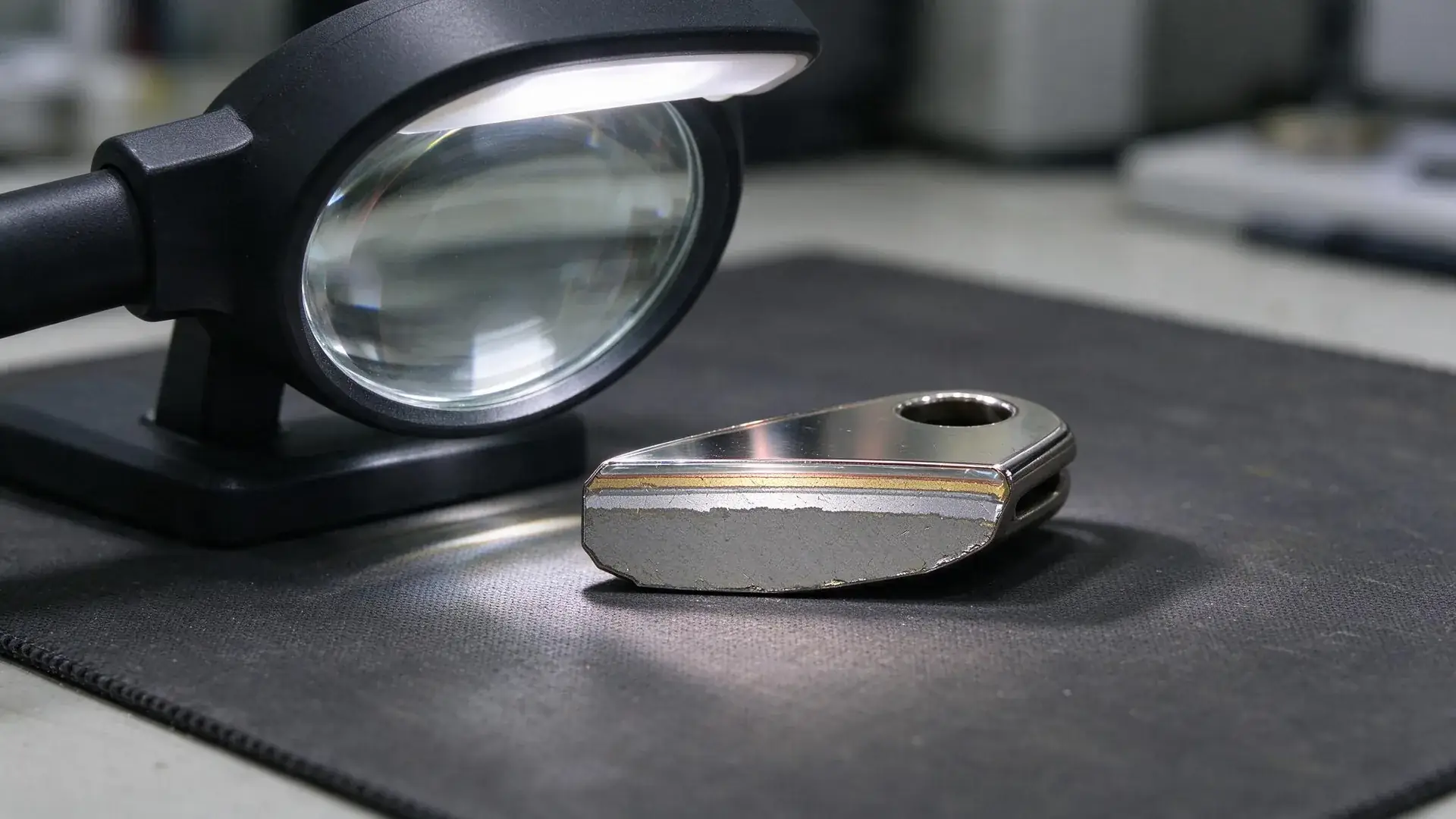
Flash plating applies a very thin, fast decorative deposit—enough to look shiny in a sample photo but often too thin to survive repeated handling, moisture, or chemical exposure. It's a classic cost-saving technique for promotional products and low-budget online retail where hardware is specified by color name, not by plating stack.
Multi-layer plating uses a thicker, engineered stack: underlayers for adhesion and corrosion resistance, a color layer for appearance, and optionally a protective top coat. The difference in field performance comes from thickness and layer continuity, not from using a more expensive "brand" of plating. The practical sourcing rule is to require the full stack in writing: base metal, each layer material, each layer thickness in microns, and whether a clear top coat is applied.
What Plating Thickness Really Means
Plating thickness is measured in microns (µm). A useful specification states the total stack thickness and the thickness of each functional layer—not just "gold finish" or "black hardware." For example, a realistic spec would list the nickel underlayer thickness, the top color thickness, and any lacquer top coat thickness separately.
What counts as "acceptable" thickness remains project-specific. A logo plate that sits flat and gets little wear may tolerate a thinner stack than a zipper puller that's pulled repeatedly in daily use and rubbed against keys. Rather than accepting a supplier's verbal assurance, ask for the micron values in writing and confirm how the supplier measures them. Cross-section microscopy can directly show layer structure; X-ray fluorescence (XRF) may be suitable as a faster method only when the equipment is calibrated for the specific base metal and coating stack and the supplier or an independent lab confirms the reading is valid for that construction. If the supplier cannot state micron values per layer and explain the measurement method, treat that as a qualification gap, not a minor paperwork issue.
Electroplating vs PVD Coating
PVD (physical vapor deposition) is a vacuum coating process that deposits a hard, thin, ceramic-like layer—often used for dark gray, gunmetal, rose gold, or other high-wear finishes. Compared with conventional electroplating, PVD coatings typically offer better abrasion resistance on flat, rigid parts like logo plates and solid sliders where the coating can bond well to a smooth prepared surface.
But PVD is not universally superior. Its color range is narrower, the appearance is often more matte or slightly metallic rather than the bright electroplated look, and flexible or deeply textured hardware parts are more difficult to coat uniformly. The cost structure is also different: PVD usually adds to unit cost because of vacuum chamber processing and lower batch throughput, though the exact cost delta depends on quantity, part size, and finish complexity.
For many bag hardware parts, a properly specified multi-layer electroplated stack with a clear top coat can often meet the expected exposure at a lower quoted cost than PVD. However, that cost comparison is project-dependent: part geometry, finish complexity, order volume, coating throughput, and the supplier's process capability all change the equation. Buyers should compare both options with supplier quotes for the exact hardware component rather than assuming one method is universally cheaper. PVD becomes worth considering when the hardware is a flat, high-touch logo plaque and the brand priority is scratch resistance over bright color depth. If you are also deciding whether to choose wheels, handles, or sliders with more demanding mechanical loads, review our related Hardware Selection Mistakes: Wheels, Handles, and Zippers in Luggage and Bags guide to connect plating choices with overall hardware sourcing decisions.
What Tests Buyers Should Require Before Mass Production
The best test plan is a small battery that recreates the product's real failure paths, not a single pass/fail certificate. The key tests, their value, and their limitations are summarized in Table 2 below.
| Test Type | What It Evaluates | What It Does Not Evaluate | Best Use Case |
|---|---|---|---|
| Salt spray | Resistance to uniform corrosive fog over a defined duration | Sweat chemistry, mechanical abrasion, humidity dry-wet cycling, real contact materials | Supplier-to-supplier comparison, plating batch screening |
| Perspiration / sweat resistance | Corrosion from salt, urea, ammonia, and pH typical of human sweat | Long-term dry-wet cycles, sunscreen or sanitizer chemistry | Gym bags, backpacks, travel duffels, handheld straps |
| Abrasion / handling simulation | Wear on high-touch surfaces like zipper pullers and logo plates | Deep chemical attack, storage condensation | High-touch hardware approval for daily-use bags |
| Adhesion / cross-hatch | Whether plating delaminates from base metal under stress | Full product lifecycle in humid storage | Quick batch screening, sample vs. production comparison |
| Humidity exposure | Condensation and moisture-driven corrosion in sealed packaging | Mechanical abrasion or sunscreen interaction | Checking sea shipment and warehouse storage risk |
| Material compatibility | Reaction between hardware and leather, PU coating, dyes, or rubber | Long-term cosmetic discoloration from sunlight | Bags with hardware in direct contact with treated fabrics or leather |
Salt Spray Testing and Its Limits
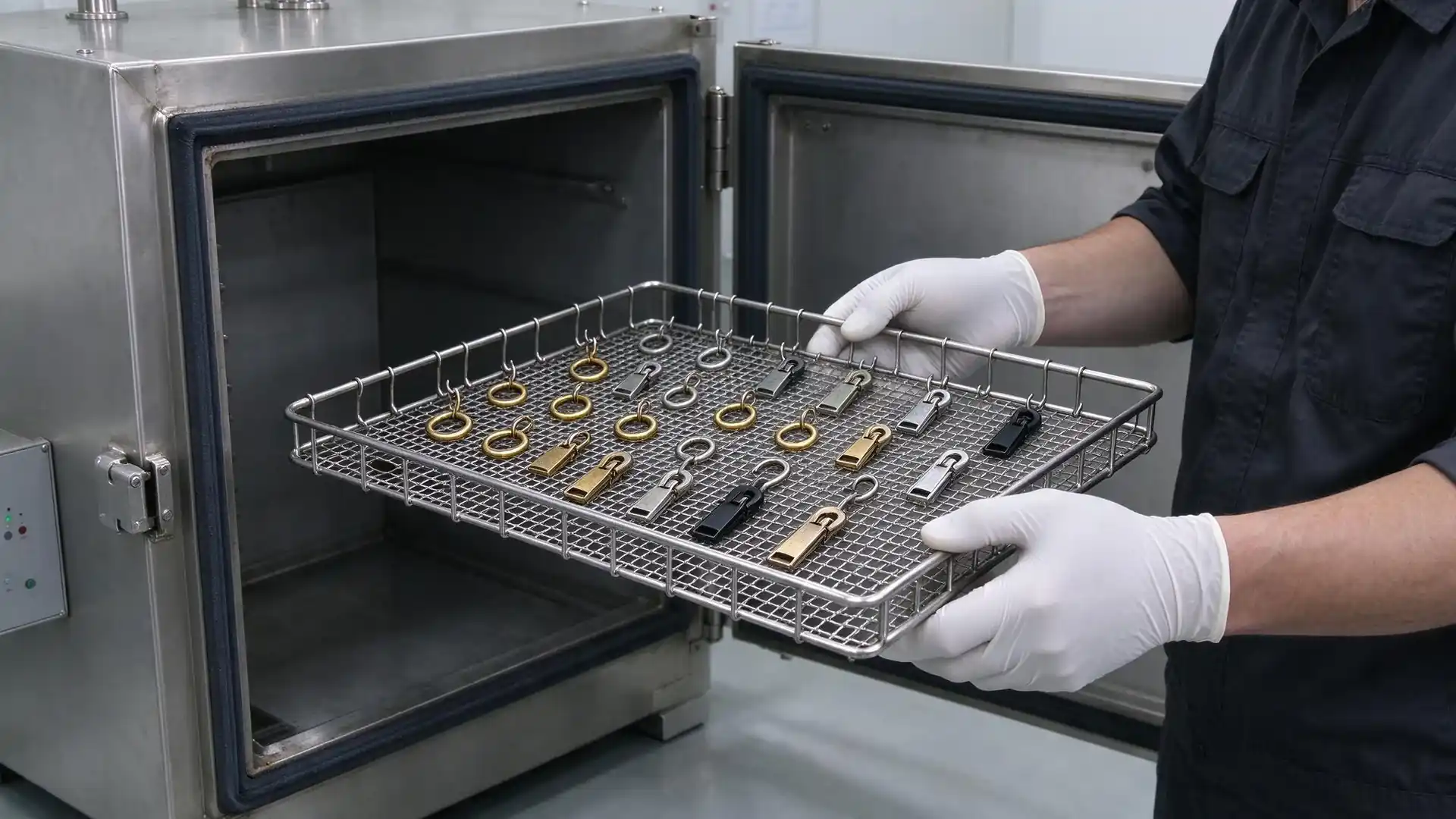
Salt spray testing, commonly referenced to ASTM B117 or ISO 9227, exposes plated samples to a continuous salt fog in a controlled chamber for a defined number of hours. It's a fast comparative tool that can quickly reveal gross plating porosity, edge problems, or a batch with an unusually thin underlayer.
But salt spray does not simulate real human wear. A very short chamber pass tells you almost nothing about prolonged daily handling on a gym bag. And a long-duration pass doesn't excuse a plating stack that fails the moment a user rubs hand sanitizer into a zipper puller. Use salt spray as a screening tool with agreed acceptance criteria: test method, number of hours, what counts as acceptable corrosion, and how the accepted part will be compared to the retained golden sample.
Sweat Resistance and Chemical Exposure Testing
Perspiration testing is more relevant than salt spray for any bag that will be held, worn, or carried against skin. Human sweat is not just salty water; it contains salt, urea, ammonia, and organic acids that can attack plating differently from a uniform salt fog. Alcohol-based hand sanitizer, sunscreen oils, acidic cosmetic residues, and chlorinated cleaning wipes can all strip or stain a thin electroplated top layer.
Say you're ordering a gym duffel with branded zinc alloy zipper pullers. The puller looks perfect on the sample. The real risk is a customer who applies sunscreen, grabs the puller, stores the duffel in a warm car, and leaves it for several days. That scenario—not the salt chamber—is what determines whether you get a return. Require a perspiration or sweat simulation with the buyer-defined test method and acceptance criteria, and add sanitizer or sunscreen contact testing when the bag targets fitness, travel, or beauty retail channels.
Abrasion and Handling Simulation
Zipper pullers, logo plates, sliders, and any hardware touched repeatedly throughout the day need abrasion and handling simulation, not just chemical testing. The goal is to catch plating that looks uniform at rest but wears off after repeated finger contact, ring scratching, or pocket friction.
A practical handling simulation can be a simple repeated-contact test using a defined material, pressure, and cycle count, agreed between buyer and supplier. For zipper-specific failure mechanisms like slider wear and puller detachment, our separate guide on zipper durability—Why Zippers Break: Material, Design, Stitching & Quality Issues Explained—extends the testing logic to the full zipper system.
Material Compatibility Testing
Hardware doesn't fail in isolation. A plating stack can pass salt spray and still blacken after prolonged direct contact with PU-coated fabric, chrome-tanned leather, dyed lining, or rubber trim. The mechanism is chemical migration: plasticizers in polyurethane coatings, sulfur compounds in some rubber, and residual tanning or dye chemicals can react with the plating or the material interface to cause discoloration, especially in a warm or sealed package.
When the bag uses PU panels, synthetic leather, or chrome-tanned leather adjacent to hardware, ask the supplier to run a contact compatibility test for a defined duration and temperature. The test should replicate direct contact, not the hardware sitting alone in a test chamber. If the supplier has no compatibility test method, at minimum require a documented material declaration and a paired sample from an actual production lot for review before approval.
Bulk Production QC for Hardware Consistency
The biggest sample-to-bulk risk in bag hardware testing is plating lot inconsistency. A supplier may source plated parts from a subcontractor; the first batch looks perfect, then the next batch uses a slightly thinner nickel underlayer, a weaker top color, or a different lacquer. The plating spec alone won't catch this drift; the inspection workflow will. Start with the long-standing QC principle covered in our Bag Quality Control Checklist for Buyers: incoming, in-process, and final inspection each have a different job, and skipping any one of them lets defects hide until unboxing.
Hardware Approval Workflow Before Production
The practical approval sequence locks the plating finish at each stage:
- Finish reference: confirm the intended plating color, base metal, and surface treatment against a physical reference or manufacturer standard.
- Plating specification sheet: confirm the full stack—base metal, each layer material and micron thickness, top coat, and whether a clear protective coat exists.
- Reference sample: approve a small set of hardware pieces that represents the exact plating color and finish you expect.
- Pre-production sample: verify the production plating lot matches the reference sample and the written stack before assembly of bulk bags.
- Golden sample retention: store an approved reference under clean, dry conditions and use it for every future batch comparison.
If you need a step-by-step approval discipline for the full bag, not just hardware, review our Bag Sample Approval Checklist for B2B Buyers: Verify Before Mass Production before you sign off on pre-production.
Packaging and Storage Risks During Shipment
Packaging is a hardware reliability factor. Metal parts sealed inside a polybag with no anti-tarnish tissue or desiccant can trap moisture during long sea shipments, especially when the carton passes through temperature changes and condensation forms. That condensation accelerates corrosion on the exact plating areas that were marginal to begin with.
Ask your supplier to confirm the packaging stack: polybag type and venting, anti-tarnish paper or tissue, desiccant sachets where needed, and carton venting. The right packaging doesn't fix a bad plating stack, but the wrong packaging can make a mediocre stack fail before the product ever reaches a shelf.
What Buyers Should Check During Final Inspection
Final inspection for plated hardware should look at visual consistency first, then adhesion and packaging. The most frequent escapes are subtle tonal drift between batches, rough edges where plating was applied unevenly, peeling at sharp corners, and plating exposure where the top layer was scratched during assembly.
A reasonable final inspection approach groups hardware by lot and compares against the golden sample under consistent lighting. Check color tone deviation, surface scratches, oxidation spots, rough edges, and plating adhesion on a sampling basis. AQL 2.5 is sometimes used as a starting point for major defects on bag hardware, but it should not be treated as a fixed rule. The buyer, supplier, and inspection party should agree on the critical/major/minor defect definitions, sample plan, and acceptance criteria in writing.
RFQ Checklist for Bag Hardware Durability Projects
The clearer the RFQ, the lower the dispute risk when hardware tarnish appears after shipment. Buyers should specify hardware finish as a technical requirement, not a one-line color name. Use this two-column checklist when preparing an RFQ or hardware specification sheet.
| Field | Your Input / Options |
|---|---|
| Bag category | Backpack, travel duffel, gym bag, tote, cosmetic pouch, luggage, other |
| Target market | Online retail, wholesale, promotional, corporate gifting, other |
| Hardware component | Zipper puller, D-ring, buckle, rivet, logo plate, slider, trolley trim |
| Base metal | Zinc alloy, brass, steel, aluminum, other |
| Plating finish | Gold, black, gunmetal, antique brass, rose gold, silver/chrome, other |
| Required plating stack | Nickel underlayer thickness in microns, top color thickness, clear coat—confirm in writing |
| Coating method | Electroplating, PVD, lacquer top coat, supplier-confirmed |
| Expected exposure environment | Daily carry, gym/wet, beach, cosmetics, humid storage |
| Required test method | Salt spray, perspiration, abrasion, adhesion, humidity, material compatibility |
| Acceptance criteria | Buyer-defined pass/fail, duration, comparison method vs. golden sample |
| Packaging/storage requirement | Anti-tarnish tissue, desiccant, polybag venting, carton venting |
| Sample approval owner | Buyer name, supplier contact |
| Inspection timing | Incoming hardware, inline, final inspection |
| Batch consistency expectation | Compare every incoming lot against retained golden sample in writing |
Supplier Questions Buyers Should Ask in Writing
Some suppliers list a plating finish by color only, not by stack. Before sampling, get written confirmation on these questions:
- What is the base metal, and who performs the plating—the factory or a subcontractor?
- What is the full plating stack, including nickel underlayer material and micron thickness, top color layer, and clear top coat?
- How does the supplier measure plating thickness, and can they provide the method?
- Which test method does the supplier run for salt spray, perspiration, and adhesion, and what are the acceptance criteria?
- How will the supplier retain the golden sample, and what process controls prevent lacquer or plating batch drift?
- What happens when a plating batch fails—will the supplier quarantine, rework, or replace, and who owns the cost?
Get the answers in the supplier's own documentation. A verbal "standard black plating" is not a specification, and it won't help you defend a return claim later.
Hardware Sample Approval Requirements
The most reliable sample approval method is a physical comparison under the same lighting and the same angle. Retain two reference pieces: one for the buyer, one for the supplier, both tagged with the finish name, plating spec, and date. When the first bulk hardware lot arrives, compare incoming parts against the retained reference before assembly. If the tone is slightly different, that's a warning sign the plating batch has drifted—address it before zipper pullers get sewn into finished bags.
FAQ About Bag Hardware Testing
These questions cover the most common sourcing misunderstandings buyers have about plating, tarnish, and testing before bulk production.
Is salt spray testing enough for handbag hardware?
No. Salt spray testing is a useful comparative screening tool for evaluating corrosion under a continuous salt fog, but it does not reproduce human sweat chemistry, mechanical abrasion, or chemical contact from sunscreen, sanitizer, PU coatings, or treated leather. Use salt spray as one input, and add perspiration, abrasion, adhesion, humidity, and material compatibility testing based on the product's real use environment.
Why does hardware tarnish even after passing testing?
The most common reason is that the tested sample and the production lot didn't use the same plating stack. A golden sample may carry a thicker nickel underlayer while the bulk batch comes from a subcontractor with a thinner, cheaper stack. Packaging condensation, warehouse humidity, or prolonged contact with plasticizer-rich PU fabrics can also defeat a stack that passed a clean, isolated lab test. The pass was valid for the part tested; it didn't cover the part shipped.
Does thicker plating universally mean better durability?
Thicker plating is usually more durable for the same base metal and layer structure, but thickness alone is not a reliable quality indicator. A thick porous layer with poor adhesion can still peel or tarnish, while a well-bonded slightly thinner multi-layer stack can outperform a thick flash finish. Require the full stack specification with per-layer micron thickness, base metal, and adhesion evidence rather than chasing a single total thickness number.
Can zipper pullers corrode during shipping?
Yes. Zipper pullers packed inside sealed polybags can sit in warm, humid cartons during long sea freight and warehouse storage, creating condensation that initiates corrosion on marginal plating. Anti-tarnish tissue, desiccant sachets, polybag venting, and carton venting reduce the risk, but they can't fix a fundamentally insufficient plating stack. Confirm both the plating spec and the packaging stack before shipment.
Should buyers request PVD coating for all bags?
No. PVD is typically harder and more abrasion-resistant than conventional electroplating for flat, rigid parts like solid logo plates, but it offers a narrower color range, a different appearance, and a higher cost structure for many applications. A properly specified multi-layer electroplated stack with a clear top coat is often sufficient and more economical for zipper pullers, D-rings, and buckles, but the comparison must be confirmed by quote for the specific part and volume. Reserve PVD for high-touch, rigid, high-wear pieces where scratch resistance drives the branding decision.
How should buyers store approved hardware samples?
Store approved golden samples in a clean, dry, low-humidity environment—ideally inside a sealed anti-tarnish bag or wrapped in anti-tarnish tissue, away from direct sunlight and strong chemicals. Tag each sample with the finish name, plating spec, and approval date. Use only the stored reference piece for future batch comparisons; a sample left on a desk or in a warm drawer may itself tarnish and become a misleading comparison standard.
Official Sources and Compliance References
This guide references public test methods and plating concepts that buyers should verify with their supplier rather than quoting as universal pass/fail statements. Common method references include ASTM B117 and ISO 9227 for salt spray testing, adhesion test methods such as cross-hatch testing under ISO 2409 or ASTM D3359, and perspiration test methods defined by the buyer and supplier together. PVD and electroplating definitions follow standard material science terminology. Plating stack micron values, layer structure, and acceptance criteria are project-specific and must come from supplier documentation and buyer-defined requirements. No certification, test result, or compliance claim in this article should be treated as a universal standard; confirm the applicable requirements with your supplier and, where relevant, your target market's product compliance advisor.
Conclusion: Test the System, Not the Certificate
The most durable bag hardware isn't the one with the shiniest sample or the longest salt spray certificate—it's the one whose plating stack, chemical exposure, abrasion behavior, and production batch controls were verified as a system. Approve hardware by written plating specification, retained golden samples, real-use simulation tests, and bulk inspection discipline. That's how you stop the post-shipment tarnish discovery from becoming a return rate problem.
When a buyer or supplier reviews tarnished hardware, the first question is: what's under the color? Start from the RFQ checklist above, put your hardware finish on the spec sheet in writing, and don't let "standard black plating" survive as a description. If the supplier can't name the nickel underlayer and the micron stack, you're not sourcing plated hardware; you're sourcing disappointment.
Get A Quote

Get A Quote
0 Comments