
Makeup Bag Manufacturer Guide: Cosmetic Pouch Materials & Leak Resistance
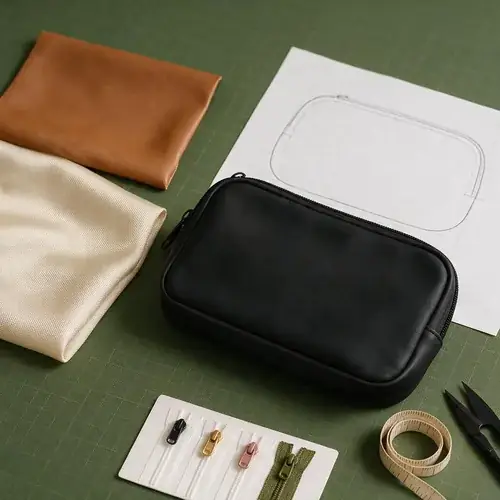
A reliable makeup bag manufacturer is not just a sewing factory — it is a supplier that helps you lock material gauge, seam construction, zipper stress points, and bulk QC against an agreed AQL before the first carton ships. If you are a beauty brand, Amazon seller, or promotional kit buyer, the sourcing decision comes down to four variables: outer material, wipeable lining, internal structure, and a specified inspection standard. Get those four locked in writing, and most of the usual return drivers — leaking pouches, collapsed shape, snagged zippers, yellowed clear film — become much more controllable.
This guide is written for the buyer who has already seen enough “we can make any bag” supplier messages and now needs a technical, RFQ-ready framework. It covers how to compare PU, TPU, nylon, quilted, canvas, and transparent cosmetic pouches; how to specify spill resistance without overclaiming waterproofing; how structure prevents a bag from collapsing when half full; and how to build QC terms a factory can actually follow.
At OMASKA, this is the same logic we use when turning a pouch idea into a repeatable bulk order. So the action after reading is simple: stop asking for “pricing” and start asking for a material gauge, a lining wipe test, a structure drawing, and a written acceptance standard.
Quick Answer: What to Lock Down Before You Contact a Makeup Bag Manufacturer
Do not start with price. Start with the acceptance specification, because material, lining, structure, and QC drive unit cost, MOQ, lead time, and long-term return risk. For many beauty-brand programs, I start with a PU or quilted nylon outer, a wipeable PU or EVA lining with bound interior seams, a structured body where shape matters, and, if transparency is required, a clear material gauge based on expected flex cycles, temperature range, and edge finishing. One planning example is roughly 0.35 mm or thicker TPU, but treat it as project-specific and confirm it with the material datasheet and a pre-production sample.
Here is the shortest decision path:
- Retail vanity case or travel train case: structured PU outer, wipeable lining, zipper with reinforced corner travel, EVA or PE board support.
- Lightweight travel pouch: quilted nylon or polyester outer, coated lining, compact flat or semi-structured shape.
- Clear TSA/stadium or transparent beauty organizer: a supplier-confirmed clear film gauge with edge finishing and odor conditioning in scope; TPU is often preferred over thin PVC for flex resistance, but thickness must be project-specific.
- Gift-with-purchase or promo kit: stock-model decoration can be enough if the buyer accepts setup charges and the supplier controls the base bag.
Get the supplier to confirm the outer material, lining type, zipper model, logo method, and AQL acceptance levels in writing before sampling. Those five lines stop more future problems than a long email thread.
Scope of This Guide: Cosmetic Bag Sourcing, Not Makeup Tips
This page is a B2B procurement and product development guide. It does not cover cosmetics formulation, makeup application, or consumer packing advice. It covers the engineering and verification work a buyer or product manager must do before submitting a cosmetic pouch RFQ.
The real sourcing risk in a beauty bag is not usually the big visible design choice. It is the silent specification gap: a clear film gauge that is never confirmed before approval, a soft lining that stains, a zipper that cannot handle a curved corner, or a sample that looks good on video but collapses when a customer carries three brushes and one foundation bottle. This guide aims to remove those gaps.
Sourcing Cosmetic Bags: OEM vs. ODM vs. Stock Decoration
Before you judge a factory, you need to know which type of supplier you are actually talking to. A makeup bag manufacturer may be an OEM factory, an ODM developer, or a trading company that decorates existing stock. The difference changes everything: MOQ, customization depth, quality control, and who owns the next order’s consistency.
A stock decorator can be the right choice for a small test order or a promotional pouch where the base bag already exists. That is not the same as OEM development. Direct OEM work typically requires you to supply the design direction, dimensions, artwork, material preferences, packaging requirements, and target-market information; the factory then handles pattern development, sampling, material matching, and production control. ODM often starts from an existing construction and adjusts materials, trims, size, and branding. The most expensive mistakes to avoid when sourcing bags from China usually begin with a buyer treating a low-spec decorator as a proven OEM factory.
Stock Decoration Is Not the Same as OEM
When a supplier says “no minimum” or “we can put your logo on it,” you are often looking at stock-model decoration, not custom pouch development. That can work, but you need to confirm three things in writing:
- Who owns the base bag inventory and what happens on repeat orders.
- Which logo methods are feasible on that exact material surface.
- Who accepts responsibility for decoration alignment, placement, and repeat-order color consistency.
If the answer is “we will check with the factory,” you are one step removed from the production decision. That is not automatically a reason to walk away, but it changes how much emphasis you put on sample control and final inspection.
What a Real Cosmetic Bag Tech Pack Contains
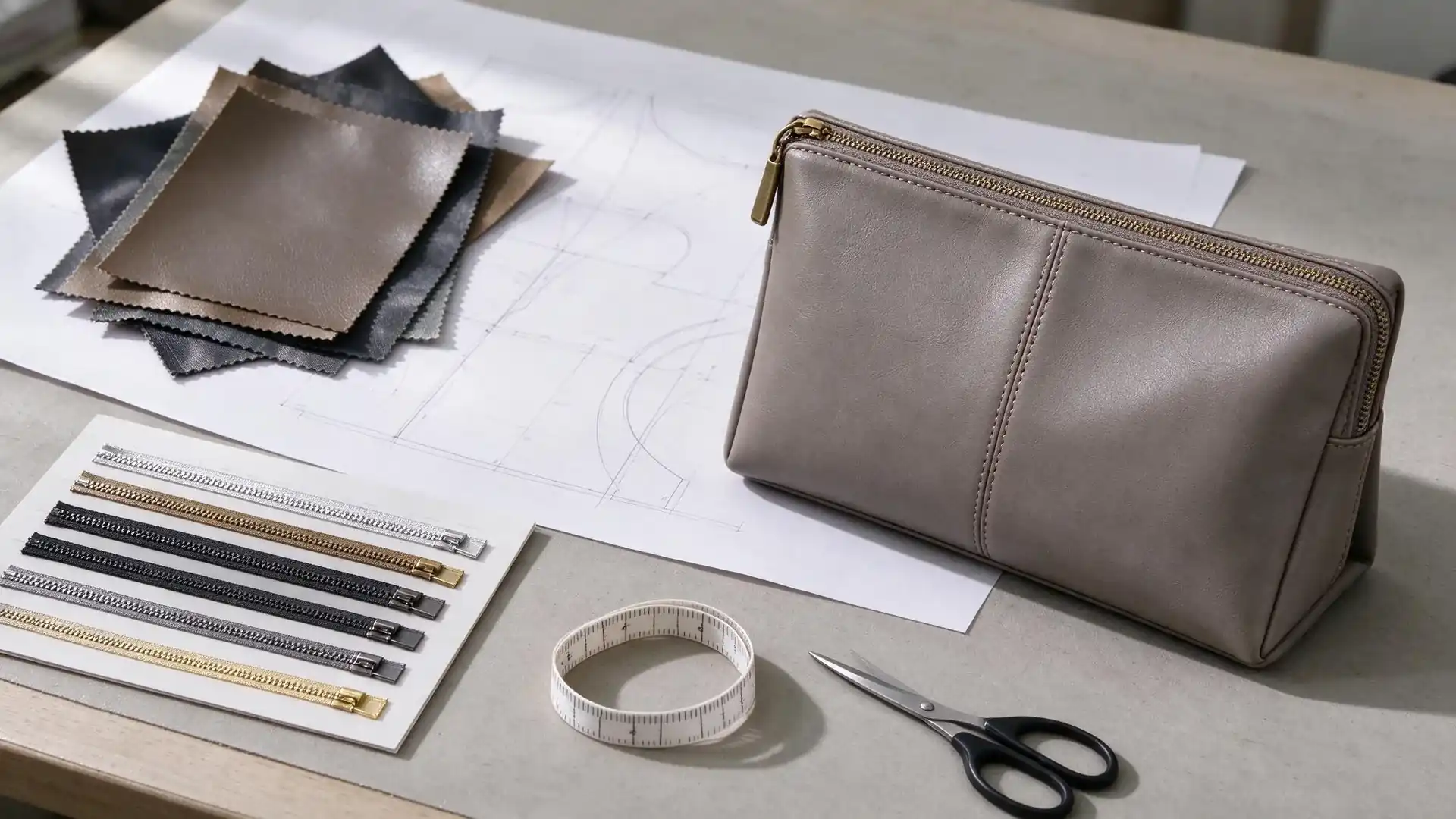
A competent OEM supplier can quote from an RFQ, but a proper tech pack separates professional buyers from price shoppers. For a cosmetic pouch, the tech pack should define at least these fields:
- Outer shell material, gauge or fabric weight, and color reference.
- Lining material and finish, including whether it must wipe clean.
- Dimensions, capacity, and whether the bag must stand upright.
- Zipper type, length, puller style, and stress-point reinforcement.
- Logo method, placement, artwork file, and color match instruction.
- Interior layout: loops, pockets, dividers, removable pouches.
- Packaging: polybag, insert packing, barcode, retail display requirement.
- Test and inspection standard: AQL level, spill test, gauge check, zipper cycle test.
Cosmetic Bag Materials: Comparing Outer Shells
Outer material choice determines the bag’s retail positioning, weight, printability, durability, and cost. It also determines which QC risks matter most. A beauty brand selling a structured vanity case needs different controls than a travel brand selling a lightweight wash bag. Table 1 summarizes the trade-offs.
| Material Type | Best For | Key Sourcing Risks | What to Specify or Verify |
|---|---|---|---|
| PU vegan leather | Retail beauty kits, vanity cases, premium GWP | Crease marks, topcoat peel, liner glue bleed, odor | Backing gauge, logo method compatibility, flex and rub performance |
| Nylon / polyester | Travel pouches, wet/dry organizers, brand merch | Coating failure, seam slippage, print adhesion | Denier, coating type, seam edge finishing, print adhesion test |
| Canvas | Natural or casual brand direction, promo sets | Shrinkage, staining, dye transfer | Fabric weight, pre-shrink treatment, optional coating |
| Clear TPU / PVC | TSA/stadium, transparent travel, beauty organization | Thin gauge flex cracking, yellowing, odor | Material type, project-specific gauge confirmed against flex/crease review, edge finishing, UV/odor test |
| Quilted | Soft vanity, gift sets, padded organizers | Wrinkling, foam delamination, stitch skip | Stitch density, backing foam, quilt alignment |
PU Vegan Leather: Premium Look, Crease and Topcoat Risks
PU gives a polished, retail-facing surface and a wide color range, but it does not hide poor specification. The most common sourcing failures are crease marks at fold lines, topcoat cracking after repeated opening, glue bleed from the lining into the outer surface, and a strong plastic odor straight out of the polybag.
For a structured beauty case, I would ask the supplier to confirm the backing gauge and whether the PU is flex-tested for the bag’s actual fold geometry. A thin split can look identical in a photo and still wrinkle or delaminate. Logo compatibility matters too: some PU surfaces accept foil well, while others show uneven ink adhesion; ask for a decoration test on the same batch of PU, not on a generic swatch.
Nylon and Polyester: Travel Weight, Coating and Print Control
Nylon and polyester are the usual choice for lightweight travel pouches because they pack flat and tolerate moisture better than uncoated canvas. The decision between them is not just about feel. For a deeper comparison of fabric performance and coating risks, use this nylon vs polyester bags guide.
For cosmetic pouches specifically, the priority is coating. An uncoated or lightly water-repellent fabric will let a closed bottle leak through to the outside of the bag faster than a wipeable liner can compensate. Denier and coating should be confirmed on the tech pack, not inferred from marketing words. Nylon often has a stronger abrasion and tear reputation, but the final performance depends on denier, weave, and coating.
Canvas: Natural Look, Shrinkage and Staining Boundaries
Cotton canvas can fit a clean, natural, or eco-leaning brand direction, but it carries two practical risks that synthetic shells avoid. Canvas can shrink depending on fabric treatment, washing method, and humidity, and light colors can stain when foundation or oil-based skincare touches the outer surface. If the brand wants canvas, specify the fabric weight, ask about pre-shrink treatment, and consider a coated or printed canvas for the spill-prone areas.
Clear TPU vs PVC: The Material Gauge That Determines Return Rate
This is the highest-risk category for beauty brands because a clear pouch is usually chosen for TSA, stadium, or visual retail display — and the difference between a good clear pouch and a returned one is often material gauge plus edge finishing. A common sourcing risk is that the clear film gauge is not specified or verified before sample approval. Some buyers approve a clear pouch from a photo and later find it creases or cracks after repeated flexing. Thinner clear film can be more prone to crease lines, fold whitening, and edge cracks, but the actual failure threshold depends on the exact film formulation, edge finishing, plasticizer, and use conditions. This is why the buyer should confirm the gauge against the intended flex cycles, temperature range, and UV exposure rather than accepting a sample by appearance alone.
For clear cosmetic bags, a thicker TPU can reduce the cracking and creasing seen in some thinner PVC alternatives, but no single gauge is a universal safe minimum. One planning example is roughly 0.35 mm or thicker TPU, to be confirmed against the supplier’s material datasheet and a pre-production sample. TPU often offers better flex and cold-weather performance than PVC, but grade still matters; a low-grade TPU can still yellow or develop odor. The decision comes down to material purity, gauge, edge finishing, and conditioning. For a technical breakdown of the material implications, review this PVC vs TPU vs EVA bags comparison.
Quilted: Soft Texture, Foam and Stitch Alignment Risk
Quilted nylon or polyester can give a soft, premium feel to gift sets and vanity pouches. The hidden risk is in what is behind the quilting: loose foam, skipped stitches, or uneven quilt alignment that shows in hard side light. When specifying quilted fabric, ask for stitch density, backing foam type, and a production reference piece that shows the maximum acceptable quilt misalignment.
Linings & Leak Resistance: Protecting Against Cosmetic Spills
Leak-resistant is the realistic sourcing term for a stitched cosmetic bag. Waterproof is a much higher claim and only applies where the construction is fully welded, taped, or otherwise sealed without stitch holes. For most makeup bags, the goal is to keep spilled foundation, skincare, or soap from soaking through to the outer shell and to make cleanup fast.
Wipeable Lining Should Be the Default for Beauty Kits
A wipeable lining is the highest-value interior upgrade a beauty bag can have. PU, EVA, PEVA, and TPU-coated polyester linings usually resist staining better than soft brushed polyester or satin. That does not make them invulnerable; oil-heavy foundations and lip color can still ghost on some light linings. This is why you specify a wipe test, not just a material claim. For a deeper guide on lining denier and coating choices, start with this bag lining materials article.
A soft premium lining may look expensive in a photo, but it is often the wrong call for a bag designed to carry liquid skincare. One leaked toner bottle can leave a visible stain that turns a repeat customer into a one-star review.
Bound Seams and Where Waterproof Claims Break Down
Seam construction determines whether spilled liquid stays inside long enough for the user to wipe it, or wicks into the outer fabric. In a stitched bag, the first defense is a bound interior seam or a turned seam that avoids exposing raw fabric edges. Seam tape can improve resistance, but it does not make a stitched pouch airtight or watertight.
If your marketing team wants the word “waterproof” in the listing, define the test first. A bag built with normal stitched seams should not be presented as 100% leak-proof. A bag with welded or heat-sealed seams and a continuous barrier liner is a different construction and should be tested as such.
How to Specify a Spill Test Without Overclaiming
Do not ask the factory for a “leak-proof guarantee.” Ask for a defined spill-resistance test that the buyer can verify:
- Apply a specified test liquid or colored substitute to the lining at a defined volume.
- Leave it in place for a defined period in the package-use position.
- Wipe with a dry or damp cloth as instructed.
- Inspect for staining, ghosting, wicking at seams, and liquid transfer to the outer shell.
For construction-level barrier testing, ASTM D3078 is the bubble-emission method used for detecting gross leaks in sealed flexible containers. It is relevant only when the pouch or a compartment is designed and constructed as a sealed barrier; a typical stitched makeup bag with bound seams will not pass that standard unless it was engineered to. ASTM D6653 is used to evaluate packaging under high-altitude or air-transport pressure conditions, which matters if the pouch is part of a travel kit shipped by air.
Structure, Zippers & Insert Packing Layouts
A makeup bag’s structure is not only about looking good in a product photo. It determines how the bag behaves at 30% fill, how it travels in a suitcase, and how many times the zipper can survive a tight corner before the customer leaves a bad review.
Flat Pouch vs. Boxy Case: Decide Before Sampling
Flat zipper pouches are cheaper to develop and easier to print, but they do not stand, they do not hold brush organization cleanly, and they can make the brand look less premium. Boxy makeup bags and train cases hold capacity better and support compartments, but they require more sewing control: gussets, corner stitching, zipper length, and shape retention.
The decision is not “boxy is better.” It is about the selling format. If the bag ships inside a larger gift set as a component, a flat or semi-structured pouch may be correct. If it is the hero product, structure usually earns back the development cost in perceived value and lower return rates.
EVA Stabilizers, PE Boards, and Anti-Collapse Design
Collapse happens when a bag has no structural layer between the outer shell and the lining. EVA foam stabilizers, stiff PE boards, or dense foam side panels give the bag enough rigidity to hold shape when half empty. They also add weight, complexity, and cost, so the spec should be deliberate.
Ask the supplier how the structure is built, not just whether it is “sturdy.” The useful answers include the foam thickness, panel placement, bottom board, and how the stiffener is secured so it does not bend or migrate after washing or transit. A bag that stands in the sample photo but flops after two weeks of use usually has an undersized or unsecured stabilizer.
Zipper Geometry and Stress Points
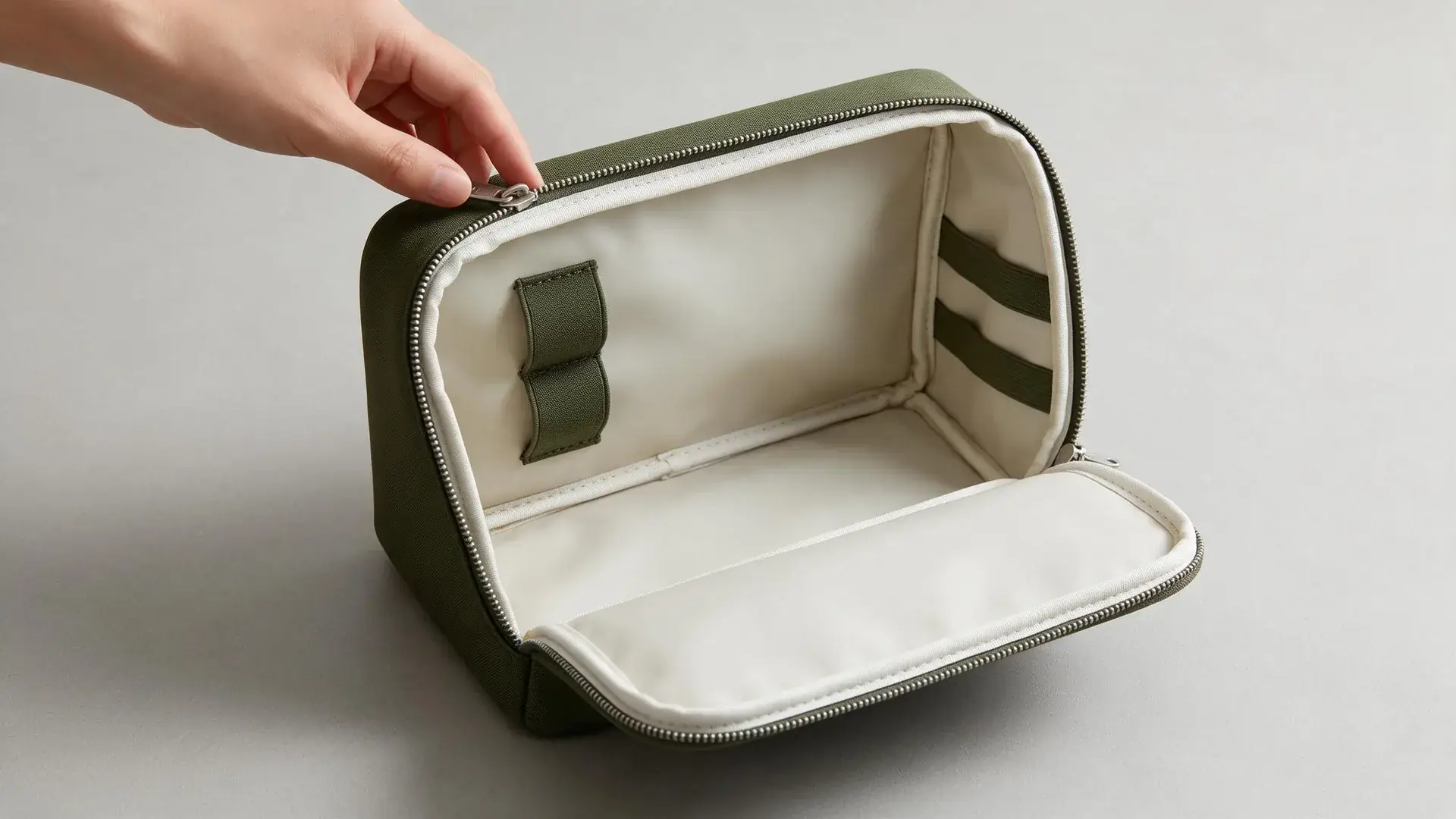
Cosmetic bags fail at the zipper termination and the curved corner more often than anywhere else. On a flat pouch, a lightweight coil zipper may be suitable, but the final size and type should be supplier-confirmed based on gusset stress, corner geometry, and opening cycle. On a structured vanity case that opens repeatedly and carries weight, a larger coil or otherwise reinforced zipper can handle the corner stress more gracefully. The important QC point is the stress path: the zipper must travel smoothly around the corner, reverse direction, and not snag at the fabric transition.
Brush Loops, Elastic Retainers, and Insert Packing
If the bag is sold as a brush organizer or professional makeup kit, internal features become the brand differentiator. Brush loops, elastic retainers, mesh or clear pockets, and detachable pouches need to be specified by location and size, not left to the factory’s default layout. Snaps and hook-and-loop attachment points should be tested for repeated attachment and removal, because weak attachment is a common early failure in organizer kits.
Insert packing refers to the internal or transit support that protects the bag’s shape and decoration inside the carton. A structured bag that ships flat or is crushed by other units can arrive with creases and permanent distortion. The packaging specification should state whether each unit needs a tissue insert, shaped cardboard, a clear polybag, or a barrier sheet until the customer opens it.
Beauty Brand QC: AQL Standards & Factory Testing
For a beauty brand, QC is not a factory formality. It is the control that protects product photography, repeat purchases, and the review line. The most useful outcome from a makeup bag manufacturer is not just a bag that passes at final inspection; it is a bag that was inspected against the same judgment criteria the brand would apply to its own samples.
AQL Acceptance Levels and What They Mean
AQL, or Acceptable Quality Limit, is a sampling-based acceptance standard, not a zero-defect guarantee. A common reference for cosmetic bags is:
- 0 critical defects
- 1.5 major defect level
- 4.0 minor defect level
These are reference levels, not a universal industry law. The buyer and supplier should agree what counts as major and minor before the first inspection. For example, a broken zipper is major; a light surface scuff hidden on the bottom seam may be minor depending on the selling channel.
The Specific Checks a Cosmetic Pouch Needs
Cosmetic bags need more than a general bag QC list. The high-value checks are:
| Check | What to Verify | Why It Matters |
|---|---|---|
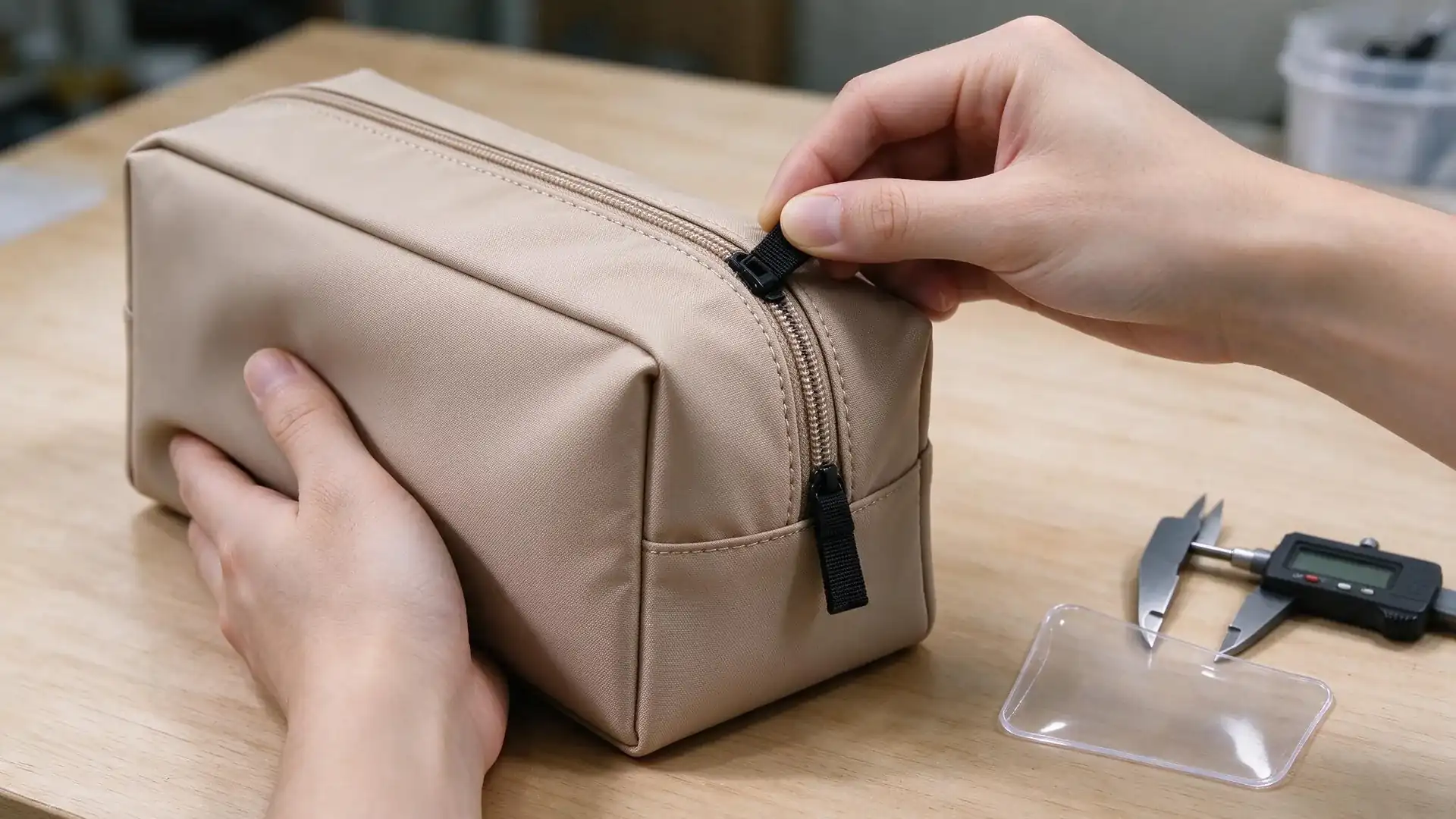
| Material gauge | Micrometer check on clear sheet; compare against approved swatch | Catches thin clear film defaults and roll-to-roll variation |
| Odor conditioning | Open polybag after an agreed airing period and note plastic/chemical smell | Avoids the “smells toxic” review on PU and PVC/TPU |
| Lining wipe test | Apply a defined oily or colored test medium, wipe, inspect stain and ghosting | Finds linings that look clean but stain after one spill |
| Zipper corner stress | Cycle zipper around curved corner, reverse, inspect for snag or tooth damage | Catches the main mechanical failure in boxy bags |
| Anti-collapse check | Fill bag to a defined low level, photograph front and rear, check shape stability | Validates the structural layer the buyer paid for |
| Seam and stitch strength | Pull or load test at zipper tape and seam junction | Reduces split seams under real use |
| Colorfastness | AATCC rub/crock and relevant light or water tests on shell and lining | Prevents dye transfer between liner and PU |
The QC Vision: Gauge and Zipper, Not Just a Once-Over
Supplier Verification: Questions That Expose a Weak Cosmetic Pouch Supplier
You can tell a lot by how a supplier answers verification questions. A weak supplier quotes before seeing the artwork and tech pack. A stronger supplier asks for gauge, lining, zipper path, packaging, and acceptance standard before confirming feasibility.
Before you commit to samples or a deposit, confirm:
- Who controls the base bag: stock decorator, trading office, or direct production team.
- Whether the supplier can provide a pre-production sample and a later top-of-production sample.
- Whether the factory can provide a bill of materials or material specification sheet for shell, lining, foam, and zipper.
- What traceability exists for clear material grade and PU backing batch.
- Whether the supplier can provide third-party or buyer-witnessed final inspection with the agreed AQL.
- How the supplier handles a repeat order when color, material, or logo method changes.
None of these questions requires a huge audit budget. They require the buyer to map responsibility and to get answers in writing.
RFQ Checklist for Cosmetic Pouch Suppliers
The more complete the RFQ, the easier it is to compare quotes and spot the supplier who is guessing. Copy this table into your sourcing file and fill in one line per project.
| RFQ Field | Your Input or Options to Confirm |
|---|---|
| Bag type | Flat pouch, boxy makeup bag, brush organizer, train case, clear pouch, quilted vanity |
| Target market / channel | Beauty retail, Amazon/FBA, gift-with-purchase, subscription box, promo kit |
| Quantity | Quote-dependent; state estimated units and stage-by-stage order plan |
| Outer material / gauge | PU, nylon, polyester, canvas, quilted, clear TPU/PVC; supplier-confirmed gauge or denier |
| Lining / finish | Wipeable, printed, quilted, color-matched; stain expectation |
| Dimensions / capacity | Target width, height, depth, volume; for many beauty pouches, target widths fall around 15–30 cm, but confirm for your market and carrying format |
| Logo method | Embroidery, print, foil, deboss, woven label, heat transfer; supplier-confirmed material compatibility |
| Zipper / hardware | Zipper chain, puller, termination, reinforcement at stress corners |
| Interior layout | Brush loops, elastic retainers, pockets, dividers, removable pouches |
| Leak resistance target | Spill-resistant for stitched construction; define test method and liquid |
| Packaging / insert packing | Polybag, retail box, barcode, FBA carton strength, insert support |
| Sample deadline | Buyer-defined; confirm artwork approval and material stock |
| Bulk delivery deadline | Buyer-defined; confirm production queue, freight mode, and season |
| QC / AQL | For example 0 critical / 1.5 major / 4.0 minor; buyer and supplier agree definitions |
| Compliance / substance limits | Confirm by target market, age group, material contact, and channel rules |
| Documentation | Inspection report, photos/video, material spec, test reports where available |
This table is not a fixed pricing grid. MOQ, lead time, and cost are all quote-dependent and should be supplier-confirmed after the specification is fixed.
Mistakes That Turn a Good Sample Into a Returned Bulk Order
Most cosmetic bag quality problems are not random factory defects. They are specification decisions that were skipped or left to supplier default. The failures that show up later usually follow a pattern:
- Approving by photo, not by sample. A clear pouch can look fine in a photo and still be too thin, creased, and odorous for the end use.
- Using the word “waterproof” without a test. The factory will not know what to build; the buyer will not know what to inspect.
- Choosing a soft luxury lining for a liquid skincare kit. It stains fast, and the brand pays for it in returns.
- Accepting the factory’s default clear sheet gauge. The default is often lighter than what the use case requires.
- Skipping a pre-production sample after artwork changes. Logo placement, color, and zipper color can shift between sample rounds.
- Under-specifying transit packaging. A structured bag that ships flat can arrive creased, misshapen, or rubbing against other units in the carton.
- Confusing stock decoration with OEM development. The sample may look acceptable, but repeat-order consistency can drift when the base bag stock changes.
Each of these becomes manageable with a written spec, a defined test, and a top-of-production or pre-shipment inspection.
FAQ About Beauty Bag Manufacturing
These are the questions buyers ask after the first supplier conversation, when they are trying to separate a real capability from a sales script.
What is the standard MOQ for custom makeup bags?
There is no universal standard MOQ for custom makeup bags. MOQ depends on whether the project is stock-model decoration, small test order, semi-custom production, or full OEM development. A low-logo MOQ may be feasible on selected stock models when the supplier accepts setup charges, but that is not the same as a true OEM factory. Ask the supplier to confirm MOQ in writing by material, color, and logo method, and ask which components drive the minimum quantity.
Can a cosmetic bag be 100% leak-proof?
Only if it is constructed as a sealed or welded barrier with no stitch holes through the spill-prone area. Most cosmetic bags are stitched, and “leak-resistant” is the defensible claim. Ask the supplier what construction supports the claim and what test method the bag has passed. If the supplier offers “leak-proof” without a construction detail or test method, treat it as unverified.
Why do clear PVC cosmetic bags turn yellow or crack?
Clear PVC may yellow from heat, UV exposure, and plasticizer migration over time. Thinner PVC film can be more prone to edge cracks and fold whitening than a thicker one, but the failure threshold depends on the exact film formulation, plasticizer, edge finishing, and use conditions. Specifying a clear TPU and confirming the gauge against the end-use flex and temperature conditions can reduce flex-cracking and creasing; for example, roughly 0.35 mm or thicker TPU is one planning value, but it is not a universal safe minimum. The final performance still depends on material grade, UV stabilization, and edge finishing.
What lining is easiest to clean for makeup and skincare spills?
Wipeable linings such as PU, EVA, PEVA, or TPU-coated polyester are better for makeup and skincare spills than brushed polyester or satin. The lining should be verified with a wipe test using a defined oily or colored medium, because some light-colored wipeable linings can still show ghosting. The right choice is not just “wipeable” in the supplier’s words; it is a lining that passes the specific spill cleanup test you define.
Official Sources and Compliance References
These standards are useful reference points when writing a cosmetic bag specification, but they must be matched to the actual bag construction, market, and latest published scope.
- ASTM D3078 — a bubble-emission method for detecting gross leaks in sealed flexible containers. Relevant if a cosmetic pouch or compartment is designed as a sealed barrier; not a universal pass/fail test for stitched bags with bound seams.
- ASTM D6653 — evaluates packaging under simulated high-altitude or air-transport pressure conditions. Useful for travel kits and air-shipped beauty sets where internal pressure changes may stress closures.
- ISO 2859-1 / ANSI ASQ Z1.4 — sampling inspection standards used as the basis for AQL acceptance. The buyer should still agree on defect classification with the supplier.
- AATCC colorfastness methods — used to assess rub/crock, light, and water-related color transfer. Apply the appropriate method to the shell and lining rather than assuming one fabric test covers the whole bag.
Verify the latest scope and applicability with the testing lab or supplier before citing a standard in your purchase order.
Conclusion: Turn the RFQ into a Controllable Specification
The strongest position for a beauty brand buyer is not “send me your best price.” It is “here is the material gauge, lining, structure, zipper path, packaging, and AQL standard I will inspect.” A good makeup bag manufacturer will work within that frame and refine it; a weak one will avoid the details.
Before you send the next RFQ, decide the outer shell, define the lining spill test, specify whether the bag must stand upright, and write the acceptance level into the agreement. That order of work protects margins, repeat orders, and brand reputation long after the sample approval meeting.
Get A Quote

Get A Quote
0 Comments