
Electrician Tool Backpack Manufacturing Guide: Load & Reinforcement
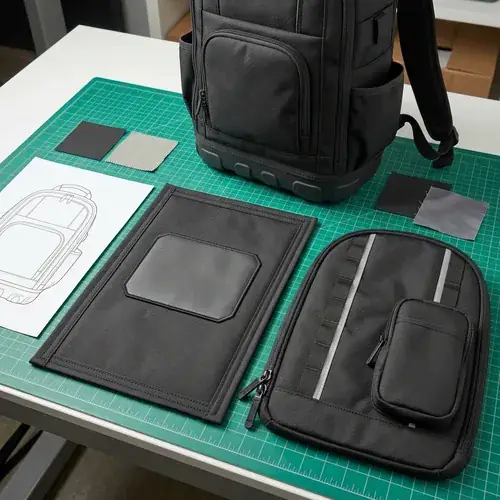
An electrician tool backpack is a heavy-duty, hands-free tool carrier engineered around a buyer-defined loaded-weight target, often in the 50–100 lb range. It needs a reinforced base, a vertical tool pocket layout, and stress-point stitching that a standard backpack simply does not have. For a private-label or industrial buyer, the real sourcing question is not whether the bag looks rugged. It is whether the carry system, bottom structure, and pocket zoning actually match the tool list and jobsite abuse profile.
If you source this category with a standard backpack spec, you will likely get a product that photographs well and fails in the field. The failure is rarely cosmetic. A strap anchor can tear away from the back panel. A bottom corner may wear through long before the upper fabric looks worn. The zipper can fail when a technician yanks the main opening with gloves on. Those failures become returns, negative reviews, replacement claims, and dead inventory. The fix is to move the specification work to the front of the program: load target first, bottom structure second, pocket mapping third.
Use this guide to prepare a technical RFQ, verify the supplier's heavy-duty construction experience, and define QC tests that reject weak samples before bulk production.
Quick Answer / 30-Second Buyer Decision
Here is the short version. If you are sourcing an electrician tool backpack, make four decisions before you choose color, logo method, or packaging:
- Loaded-weight target: Write down the buyer-defined weight range you expect in the field, often a 50–100 lb design target if your kit is in that range. Do not write "heavy duty" without a number and a test method.
- Shell and abrasion material: Use 1680D ballistic nylon or 1680D polyester as a starting point, not lightweight 600D. Add corner reinforcement and a durable lining.
- Base construction: Decide between a molded rubber/HDPE hard bottom, a PE/PP board with overlay, or a soft reinforced bottom. Each choice changes tooling, MOQ, standing stability, weight, and landed cost.
- Reinforcement method: Require full-length webbing through strap anchors, bartack and box-X stitching at stress points, and reinforced handles. Do not accept a sample just because the fabric looks thick.
You also need a pre-production test plan that gives you evidence the bag can survive loaded use, not just a photo of a filled backpack.
Scope of This Guide
This guide covers electrician tool backpack manufacturing and sourcing for private-label brands, industrial distributors, contractor-focused retailers, and Amazon or online B2B sellers. The focus is trade-tool carry: heavy hand tools, meters, drivers, bits, cables, and small parts that must stay organized and reachable on a jobsite.
It does not cover school backpacks, travel daypacks, fashion rucksacks, or thin promotional bags. The material choices, base logic, and stress-point engineering here would be overkill for those categories and wrong if copied back into a general-purpose backpack.
Why Electrician Tool Backpacks Require Industrial Engineering
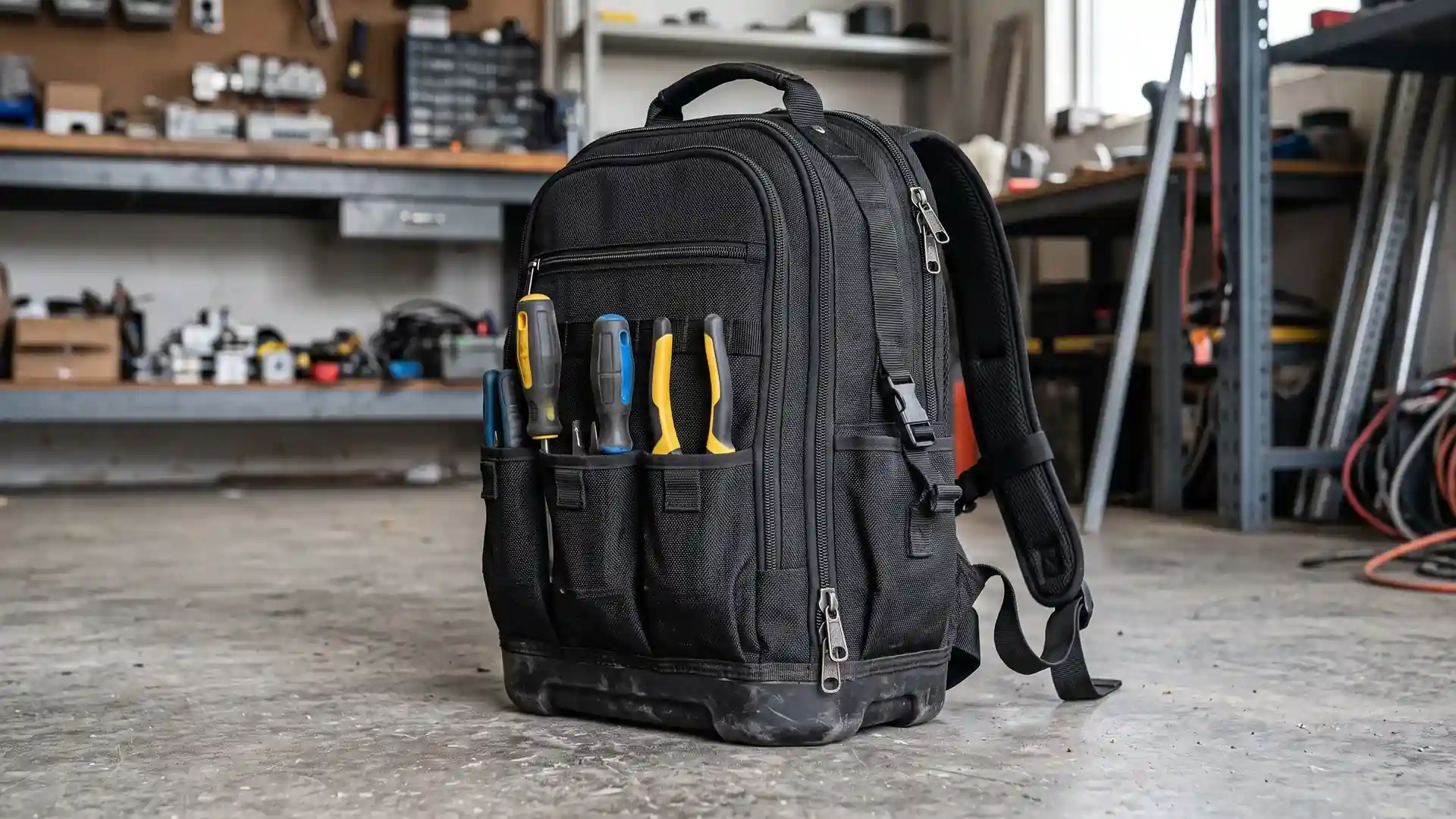
Most standard backpacks are designed around light, soft, relatively uniform loads: a laptop, papers, a jacket, maybe a water bottle. An electrician tool backpack carries dense metal tools that shift, slide, and concentrate force in small areas. The bag leans against concrete, drops from truck beds, gets dragged across floors, and is carried on one shoulder at awkward ladder angles.
That changes the product from a carrying accessory into a load-bearing system. You need to think about the bottom, the corners, the strap anchors, the zipper opening, and the interior retention points as one connected structure. If one point fails, the whole bag becomes unsellable even if the rest of it is overbuilt. This is why a contractor backpack design cannot simply be a travel backpack tech pack with "heavy duty" added to the title.
Before you modify a standard backpack spec, it helps to understand the baseline components that hold any bag together. The detailed guide on backpack structure and materials explains how the back panel, seams, base, and load-bearing frame interact, which is exactly the foundation you will upgrade for trade use.
The second difference is access behavior. Electricians, HVAC technicians, telecom technicians, and maintenance crews all carry different tool sets. A format that works for one trade may annoy another because the pocket depth, vertical access, and load balance are different. Do not treat "electrician" and "field technician" as interchangeable unless you have confirmed the target user's actual tool kit.
Load Rating & Reinforcement: Engineering for a Buyer-Defined Target
The load rating is not printed on a label. It is a test result. A reinforced tool bag can be photographed with a heavy tool load inside and still fail in the field because the seams, anchoring, and fabric work together under dynamic stress, not static weight.
Start by defining your target loaded weight as a design input derived from the actual tool list, batteries, accessories, and other items the user will carry. Many electrician tool backpack programs are planned around a 50–100 lb loaded-weight range, but that range is only a planning benchmark, not a universal category rating. The exact load rating must come from the buyer-defined tool list and be validated through a buyer-defined stress test on the pre-production sample. If you sell the bag as a 100 lb tool carrier, test it above that threshold with repeated loading, not just a single static lift.
In my experience, the most common high-risk failure is at the carry points. A shoulder strap that is only bartacked to the top of the back panel may hold 100 lb once and tear away later under repeated jerking. A handle sewn into a single layer of 1680D fabric may feel strong in a showroom sample and fail after field use. This is where supplier experience matters more than fabric weight.
Fabric and Shell Selection
The shell of an electrician tool backpack should resist puncture, abrasion, and tearing from the inside and outside. Tools with sharp corners, drill bits, saw blades, and screwdriver shafts apply pressure from inside the bag. Concrete and truck-bed surfaces abrade the outside.
1680D ballistic nylon or 1680D polyester is a sensible baseline because higher denier compared with lightweight 600D is generally associated with greater thickness, tear resistance, and abrasion resistance. But denier alone does not make a bag strong. Ask the supplier to confirm the fabric coating, weave density, backing, and test reports. A poorly finished 1680D shell with weak fiber or thin PU coating can still underperform.
The corners are commonly the first place electrician backpacks fail. Add abrasion-resistant corner patches using TPU, PVC, or a second layer of high-denier fabric. Double-layer corner construction is often more useful than a full double-layer shell because it puts extra material only where wear concentrates.
Stitch, Webbing, and Hardware Reinforcement
Heavy fabric without proper stitching fails at the seam. For the buyer-defined loaded-weight target, specify bartack and box-X stitching at the shoulder strap anchors, handle connections, side compression points, and zipper ends. This is more than cosmetic. A bartack compresses the seam into a high-density anchor point that resists tearing and spreading. A box-X pattern distributes force over a larger area and is common on handles and webbing attachments. The full breakdown of stress-point methods is covered in the article on bag reinforcement methods including bar-tack stitching.
For the shoulder harness, do not rely on a single narrow webbing strip at the top. A better design runs heavy-duty webbing from the shoulder strap down through the back panel or under the base, so the load is carried by the bag structure rather than one seam. The strap design details, including width, padding, and anchor geometry, are explained in the bag shoulder strap design and load engineering guide.
Hardware needs the same scrutiny. Heavy-duty metal zippers, often referred to as #8 or #10 in supplier language, are common design inputs for loaded openings, but the gauge alone is not a durability grade. Confirm the chain type, slider strength, corrosion resistance, and puller style with the supplier, especially if the bag will be used outdoors or near moisture. Avoid specifying a brand unless the supplier has documented it. Write "supplier-specified heavy-duty metal zipper, #8/#10 range, with buyer-approved pull style and confirmed chain/slider specification" instead.
Base Construction: Molded Rubber vs. Reinforced Fabric
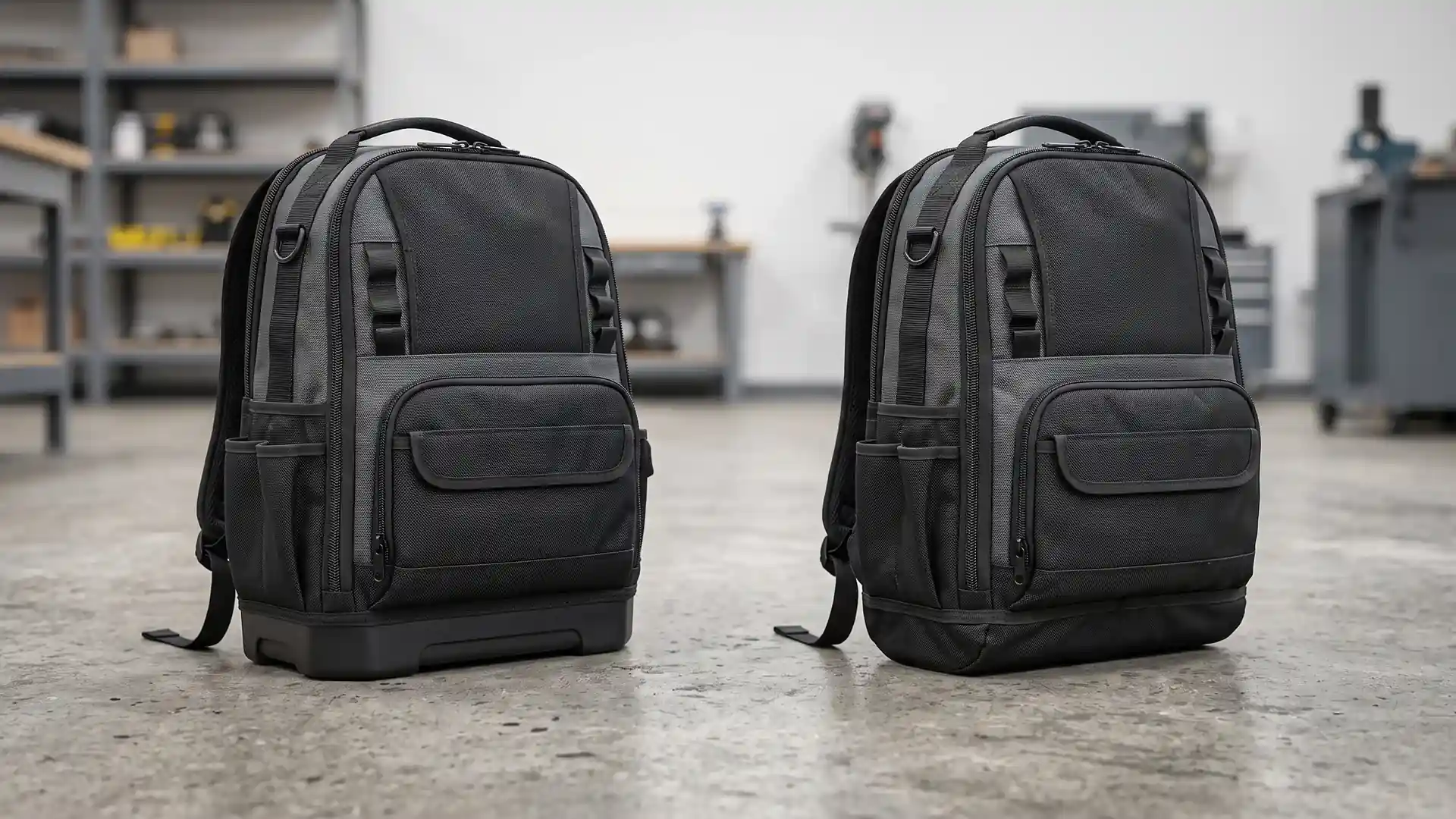
The bottom of an electrician tool backpack is usually the first part to touch concrete, asphalt, gravel, and wet floors. It also determines whether the bag stands upright or collapses into a pile. If you pick the wrong base, the bag is more likely to deform, tip over, or wear through at the lower corners even if the rest of the product is well constructed.
The right base for a hard bottom tool backpack depends on your target market, loaded-weight target, selling channel, and tolerance for tooling and upfront commitment. There are three practical options: molded rubber/HDPE base, PE/PP board with a protective overlay, and soft reinforced bottom. Each has a clear place.
| Base Type | Typical Materials | Pros | Cons | Best For | Tooling / MOQ Impact |
|---|---|---|---|---|---|
| Molded rubber / HDPE hard bottom | Rubber, TPR, TPE, HDPE, or EVA as supplier-specified | Can offer strong standing stability; protects bottom corners; resists moisture and concrete abrasion | Heavier; increases sample and tooling complexity; may affect carton size and landed cost | Premium contractor field service, heavy tool kits, outdoor/truck-to-jobsite use | Tooling-dependent; an open mold may reduce upfront investment, but the supplier must confirm MOQ, part compatibility, sample timing, and cost |
| PE / PP board with PVC/TPU overlay or 1680D wrap | Rigid board sewn into a fabric bottom panel; protective PVC/TPU or double-layer shell wraps the board | Moderate support; cleaner retail shape; usually lighter and lower initial investment than a new mold | Less overt standing rigidity; bottom seams can still abrade if not overlaid; board may distort under repeated drops | Mid-market contractor/retail channel, moderate weight range | Usually no custom mold; board thickness, density, and overlay spec must be supplier-confirmed |
| Soft reinforced bottom | Double-layer fabric, EVA foam, abrasion panels, corner patches | Light; easy to pack; no rigid board or tooling; lower shipping cube | Weakest standing stability; often not suitable for heavy metal tools unless reinforced with panels; corner wear risk remains | Light service organizer, low-load kit, or budget entry | No tooling; performance depends entirely on fabric layers, stitch density, and corner patch placement |
The trade-off is not just unit cost. A molded base can add weight and carton cube, changing landed cost and freight efficiency. But if it prevents premature bottom failure in a professional channel, it can reduce return rates, warranty exposure, and negative reviews. That is a total-cost-of-ownership decision, not a fabric-price decision. The finance case changes when you model returns and replacement cost, not just ex-factory price.
Pocket Layout & Zoning for Field Service
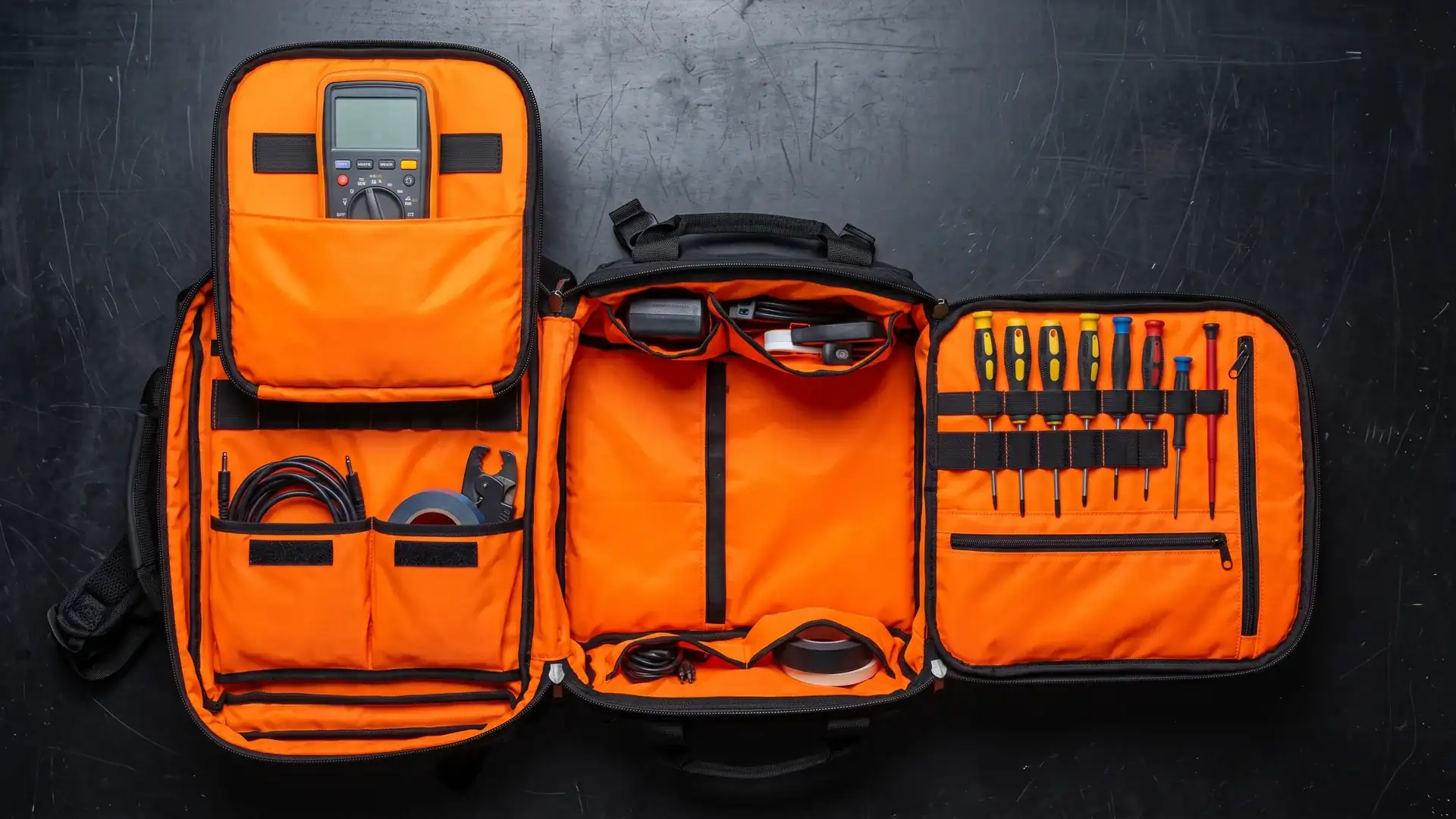
Pocket layout should start from a tool list, not a mood board. A good electrician tool backpack organizes the interior so the user can reach high-frequency tools without opening the main body, while protecting fragile electronics from heavy metal tools. The wrong layout often forces the user to dig, tip, and unload the entire bag on a job site, which defeats the purpose of a backpack format.
Map the tools into four zones:
- Fast-access outer zone: vertical screwdriver slots, plier sleeves, and bit loops on the front or side panels for tools used constantly.
- Heavy-load lower zone: dense tools such as drills, battery packs, wrenches, and large plier sets placed low and centered to keep the bag balanced.
- Protected electronics zone: a padded meter sleeve or zippered compartment away from sharp metal edges, with enough clearance for test leads.
- Small-parts and cable zone: zippered mesh or flapped pockets for wire nuts, terminals, tape, chargers, adapters, and extension cords so they do not collect at the bottom.
For electricians specifically, vertical screwdriver slots are usually the backbone of the layout. The pockets should hold each tool securely enough that it does not fall out when the bag tips, but not so tight that a gloved hand cannot remove the tool quickly. Retention options include elastic loops, webbing straps, or padded divider sleeves. Ask the factory to match pocket depth to the exact screwdriver length in your tool list.
High-visibility lining, usually orange or yellow, makes tools easier to find in low-light work areas and visually separates the product from generic black laptop backpacks. The lining is also a QC signal: if the interior has a heavy tool load, the lining should have enough seam allowance and coating to avoid showing stitch holes after repeated use.
Do not forget the main opening. Electricians often open the bag with work gloves on, so the zipper pull should be large enough to grip and the main compartment should open wide enough to access the bottom without fully unpacking. A heavy-duty metal zipper with a glove-friendly pull resists the abusive one-handed opening pattern that kills ordinary zippers.
Quality Control & Stress Testing for Tool Bags
A good tool backpack manufacturer should be able to provide or arrange documented test reports and a pre-production sample, not just a catalog photo. For electrician models, you are not only checking dimensions and color. You are checking whether the bag survives the failure modes that generate returns.
The test plan should be defined before sampling. Ask the supplier to propose test methods and acceptance criteria, then adjust them to your target market. For fabric-level abrasion and tear evaluation, the supplier should be able to name the specific ASTM or ISO method used and provide or arrange the result. The detailed comparison of ASTM/ISO standards for abrasion and tear testing will help you read those reports correctly.
| Test Type | What It Verifies | Typical Ask | Acceptance Criteria |
|---|---|---|---|
| Loaded handle/strap jerk test | Carry points under dynamic loaded stress | Load the bag to the buyer-defined target weight and apply repeated jerks or cyclic pulls through the handle and shoulder straps | No seam break, strap slippage, hardware cracking, or webbing pullout |
| Static load/creep test | Long-term deformation at carry points | Hang the loaded bag by handle or straps for a buyer-defined period | No stitch elongation or anchor separation beyond agreed tolerance |
| Loaded drop test | Base and corner protection on concrete | Drop a loaded bag from a buyer-defined height and angle onto concrete | No molded base cracking, bottom seam separation, or corner breakthrough |
| Abrasion test | Shell, corner, and base wear resistance | Submit material or finished sample to an ASTM/ISO abrasion method supplied by the factory | No lining exposure or base material failure after the agreed cycle count |
| Tear strength test | Fabric resistance to puncture and tear propagation | Request tear test report using a supplier-named method | Meets or exceeds the value you set in the tech pack |
| Zipper cycle test | Zipper durability under loaded opening | Cycle the main zipper a supplier-defined number of times with a weighted opening force | No slider failure, skipped teeth, or fabric tear at the zipper tape |
| Water resistance check | Coating or base performance if claimed | Request spray, water contact, or material report for the claimed water resistance level | Buyer-defined performance; do not claim leak-proof unless the design is tested for free liquid containment |
After the test results come back, order a pre-production sample loaded with the actual tool set or equivalent weighted mock tools. Do this even if the factory says the test report is sufficient. The way the bag sags, tips, or strains when zipped full tells you more than a dimension sheet.
Supplier Verification and Factory Fit
Not every backpack factory can build an electrician tool backpack well. A supplier that makes clean lightweight daypacks may not have the binding equipment, heavy-fabric sewing experience, or mold management system needed for a buyer-defined heavy-load product.
Verify the following before committing to sampling:
- Heavy-fabric sewing capability: Ask for photos or short video showing bartack machines, double-needle stitching, binding tape application, and a sample with reinforced stress points.
- Molded base responsibility: If the bag uses a custom molded base, confirm who owns the mold, who produces the base, who inspects it, and who is responsible if the mold part is defective. Some factories source bases from a sub-vendor. That is acceptable only if the responsibility is mapped in writing.
- Tool bag experience: Request a similar reference sample, but do not ask for confidential customer names. Ask for the physical sample, not a marketing PDF.
- Pre-production sample discipline: The supplier should be willing to make a pre-production sample with full construction details and your selected fabric, base, zipper, and lining before bulk fabric cutting.
- Inspection capability: The factory should be able to perform or arrange the loaded stress tests and provide or arrange the reports you defined. If they cannot, you need to bring in a third-party inspection service.
This is not about punishing suppliers. It is about matching the factory's real process to the product's failure risk. A trading company that can source a cheap backpack is fine for a simple tote, but a loaded electrician backpack with a molded base needs clearer responsibility for mold, material, and stress testing.
RFQ Checklist for Sourcing Tool Backpacks
The RFQ is where most electrician backpack programs fall apart. A vague request — "please quote heavy-duty electrician backpack" — usually produces vague pricing and a sample that reflects the supplier's default design, not your market needs.
When you send the RFQ to a manufacturer or sourcing partner, include the technical fields below. If you are managing a larger private-label program, the broader process in the private label backpacks sourcing guide provides a full step-by-step framework from factory selection through packaging and QC.
| RFQ Field | What to Specify |
|---|---|
| Bag type | Electrician tool backpack, open-top tote, hybrid, or rolling tool bag |
| Target user | Electrician, HVAC technician, telecom technician, contractor, or MRO technician |
| Target market | Country/channel, indoor/outdoor use, retail/Amazon/B2B distribution |
| Quantity | Initial order quantity and repeat order plan |
| Loaded-weight target | Buyer-defined target weight, often a 50–100 lb design target; test method must be confirmed from the tool list and pre-production load test |
| Shell material | 1680D ballistic nylon or 1680D polyester, coating, color, abrasion panels |
| Corner reinforcement | TPU/PVC patches or double-layer fabric; placements to confirm |
| Lining | High-visibility color, coating, and seam allowance |
| Base structure | Molded rubber/HDPE, PE/PP board with overlay, or soft reinforced; confirm tooling/open mold |
| Tool list and pocket layout | Exact tools, lengths, quantities; high-frequency access; padded meter zone; cable/small parts pockets |
| Zipper/hardware | Heavy-duty metal zipper #8/#10 range as supplier-confirmed design input, slider size, glove-friendly puller, corrosion resistance |
| Shoulder/handle | Webbing width, breaking strength, full-length anchoring, harness padding, handle reinforcement |
| Logo/branding | Method: embroidery, rubber patch, woven label, screen print; placement and thread color |
| Packaging | Polybag, barcode, carton strength, shipping marks, internal support for hard-bottom shape |
| Sample deadline | Date required for pre-production sample and photo/material approval |
| Bulk delivery deadline | Buyer-defined ship date; supplier to confirm based on fabric stock, tooling, and payment timing |
| Inspection/tests | AQL final inspection level, loaded test reports, drop test, abrasion, tear, zipper cycle |
| Compliance | Target market/age/user-specific requirements; buyer-confirmed if chemical, flammability, or other rules apply |
Do not lock in the base structure until the supplier confirms whether an open mold exists. That single answer can change MOQ, sample timing, and unit cost more than most color or fabric swaps.
Common Sourcing Mistakes That Kill Tool Backpack Programs
Most electrician tool backpack failures I see are not caused by a bad factory. They are caused by a buyer who specified the product like a fashion backpack.
- Using "heavy duty" without a number: If you do not define loaded weight and test method, the factory may default to its standard construction, and you will have less basis to hold it accountable later.
- Copying a travel backpack tech pack: Travel backpacks are built for light loads and flat objects. They do not need hard bottoms or full-length strap anchoring.
- Choosing a base from a photo: A molded base looks premium but may not fit your freight budget or MOQ. A PE board may look clean but may not survive concrete drops. Match base to user behavior, not product photography.
- Designing pockets before confirming tools: A sample with generic elastic loops can fail when the user's screwdrivers are too long, too thick, or too many.
- Overemphasizing fabric denier: 1680D fabric does not fix weak stitching, bad zippers, or a soft bottom.
- Skipping a loaded sample test: Photos of a full backpack do not prove carry point durability. Load the sample, jerk the handle, drop it on concrete, then decide.
- Ignoring packaging: A molded-base tool backpack can deform in a poorly designed carton. The packaging must protect the structural shape, not just the logo.
FAQ
These are the questions buyers ask most often before sending an electrician tool backpack RFQ.
What is the standard load capacity for an electrician tool backpack?
There is no single universal standard load rating for every electrician tool backpack. Many designs are planned around a 50–100 lb loaded-weight range, but that is a design benchmark, not a certified rating. The actual capacity should be set as a buyer-defined target based on the specific tool list and validated through a loaded stress test on the pre-production sample. If you intend to market the bag for heavy loads, test the handle, shoulder anchors, base, and zipper at the upper end of your target range rather than relying on a label claim.
Do molded rubber bases require custom tooling?
Often yes, but not always. If the supplier already has an open or stock mold for a compatible base size and shape, a molded rubber or HDPE base may be feasible without new tooling. When a new mold is required, the buyer should expect supplier-confirmed tooling investment, MOQ, sample timing, and per-unit cost impact. Ask the factory to confirm open mold versus new tooling before you approve the base design. If you need to avoid tooling entirely, a PE/PP board with a reinforced overlay or a soft reinforced bottom is the lower-commitment alternative.
Why is 1680D fabric recommended for tool bags?
1680D ballistic nylon or 1680D polyester is a common electrician tool backpack shell choice because the higher denier is generally associated with greater thickness, tear resistance, and abrasion resistance than lighter 600D fabric. It is not a guarantee of durability. The fabric's coating, weave, backing, stitch density, and corner reinforcement matter as much as the denier number. Ask the supplier for abrasion and tear test reports and confirm the material is matched to your buyer-defined loaded-weight target. A thin 1680D with poor coating can still fail under sharp metal tools.
Bottom Line for Sourcing Teams
The buyer who treats an electrician tool backpack as a specialized industrial product gets a better product than the buyer who treats it as a rugged-looking daypack.
Define the tool list first. Set a buyer-defined loaded-weight target, often in the 50–100 lb range, only as a testing benchmark, not a marketing promise. Choose the base by field behavior and channel position, then confirm tooling and MOQ in writing. Specify reinforced stitching, full-length strap anchors, heavy-duty zippers, and a pocket layout that matches the user's real access pattern. Then test the pre-production sample hard: load it, drop it, jerk the straps, cycle the zipper.
If all of that is in your RFQ before the first sample, you are not just buying a backpack. You are engineering a field-service product that survives the same abuse your customer will give it every working day.
Get A Quote

Get A Quote
0 Comments