
Custom Handbag Manufacturer Guide: Material Selection, Sampling & Risk Control
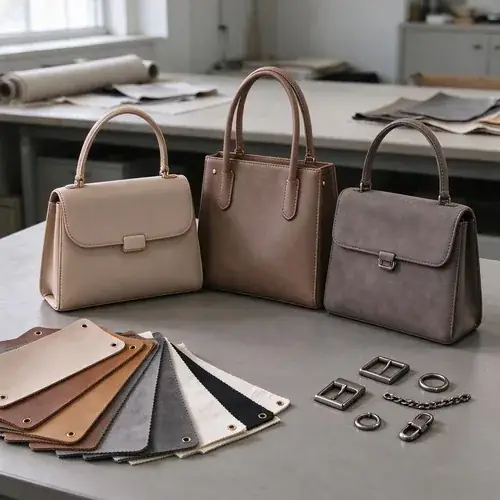
A custom handbag manufacturer is an OEM or ODM facility that translates a brand's tech pack into a physical product through pattern making, material sourcing, hardware coordination, and bulk assembly. If you're developing a structured women's handbag for retail, the question you're actually trying to solve is not just "can this factory sew." It's whether the factory controls three things that decide your defect rate and shelf position: material behavior, hardware quality, and structural consistency.
Handbags fail differently from backpacks. A soft backpack can absorb a lot of construction error because fabric stretches and compartments hide uneven seams. A structured handbag exposes every curved panel, edge-paint line, turn-lock alignment, and handle attachment point. If edge paint cracks after a short retail cycle, or gold-tone hardware starts showing tarnish in a customer's unboxing photo, you don't have a supplier shortlist problem. You have a product write-off.
This guide walks through the decisions in the order I would make them with a client: settle material grades and hardware finishes first, then understand sampling stages and why they cost more than bulk, then lock the handbag-specific quality checkpoints into your inspection plan. By the end, you'll know what to specify, what to request in writing, and what to reject before bulk cutting starts.
Quick Answer: What to Expect from an OEM Handbag Factory
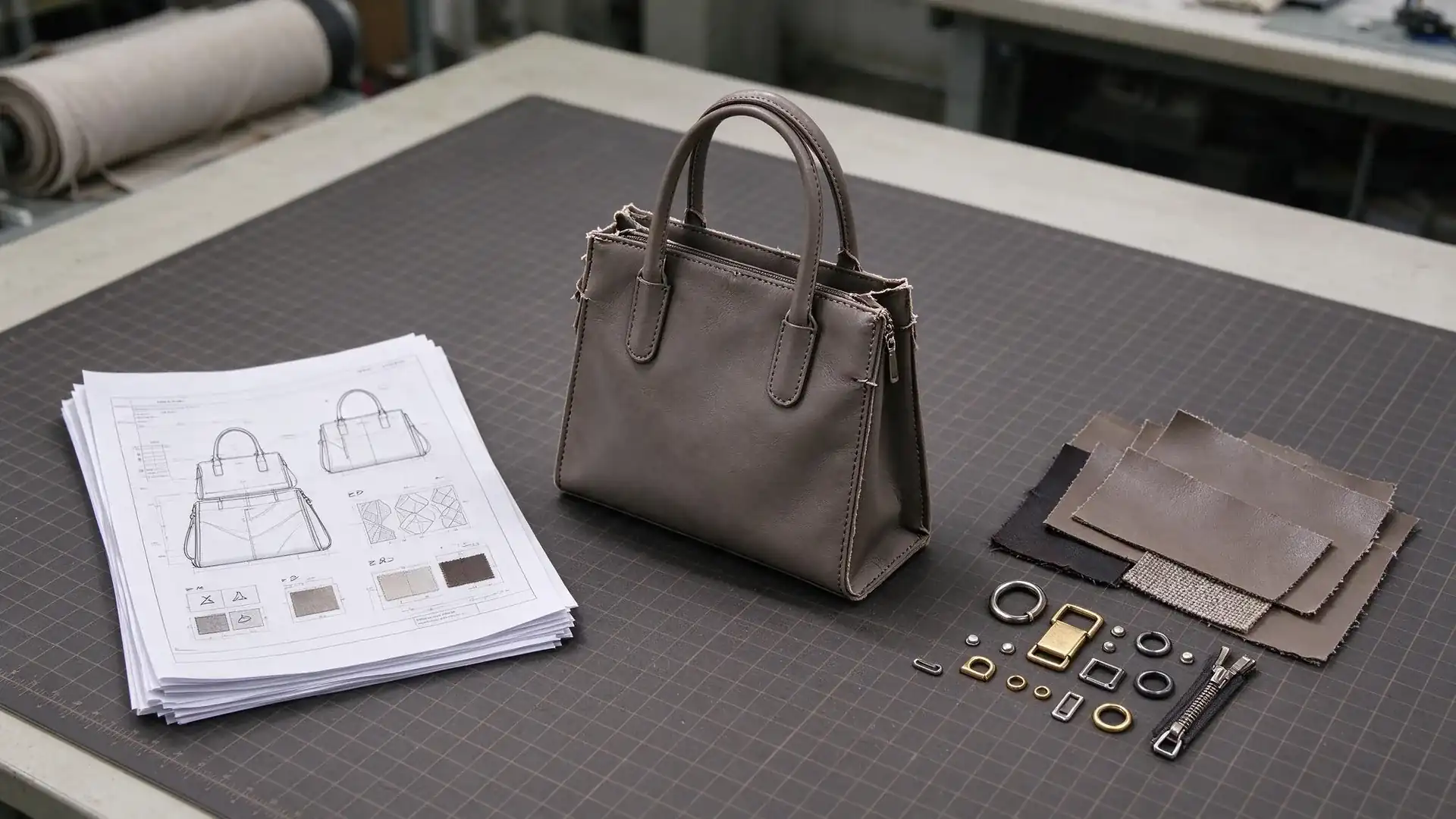
When you work with a custom handbag manufacturer, the handbag manufacturing process runs tech pack → pattern → first prototype → pre-production sample → bulk production → final QC. You own the inputs; the factory owns the conversion. When a handbag project goes wrong, it's usually not because somebody lied. It's because one side assumed the other side would fill in the blank.
You define the target retail positioning, exact dimensions, silhouette and closure system, exterior material preference and grade, lining type, hardware finish and logo placement, compliance targets, and packaging requirements. The factory defines how panels are cut for yield, seam allowances and assembly order, which stiffeners or backings are needed to hold shape, whether stock hardware fits or a custom mold is required, and which inspection points catch handbag-specific defects.
That whole chain becomes easier to manage when the material choice is specified properly. A vague "vegan leather" or "canvas handbag" note on a tech pack invites a cheaper substitution that may hold the shape in a photo but fail later on edge finish or flex performance.
Handbag Material Selection: Leather, PU, and Fabrics
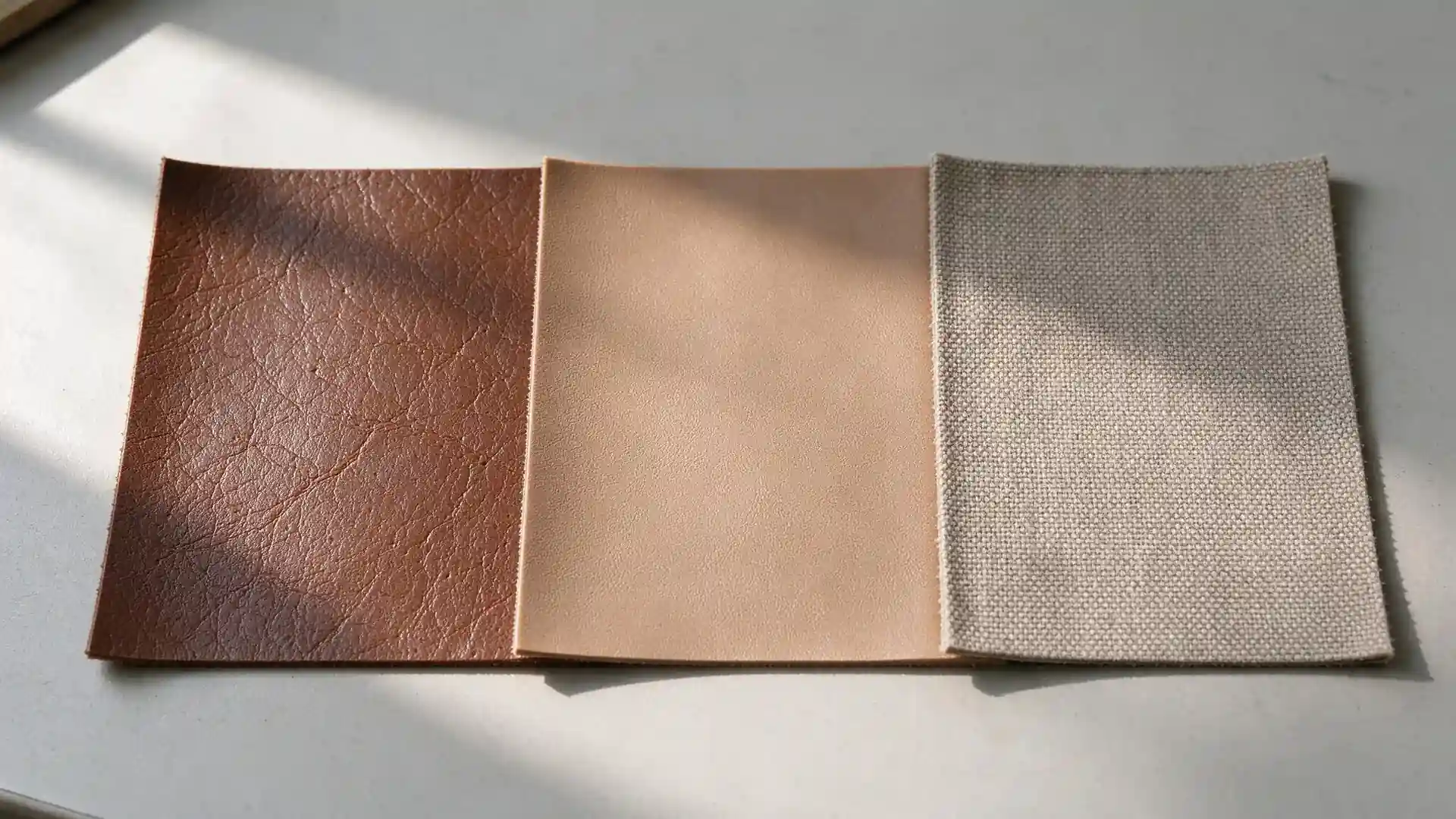
Your exterior material is a structural decision, not just a design decision. Top-grain leather, microfiber PU, PVC, and canvas behave differently when cut, folded, edge-painted, and pulled around a curved panel. Before you give in to a price point, you need to understand which material systems your retail positioning can actually support.
Full-grain leather keeps the natural top surface, including markings. It develops character over time, but hide yield drops and color consistency becomes harder to control. Top-grain leather is sanded and corrected for a more uniform surface, which is often easier for a brand that needs repeatable color across a retail shelf. Split leather or heavily coated split material sits lower in the market and usually depends on a heavier surface treatment to look acceptable.
Microfiber PU is the premium synthetic I'd recommend when a brand wants a vegan story or a tighter cost structure without looking obviously plastic. Its denser fiber base gives a more consistent panel thickness than tissue-backed PU or PVC, and it often takes edge paint and adhesive more predictably because the edge surface is more stable. Standard PVC is cheaper, but edge finishing, long-term flex performance, and EU-style material declarations become bigger risks. For a structured canvas handbag, the fabric weight matters: I'd still use roughly 300–350 gsm as the planning reference for a heavy canvas that can hold corners, but the exact weight should be confirmed with a physical swatch and a stiffener recommendation from the factory.
When you're choosing between genuine leather and a synthetic alternative, the genuine vs PU leather sourcing guide goes deeper into grading, yield loss, and the real cost drivers in both material systems.
Handbag Material Comparison
The table below is the short form of what I would send back to a brand that hasn't picked a material yet. Use it to filter the options before you commit to a tech pack.
| Material Type | Best Retail Positioning | Key Cost Drivers | What to Confirm with Supplier |
|---|---|---|---|
| Top-grain leather | Mid-to-upper retail, corrected uniform surface | Hide yield, thickness sorting, color batch range, tannery minimums | Confirm grain correction method, thickness in mm, color lot tolerance, edge finish compatibility |
| Full-grain leather | Premium or luxury positioning | Lower usable hide yield, natural defect sorting, color lot variation | Confirm natural marking acceptance, surface grading rules, and break-in and care expectations for the final leather |
| Split leather or coated split | Entry retail, smoother cost profile | Coating quality, paint bond, long-term flex performance | Confirm how the surface coating is marketed and how the edge will be finished without peeling |
| Microfiber PU | Vegan or premium synthetic, good edge control | Fiber-base grade, coating thickness, abrasion rating | Confirm abrasion rating, backing, colorfastness, and edge paint and adhesive compatibility with the exact batch |
| Recycled PU (rPU) | Sustainability-led retail with GRS story | GRS transaction documents, limited colors, minimum order visibility | Confirm recycled content claim, certificate scope, color stability, and future color reorder risk |
| Heavy canvas or cotton canvas | Casual fashion, everyday structured bags | GSM, weave density, required stiffener, lining coverage | Confirm exact GSM and tightness, shrink behavior, and which backing board or lamination holds the shape |
| PVC or coated fabric | Low-cost, promotional or novelty retail | Phthalate status, edge adhesion, cold-crack behavior | Confirm phthalate controls for the market; avoid when edge paint and long flex life are core selling points |
Never approve a material from a phone photo. Even from the same supplier, the difference between a top-grain batch and a heavy coated split shows clearly only in hand, under retail lighting, and after flexing the edge. Request three physical swatches when you can: one bright color, one neutral, and one dark color.
Handbag Hardware Sourcing and Coordination
Hardware is where handbag sourcing gets expensive and where compliance failures happen quietly. A turn-lock, chain strap, D-ring set, magnetic snap, or metal logo plaque can look identical in a photo and behave completely differently in plating retention, color tone, and heavy-metal test results.
Stock hardware is the lower-risk starting point: buy an existing base component, specify a finish, and move on. Custom hardware — a unique turn-lock, an oversized logo plaque, or a shaped chain — involves a new mold or tooling step. That almost always means a supplier-confirmed setup cost, a separately confirmed minimum quantity, a longer lead time, and a real risk that the first color sample does not match your brand direction.
Plating quality controls tarnish and wear. The exact plating process, thickness, base metal preparation, and finish spec matter more than the marketing word "gold-tone." A thin electroplated gold-tone finish on a zinc base can tarnish quickly, while a well-specified physical vapor deposition (PVD) coating on prepared brass or stainless steel may offer better wear resistance. PVD is not automatically more durable; its performance depends on substrate preparation, coating thickness, and the specific plating spec. The factory should be able to give you a finish code, a base-metal description, and a plating spec rather than just a phone photo of a shiny part.
For the European market, handbag hardware and other metal trims may be subject to REACH, but REACH is not a single clean ban. Annex XVII restrictions cover specific substances and articles where a restriction is listed; separately, the SVHC candidate list creates communication and, at certain thresholds, notification duties — not an automatic ban on every SVHC. Confirm the exact substance list, threshold, and test scope for the final hardware finish, base metal, and component supplier. Some importers also use RoHS-style heavy-metal limits for metal trims as a private buyer specification, not as a legal RoHS product requirement for bags. For the U.S. market, California's Proposition 65 is a regulatory warning and exposure requirement: whether a warning applies depends on the specific chemical exposure from the final leather or PU, coating, lining, adhesive, and metal components sold into California. Scope it against the final material and hardware reports and confirm the warning obligation with a qualified supplier or importer familiar with California retail exposure. Never accept "all compliant, no problem" as a substitute for test reports — ask for the report and check that the report scope matches your exact finish, base metal, and final hardware supplier.
If your project includes custom zipper pulls or closures, make sure the supplier names the actual component spec rather than a brand name you can't verify. A supplier-specified coated coil or molded zipper is usually sufficient for most fashion handbags; moisture-resistant hardware is not the same as watertight.
A useful reference before you finalize the trim list is our guide on how to choose fabric, lining, and hardware for a bag order. The hardware principles carry directly into handbags.
The Handbag Sample Development Process
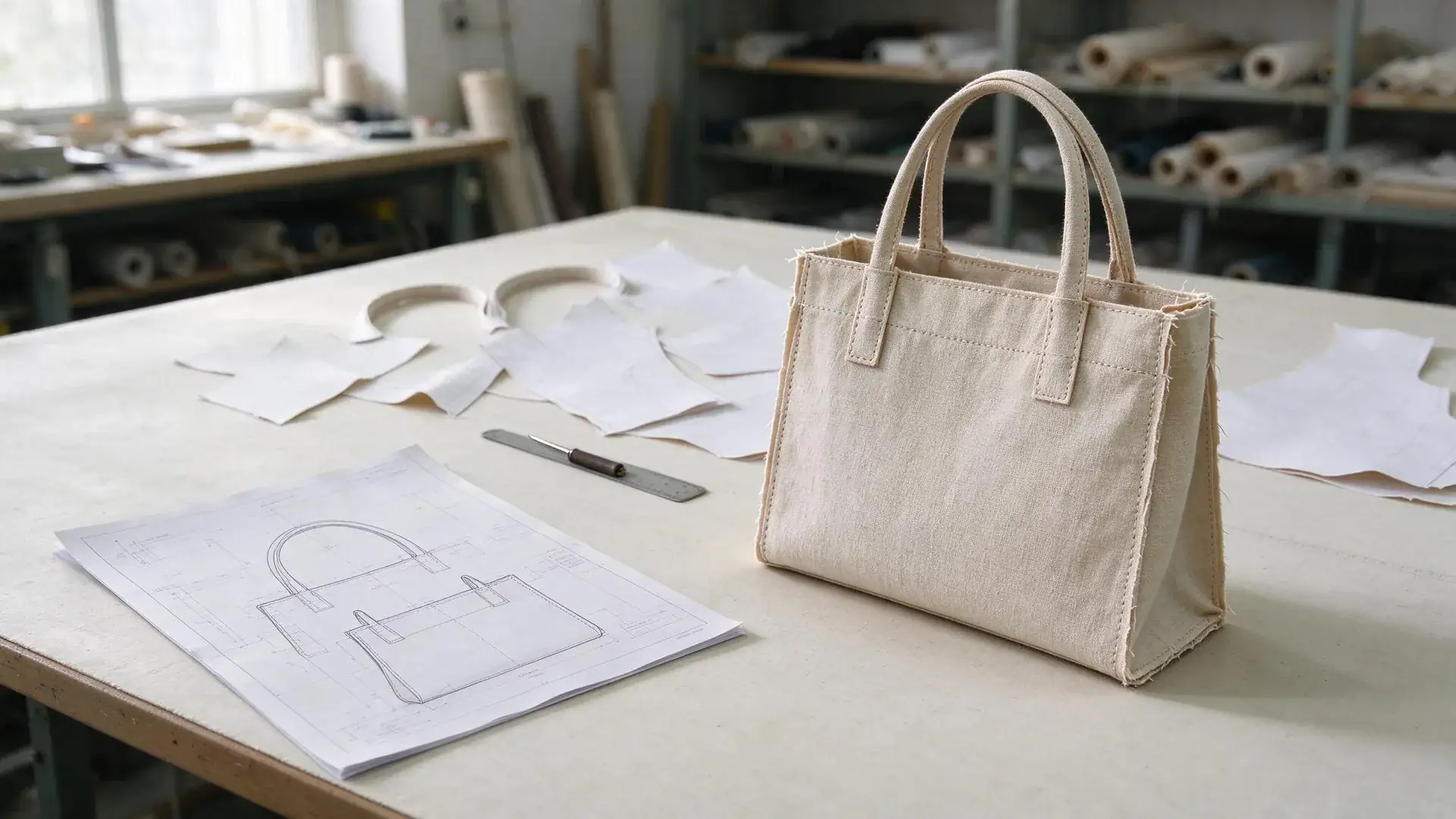
Sampling is the cheapest moment to change shape, hardware, and material. After bulk cutting starts, the same correction becomes rework — and that's when projects lose money.
Pattern making is the silent foundation. It converts your 2D reference into cutting templates that account for seam allowance, material stretch, and assembly sequence. A basic flat tote may take a shorter pattern session. A structured handbag with multiple compartments, curved panels, and a reinforced base often requires a full working day or more of specialized pattern labor; the real timeline is quote-dependent. Those are development-time planning references, not delivery promises; sampling also includes material sourcing wait time, sewing queue, and revision rounds.
The first prototype is a development sample. Its job is to test proportion, handle drop, closure function, and the way stiffeners hold the shape. It's normal for the first prototype to use substitute or lower-cost material — that keeps rework costs down while the pattern is still moving. Do not reject a prototype over color. Reject it over silhouette errors, closure misalignment, or a handle drop that creates an awkward line.
The pre-production sample (PPS) is the harder gate. It must use final bulk leather or PU, final hardware finish, final edge paint, final lining, and final logo. Anything you approve at PPS becomes the sealed reference for bulk QC. If a factory tries to skip the PPS and jump straight from a rough prototype to bulk cutting, push back.
Handbag sample development costs surprise a lot of first-time buyers. A handbag prototype often costs several times the eventual bulk unit price, and that is not a markup trick. The multiple covers one-off pattern labor, sourcing small quantities of the specified material, manual assembly, and the first adjustment cycle. The exact sample cost is quote-dependent, so ask the factory to break out the prototype charge from the bulk price before you approve development. If a supplier quotes a prototype at the same price as bulk, that may mean the factory is not developing a fully custom pattern. Ask for pattern ownership, a development breakdown, and written confirmation of whether the sample is a stock-model decoration or a newly developed pattern before you approve the development.
Handbag Sampling Stages
Use this table to name the stage you're asking for in emails. Mixing up "first prototype" and "pre-production sample" is one of the most common causes of sampled products that don't match bulk.
| Stage | Purpose | Buyer Action | Supplier Deliverable |
|---|---|---|---|
| Pattern making or technical pattern | Convert 2D design into cutting templates with seam allowance and assembly logic | Confirm dimensions, handle drop, closure placement in the tech pack | Pattern set, cutting plan, draft BOM |
| First prototype or development sample | Test shape, proportion, closure function, stiffener behavior | Review silhouette and function; ignore material color or substitute hardware | Sewn prototype in substitute material with deviation notes |
| Pre-production sample (PPS) | Confirm final materials, hardware, edge paint, lining, logo, and packaging | Approve in writing only after checking weight, lining fit, edge paint, and hardware motion | Final-spec PPS with signed approval reference |
| Sealed or gold sample (optional) | Lock the physical reference that bulk inspection will compare against | Approve and keep a copy for the inspector and the factory | Duplicate sealed reference sample |
Pattern making is also why it's worth understanding the complete bag manufacturing process before you negotiate sampling. The cutting and assembly sequence determines where leather or fabric panels can be saved — or wasted.
Production Risk Control and Quality Checkpoints
The defects that come back from consumers on handbags are rarely a broken zipper. They are edge paint cracking, hardware tarnish, wavy stitching on curved panels, lining pucker, and left-right asymmetry in the finished shape. That's what you should load into the inspection manual.
Edge paint is one of the most visible handbag defects and one of the hardest to fix cleanly at the bulk stage. It cracks at flex points if the paint is too rigid, peels if the edge surface isn't prepared well, and shows as uneven thickness on a curved edge. On the PPS, flex the flap and check around the handle attachments. If you can already see hairline cracks, bulk flexing will make them worse.
Handle and strap attachment should be tested, not trusted. For a structured handbag, a buyer-defined drop test or cycle test on the handle anchoring catches failures before the cartons leave. Ask the factory which weight and cycle count they use, then compare that against your target product weight plus a margin.
Hardware inspection happens under neutral light at arm's length. Look for pitting, uneven plating color, blooming, and scratches that will read as damage in photos. One small chip on a turn-lock at the PPS stage is a red flag: request more sampled pieces or a duplicate PPS, check plating adhesion and batch consistency, and verify whether the chip is an isolated handling mark or a finishing problem before approving hardware.
Lining fit is a QC point most buyers skip. The lining should sit correctly in the bottom corners and along the gussets without excess fabric bagging outward. That pucker becomes immediately visible in an open-bag product photo.
Use this checklist as a starting point for your handbag QC plan. These are checkpoints, not the full inspection; put them into the factory's inspection manual and agree on an AQL level before bulk production.
- Edge paint: smooth along the full edge, no cracks at flex points, no peeling at the cut edge, no visible color drift between panels.
- Handle and strap anchoring: pass the buyer-defined drop or load test; bartack or reinforcement stitching is undamaged after testing.
- Hardware plating: neutral-light visual check for pitting, tarnishing, color mismatch across D-rings and turn-lock; clasp and magnet motion is smooth.
- Lining fit: no excess fabric bagging at bottom corners or side gussets; seams lie flat under the interior panel.
- Stitching: consistent stitches per inch on straight panels, no skipped stitches on curves, seam allowance respected without puckering.
- Shape symmetry: left and right panel lines match at the handle base and base corners; the bag sits flat without rocking.
- Closure function: turn-lock, magnetic snap, zip flap, or frame closure opens and closes without catching; no gap at the closed edge.
One thing I would not trust is a verbal QC promise. Put the checkpoints in writing and tie them to an acceptance sampling level. AQL 2.5 is a common reference point for major defects on bags, but the right level depends on your retail segment and the defect that matters most to your end buyer.
RFQ Checklist for Custom Handbag Manufacturing
A clean RFQ is the quickest way to separate a genuine OEM handbag factory from a trader who is only going to ask you for a target price and a photo. The more complete your spec, the less room there is for a factory to fill a blank with something cheaper.
Before you send anything, spend some time learning how to evaluate bag manufacturers beyond unit price. Then fill the table below with the most accurate information you have. A blank field is fine if you honestly don't know — but say so, rather than writing a vague "standard" and expecting the factory to guess.
| RFQ Field | Your Input |
|---|---|
| Bag type and silhouette | Structured handbag, shoulder bag, crossbody, mini top-handle; closure style |
| Target market and channel | Countries, retail channel, price positioning; informs compliance and material selection |
| Quantity | First order plus planned reorders; separate product MOQ from custom mold MOQ |
| Target unit cost | FOB basis and the landed-cost assumptions you are using |
| Dimensions | External length x height x depth, handle drop, gusset width, base dimensions |
| Exterior material | Leather grade, PU type, canvas GSM, or other; request physical swatch confirmation |
| Lining | Type, color, printed or plain, contrast or tone-on-tone |
| Structure | Stiffener, base board, reinforcement at handle base, panel backing |
| Hardware | Turn-lock, zipper, D-ring, dog hook, foot studs, magnet, logo plaque, chain; finish and base metal |
| Logo | Method, position, size; confirms whether a custom mold or label setup applies |
| Compliance | REACH, RoHS-style metal limits, Prop 65, OEKO-TEX, GRS — only if applicable to the product and market |
| Packaging | Dust bag, retail box, hangtag, barcode label, carton marking, insert card |
| Sampling | First prototype and PPS requirements, approval process, seal sample |
| QC | AQL level, key checkpoints, third-party or factory inspection, reference sample |
| Deadlines | Sample date and bulk delivery date, tied to artwork and material approval |
| Documents | Test reports, BOM, color swatch record, packing list requirements |
That table is also the strongest shortlist filter. Send the completed version to qualified OEM handbag factories and ask them to confirm material availability, hardware tooling, sampling plan, and QC scope in writing; when the inputs are complete, the quotation reflects your actual material and hardware choices instead of each factory's assumptions.
FAQ: Custom Handbag Manufacturer Questions
These are the questions a working fashion brand or sourcing manager actually asks before contacting a custom handbag manufacturer — answered the way I would answer them in a call.
How much does a handbag prototype cost to develop?
A handbag prototype often costs several times the eventual bulk unit price, but the exact multiple is quote-dependent. That sample cost covers pattern labor, sourcing small quantities of the specified material, manual assembly, and the first adjustment cycle. Ask the factory for a separate sample quote tied to your BOM. If a factory quotes a prototype at the same price as bulk, treat that as a prompt to ask whether the sample is a stock-model decoration or a newly developed pattern, and request a development breakdown before approving the sample charge.
What is the MOQ for custom handbag manufacturing?
There is no single MOQ that works across the industry. If the factory can cut your design from stock materials and stock hardware on an existing construction, the minimum order tends to be lower. If you need a custom turn-lock mold, a special edge paint color, or a specialty exterior material, the MOQ rises separately for that component. Ask for the MOQ in writing, and separate the product MOQ, the decoration MOQ, and any hardware mold MOQ.
How long does pattern making take for a structured handbag?
Pattern making for a structured handbag with multiple compartments, curved panels, and a reinforced base often requires a full working day or more of specialized pattern labor; a basic flat tote is typically quicker. Development time is quote-dependent, and sampling adds material sourcing time, sewing queue time, and revision rounds on top of pattern work.
Do custom handbag factories handle REACH compliance?
A professional OEM handbag factory should understand REACH and be able to source hardware and materials with test documentation. But compliance is never automatic. You still need to specify which Annex XVII restrictions or SVHC communication duties apply to your target market, confirm the final plating and base metal suppliers, and decide whether factory test reports are enough or whether you need independent testing.
What is the difference between a first prototype and a pre-production sample?
The first prototype exists to test shape, proportion, and function. It is often made with substitute or lower-cost materials so you don't waste expensive leather while the pattern is still changing. The pre-production sample (PPS) comes after the pattern is approved and uses the exact bulk leather or PU, final hardware finish, final edge paint, final lining, and final logo. The PPS is your approval gate before bulk cutting — anything you approve there becomes the sealed reference for bulk QC.
Official Sources and Compliance References
These references explain the compliance standards a fashion brand may need to check before bulk handbag production. Treat them as buyer-defined verification targets, not assumed certificates — confirm with the supplier which one applies to your exact material, color, hardware base metal, and destination market.
- REACH (EU Regulation) — covers both Annex XVII restriction limits and SVHC candidate-list communication and notification duties; relevant to handbag hardware, coatings, leather chemicals, and metal trims, but the applicable duty depends on the exact article, substance, threshold, and market placement.
- RoHS-style limits — a voluntary heavy-metal specification for metal trims sometimes requested by importers. RoHS itself is an electrical and electronic equipment directive, so confirm whether the buyer requirement is a private finish specification or an actual legal test obligation.
- OEKO-TEX Standard 100 — independent testing for harmful substances in textiles; useful when the lining, straps, or woven trims sit against skin in normal use.
- GRS (Global Recycled Standard) — a chain-of-custody standard for recycled content claims; necessary only when the brand markets materials like recycled PU or post-consumer fabrics.
- ISO 2859-1 and AQL — the acceptance sampling framework used to define how many pieces are inspected and what defect level is accepted for a lot.
The trap to avoid is staring at a certificate PDF and assuming it covers your exact SKU. Check the scope, the lot, and the color. A REACH-style metal report for the supplier's standard brass turn-lock may not cover the custom gold-tone batch you just approved.
Conclusion
Fashion-brand sourcing gets much simpler when you stop treating a handbag like a generic bag with better looks. The material grade decides the edge behavior and the cost floor. The hardware finish decides the visible aging story and the compliance workload. The pattern and sample sequence decide how certain you can be on bulk day.
Build your spec in this order: material swatch, hardware finish code, pattern approval, PPS sign-off, handbag-specific QC checklist. Then send the RFQ table above with the blanks filled honestly to qualified factories on your shortlist. A supplier that can respond to each field with a clear confirmation or a specific question is already showing the pattern of communication you need for a handbag program. That structured input is the fastest way to get a quotation that reflects your actual product rather than an optimistic assumption.
Get A Quote

Get A Quote
0 Comments