
Top 10 Branding Mistakes New Bag Brands Must Avoid: A Supply Chain & Product Development Audit
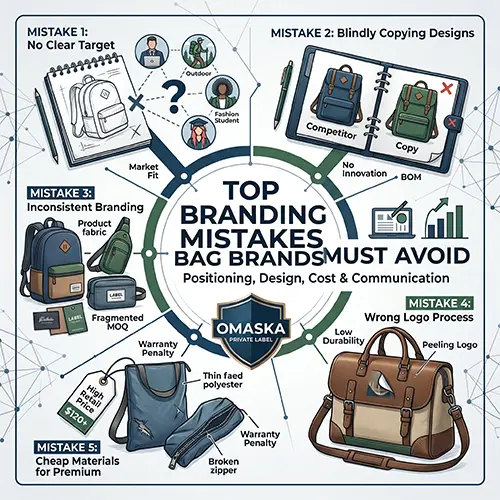
The failure rate of new bag brands is rarely due to a lack of marketing budget; it is typically caused by a disconnect between brand ambition and supply chain reality. When branding decisions ignore manufacturing conditions, the result is delayed sampling, high defect rates, and collapsed profit margins. This technical audit breaks down the most critical branding mistakes new luggage and backpack brands make—and the exact operational conditions required to avoid them.
Phase 1: Positioning & Concept Failures
Before physical manufacturing begins, conceptual errors dictate the structural destiny of a bag. Defining a brand purely based on “aesthetic vision” rather than “functional scenarios” invariably leads to a severe mismatch in the subsequent Bill of Materials (BOM). This phase analyzes how misaligned positioning destroys a product’s market viability.
Mistake 1 — Misaligning Functional Scenarios with Structural Engineering
A common trap for new brands is defining a target audience without defining the specific “working condition” the bag will endure. When a brand claims to target “heavy-duty urban commuters” but fails to implement the necessary structural engineering, brand trust collapses immediately upon the first use.
If a backpack is designed to carry a 15-inch laptop, a tablet, and daily gear, the static weight easily exceeds 5kg. If the factory is instructed to build this using flat, single-density foam straps to achieve a “minimalist brand look,” the perceived weight on the user’s trapezius muscles will cause immediate discomfort.
Table 1: Functional Scenario vs. Structural Engineering Requirements
| Brand Target Scenario | Common Branding Mistake | Correct Structural Engineering Condition |
| Heavy Urban Commuting | Prioritizing slim aesthetics over strap padding. | Must use S-shaped ergonomic straps with high-density EVA foam and a rigid internal PE board for structural support. |
| Outdoor & Tactical | Using standard nylon for a "rugged" look without tear-resistance. | Requires Ripstop fabric architecture and X-box (bar-tack) reinforced stitching at all primary load-bearing stress points. |
| Luxury Business Travel | Over-complicating external pockets for "functionality." | Requires streamlined exteriors with concealed YKK AquaGuard zippers and premium leather trims to maintain a high-end corporate aesthetic. |
The Fix: A brand’s positioning must be translated directly into physical engineering parameters. The Tech Pack must specify load distribution systems before finalizing the external aesthetic.
Mistake 2 — Reverse-Engineering Competitors Without Understanding Their BOM
Startups frequently bring a $300 premium backpack to an OEM factory and request a visual clone at a $30 target cost. This reflects a fundamental misunderstanding of supply chain economics, specifically the Bill of Materials (BOM) and mold amortization.
Premium brands utilize proprietary hardware—custom-molded zipper pullers, uniquely cast aluminum buckles, and specialized fabric weaves. A global brand ordering 100,000 units can easily absorb a $2,000 steel mold fee; it adds only $0.02 to their unit cost. If a new brand ordering 500 units attempts to copy these custom details, the same mold fee adds $4.00 to their unit cost, completely eroding their profit margin.
The Financial Reality: Blindly copying high-end structural features without high-volume leverage forces the factory to use substandard generic alternatives to hit the target price. The result is a bag that looks like a premium product in photos but feels cheap and fragile in reality.
Phase 2: Material & Hardware Miscalculations
Material science is objective. Selecting fabrics and hardware based purely on branding mood boards, without considering physical properties and factory Minimum Order Quantity (MOQ) restrictions, guarantees high defect rates and dead inventory. This phase details the financial and structural consequences of poor material choices.
Mistake 3 — Selecting the Wrong Logo Application Process for Specific Fabrics
The logo is the anchor of a brand’s visual identity. However, applying the wrong logo technology to a specific fabric substrate is a primary cause of post-launch quality failures. A logo peeling off a premium bag destroys brand equity instantly.
For example, waterproof backpacks often utilize fabrics coated with thick Polyurethane (PU) or Polyvinyl Chloride (PVC). Standard Silk Screen Printing cannot chemically bond with these slick, non-porous coatings. When exposed to temperature fluctuations or physical abrasion, the printed logo will crack and detach.
Table 2: Logo Application Process Matching Matrix
| Fabric / Material Surface | Incorrect Logo Process (High Risk) | Recommended Logo Process | Cost & MOQ Implication |
| PU-Coated / Waterproof Nylon | Silk Screen Printing (Will peel off) | High-Frequency Embossing or Rubber Patch | Moderate cost; requires a custom mold (MOQ typically 500+). |
| High-Denier Cordura (Rough Texture) | Heat Transfer (Fails to adhere to deep grooves) | Woven Label or Direct Embroidery | Low cost; high durability; excellent for tactical/outdoor branding. |
| Smooth Leather / Vegan PU | Embroidery (Punctures and weakens the material) | Blind Debossing or Metal Badge | High perceived value; metal badges require tooling fees. |
Mistake 4 — Causing MOQ Fragmentation Through Inconsistent Material Sourcing
In an effort to launch a “diverse and rich” initial collection, new brands often specify different fabrics, zipper colors, and lining patterns for every single SKU. This strategy creates a critical supply chain bottleneck known as MOQ Fragmentation.
Factories purchase fabric in rolls (typically 100 to 500 meters per roll, depending on the dye). If a brand orders 300 backpacks in 600D Olive Green, 300 messenger bags in 420D Navy Blue, and 300 sling bags in 900D Black, none of the individual material requests will meet the fabric mill’s minimum order requirement. The factory must either reject the order, charge exorbitant sourcing surcharges, or force the brand to buy and warehouse the unused leftover fabric.
The Strategy: Successful new brands build their initial matrix around a single, high-quality core material (e.g., standardizing a specific 600D Recycled PET across all models). Brand differentiation is then achieved through low-MOQ trims, interchangeable custom zipper pullers, and modular pocket designs.
Mistake 5 — Mismatching Fabric Denier and Hardware Quality with Retail Pricing
Attempting to support a premium retail price point ($100+) using entry-level raw materials is a mathematically flawed branding strategy. The physical lifespan of a bag is dictated by its weakest component, which is almost always the zipper or the fabric’s tear resistance.
If a brand selects standard 210D polyester (a lightweight lining material) for the exterior shell to save $1.50 per unit, the bag will fail basic abrasion tests. Furthermore, downgrading from industry-standard YKK zippers to unbranded alternatives to save $0.80 per bag drastically increases the risk of zipper fatigue failure.
The Warranty Calculation: If a broken zipper results in a customer return, the brand loses the product cost, the outbound shipping, the return shipping, and the customer acquisition cost (CAC). Saving $0.80 on hardware often results in a $40+ reverse logistics penalty. Hardware quality must align with the brand’s warranty promises and retail positioning.
Phase 3: Factory Communication & Execution Errors
Even with perfect market positioning and premium materials, a brand will fail if its vision cannot be translated into factory-executable commands. This phase highlights the critical translation errors between marketing departments and the manufacturing floor, emphasizing why factories require strict, measurable parameters rather than emotional brand inspiration.
Mistake 6 — Relying on “Brand Mood Boards” Instead of Strict Tech Packs
Startups often communicate with factories using emotional or abstract terms like “premium feel,” “structured silhouette,” or “vintage colors.” For a production line, these words are entirely meaningless. The lack of a comprehensive Tech Pack detailing physical parameters is the number one cause of inconsistency between the golden sample and the final bulk production.
If a brand does not specify the exact stitch density, assembly line workers might widen the stitch length to increase daily output, severely compromising the bag’s seam strength.
Table 3: Brand Language vs. Factory Tech Pack Instructions
| The Brand's Emotional Request | The Required Tech Pack Parameter | Impact on Supply Chain Execution |
| "It needs a premium, bouncy feel." | Specify 1.5mm high-density EVA foam bonded with 300g velvet lining. | Ensures tactile consistency across every single unit in the batch. |
| "The color shouldn't look cheap." | Specify Pantone TCX code; mandate color-matching under D65 standard light. | Eliminates dye lot variations (缂稿樊) and visual inconsistencies. |
| "Make sure it's durable." | Mandate 3.5 stitches per centimeter; require X-box (bar-tack) reinforcement at stress points. | Drastically reduces tear-related warranty claims and reverse logistics costs. |
| "The hardware must look shiny." | Specify Zinc Alloy die-casting + matte nickel plating (Must pass 48-hour salt spray test). | Prevents hardware oxidation and rusting during humid ocean freight transit. |
y international freight forwarders.
The Financial Reality: A soft backpack that could be shipped flat-packed might incur 3 to 5 times the air freight cost if placed inside an oversized rigid box. This single branding decision can instantly inflate the logistics cost per unit from $4.00 to $12.00. For a brand with a $50 average order value, bleeding $8 in unnecessary freight costs per unit will annihilate the net profit margin and bankrupt the brand within its first year.
Phase 4: Post-Launch & Scaling Blind Spots
Successfully launching the first product does not guarantee long-term brand survival. Many new brands dilute their core competency and destroy their margins through undisciplined product expansion and an inability to process market feedback into engineering improvements.
Mistake 9 — Scaling the Product Matrix Without Supply Chain Leverage
After a successful flagship backpack launch, new founders often rush to develop entirely unrelated categories—like jumping from canvas daypacks to hard-shell polycarbonate luggage. This expansion strategy abandons their existing supply chain leverage.
Every new material category requires new mold fees, new material suppliers, and entirely different QC testing protocols. Successful scaling relies on material reuse. Brands should utilize their already-sourced core materials (e.g., the 600D rPET fabric that already meets the factory’s MOQ) to develop ancillary items like tech pouches, wash bags, or messenger bags. This consolidates fabric orders, lowers costs, and maintains a highly cohesive brand identity.
Mistake 10 — Disconnecting the Defect Feedback Loop from Future R&D
Brand building is an iterative engineering process. Many brands fail because they treat post-launch customer complaints purely as a customer service issue (issuing refunds) rather than an R&D directive.
The Correct Feedback Loop: If 10% of 1-star reviews on Amazon or your DTC website complain about “zippers getting stuck,” the marketing team must immediately feed this data back to the supply chain team. The subsequent Tech Pack for the next bulk order must be updated to mandate a larger zipper gauge (e.g., upgrading from #5 to #8) or require pre-lubrication of the zipper tracks before assembly. A brand only survives if it engineers its defects out of existence.
How to Fix Each Branding Mistake: The 5-Step B2B Audit
To build a resilient and profitable bag brand, do not pay your factory deposit until you have cleared this 5-step supply chain audit:
- The Engineering Audit: Does your Tech Pack contain physical parameters (stitch density, tolerances, salt-spray standards), or is it just a collection of aesthetic photos
- The Cost Audit: Have you calculated your Total Landed Cost (TLC) based on dimensional weight? (Implement flat-packing or vacuum-sealing for soft bags to save 30%+ on freight).
- The Material Audit: Is your chosen logo application compatible with your fabric’s chemical coating? (Mandate cross-cut tape tests for printed logos on PU-coated nylons).
- The Standards Audit: Is an AQL 2.5/4.0 inspection legally bound in your manufacturing contract?
- The Feedback Audit: Do you have a Standard Operating Procedure (SOP) to translate 1-star customer reviews directly into updated factory Tech Packs for your next production run?
Brand building is not an exercise in graphic design; it is an exercise in applied supply chain management. Master the manufacturing variables, and the brand will naturally sustain itself.
Mistake 6 — Wrong Size or Function for Target Users
Designing a bag’s dimensions and functional layout based purely on aesthetic proportions rather than user ergonomics and global logistics is a critical error. The physical size of a bag dictates not only its usability but also its shipping classification.
When the size or function does not align with the target user’s actual daily conditions, the product fails in the market. Furthermore, arbitrary sizing decisions—such as making a backpack 2cm wider just for a specific silhouette—can trigger massive logistical penalties.
Table 3: The Impact of Sizing Errors on Usability and Freight
| Sizing/Function Error | Impact on the Target User | Impact on the Supply Chain (TLC) |
| Oversized Laptop Compartment | A 13-inch laptop bounces inside a 17-inch compartment, causing damage and poor weight distribution. | Exceeds standard carton dimensions, leading to a 30% increase in volumetric weight charges. |
| Over-compartmentalization | Too many small, rigid pockets limit the ability to pack bulky items, frustrating users. | Increases Direct Labor costs (more sewing steps) and drives up the Bill of Materials (BOM) due to excess zippers. |
| Incorrect Strap Spacing | Straps sewn too wide slip off narrow shoulders; straps sewn too narrow pinch the neck. | High return rate due to ergonomic failure, destroying the brand's reputation for comfort. |
The Engineering Fix: Dimensions must be reverse-engineered from the core items the bag is meant to carry (e.g., standard airline carry-on limits, MacBook Pro dimensions) and optimized to fit standard shipping cartons without wasted space.
Mistake 7 — Ignoring Packaging and User Experience
Packaging is the physical bridge between the manufacturer and the consumer. Ignoring this step, or treating it merely as an afterthought, creates two distinct risks: destroying the perceived value of a premium brand or unintentionally skyrocketing the Total Landed Cost (TLC).
Many new brands focus entirely on the bag itself and allow the factory to pack it in a standard, unbranded polybag. Conversely, some brands overcompensate by requesting rigid, non-collapsible gift boxes for soft backpacks. Both extremes represent a failure in supply chain strategy.
-
The Unboxing Value Trap: If a customer pays $120 for a premium backpack and receives it in a thin, wrinkled plastic bag, the perceived value instantly drops. Replacing a standard polybag with a branded PEVA frosted zip bag or a reusable fabric dust bag costs only $0.30 to $0.80 per unit but exponentially elevates the unboxing experience.
-
The Dimensional Weight Trap: If a brand insists on shipping soft bags fully stuffed with paper inside rigid boxes to maintain their shape, the volume of the shipment multiplies. In international air and ocean freight, you pay for the space the cargo takes up (Dimensional Weight). A poor packaging strategy can easily inflate shipping costs by $5.00 to $10.00 per unit, eliminating the net profit margin.
Mistake 8 — Lack of Quality Standards
Brand equity is entirely dependent on product reliability. A fatal mistake new brands make is signing a Purchase Order (PO) that only requests “high quality” without defining the mathematical parameters for acceptance and rejection.
Quality control cannot be subjective. If a brand does not establish strict testing protocols before production begins, they forfeit their leverage during the Final Quality Control (FQC) inspection. Factories operate on acceptable defect margins; if a brand does not define what constitutes a defect, the factory’s standard will prevail.
Table 4: Mandatory B2B Quality Control (QC) Protocols
| QC Testing Category | Standard Implementation | What It Prevents |
| Acceptable Quality Limit (AQL) | Implementing AQL 2.5 (Major Defects) and 4.0 (Minor Defects) during final inspection. | Prevents bulk shipments containing unacceptable levels of loose threads, asymmetrical sewing, or fabric stains. |
| Dynamic Load Test (Jerk Test) | Subjecting the loaded bag (e.g., 20kg) to 500+ cycles of oscillating drops. | Prevents shoulder straps and top handles from tearing during real-world heavy usage. |
| Zipper Fatigue Testing | Reciprocating the main compartment zipper slider back and forth 5,000+ times. | Eliminates the risk of zipper teeth separating or sliders derailing—the #1 cause of bag warranty claims. |
Mistake 9 — Poor Color & Material Consistency
Visual inconsistency destroys the illusion of a premium brand. When a customer buys a navy blue backpack and later purchases a matching navy blue wash pouch, discovering that the two items are different shades of blue shatters brand trust.
This error stems from a failure to manage “Dye Lot Variations” (缸差) and a lack of standardized material sourcing. Different batches of fabric dyed months apart will naturally exhibit slight color deviations.
The Condition for Consistency: Professional brands do not rely on a computer screen to approve colors. They mandate the use of physical Pantone TCX fabric swatches and require the factory to conduct color-matching under a standardized light source (e.g., D65 lighting). Furthermore, failing to specify colorfastness standards (色牢度) means the bag’s dye might bleed onto the user’s white shirt during a rainstorm, resulting in catastrophic brand damage.
Mistake 10 — No Branding Guidelines
A factory is an execution unit, not a design agency. Sending a factory a few conceptual sketches and a JPEG of a logo is insufficient. The absence of strict Branding Guidelines and a comprehensive Tech Pack guarantees that the final bulk production will not match the initial sample.
Without precise guidelines, assembly line workers are forced to guess. This leads to logos being sewn slightly off-center, incorrect hardware finishes being applied, and inconsistent label placements across different product batches.
Essential Tech Pack Inclusions:
- Logo Positioning Tolerances: Exact measurements (in millimeters) from the top seam and center axis for logo placement, including the acceptable margin of error (tolerance).
- Thread Specifications: Explicitly stating the thread thickness and the required stitch density (e.g., 3-4 stitches per centimeter).
- Hardware Finishes: Specifying the exact metal treatment (e.g., matte black electrophoretic coating, brushed nickel) rather than just saying “dark metal.”
Mistake 11 — Bad Communication with Factory
Translating consumer marketing language into manufacturing instructions is a critical skill that new brand owners often lack. Factories communicate in the language of Bill of Materials (BOM), Minimum Order Quantities (MOQ), and structural engineering.
When a brand owner says, “I want the bag to feel more structured and premium,” the factory manager cannot translate that into an assembly line instruction. This miscommunication leads to endless sampling loops, delayed launch dates, and frustration on both sides.
The Professional Translation: Instead of emotional descriptors, brands must use technical directives. “Make it more structured” should be communicated as: “Upgrade the internal lining back-panel from 0.5mm PE board to 1.5mm high-density EVA foam, and add piping (骨条) to the exterior seams.” Speaking the manufacturer’s language is the only way to ensure accurate execution and control costs.
Mistake 12 — No Feedback Loop After Launch
The launch of a brand is not the finish line; it is the beginning of the data collection phase. A major branding mistake is treating post-launch customer complaints purely as customer service issues (issuing apologies and refunds) rather than treating them as crucial R&D intelligence.
If 8% of Amazon reviews mention that the water bottle pocket is too tight, the brand is failing if the next production batch does not address this.
The Iterative Engineering Cycle: A successful brand treats every defect as a supply chain variable to be solved. If users report straps tearing, the brand must update the Tech Pack for the next bulk order to require X-box (bar-tack) stitching at the stress points. A brand only survives long-term if it engineers its defects out of existence batch by batch.
How to Fix Each Branding Mistake
Building a profitable bag brand requires systematically eliminating variables before mass production begins. To avoid the mistakes outlined above, brand owners should implement the following procurement checklist:
- Validate the Tech Pack: Ensure every dimension, fabric denier, and Pantone color is mathematically defined. Never rely on verbal agreements or mood boards.
- Standardize the BOM: Prevent MOQ fragmentation by using a consistent core fabric (like 600D Nylon) across your product matrix, achieving differentiation through low-MOQ trims and custom hardware.
- Contractual QC Standards: Embed AQL 2.5/4.0 inspection terms and specific physical testing requirements (dynamic load, colorfastness) directly into the Purchase Order.
- Optimize for Logistics: Audit the packaging design specifically for dimensional weight. Implement nesting or vacuum-sealing strategies for soft goods to protect the Total Landed Cost (TLC).
- Establish the Feedback Loop: Create a Standard Operating Procedure (SOP) where 1-star reviews are translated into direct engineering modifications for the factory before the next deposit is paid.
Conclusion: Building a Brand is Engineering a Supply Chain
In the highly competitive luggage and backpack market, a successful brand is not built on aesthetics alone; it is engineered through rigorous supply chain management. The branding mistakes outlined in this guide—from fragmented MOQs and vague Tech Packs to dimensional weight penalties and mismatched materials—all share a common root cause: a fatal disconnect between marketing ambition and manufacturing reality.
To survive and scale, new brand founders must fundamentally shift their perspective. You are not merely selling a bag; you are managing a Bill of Materials (BOM), enforcing Acceptable Quality Limits (AQL), and optimizing the Total Landed Cost (TLC). By treating the manufacturing floor as an engineering partner rather than a simple execution tool, and by establishing strict, data-driven protocols before the first Purchase Order is signed, brands can avoid these structural pitfalls.
Brand equity is ultimately defined by product consistency. Master the manufacturing variables, eliminate the guesswork from your factory communication, and your brand’s profitability and market reputation will naturally follow.
Get A Quote

Get A Quote
0 Comments