
Bag Closure Types: Zippers, Magnets, Buckles & Drawstrings for OEM Sourcing
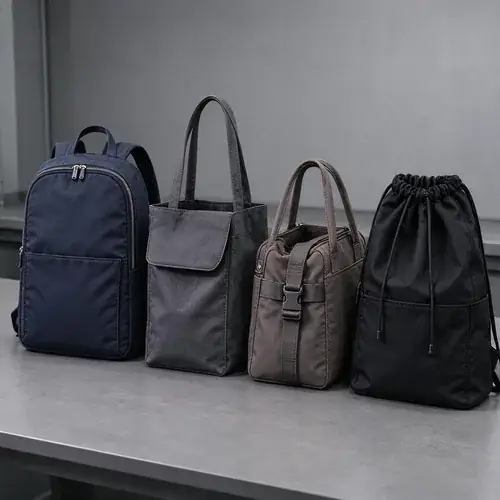
Bag closure types are not a styling afterthought. They decide how quickly a user can open a bag, how well the opening resists accidental entry, how long the product lasts in daily use, and how much assembly labor and after-sales risk you carry. In B2B sourcing, the choice usually falls to one of four systems — zippers, magnets, buckles, or drawstrings — and each one has a different failure profile, a different role in landed cost, and a different place in your spec sheet.
The wrong closure choice often lands in a return, a one-star marketplace review, or a warranty claim. A tote that pops open when it tips over in a trunk, a backpack zipper that snags the lining after a few commutes, a magnetic flap that loses grip on a double-layer PU panel — each failure travels back to a specification decision that could have been caught during sampling. This guide compares the four major closure systems using the same criteria a sourcing or product-development team should apply: security, access speed, durability under load, material and structure compatibility, production complexity, QC burden, and total after-sales risk.
By the end, you should be able to write a closure specification inside an RFQ that a factory can quote more accurately and a QC team can inspect consistently. If a supplier answers only "this closure is popular," push for the sample evidence, test method, and failure data in the sections below.
Quick Answer / 30-Second Buyer Decision
The practical rule for most OEM/ODM projects is this: choose the closure that matches the bag's opening frequency, loaded weight, and security expectation, not the closure that looks most premium on a moodboard.
- Main compartment carries weight, movement, or valuable items → start with a zipper and decide the gauge and slider detail from the load.
- One-handed access and lightweight fashion carry → a magnetic closure may work, provided the panel and flap design hold the magnet in place under torsion.
- Load-bearing strap, roll-top, or compression feature → a side-release buckle is structural hardware, not just a fastener.
- Lowest hardware count, fastest assembly, or promotional price pressure → a drawstring system works, but only if you accept the lower containment.
That order changes when the use case changes. A magnetic flap usually isn't a security closure, a buckle usually isn't a comfortable main-compartment closure on a daily backpack, and a drawstring shouldn't be treated as a theft deterrent in a crowded commuter environment. The rest of this guide explains the mechanism behind those limits.
Scope of This Guide
This page is written for brand owners, product managers, Amazon and online retailers, wholesalers, and OEM/ODM teams comparing closure systems during specification planning, RFQ drafting, and sampling. It covers bag closure selection for backpacks, totes, handbags, travel bags, promotional bags, and light industrial/cooler-style bags.
The focus is functional and procurement-driven: how closures affect security, durability, production quality, return risk, and product positioning. It does not cover luxury fashion trend commentary, decorative handbag taxonomy, deep luggage trolley and wheel engineering, or consumer "best bag" rankings. Pricing, MOQ, and lead time are deliberately excluded because they are quote-dependent and vary by hardware source, bag construction, order quantity, and destination — verify them directly with your supplier.
Quick Comparison of Common Bag Closure Types
A closure system should be shortlisted on six variables before any material spec is written: security, access speed, durability context, structural support, assembly complexity, and the type of bag where the system is most reliable. Use the matrix below as a first-pass filter, then test your shortlist against the section-specific risks that follow.
| Closure type | Security | Access speed | Durability context | Structural support | Assembly complexity | Typical applications |
|---|---|---|---|---|---|---|
| Zipper | High containment; can be lockable | Two-hand, slower unless oversized puller | Long when coil/tape, slider and stitching are specified | Low; does not carry load | Medium-high, alignment and seam finishing matter | Backpacks, laptop bags, travel bags, secure handbag main compartments, cooler bags |
| Magnetic | Low-medium; flap can open under load or torsion | Fastest, one-touch | Moderate, panel thickness and alignment dependent | None | Low-medium, but magnet placement and gap control require care | Fashion totes, phone pouches, flap pockets, cosmetic bags |
| Buckle | Medium as a flap closure, high as secondary/structural lock | Moderate, two-hand for side-release | Load-dependent; grade and anchor stitching dominate | High | Medium, multi-part assembly and anchor tacking | Compression straps, roll-tops, flap side closures, tool bags |
| Drawstring | Low; gathered opening can be pried open | Moderate-fast | Cord, channel, and cord-lock dependent | Low | Low | Gym sacks, promotional bags, some bucket bags, specialty closures |
When Zippers, Magnets, Buckles, and Drawstrings Work Best
Each system earns its place in a category, but only when matched to that category's real usage.
Backpacks and laptop bags: The main compartment and laptop compartment should use a zipper. A drawstring cinch under a flap can be a low-cost secondary closure, but it is not a substitute for the main zipper on a commuter backpack because the contents shift against the opening as the wearer moves. Fast-access front pockets may use magnets, but keep the load-bearing laptop area zipped.
Totes: Flat or shallow totes often use a magnet on a folded flap because the bag is usually carried upright and under light load. If a tote carries a tablet or laptop and regularly tips over, the magnet stops being a closure and becomes a gap. A zipper-top tote is the safer choice when the buyer says "commuter use, documents inside."
Handbags: Magnet flaps are common in fashion silhouettes because the closure is hidden and fast. The failure risk rises when the flap leather or PU is thick enough to separate the magnet halves, or when the handbag is overstuffed. Inner zip pockets protect small valuables even when the outer body is open.
Travel bags: Main compartments and expansion areas use zippers. Compression straps use buckles; those buckles are there to carry load and hold shape, not to provide burglary-level security.
Promotional and lightweight bags: Drawstring systems reduce hardware count and assembly time, which fits a price-sensitive program, but the same structure leaves the opening visibly gathered and easy to spread apart.
How Closure Systems Affect Security and Theft Resistance
Security is not a single property. It is a combination of opening coverage, force required to open, and whether the closure can fail open during normal movement. Zippers provide the most complete containment of the four common systems; magnets optimize access speed; buckles act as barriers and structural support; drawstrings expose the most opening area at the top.
| Closure type | Contained when closed | Unintended opening risk | Casual theft resistance | Where it fails in practice |
|---|---|---|---|---|
| Zipper | Full opening is joined | Low when slider is parked properly | Highest of the four | Overpacking stress, worn coil, bent slider |
| Magnetic | Flap overlap, open edges | Medium-high under twist or heavy fill | Low | Panel flex, thick stack, misaligned magnet halves |
| Buckle | Flap or strap held closed | Low once engaged | Medium-high when combined with flap | Not a barrier on its own if gap remains |
| Drawstring | Gathered mouth remains open | Medium, cinches loosen with motion | Low | Gathered opening can be spread or picked open |
Why Zippers Remain the Standard for Travel and Laptop Bags
A zipper works because it joins the entire opening, edge to edge, rather than holding a single point. That gives the main compartment a continuous line of resistance against both accidental opening and casual hand entry. On a laptop backpack, a well-fitted coil or molded zipper keeps the lid closed even when the bag tips over or the contents press outward. The slider can also be parked at an end and, if the design requires, paired with a lockable puller loop.
The security boundary is important: a standard zipper closes the opening and resists casual hand entry, but it is not puncture-resistant unless the chain, tape, and surrounding panel are specifically designed, specified, and tested for that requirement. A lockable slider deters quick entry; it does not make the bag theft-proof. B2B product descriptions should avoid absolute anti-theft claims unless the full bag construction is tested and documented.
Where Magnetic Closures Improve Convenience but Increase Risk
The appeal of a magnet is speed and a clean exterior. The trade-off is that it holds only one point, not the full opening. A flap with a single magnet can twist open when the bag is carried under one arm or overfilled. The risk increases with panel thickness: every additional layer of fabric, foam, or stiff PU between the magnet halves reduces their effective pull. In production, a magnet that felt strong as a bare hardware sample can feel weak once hidden inside a doubled flap and lining.
For buyers, "magnetic closure bags" means confirming three things at sample stage: the assembled flap thickness where the magnets sit, the alignment tolerance between the male and female sides, and whether the magnet is stitched or heat-sealed inside a dedicated pocket rather than glued. Adhesive-only magnet attachment can be a common premature failure in low-cost fashion bags.
Buckles as Structural Support vs Primary Security
Side-release buckles on a flap can add security, but their real value is load control. On compression straps, roll-tops, or shoulder-release systems, the buckle is under repeated tension and must resist pull direction, not just static closure. A buckle mounted so that the webbing pulls at an angle against the side arms tends to fail sooner than one where the load runs straight through the hardware.
When a buckle is the primary flap closure, the bag still needs a shaped flap that covers the opening. A buckle alone leaves the mouth unsealed if the opening is wider than the strap, so treat it as a latching point plus coverage, not as a zip substitute for a full compartment.
Drawstring Systems for Lightweight and Low-Complexity Designs
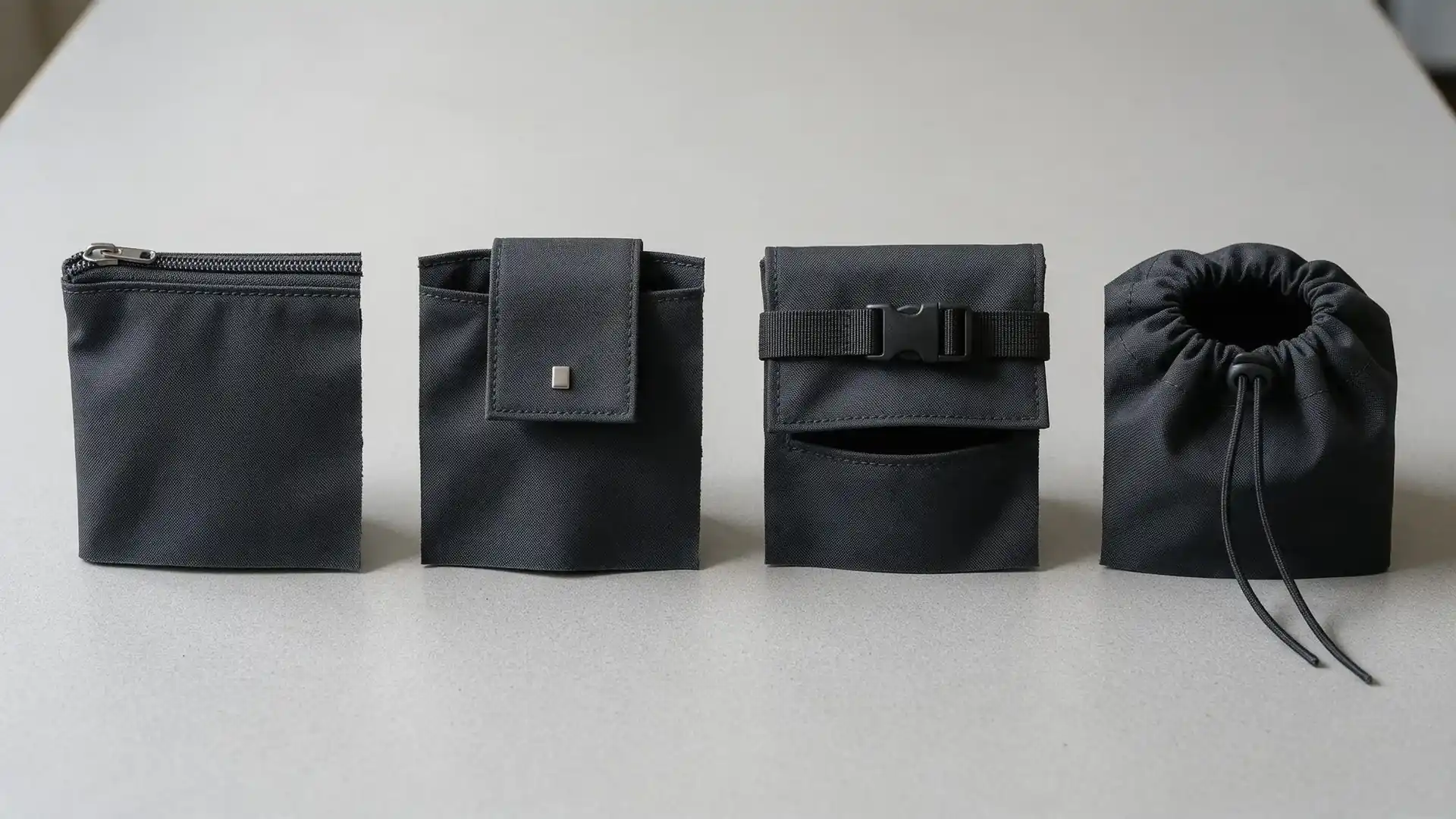
Drawstring closures reduce hardware count, which is why they appear in gym sacks and promotional bags. The failure mode is not mechanical complexity; it is containment. The gathered mouth is open at the same moment the user wants the bag to feel closed, and the cord lock can lose grip through abrasion or dirt after repeated pulls. For any bag that carries tablets, passports, or other flat valuables, a drawstring should be secondary to a zippered or flap-covered compartment.
Durability and Failure Risks Buyers Should Evaluate
Closure durability is a system result, not a single-part property: hardware quality plus stitching execution plus fabric behavior plus load and use frequency. A common sample-stage failure pattern is that the hardware is fine, but the installation fails under load. Buying an expensive zipper or branded magnet does not fix a weak seam, a misaligned panel, or an overloaded compartment. The failure table below is the part you should turn into acceptance criteria before bulk production.
| Closure system | Common failure mode | Typical cause | Prevention method | QC checkpoint |
|---|---|---|---|---|
| Zipper | Slider detaches or jams; coil separates | Bent slider lips, wrong tape offset, overpacking stress | Specify coil/molded type, gauge, tape width, end bar-tacks | Smooth open/close cycle under stuffed load |
| Magnetic | Magnet falls out or loses pull | Adhesive-only attachment, thick panel stack, misalignment | Stitched or sealed pocket, alignment guide, panel-thickness check | Pull test on assembled flap, gap inspection |
| Buckle | Side arm cracks or disengages | Low resin grade, regrind content, pull at angle, UV/impact | Choose load-appropriate material, reinforce anchor stitching | Load test along actual force direction |
| Drawstring | Lock slips, cord frays, channel tears | Low-grade lock spring, cord/channel friction mismatch | Match cord diameter to lock, reinforce channel ends | Cinch-release cycle test, channel seam inspection |
Zipper Closure Durability Depends on More Than the Brand Name
The durability of a zipper lives in four places: chain structure, tape, slider, and installation. Coil zippers are spiraled polymer monofilament and are generally flexible around corners; molded-tooth zippers have individually shaped teeth and may feel stiffer through curves, while their load performance depends on gauge and chain design. Gauge matters because it controls tooth size and strength range: lightweight bags often run a smaller gauge, while a heavy travel or tool bag can justify moving up to a larger coil or molded chain. None of this is a fixed formula — the required gauge depends on the bag's loaded weight and opening radius, so the spec should state the intended use, not just "durable zipper."
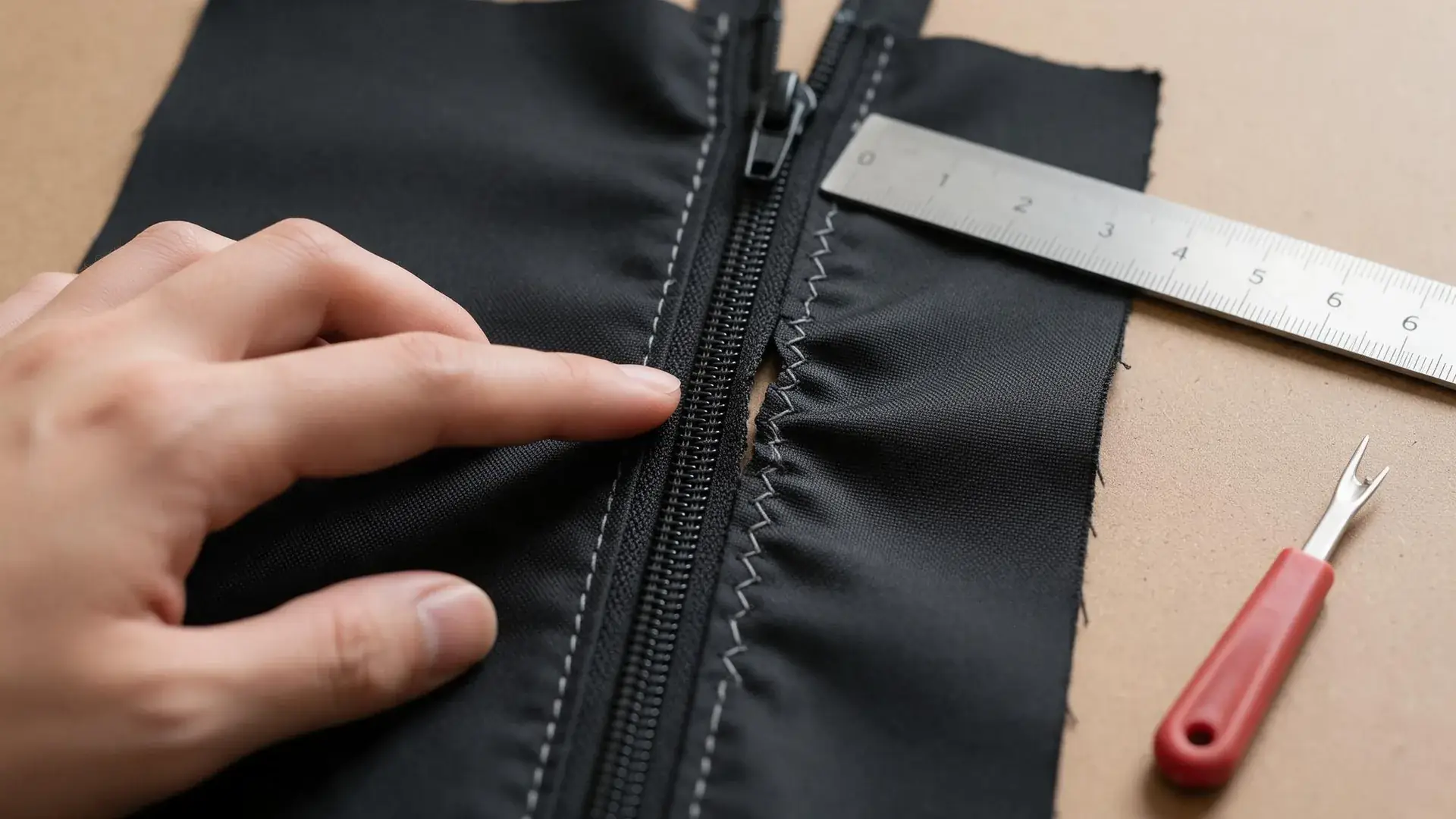
Installation is often where B2B failures hide. Weak stitch tension, missing end bar-tacks, a slider forced onto the wrong tape width, or a zipper tape sewn too close to the cut edge can each shorten life more than a hardware upgrade would fix. Buying a better zipper and then letting production save labor on the seam is a common specification error. Dig into the detailed selection logic in the Zippers for Backpacks & Luggage: The Ultimate B2B Sourcing & Cost Guide.
Common Magnetic Closure Failure Points
Three common failure points show up with magnetic closures in production. First, the magnet detaches because it is glued onto a smooth coating instead of being enclosed in a stitched or heat-sealed pocket. Second, the assembled panel stack is thicker than the magnet's useful range, so the flap sits closed but pops with a light bump. Third, the male and female halves are placed slightly apart, creating an air gap that subtracts pull force even when the bag looks aligned on the table. Ask the supplier for an assembled prototype with the final fabric layers, not a loose hardware sample, and press the flap from multiple angles.
Buckle Material and Load Direction Risks
A side-release buckle that cracks in use is usually a material or mounting problem, not a design idea problem. Cheaper buckle batches may contain recycled regrind or inconsistent resin, which reduces impact resistance and long-term elasticity. Moisture absorption in some nylon grades can change fit and feel, while POM/acetal is often chosen for lower friction and stable engagement. Even the right material can fail when the webbing pulls the buckle at an angle, because the force concentrates on one side arm instead of spreading through the mechanism. Specify the load direction and anchor stitching in the same hardware block so the buckle, webbing, and bar-tack are reviewed as one system. The Buckles & Hardware: Strength Grades, Materials & Cost Optimization Guide covers material grades and pull-strength verification in more depth.
Drawstring Wear, Friction, and User Complaints
Drawstring complaints cluster around usability, not catastrophic breakage. A cord that is too thick jams in the channel; one that is too thin slips in the lock. A lock spring that is too strong makes reopening awkward; too weak causes the cinch to loosen while the bag moves. Fabric channels can tear at the exit points if the cord is pulled at a hard angle, especially on coated polyester or thin ripstop. During sampling, open and close the drawstring repeatedly while the bag is partially loaded, and check whether the cord end is finished cleanly enough to avoid fraying inside the channel.
Matching Closure Types to Bag Materials and Structures
The same zipper or magnet behaves differently on a stiff coated polyester panel, a flexible nylon shell, a soft PU flap, or a faux-leather gusset. Material compatibility is about panel stiffness, seam allowance, edge finishing, and whether the reinforcement can transfer opening force away from the closure.
| Closure system | Material sensitivity | Structural notes | Common mistake |
|---|---|---|---|
| Zipper | Coated fabrics, PU, and high-density nylon may require wider seam allowances or reinforced edge finishing depending on panel construction and supplier pattern allowance | Edge binding and end bar-tacks reduce tape pull | Sewing zipper too tight to a stiff coated panel, causing tape ripple |
| Magnetic | PU and faux leather increase stack thickness; soft fabrics allow flap flex | Hidden magnet pocket or backing panel needed | Using adhesive on coated surface; ignoring alignment tolerance |
| Buckle | Load passes through webbing anchor, not fabric face | Box stitch or bar-tack at anchor, spread load over wide webbing | Pulling webbing at an angle through a single stitch line |
| Drawstring | Thin or slick fabrics need reinforced channel exits | Folded fabric channel, grommet or bound exit | Channel seam tearing at the cord exit point |
Fabric and Coating Considerations for Zipper Installation
Polyester and nylon take zipper installation differently. A coated polyester panel is stiffer and less forgiving when the zipper tape is sewn too close to the fabric cut edge, which can produce a wavy seam that looks bad and wears faster. A soft nylon panel is easier to feed but may need edge binding or a reinforcement strip so the zipper does not distort the opening. When a bag uses a coated or water-resistant shell, confirm that the needle puncture along the zipper seam will not create more water entry than the zipper itself.
Magnetic Closures in PU and Fashion Bags
PU and faux-leather bags are a common home for hidden magnetic closures, and also a common place where magnetic holding force disappears. A doubled faux-leather flap, a foam layer, and a fabric lining can create a stack that keeps the magnet halves from sitting close enough to latch firmly. Specify the magnet type and size in the context of the final panel stack, ask for an assembled sample rather than a loose flap, and check whether the magnet enclosure changes the visible surface — stiff PU shows a raised pocket if the magnet is too thick. When weighing materials for that flap, Faux Leather vs Real Leather Bags: Durability, Cost, Sourcing Risks & Brand Positioning explains how panel thickness and finish change construction risk.
Structural Reinforcement Needed for Buckle Systems
A buckle is only as strong as the seam holding the webbing to the bag. On roll-tops or compression straps, the load cycles through the buckle into the webbing and then into the anchor. The anchor should use a box stitch or multiple bar-tacks, and the webbing should enter the anchor at the same angle the force will travel in use. If the bag carries heavy items, a wide webbing loop or an internal strap extension spreads load across more fabric than a single short tab.
Production Cost, Assembly Complexity, and Lifecycle Business Risk
The cheapest closure at BOM level is not automatically the cheapest closure in the business. Compare landed cost and after-sales cost together: assembly time, rejection rate, packaging protection, return probability, and brand review risk.
| Cost driver | Zipper | Magnet | Buckle | Drawstring |
|---|---|---|---|---|
| Hardware unit cost | Moderate | Low-moderate | Moderate | Low |
| Assembly labor | Higher, requires alignment and seam finish | Moderate, insertion and gap check | Moderate, multi-part and bar-tacks | Low |
| Field failure exposure | Returns if slider or coil fails | Returns if flap opens or magnet drops | Failure of load path can be dangerous | Lower cost impact but usability complaints |
| Packaging sensitivity | Painted slider can scratch surface in carton | Magnet may attract nearby metal accessories in packing | Protruding buckle can press into panels | Cord can tangle in bulk cartons |
| SKU complexity | Size/color/plating variants | Magnet size and mounting style | Grade and finish variants | Cord color and lock type |
Why the Cheapest Closure Option May Increase Return Rates
A cheap closure that fails in the field can cost the entire unit twice: once as a return or refund, once as a review that suppresses a listing. Buyers should review closure-related return reasons as product hypotheses, not universal rules: zipper issues are commonly reported as broken sliders or separated coils, magnet issues as a flap that will not stay closed, and drawstring issues as a cord lock that does not hold. Each pattern is often a specification decision that looked fine on a sample table and failed when a real user stuffed the bag. The TCO view is this: an incremental hardware upgrade may cost a small per-unit amount, while a predictable closure failure consumes shipping, inspection, remarketing, and brand trust in the same transaction. Ask the supplier to price the closure option as a buyer-defined acceptance risk, not as a standalone component choice.
Hardware Standardization vs Custom Hardware Development
Standardized hardware is easier to inspect, easier to replace, and easier to reorder. Custom hardware molds or finishes make a design unique but add development time, tooling risk, and replacement-part complexity. Use stock hardware when the closure is invisible or low-branding; consider custom only when the closure is visible branding, a protected mechanism, or a size that stock hardware cannot provide. Either way, confirm whether the supplier keeps replacement hardware in stock; a custom magnet or buckle with no spare parts turns a minor field issue into a full-bag replacement.
QC Tests and Supplier Verification for Bag Closure Systems
A closure spec is useless without a defined acceptance test. The buyer should not rely on "it opens and closes smoothly" alone; define the cycle count, load direction, and inspection level before the golden sample is signed.
| QC check | What to verify | How to inspect | Buyer acceptance example |
|---|---|---|---|
| Open/close cycle | Smooth travel, no catching | Repeated full open-close under representative load | Buyer-defined count across all colorways |
| Pull force | Hardware does not separate unexpectedly | Pull along actual use direction, record strain | Confirmed at golden sample, not bare hardware |
| Alignment | Zipper teeth/coil meet, magnet halves align, buckle arms seat fully | Visual close-up on closed product | No visible gap or uneven tape |
| Stitch reinforcement | Bar-tack length, box stitch, seam tension | Check each anchor and zipper end | Stitches count matches approved sample |
| Finish consistency | Plating color, coating, edge smoothness | Compare against approved hardware swatch | No visible color shift or sharp burr |
| Corrosion | Rust or degradation risk on plated metal | Only if supplier confirmation requires it | Buyer-defined humidity/salt exposure if applicable |
Questions Buyers Should Ask During Sampling
When the sample arrives, ask the supplier these rather than checking it off a box:
- Is the closure assembled with the final fabric, lining, and padding stack, or only a loose hardware sample?
- What gauge, coil type, tape width, and slider material were used in this exact sample?
- How is the magnet enclosed — stitched pocket, heat-sealed backing, or adhesive?
- Can the supplier show the same side-release buckle with the exact webbing and stitch configuration that will run in bulk?
- What is the supplier's standard closure cycle or pull test, and will bulk production be checked to the approved sample or to a looser standard?
What to Include in a Closure Hardware Approval Sheet
A one-page approval sheet reduces the "sample vs bulk" ambiguity. Include the closure type, size, material grade, finish or plating, attachment method, stitch count at anchors, alignment tolerance, and any inline or final inspection standard. Photograph the approved sample from the closure side and store it with the hardware spec sheet. That sheet becomes your reference when the bulk run arrives, and it is the document a third-party inspector should compare against.
RFQ Checklist for Closure System Development
This is the information a supplier needs to quote and sample the closure correctly. Include as many of these fields as the development stage allows; the right-hand column is where your team should fill in the buyer-defined value.
| Field | Your input / options |
|---|---|
| Bag category | Backpack, tote, handbag, travel bag, promotional bag, other |
| Closure type by location | Zipper, magnetic, buckle, drawstring, combination |
| Main opening size | Width and radius in buyer-defined units |
| Main material and panel thickness | Fabric, coating, PU/faux leather layering |
| Lining | Material and whether it sits inside the closure path |
| Intended load weight | Maximum loaded weight for the compartment |
| User scenario | Daily commuter, travel, gym, fashion, promo giveaway |
| Security requirement | Light containment, casual deterrence, lockable closure |
| Water-resistance expectation | Splash resistance or full waterproof construction |
| Hardware color / finish | Plating, coating, matte or gloss |
| Logo method if near closure | Embossing, plate, print, label placement |
| Packaging requirement | Polybag, carton, protruding-hardware protection |
| Inspection standard | AQL level, cycle count, pull-force method |
| Sample approval process | Prototype, pre-production sample, golden sample |
| Replacement-part availability | Whether spare sliders, magnets, buckles or locks are kept |
FAQ About Bag Closure Types
These questions recur in OEM product-development conversations, usually after the first sample but before bulk production. The answers below are written for buyers making a spec decision, not for end consumers comparing finished products.
Which bag closure type is the most durable?
It depends on the load and installation, not on a universal ranking. A correctly installed, correctly sized zipper usually lasts longer under repeated stress than a magnet or drawstring because it joins the full opening and spreads force along the seam. But a heavy gauge zipper on a flexible fashion tote can be oversized and cumbersome, while a well-enclosed magnet on a light flap can outlast a poorly stitched zipper. Durability comparison means something only at the same panel thickness, load, and opening frequency.
Are magnetic closure bags suitable for travel products?
Only in limited positions. A magnetic pocket or a small flap closure may work on a travel bag's front organizer, but it should not be the only closure for a main compartment that holds documents, tablets, or clothing. The compartment shifts orientation through transit, and a single magnet point can separate when the bag is overstuffed or twisted. For travel main compartments, use a zipper and treat any magnet as a secondary fast-access flap.
What closure type works best for laptop backpacks?
A zipper. The laptop compartment should be fully enclosed with a continuous zipper, preferably with a protective lip or false floor rather than the zipper teeth pressing directly onto the device. A magnetic flap on the same compartment adds speed but not protection; the laptop compartment is the one place where you actively want maximum containment over fast access.
Are water-resistant zippers fully waterproof?
No. A water-resistant zipper uses a coated or treated tape and often a reverse coil to reduce splash entry, but it is not automatically watertight. A waterproof closure requires a welded or coated zipper tape and fully sealed construction around the zipper, not just a water-resistant chain sewn into a standard seam. Be specific in the RFQ about the difference; suppliers sometimes use "water-resistant" loosely because it costs less and photographs the same.
How can buyers reduce zipper failure risk in bulk production?
Move the decision from hardware brand alone to a complete installation spec: chain type, tooth gauge, tape width, slider material and plated finish, stitch density at the zipper seam, end bar-tacks, and a buyer-defined open/close cycle test on a stuffed sample. Then approve a golden sample and compare bulk production to that sample, not to a new bare hardware pull. Use Why Zippers Break: Material, Design, Stitching & Quality Issues Explained to connect each installation spec to the failure mode it is meant to prevent. If the supplier cannot state the zipper installation details in the spec sheet, treat that as a red flag even when the hardware itself looks fine.
Official Sources and Compliance References
Zipper and closure terminology in this article follows standard industry usage you can cross-check through supplier technical datasheets and the technical reference material published by zipper hardware manufacturers. That material supports the practical structural terms — coil chain, molded teeth, slider body, tape, gauge, puller, end stop, and bar-tack — used in closure specifications. It does not, by itself, confirm a buyer's exact pull strength or cycle requirement.
For any closure-related test, use your own buyer-defined acceptance criteria. Common references like ASTM or ISO test methods may apply depending on the product category, target market, material contact, and the buyer's latest compliance requirements, but no test standard should be assumed from a blog page. Confirm the appropriate method, sample size, and pass/fail threshold in writing with your supplier or a third-party QC provider before bulk inspection.
Conclusion
Final closure selection should land on the system that best matches the bag's opening frequency, loaded weight, security expectation, and material stack — and then be documented as an installation and QC requirement, not as a single hardware part number. Bag closure types are a risk-management decision as much as a design decision.
For most B2B buyers, the default starting points are simple: zipper for load-bearing or security-sensitive main compartments, magnet for fast-access fashion flaps, buckle for any strap or roll-top that carries force, drawstring for low-hardware promotional or gym applications. The moment a supplier says "this closure is fine," ask them to prove it on an assembled sample with the final fabric, lining, and padding. That one request catches many of the closure failures that would otherwise reach the marketplace as a return.
Get A Quote

Get A Quote
0 Comments