
Bag Customs Clearance: How Importers Prevent Holds & Compliance Errors
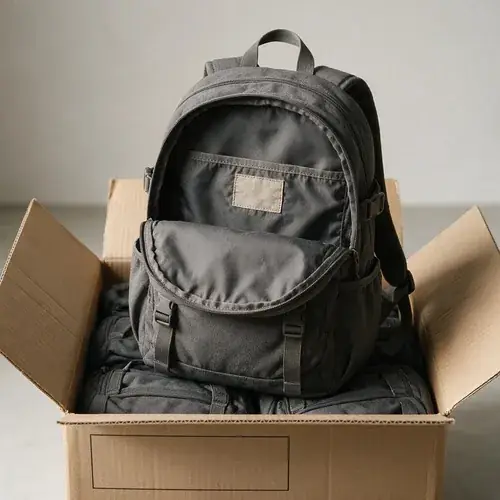
A customs-ready bag shipment means one consistent story across the Commercial Invoice, the physical cartons, the product labels, and the test reports—before the goods ever leave the loading dock. Bag customs clearance usually fails on paperwork, not freight handling. The trigger is usually a buyer approving a sample without checking the Country of Origin label, accepting a vague material description on the invoice, or letting the supplier ship with a fiber-content tag that doesn't match the actual fabric.
The financial pain shows up at the port—demurrage, storage, relabeling under customs supervision, missed Amazon or retail delivery windows—but the root cause was locked in earlier during the purchase order and golden sample. A container sitting in exam status can cost more than the freight itself once you add the downstream supply chain damage.
This guide gives importers a prevention framework: the documents to demand, the physical labels to lock into sample approval, the testing triggers that differ by bag type, the Importer of Record boundary nobody should outsource blindly, and a pre-shipment checklist you can hand to your inspector before the container is loaded. Use it before you issue the PO, not after the goods sail.
Quick Answer: What Makes a Bag Shipment Customs-Ready
The Importer of Record owns legal responsibility for bag customs clearance—not the factory, and not automatically the forwarder unless you've specifically arranged that role in writing. So the practical question is: what do you force the supplier to prove before mass production and before final loading?
Work through these six gates and you remove the most avoidable customs holds:
- Confirm your HS code with a licensed customs broker, using the exact outer-surface material, fiber composition, construction, and intended use of each SKU.
- Mandate a permanent "Made in [Country]" label on every bag, with placement and attachment method approved on the golden sample.
- Require a fiber-content label that matches the physical fabric and the Commercial Invoice description, especially for textile backpacks and duffels.
- Identify whether the bag triggers a product-safety rule—children's backpack, food-contact cooler bag, exotic leather—and request the matching third-party test report.
- Write into the PO that the supplier must issue a true and accurate Commercial Invoice and must not under-declare value.
- Photograph labels, tags, and carton marks during final inspection and match them to the Packing List and Bill of Lading.
If you do nothing else, do those six. Customs clearance becomes a verification exercise at the factory gate, not a panic call after the vessel departs.
Scope of This Guide
This page covers B2B bag importers—brand owners, marketplace sellers, wholesalers, and procurement managers—who buy backpacks, laptop bags, travel bags, duffels, luggage, trolley bags, cooler bags, school bags, and promotional bags internationally, primarily into the US and EU. The focus is customs and border risk management: preventing shipment holds, compliance flags, and documentation errors before cargo reaches the destination border.
What this guide deliberately does not do is give exact duty rates, fixed HS code numbers, guaranteed clearance timelines, or legal advice. Those are project-specific, material-dependent, destination-dependent, and require a licensed customs broker or compliance professional. The guide also does not cover regulated products far outside general bag sourcing, such as medical transport devices or specialized hazardous-material packaging.
Why Bag Customs Clearance Goes Wrong: The Holds Importers Hit Most Often
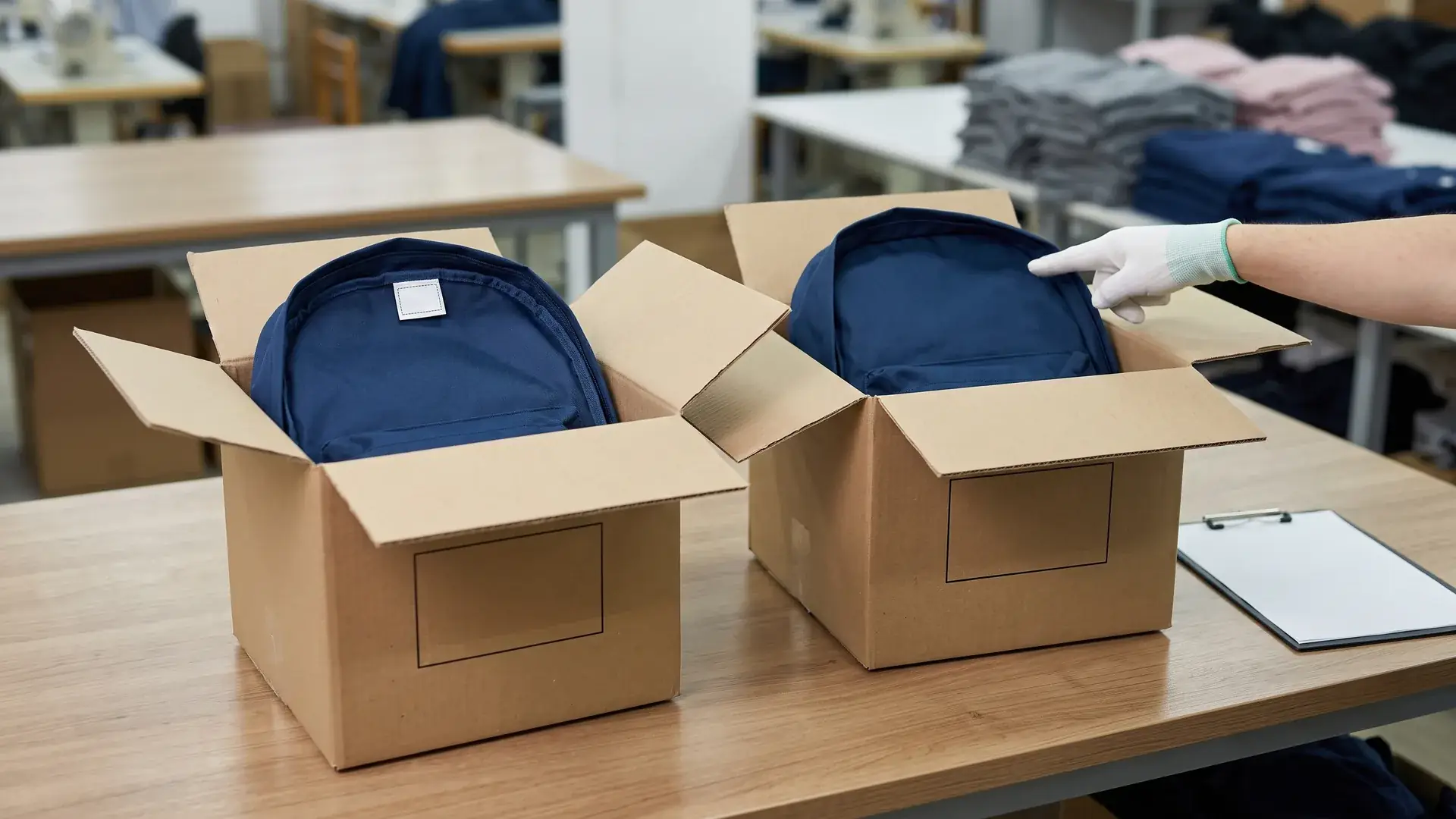
Most bag import holds trace back to three fixable errors, and all three are discoverable before the container arrives: HS classification mismatch, missing Country of Origin marking, and document inconsistency.
HS code mismatch is the most expensive guessing game in bag sourcing. The correct classification depends on the outer surface material and the product's function. A backpack with a polyester woven outer shell can sit in a different provision than a backpack with a leather or plastic-sheet outer surface. A laptop bag with a dedicated padded computer compartment may classify differently from a plain travel backpack. The supplier often puts a generic code on the invoice, or a code that was "close enough" on the last order—and the broker catches it after the goods land. At that point the entry may be rejected, amended, or pulled for physical exam while storage charges accrue.
Missing Country of Origin marking is the most visible physical hold. The US requires imported articles to be marked conspicuously, legibly, indelibly, and permanently with the English name of the country of origin. A woven label stitched into an inner seam works. A loose paper hangtag usually does not satisfy the permanence requirement, because it can be removed. If the label is missing at the port, customs can require relabeling under supervision at the importer's expense—or refuse the goods.
Document inconsistency is the easiest thing to prevent and the most common thing buyers skip. The Commercial Invoice quantity must match the Packing List exactly, and both must match the physical cartons and the Bill of Lading. Under-declaring the invoice value to reduce duties is not a savings strategy; it's a red flag that invites examination, penalties, and a customs record that follows the importer on future entries.
The commercial mechanism is straightforward. A customs hold does not end when the inspector looks at the goods—it extends through a document request, an exam, a broker's response, and a release. Each day can add terminal storage, demurrage, trucking waits, and missed customer deadlines. For a B2B buyer, the landed cost impact of a hold is often larger than the product's unit margin on the order.
Essential Customs Clearance Documents for Bags
Entry clearance runs on a small document set, and the problem that triggers an exam is almost always a mismatch between documents rather than a missing sheet. The broker needs the Commercial Invoice, Packing List, and Bill of Lading or Air Waybill to line up on quantity, weight, consignee, and description; the Certificate of Origin and any test reports layer on top depending on the product and destination.
| Document Name | Provided By | Purpose in Bag Import | Common Error to Avoid |
|---|---|---|---|
| Commercial Invoice | Supplier / exporter | Declares true value, material composition, quantities, Incoterm, buyer and seller | Vague descriptions ("gift bag"), undervaluing, missing fiber breakdown |
| Packing List | Supplier / exporter | Carton-by-carton quantity, dimensions, and gross/net weights | Quantities don't match invoice or actual loaded cartons |
| Bill of Lading / Air Waybill | Freight forwarder / carrier | Contract of carriage; names consignee and notify party | Consignee mismatch, marks different from packing list |
| Certificate of Origin | Supplier / chamber of commerce | Supports country-of-origin marking and any preferential duty claims | Incorrect origin statement, missing for trade program claims |
| Customs bond / broker authorization | Importer / broker | Authorizes the broker and guarantees duties to the customs authority | Not in place before cargo arrives |
The Commercial Invoice deserves special scrutiny because it is both a customs document and a commercial record. It should identify the buyer and seller, give a precise product description by material and function, show unit quantities and totals, state the Incoterm and currency, and avoid any language the supplier guessed. "Promotional bag, assorted" tells customs nothing about the outer surface, the end use, or whether a product rule applies—so it invites an exam.
Ask your supplier for document drafts before loading, not after. A Packing List error caught before loading costs an email; the same error found at destination costs days of demurrage and a broker amendment.
Bag Labeling & Marking Compliance (US & EU Focus)
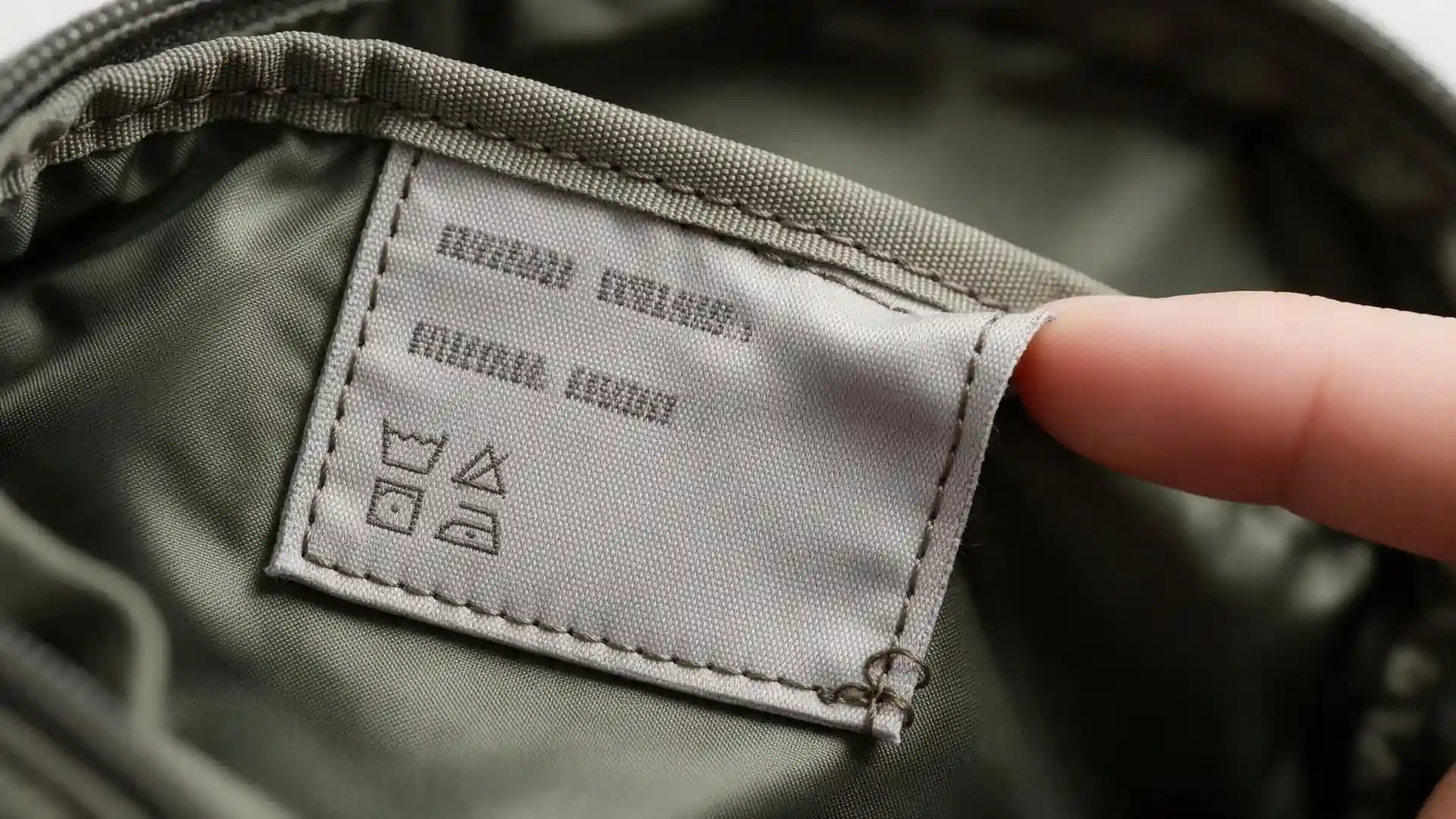
Physical labeling is part of bag customs clearance, not a packaging afterthought. The US rules put the burden on the importer to ensure each article is permanently marked before entry, and the EU textile rules put the burden on getting the fiber names and percentages correct.
Country of Origin marking first. Under US law, every article of foreign origin must be marked with the English name of the country of origin in a conspicuous place, as legibly, indelibly, and permanently as the nature of the article permits. For bags, that usually means a woven or printed label stitched into a main seam, or a heat-sealed tag that cannot be removed without damaging the product. A sewing label stitched on all four edges is the safest physical form; a swing tag hanging from a webbing loop is not a reliable substitute. Approve the exact label artwork, size, thread color, and seam location during sample approval so the bulk factory has one locked reference.
Textile fiber content next. For many textile bags sold into the US, the FTC's Textile Fiber Products Identification Act governs fiber-content disclosure. The label typically lists fibers by generic name in descending order of weight—such as the shell, lining, and trim breakdown—along with the manufacturer or dealer identity and the country of origin. The percentages on the label must match the material actually cut into the bag. A label that overstates polyester content on a bag with a cotton lining creates both a customs risk and a marketplace return risk. Whether a specific bag falls under the TFPIA label requirement depends on its construction and intended use, so confirm applicability with your supplier and a compliance reviewer before bulk cutting.
Care labeling is conditional. Care instructions are mandatory for most apparel and some textile products, but not every bag type automatically requires a care label. Confirm the requirement for your exact product; if it applies, add the care icons to the same stitched label rather than printing a second loose tag.
EU logic is slightly different. The EU textile fiber labeling regulation requires fiber composition labels for textile products sold in the EU, using the correct fiber names and percentages. Country-of-origin marking is not a uniform EU-wide requirement across all bags, but individual member states and marketplace policies may demand it. Buyers shipping to France, Germany, or Spain should confirm whether the destination's rules or the customer's purchase order impose a stricter country-of-origin requirement than the product currently carries.
This is the point where a customs error becomes a production error. If the label is wrong on the golden sample, it will be wrong on every unit. Use the Bag Sample Approval Checklist for B2B Buyers: Verify Before Mass Production as the control point for label artwork, attachment method, and seam placement—once bulk fabric is cut, relabeling a full order is not a trivial fix.
Material Testing & Regulatory Compliance by Bag Type
The testing an importer needs depends on who uses the bag and how—not on whether the product "feels safe." Customs agencies do not test every unit, but they can and do select goods for examination based on product type, documentation, and the importer's history. The right question is whether your bag type triggers a mandatory rule, a discretionary risk, or no specific rule at all.
Children's Bags and CPSIA
A school backpack marketed primarily to children 12 and under is likely a children's product under US law and may be subject to CPSIA lead and phthalate limits. The applicable thresholds cover lead in surface coatings and accessible component parts, plus restrictions on certain phthalates in applicable components; confirm the current limits against the version of the rule your lab uses. Children's products subject to these rules typically require third-party testing at a CPSC-accepted laboratory, a Children's Product Certificate, and a permanent tracking label identifying the manufacturer and batch. The exact scope depends on which components—zipper pullers, coatings, printed fabrics, plastic buckles—are actually accessible to the child. Do not assume a promotional kids' bag is exempt because it's "just a bag"; confirm the age grade and applicable test matrix before the supplier ships.
Cooler Bags and Food-Contact Linings
A cooler bag that carries sealed beverage containers is different from one whose liner is designed to touch food or ice directly. If the liner is intended or reasonably expected to contact food or beverages, US FDA food-contact requirements may apply to that liner material and any coatings or adhesives. The supplier should provide material documentation for the liner film—such as its polymer formulation and any food-contact compliance letter—rather than just saying "food safe." If the bag only holds sealed cans or sealed food packaging, the food-contact requirement may not attach at all. The point is to define the intended use in the purchase order and get the supplier to confirm, in writing, which materials need documentation.
Exotic Leathers and CITES
Bags made from certain exotic species—some reptiles, snakes, crocodilians, or other regulated wildlife—may require CITES permits or certificates before import. The sensitivity is species-specific and depends on both the origin and destination country. If your brief mentions "genuine exotic leather," ask the supplier to identify the exact species and supply the corresponding CITES documentation; if the supplier cannot name the species, treat that as a material risk.
Metal Hardware: Zippers, Pullers, and Sliders
Zipper compliance testing means two different things, and buyers blur them at their own cost. Regulatory compliance asks whether the metal or coated zipper contains regulated substances: lead in accessible coatings or substrates for a children's bag, nickel release for metal parts with prolonged skin contact under EU REACH, restricted azo colorants in certain dyed textile or leather components, or SVHC obligations under the EU candidate list. Mechanical performance asks whether the zipper can withstand repeated opening, crosswise pull, and slider retention—a quality and returns issue, not a customs entry issue. Customs cares about the chemistry; your customer cares about the zipper holding up in daily use. A lab can test both, but request them as separate scopes: regulatory tests for entry compliance, mechanical tests for durability.
For EU-bound bags, REACH is the umbrella to ask about. Metal zipper pulls and buckles intended for direct and prolonged skin contact may need nickel-release testing; dyed textile or leather parts that contact skin may trigger restricted aromatic amine checks; and the supplier should confirm whether any SVHC above the reporting threshold is present in the finished article. These are not automatic for every bag—a polyester backpack with plastic hardware may have no such trigger—but the buyer should ask the question and get a written answer.
Incoterms & Importer of Record (IOR) Responsibilities
The Importer of Record is the legal entity responsible for ensuring the bag shipment complies with destination customs laws, pays the duties, and holds the documentation. In most international bag orders, that entity is the buyer—even when the factory arranges the shipping and someone else pays the freight bill.
Under EXW, FOB, or CIF, the buyer handles destination clearance through a broker and is plainly the IOR. The supplier's job ends at the factory gate, the port of loading, or the port of destination freight point, depending on the term. Under DAP, the seller delivers to a named destination but the buyer still handles import clearance. Under DDP, the seller nominally covers duties and delivery, but there is a trap importers repeatedly hit: the forwarder or supplier may clear the goods using the buyer's tax ID or company name as the consignee. In that case, the buyer is still the Importer of Record on paper, which means the buyer remains responsible for the entry even though someone else collected the freight money.
The practical rule: never assume the factory "took care of customs." Ask exactly one question in writing before the PO—"Who is named as the Importer of Record on the destination entry, and whose tax ID or company number is used?" If the answer is yours, you own the compliance even when the salesperson says DDP. That's not nitpicking; that's where liability lives. For a deeper treatment of how the shipping term changes freight, duty, and risk allocation, see Shipping & Incoterm Mistakes: FOB, CIF, EXW, DDP and Freight Cost Risks Explained.
One more PO-level action matters more than most buyers realize: add a clause stating that the supplier must not under-declare the commercial value of the goods. Suppliers sometimes under-declare to "help" the buyer pay less duty. It doesn't help—it shifts legal risk to the buyer and gives customs a reason to examine every future entry. State it plainly in the purchase order and make the supplier acknowledge it in writing.
Pre-Shipment Customs Checklist for Bag Buyers
Customs checks belong inside your final inspection routine, not in a separate compliance meeting after the goods load. Fold these items into Final Quality Control and loading supervision, and require the inspector to photograph each one with the carton number visible.
- Confirm HS codes in writing from a licensed customs broker for the exact outer material, fiber composition, and use of each SKU.
- Verify "Made in [Country]" labels are permanently stitched or heat-sealed in the approved position on sampled cartons across every color.
- Check that fiber-content tags match the actual shell and lining fabrics and the Commercial Invoice description.
- For children's bags, confirm third-party test reports and the Children's Product Certificate are in hand before the container closes.
- For cooler bags, confirm the food-contact material documentation matches the liner actually used in production.
- Match Commercial Invoice quantities exactly to the Packing List and the physical carton count.
- Verify carton shipping marks match the Packing List and Bill of Lading or Air Waybill.
- Confirm consignee name, address, and notify party on the B/L exactly match the broker's instructions.
- Check that any barcode, GTIN, or marketplace label printed on packaging matches the listing and the packing data.
- Include label and carton-mark photographs in the final inspection report for your customs file.
The inspection angle is deeper in Bag Quality Control Checklist for Buyers, but the customs-specific message is simple: if the label, the carton, and the invoice don't agree at the factory, they won't agree at the border.
Supplier Verification: Test Customs-Readiness Before You Send the PO
Pick a bag supplier on their willingness to produce customs-ready documents and permanent labels, not just on the lowest unit price. A supplier that resists accurate labeling or offers to "reduce the invoice" is transferring legal risk to you for a short-term apparent duty saving.
Ask these questions before you issue the PO, and get the answers in the quote or email thread:
- Can you permanently stitch our country-of-origin and fiber-content labels in the approved position, and provide label artwork for approval before bulk?
- Will you issue a true and accurate Commercial Invoice showing the real value, materials, and quantities, with no under-declaring?
- Can you provide an exact fiber breakdown by percentage and weight for the shell, lining, and trim, and confirm it matches the label?
- For children's bags, will you supply third-party test reports for CPSIA scope and issue the required tracking information?
- For cooler bags, can you provide food-contact documentation for the liner film and adhesive if food contact is intended?
- Will you share a Packing List draft before loading so we can reconcile quantities and carton marks in advance?
Some supplier behaviors are hard stop signals: offering to under-declare value, refusing to share material composition, or claiming "no labels are needed for your country" without checking. Those are precisely the patterns covered in 15 Red Flags to Identify Unreliable Bag Manufacturers Before You Order. Customs-readiness is just another name for supplier professionalism, and it shows up in the paperwork before it ever shows up in the product.
RFQ Checklist: Customs-Ready Bag Sourcing
Send these fields to OMASKA or your shortlisted factory so customs-readiness can be quoted and confirmed, not assumed. The right column is where the buyer defines the requirement; the supplier must confirm it in the quote.
| Field | Specify or Confirm |
|---|---|
| Bag type and SKU | Backpack, laptop bag, duffel, luggage, cooler bag, school bag, promotional bag |
| Target market / import country | US, EU member state, UK, Canada, Australia, other |
| Order quantity | Buyer-defined quantity and shipping plan |
| Incoterm | EXW / FOB / CIF / DAP / DDP |
| Importer of Record | Who is named on the entry, and whose tax ID is used |
| HS code basis | Proposed code by broker, with outer material and function confirmed |
| Fiber composition | Shell, lining, trim percentages to be printed on the label |
| Country of Origin marking | Stitched or heat-sealed label, position, size, and text |
| Required testing | CPSIA / REACH / food contact / CITES / mechanical durability |
| Labeling approval | Artwork proof, placement photo, golden sample sign-off |
| Carton marks | Shipping mark format and match to B/L |
| Commercial Invoice policy | True value declaration, no under-declaring |
| Pre-shipment documents | Invoice, packing list, B/L/AWB, COO, test reports |
| Inspection | Final QC to include label, tag, carton mark, and quantity photo verification |
| Delivery timeline | Sample and bulk deadline, buyer-defined and confirmed |
This table works as a supplier screening document. If a factory can't answer the labeling, testing, and documentation rows confidently, it will be hard to make the shipment customs-ready after production starts.
FAQ: Bag Customs Clearance and Import Compliance
These are the questions importers most often ask once they realize the product, not the vessel, causes the hold.
What documents are needed to import bags?
The core set is a Commercial Invoice, a Packing List, and a Bill of Lading or Air Waybill. Depending on the product and destination, you may also need a Certificate of Origin, a third-party test report for regulated bags such as children's backpacks or food-contact cooler bags, and a customs bond or broker authorization. The documents are less important than their consistency: invoice quantity, packing list, carton marks, and the Bill of Lading must all match.
What is the correct HS code for bag customs clearance?
There is no single correct code for "bags." The Harmonized System classification depends on the outer surface material—woven textile, coated fabric, leather, rubber, plastic sheeting—plus the product's function and construction. A cotton canvas tote, a polyester laptop backpack, and a polycarbonate hard-side suitcase each follow a different classification path. A licensed customs broker should confirm the code using photos, exact material composition, and the product's intended use before mass production.
Do bags need a "Made in" country of origin label?
For bags entering the US, yes. US law requires the English name of the country of origin to be marked conspicuously, legibly, indelibly, and permanently on the article. A stitched woven label in the main seam is the standard practical solution. In the EU, textile products require fiber composition labels, while country-of-origin marking requirements can vary by member state; many importers add the origin label anyway for customer and marketplace requirements.
What are the customs requirements for children's backpacks?
If the backpack is marketed primarily to children 12 and under, it is likely a children's product and may trigger US CPSIA requirements—lead limits in accessible parts and coatings, phthalate restrictions, third-party testing at a CPSC-accepted laboratory, a Children's Product Certificate, and a permanent tracking label. The exact test scope depends on the components and age grade. A generic promotional bag given to adults is not automatically a children's product just because children might touch it.
Can my supplier handle customs clearance for me?
Only under specific Incoterms such as DAP or DDP, and only through a licensed customs broker or forwarder. Even under DDP, the supplier or forwarder may clear the goods using the buyer's tax ID, which keeps the buyer as the Importer of Record legally responsible for the entry. Buyers should always ask in writing who is named as the Importer of Record and whose tax ID or company number appears on the destination entry.
What happens if my bags are missing the "Made in" label?
Customs may hold the shipment, require relabeling under supervision at the destination—usually at the importer's expense—or refuse entry. The hold triggers terminal storage, demurrage, and delivery delays in addition to the relabeling work. The fix is a pre-shipment inspection that confirms the label exists on every bag and every carton, because fixing it at the port is always slower and more expensive than fixing it at the factory.
Official Sources and Compliance References
These are the governing authorities and regulations referenced in this guide. Each one is relevant to a different layer of bag import compliance, and importers should confirm current scope with the appropriate agency or a qualified compliance professional.
- US Customs and Border Protection (CBP): country-of-origin marking rules, entry requirements, and the Importer of Record framework for goods entering the United States.
- Federal Trade Commission (FTC): Textile Fiber Products Identification Act and care-labeling requirements for textile products sold in the US.
- US Consumer Product Safety Commission (CPSC): CPSIA lead and phthalate limits, children's product certification, tracking labels, and third-party testing requirements.
- US Food and Drug Administration (FDA): food-contact material compliance for cooler bag linings and other components intended or reasonably expected to touch food or beverages.
- CITES authorities / US Fish and Wildlife Service: permits and certificates for bags made from regulated wildlife species and exotic leathers.
- European Chemicals Agency (ECHA) / REACH: EU chemical restrictions, including nickel release, restricted azo colorants, and SVHC obligations for imported articles.
- EU textile fiber labeling regulation: mandatory fiber composition labeling for textile products sold in the EU.
Conclusion: Make Customs a Factory-Gate Decision
Bag customs clearance is decided long before the container reaches the border. It's decided when you confirm the HS code, lock the stitched label into the golden sample, demand matching documents, and put the six pre-loading gates into your final inspection. Every hold, exam, and relabeling bill you prevent is margin you keep—and every shipment you push through without a customs-ready file is a commercial risk you chose to carry.
Don't treat customs as the forwarder's problem or the factory's afterthought. Write the labeling, testing, and documentation requirements into the RFQ, verify them in sample approval, photograph them at final QC, and confirm the Importer of Record in writing before the PO. If the paperwork, the labels, and the cartons agree at the factory, they have a much better chance of clearing at the port.
Get A Quote

Get A Quote
0 Comments