
Drone Backpack Design Guide: EVA Protection, Divider Systems & Fit Testing
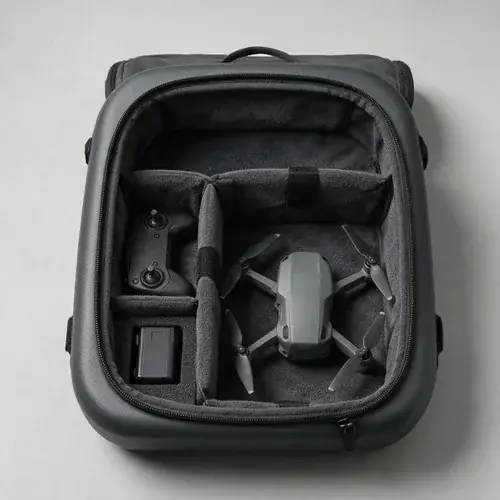
A drone backpack is not a camera bag with a few extra dividers. It is a specialized equipment carrying case that must protect the gimbal and inertial measurement unit from vibration, isolate heavy LiPo batteries from folding rotor arms, and still close without forcing the zipper or compressing the drone. This guide helps product managers and sourcing teams evaluate molded EVA drone case protection against soft-shell designs, specify divider layouts and foam density, and run loaded equipment fit tests before approving the pre-production sample.
The commercial risk of getting this wrong shows up after the first shipment reaches customers. Units come back with damaged gimbals, crushed rotor arms, or zipper bulges because a battery shifted during transit. For Amazon sellers and branded marketplace channels, those failures turn into return rates, reviews about poor protection, and a product line that never earns repeat purchase trust. The heavier cost is not the shell price — it is the landed cost of remaking, repacking, or replacing inventory after the first production run.
Before you send an RFQ to a drone backpack manufacturer, you need to make three decisions in order: which exterior shell strategy fits your volume and protection requirement, which internal zones carry the most damage risk, and which fit-test photographs and force checks you will require on the pre-production sample. The sections below follow that same decision path.
Quick Answer: The 60-Second Drone Backpack Specification
If you're short on time, here is the decision sequence that keeps most projects out of trouble.
For a fragile consumer or prosumer drone with an exposed gimbal and folding arms, start with a molded EVA drone case or a semi-rigid EVA-backed shell. Build the divider system around actual measured equipment, not generic category dimensions. Keep LiPo batteries in a separate, closed, high-density foam pocket positioned away from the gimbal and rotor arm edges. Then specify a loaded fit test on the pre-production sample: equipment must seat without forcing, the zipper must clear every corner with no bulge, and the filled case must survive a shake or lift check without the battery pack moving against the drone.
If the drone is light, the gimbal is guarded or removable, and the unit ships inside a strong outer carton, a soft-shell camera divider backpack with PE board reinforcement may be enough. If the product will ship alone in a polybag or be presented as premium retail, move to the molded EVA route.
What you don’t do is copy a standard camera backpack layout and call it a drone bag. The core failure mode is specific: a LiPo battery behaves like a dense hammer during transport, and a gimbal behaves like a fragile pointer. If those two share a cavity, the gimbal loses.
Scope of This Guide
This guide covers how a brand or sourcing team should specify exterior protection, divider systems, foam density, fit testing, and RFQ inputs for a drone carrying case or backpack. It applies to product managers evaluating OEM/ODM production, Amazon sellers preparing a first order, and distributors replacing an existing camera-style bag that has returned too many damaged units.
It does not cover drone flight logic, battery charging safety, drone operation manuals, or generic travel backpack styling. It also does not quote fixed mold fees, MOQs, or lead times because those numbers are project-specific and depend on cavity geometry, order volume, material grade, and the supplier's production schedule.
Why Drone Backpacks Require Specialized Equipment Protection
A standard camera bag fails on a drone because the load is not only fragile — it is also dense and mechanically exposed. Three distinct failure modes drive the design.
First, the gimbal is a suspended, sensitive assembly. It is one of the most damage-sensitive assemblies during transport and one of the most likely parts to arrive misaligned or broken if something hard presses against it. A camera bag's padded dividers are usually designed for lens barrels and camera bodies, not for a gimbal that protrudes from the front of the aircraft.
Second, LiPo batteries are heavy relative to their size. A battery pack that weighs a significant fraction of the drone's body weight can become a concentrated point load when the package is dropped or thrown during transport. The same soft divider that protects a lens from light contact will not stop a battery from sliding into a rotor arm hinge.
Third, the inertial measurement unit, or IMU, may not show visible damage. Prolonged or repeated vibration during transport can affect calibration confidence or force the user into a recalibration sequence. That does not create a dramatic unboxing failure, but it creates a support burden and a poor first-use experience. A drone backpack therefore needs to manage shock, mass isolation, and vibration attenuation at the same time, not just organize gear.
In my experience, the most common field failures from brands are not random material defects. They are predictable combinations: a heavy battery pocket placed above the gimbal, a lid that presses directly onto a folded rotor arm, a zipper that fights the equipment at the corner because the cavity is a few millimeters too shallow, and a handle that tears because the loaded case was tested empty.
Molded EVA vs. Soft-Shell: Choosing the Right Exterior
The exterior decision controls how predictable the protection cavity is, how much tooling investment is involved, and how the bag performs when the drone ships without a large outer carton around it.
As a practical position, choose a molded EVA drone case when the drone has an exposed gimbal, the accessory kit includes one or more dense batteries, or the product is intended as premium retail. Choose a soft-shell camera divider backpack when the drone is light, the gimbal is guarded or removable, and the unit will ship inside strong outer packaging.
Thermoformed EVA shells give you a semi-rigid, repeatable cavity depending on EVA density, wall thickness, and shell structure. The closed-cell foam absorbs shock by compressing instead of transferring the full impact straight through fabric into the equipment. Crush resistance and shape retention are build-dependent and should be supplier-confirmed against the packed weight and shipping method. The trade-off is tooling. A custom molded shell requires a mold, and the cavity shape, draft angle, lid alignment, and zipper track placement all need to be reviewed on a mold sample before production.
For fast-changing drone models or small trial orders, CNC-carved EVA inserts inside a simpler soft shell can buy design flexibility without locking tooling too early. For larger repeated production volumes, thermoformed molds are usually the better path to consistent fit, but the tooling cost and minimum order constraints are quote-dependent and must be confirmed with the supplier.
Closed-cell EVA density and wall thickness should be supplier-confirmed against the packed weight and crush requirement, not copied from a generic bag spec. A heavier accessory kit needs firmer foam or more structure; a thin-walled shell with low-density foam may look protective but collapse under a concentrated battery load. Ask the supplier for a cut sample or shell cross-section and their written density recommendation for the loaded case, rather than accepting a verbal density claim.
Here is the comparison buyers should use when shortlisting designs:
| Feature | Molded EVA Shell | Soft-Shell (PE Board Reinforced) | Best Use Case | Tooling/Mold Requirement |
|---|---|---|---|---|
| Cavity consistency | High — repeatable molded shape | Medium — depends on sewing and internal board alignment | Premium or fragile drones with protruding gimbal | Mold fee and setup charges apply; quote-dependent |
| Shock absorption | Predictable through closed-cell foam compression | Variable; foam panels and PE board share the load | Light drones inside strong outer cartons | No hard tooling; pattern and board cutting still needed |
| Weight per packed liter | Moderate to higher depending on density | Usually lighter | Carry-on or soft travel formats | Not mold-driven |
| Zipper integration | Molded track or sewn-on zipper band; needs radius check | Sewn zipper band; corner shape depends on fabric | Both need loaded corner clearance | Molded version requires tooling-compensated zipper allowance |
| Design change speed | Slower; mold geometry must be revised | Faster; pattern and divider layout can change | Early-stage product testing | Molded changes can add tooling cost or time; confirm |
| Typical production path | Thermoformed shell + CNC or die-cut interior | Fabric shell + PE board + hook-and-loop dividers | Varies by order volume | Soft shell can move to molded shell later if volume supports it |
If you’re leaning toward a hard-shell build, read the full mold engineering logic in the molded EVA case plan before locking cavity dimensions. The same cavity shape that looks good on paper can create zipper stretch or lid compression problems if the drone's measured protrusions were not included.
Internal Divider Systems and Foam Density Planning
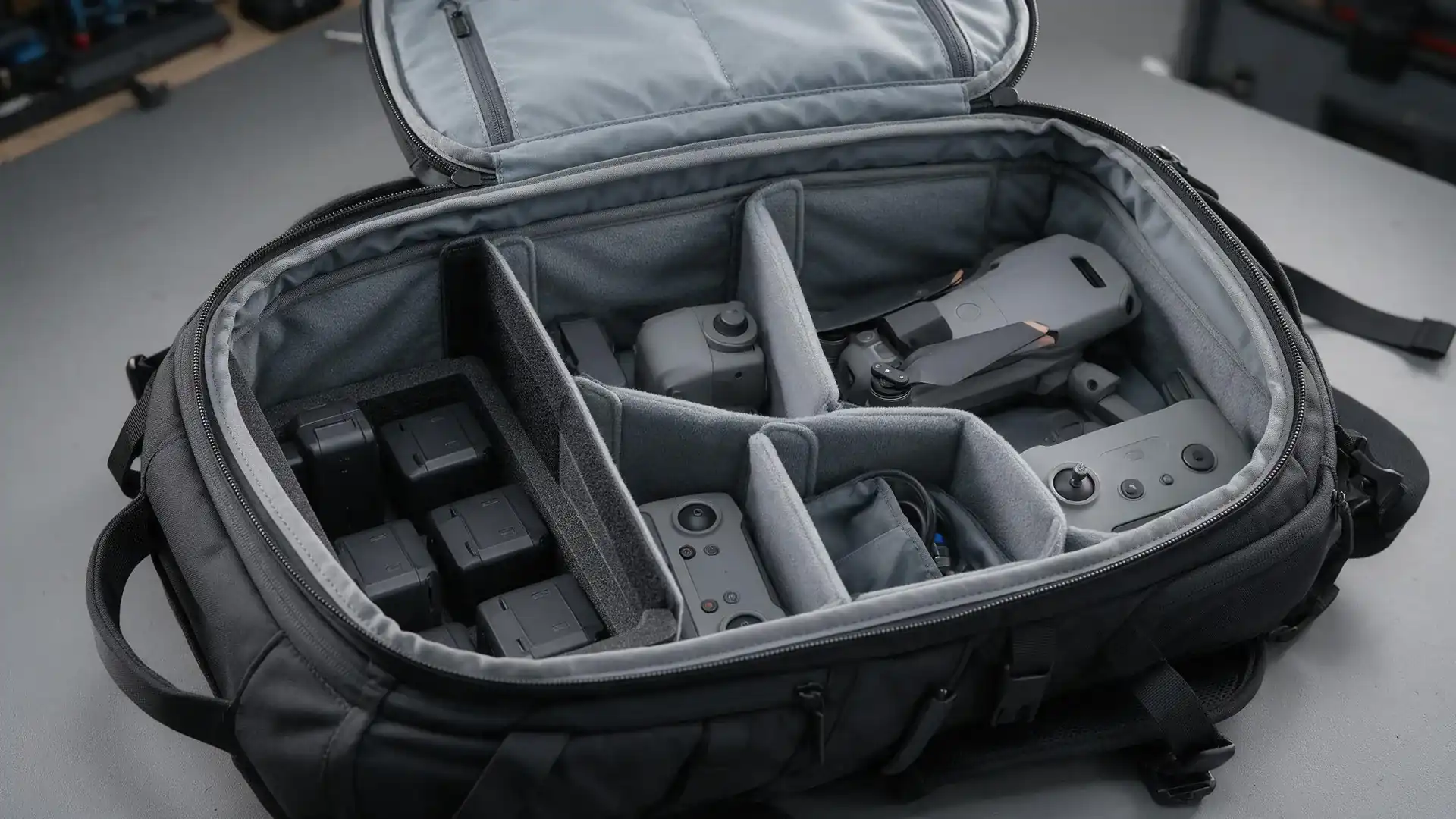
The interior is a mass-isolation problem, not a random grid of Velcro walls. A good drone backpack interior divides the cavity by damage risk first and by product category second.
Zone mapping works because damage does not spread evenly through a packed case. A battery that shifts during a drop applies force in one direction; a gimbal that touches a rigid side wall receives that force directly. The simplest preventive step is to place dense, hard-edged items away from sensitive surfaces and give each zone its own retentive structure.
| Component | Risk Factor | Recommended Placement | Divider/Foam Requirement |
|---|---|---|---|
| Drone body with gimbal | Gimbal crush, scratch, vibration | Center or upper cavity, away from battery path | Brushed tricot lining, medium-density foam, no hard side contact |
| LiPo battery | Mass movement, terminal/connector damage | Isolated bottom or front pocket, preferably closed | High-density foam sidewalls, secure flap or strap, insulation near terminals |
| Controller or remote | Screen and joystick crush | Separate compartment with clear lid clearance | PE board or medium foam divider, elastic retention |
| Folding rotor arms | Hinge deformation | Supported in a fixed position, not forced sideways | Molded recess or foam cutout, soft lining at hinge area |
| Cables, chargers, spare props | Abrasion and tangling | Mesh lid pocket or separate zipper pocket | Low-density padding, clear separation from drone surfaces |
Foam firmness should follow loaded weight, not a simple "more foam is better" rule. A heavy accessory in soft foam sinks and moves; a fragile accessory in very hard foam receives the full shock impact. If the drone body is one weight and the battery pack adds significant mass, the battery pocket needs firmer sidewalls than the camera or gimbal cavity. Ask the factory to map foam density by compartment, not by whole case.
For scratch-prone surfaces, specify a brushed tricot or equivalent soft lining against the drone body, gimbal, and controller screen. Hard exterior foam alone protects from impact but can still scuff expensive surfaces during repeated packing and unpacking. The lining choice seems cosmetic, but for a product marketed as premium protection it is part of the return-risk calculation.
Equipment Fit Testing and Pre-Production Sample Approval
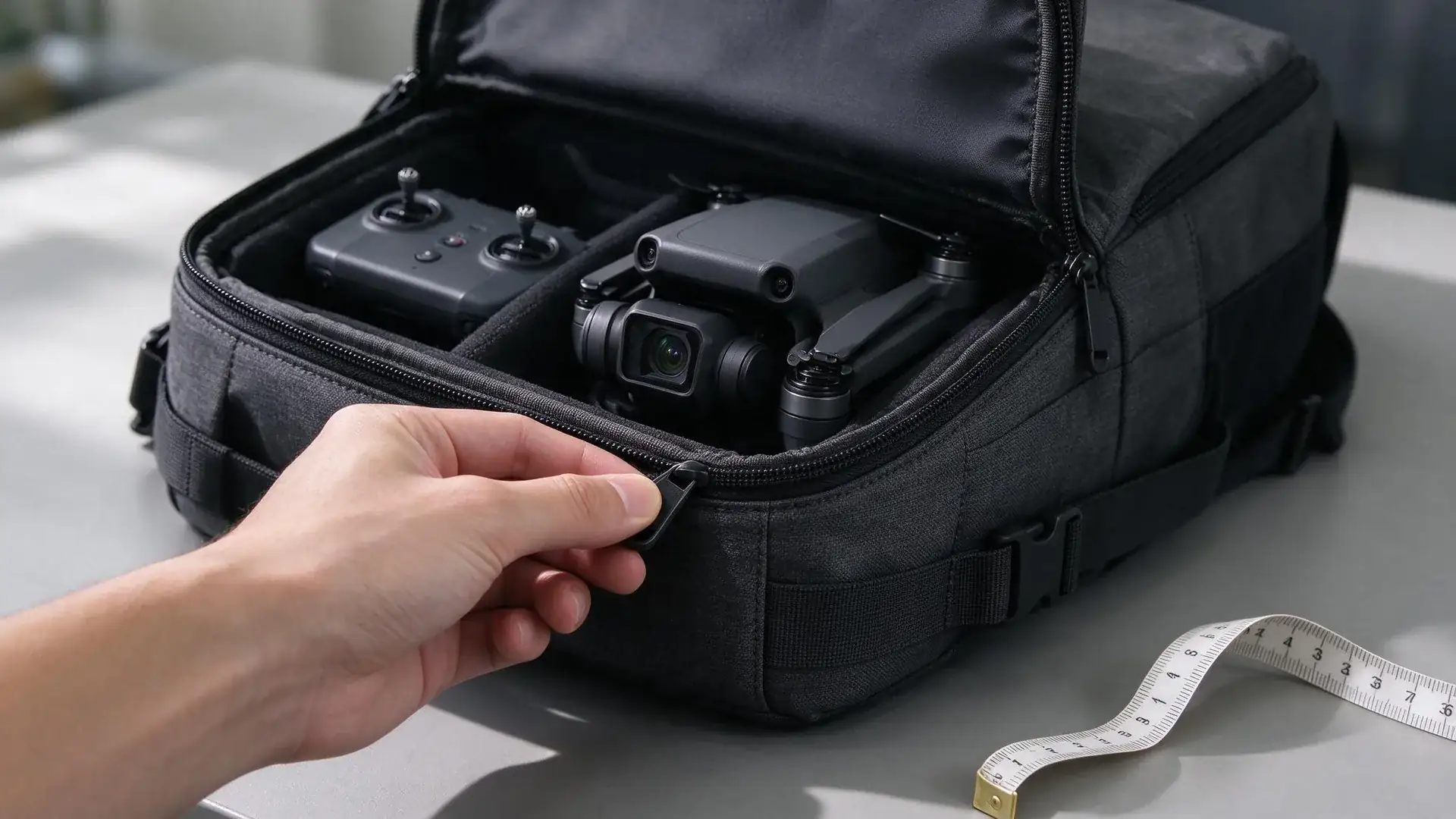
Fit testing is where most drone backpack projects get approved too early. A factory can build exactly to the drawing and still produce a case that crushes the gimbal, because the drawing did not include the drone's protruding parts or the real packed battery layout.
The first rule: use actual measured equipment, not a generic category dimension. Send the factory the drone's true length, width, height, folded arm shape, gimbal protrusion, and battery dimensions. A drawing that says "fits a standard drone" is the documentation equivalent of guessing.
The pre-production sample, or PPS, is the point where you prove the fit before bulk fabric is cut. Require loaded photographs from the top, side, and lid-closed positions, not just an empty case photo. Loaded photos look less polished, but they show whether the zipper bulges, whether the lid compresses the drone, and whether any divider folds under load.
Before you sign the PPS approval, work through this checklist:
- The actual drone and accessories fit without forcing; no folded rotor arm must be pressed sideways to enter its cavity.
- The zipper clears all corners smoothly; the puller should not need to be tugged sideways around a bend.
- Heavy batteries do not shift during a shake or lift test; they remain in the closed battery pocket.
- The lid closes without excessive compression on the gimbal; soft foam contact is acceptable, hard point contact is not.
- The handle and shoulder strap attachment hold the loaded weight; inspect bar tacking and attachment stitching at stress points.
- Loaded fit photographs from top, side, and lid-closed views are documented for record.
The fit test does not need to be complicated. A simple buyer-defined loaded shake check is often more revealing than an over-specified drop test. Fill the case to its packed configuration, close the lid, lift by the handle for a defined number of cycles, then open and inspect whether the battery moved, the gimbal touched a hard surface, or the dividers shifted. The exact weight, cycle count, and pass/fail rule are buyer-defined and should be confirmed with the supplier before testing.
If this is your first sensitive-equipment case program, the equipment carrying case sample guide will help you structure foam density checks, divider stability, and handle verification into one approval workflow.
Supplier Verification for a Drone Backpack Manufacturer
Before you send detailed drawings, you need to know whether the supplier can actually control the three failure points that matter: cavity fit, foam density consistency, and zipper route stress. Ask for evidence, not capability adjectives.
A supplier can call itself a backpack factory while actually buying the molded EVA shell from a separate insert shop and only doing final sewing. That is not automatically a problem, but it changes who controls cavity accuracy. Ask who owns the tooling, who cuts the foam, and who is responsible when the pre-production sample does not fit the actual drone.
The questions below separate suppliers who understand equipment cases from bag makers who can only approximate one:
- Who produces the molded EVA shell in-house, and who controls the cavity drawing?
- Can you provide a cross-section or cut sample showing actual foam thickness and density?
- Does the pre-production sample follow the same process as bulk: CNC-carved insert, thermoformed shell, or both?
- How do you verify zipper pull force and zipper clearance on a loaded case?
- What final inspection standard do you use, and how are major and minor defects classified?
- Do you require written loaded fit-photo approval before bulk fabric cutting?
- Can you produce a small trial run before committing to the full order?
Some buyers may begin discussions around AQL 2.5 for major-defect acceptance depending on product category and risk tolerance, but the final acceptance level and defect definitions are project-defined and must be agreed before production. Do not accept "we inspect every piece" without the defect definitions behind that statement.
RFQ Checklist for Drone Backpack Manufacturers
The more precise the RFQ, the fewer surprise tooling changes and sample loops. A vague request for "a standard drone backpack" forces the factory to guess dimensions, foam density, and zipper load. The quote will either be padded to cover ambiguity or revised later when reality appears.
Use this format when approaching a drone backpack manufacturer:
| Field | What to provide or ask |
|---|---|
| Bag type and shell | Drone backpack with molded EVA, semi-rigid EVA-backed, or soft-shell PE-reinforced construction |
| Drone measurements | Actual measured length, width, height, folded arm shape, gimbal protrusion, and sensitive surfaces |
| Accessory list | Drone body, controller, battery count and dimensions, charger, cables, spare props |
| Loaded weight | Packed configuration weight, including all accessories that will ship inside |
| Target market and channel | Amazon, independent online retail, distributor, wholesale, promotional |
| Logo and branding | Placement, method, size, and whether it crosses a curve or zipper path |
| Lining and hardware | Brushed tricot or equivalent lining, zipper type and gauge, handle and shoulder strap requirements |
| Protection requirement | Crush resistance, vibration isolation, drop height or buyer-defined loaded test |
| Packaging | Retail box, polybag, barcode label, carton count, shipping mark, FBA or marketplace carton rules if applicable |
| Sample and delivery | Pre-production sample deadline and bulk delivery windows; confirm supplier lead time after artwork and tooling approval |
| QC and inspection | AQL level, inspection points, fit-photo process, zipper and foam checks |
| Compliance and transport | LiPo battery transport constraints, terminal protection, target-market transport restrictions |
If the factory does not ask for device weight and accessory list, that is a warning sign. Proper cavity design cannot be quoted from a product name alone. Once you have two or three credible factories, move into the full supplier audit process described in the guide on how to evaluate backpack manufacturer capabilities.
FAQ About Drone Backpack Design and Fit Testing
These are the questions sourcing teams most often ask after reviewing the shell and fit-test requirements.
How do you test a drone backpack for crush resistance?
Use a buyer-defined test on a fully loaded, closed sample. The simplest practical version is a static load or controlled flat drop from a specified height, followed by inspection for shell deformation, divider movement, and contact between dense accessories and sensitive drone surfaces. The exact load, drop height, and pass criteria should be agreed with the supplier and your QC plan before testing. Do not accept a generic "drop tested" claim without knowing what was loaded inside the case during the test.
Can I use CNC-carved foam instead of a custom EVA mold?
Yes, and in some cases you should. CNC-carved foam inserts inside a simpler soft shell are useful for fast-changing drone models, small trial orders, or projects that do not yet have final accessory dimensions locked. The trade-off is repeatability, edge finish, and production speed at higher volumes. Ask the supplier whether the carved insert route can later migrate into a thermoformed mold without changing the exterior dimensions or zipper route. Tooling feasibility and cost are supplier-confirmed and project-specific.
Why must LiPo batteries be isolated in a drone carrying case?
LiPo batteries are dense and can become a moving point load during transport, which turns them into the most likely object to crush a gimbal or rotor arm inside a packed case. Isolation also keeps battery terminals away from metal parts, cables, and other conductors, reducing the chance of an accidental short circuit. The divider design should include a closed, padded battery pocket with enough sidewall foam to prevent movement and place the battery away from fragile equipment surfaces.
Official Sources and Compliance References
This article intentionally avoids quoting fixed standards because compliance depends on target market, drone class, battery chemistry, and transport route. Before bulk production, ask your supplier and your compliance contact to confirm the following sources and requirements:
- The drone OEM dimensional drawing or a physical measured sample, used as the cavity reference.
- The battery manufacturer safety data sheet and transport guidance for LiPo battery protection and terminal isolation.
- The target market's transport regulations for batteries in finished accessories, including any carrier or marketplace requirements.
- Your nominated inspection standard for zipper pull force, seam strength, loaded handle strength, and drop or compression behavior.
Do not ship a run based on a competitor product photo. The physical reference is the drone and its real accessories, not a marketing image.
Conclusion: Approve the System, Not Just the Bag
A drone backpack succeeds or fails as a system: shell, foam density, divider placement, zipper route, handle strength, and packed accessory layout all interact. If you approve each part in isolation, you can still ship a product that crushes the gimbal because the battery moved during transport.
The sequence that prevents that outcome is the same in every sourcing meeting: capture actual measured equipment, choose the exterior shell based on protection and volume, map internal zones by damage risk, require a loaded pre-production fit test, and document the pass criteria before bulk fabric is cut. Do that, and the first production run has a much better chance of looking like the approved sample — and of staying that way after it has bounced through a courier network.
Get A Quote

Get A Quote
0 Comments