
Heavy Duty Bag Zippers: Coil vs Resin vs Metal Selection Guide
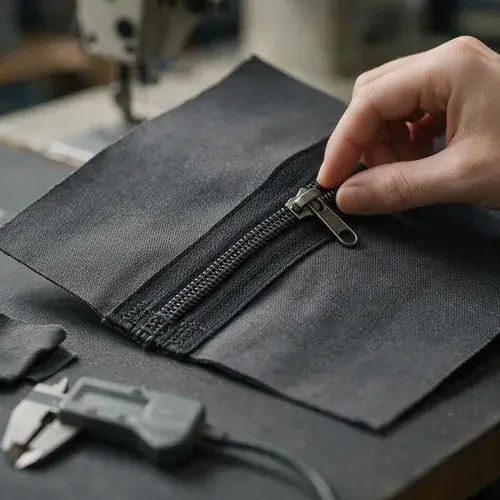
Heavy duty bag zippers are not defined by tooth material alone. They are a load-bearing closure system: the chain size, slider retention, zipper tape, sewing reinforcement, and the bag's opening geometry all determine whether the zipper survives a loaded backpack, an overpacked suitcase, or a tool bag. The safest specification decision starts with the actual load pattern, environment, and test acceptance method — not with the word "heavy-duty" on a supplier quote.
The commercial exposure is real. A zipper that separates on a fully packed 28-inch suitcase or on a work bag full of tools doesn't fail quietly. It produces returns, replacement claims, bad marketplace reviews, and a slow erosion of brand trust, especially when the product was positioned as durable. Many of those failures are not caused by the zipper being "cheap." They come from specifying the wrong zipper system for the bag structure, the wrong slider for the chain, or testing only an empty sample under ideal conditions.
This guide gives you a structured way to choose between coil, resin, and metal zippers for heavy-duty bags, map zipper stress to real bag structures, define tests before bulk production, and write an RFQ that reduces the chance of a supplier substituting an ambiguous "heavy-duty zipper." Use it before sampling, not after the first production run.
Quick Answer: The 30-Second Buyer Decision
The first thing to know about heavy duty bag zippers is that zipper size and tooth material are only two variables. A larger zipper doesn't automatically prevent failure if the slider is weak, the tape is under-spec, or the zipper ends are poorly stitched into a high-load corner.
For most curved backpack openings, soft luggage, and flexible duffels, a correctly sized coil zipper with a matched slider and reinforced zipper ends is the most forgiving starting point. For wide, structured luggage panels, molded resin zippers often handle tooth alignment and panel rigidity better. For straight-opening industrial bags with heavy abrasion and no corrosion risk, metal zippers can be justified, but the weight, slider impact, scratches, and rust risk need to be checked before you commit.
Your default should not be "buy the biggest zipper." It should be: identify the load direction, the opening geometry, the environment, and the minimum acceptance test you can actually require from the supplier.
What Makes a Zipper "Heavy-Duty" in Bags and Luggage?
"Heavy-duty" has no universal factory definition. One supplier may use it to mean a #10 zipper, another may mean a metal tooth zipper, and another may simply mean a standard #5 zipper sewn into a thick fabric panel. Your job is to translate the marketing term into measurable components.
A bag zipper is not just a chain of teeth. It is a system of interacting components:
- Zipper chain/teeth: the interlocking element that resists opening pressure.
- Zipper tape: the woven edge that holds the chain and gets sewn into the bag.
- Slider: the moving part that engages and separates the teeth.
- Puller: the user contact point that transfers force into the slider.
- Stops and sewing: the ending structure and the stitch line that anchor the zipper into the bag.
A heavy-duty zipper must be strong in all of these areas at once. If the tape tears away from a thick PU-coated fabric, the tooth strength is irrelevant. If the slider spreads open under load, a strong chain still fails. That is why the correct way to specify a zipper is as a system, not as a single "size."
The practical evaluation framework for heavy-duty work includes: chain size category, slider material and retention, tape type and width, sewing allowance, reinforcement at zipper ends, and the curvature of the zipper path. The same zipper can perform well on a straight duffel opening and badly on a curved backpack opening.
Why Tooth Material Alone Does Not Determine Durability
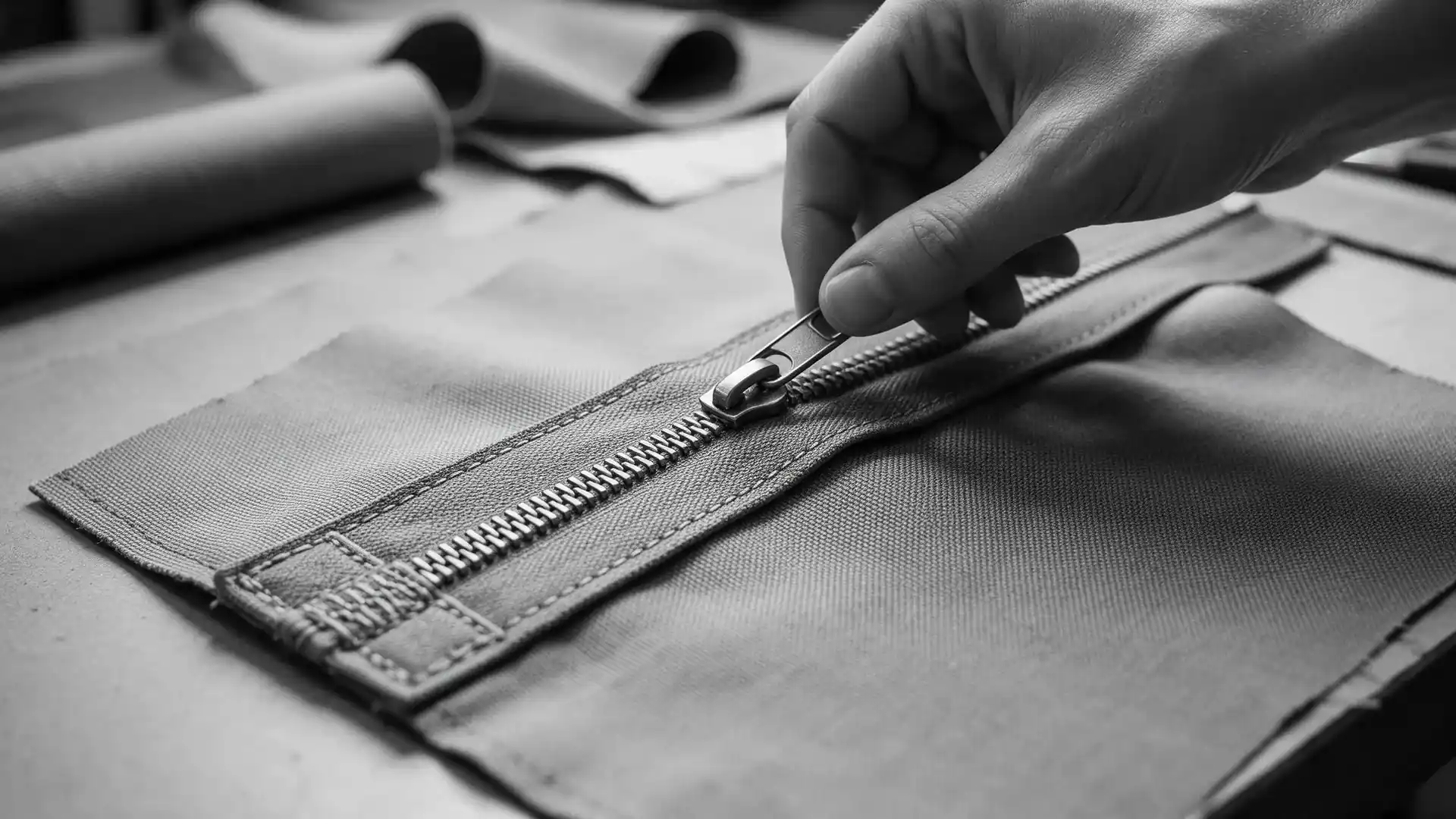
Buyers often assume that metal means strongest, resin means middle, and coil means weakest. That shortcut creates predictable sourcing errors. Tooth material changes the failure mode, but it does not change the fact that the zipper is only as strong as its weakest connected part.
A strong chain can still fail through:
- Slider mismatch: a large chain in a cheap, thin-gauge slider can jam, spread, or skip teeth.
- Weak zipper tape: a narrow, low-density tape can tear along the stitch line before the teeth break.
- Stress concentration: curved openings, bottom corners, and expansion seams can concentrate force into one short segment of zipper.
- Sewing failure: insufficient seam allowance, incorrect thread tension, or missing bar-tacks let the zipper peel out of the bag.
The point here is that you should not specify "metal zipper" and stop. You should specify chain, slider, tape, sewing, and end reinforcement as one package.
Coil Zipper vs Resin Zipper vs Metal Zipper for Heavy-Duty Bags
These three constructions behave differently when the bag is stuffed, bent, twisted, exposed to moisture, or dragged across rough surfaces. Choosing correctly comes down to how the bag creates load against the zipper.
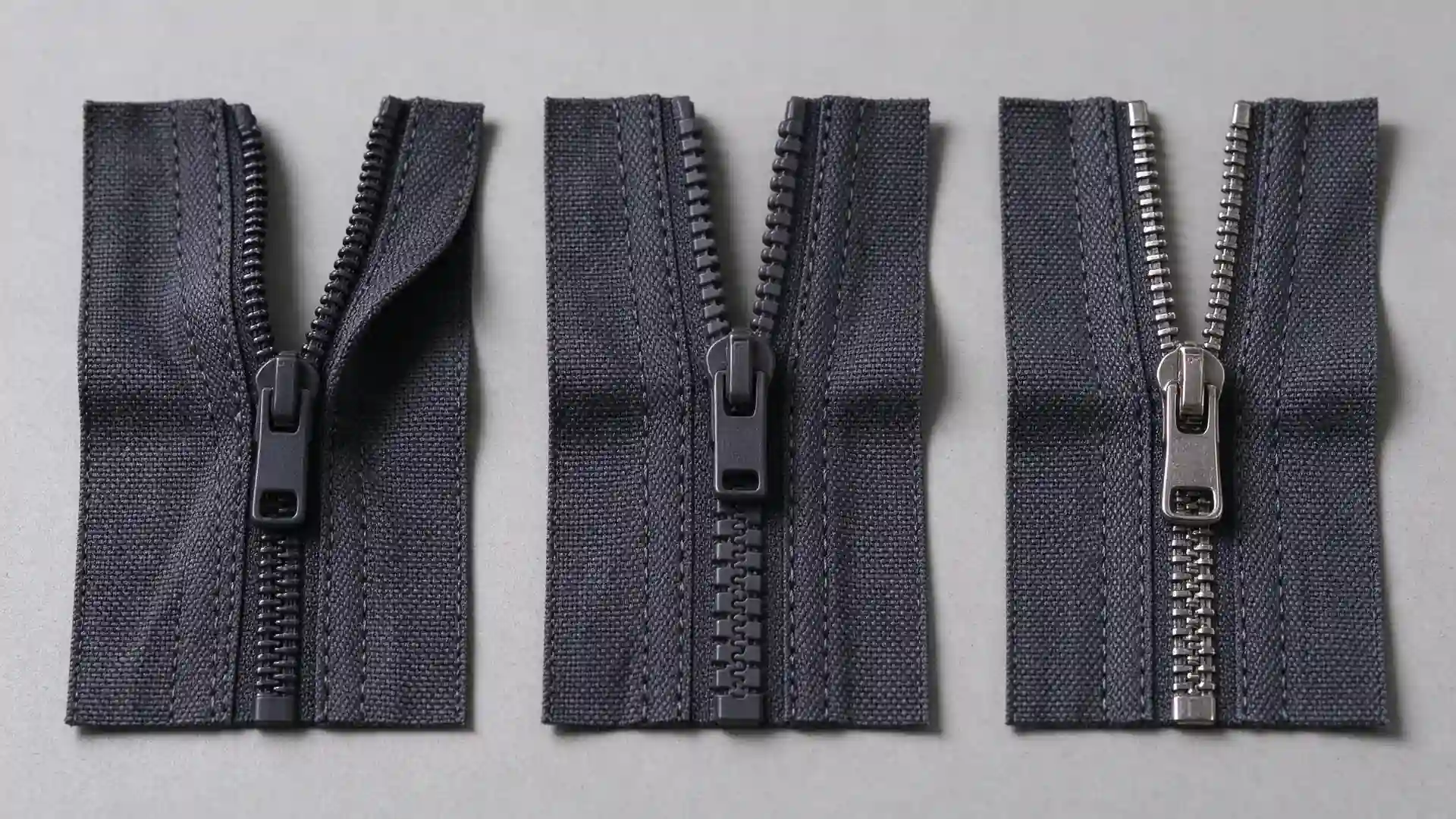
A coil zipper is made from a continuous spiral of synthetic monofilament stitched or woven onto tape. It tolerates curved sewing paths better because the teeth can move and flex along the chain. Its main weakness is that the teeth can be pinched or distorted if the tape is sewn too tight, and a worn slider can skip teeth on a heavily loaded curve.
A resin zipper uses molded plastic teeth, often on a wide tape. The tooth profile creates a firmer, more structured engagement. It is common on large luggage panels and expandable cases because the wide molded teeth resist being pulled apart across a straight or gently curved opening. The trade-off is that resin zippers can feel stiffer and may be more sensitive to cold or impact than coil in some applications.
A metal zipper uses metal teeth clamped onto the tape. It offers good abrasion resistance and a rigid, high-perceived-quality appearance. The risks are weight, corrosion, scratching against other materials, and a slider that can jam if the teeth are bent or impacted. Metal is not automatically stronger; it is stronger in certain loading conditions and riskier in others.
The comparison below should be read as a sourcing starting point, not a certification.
| Criterion | Coil zipper | Resin zipper | Metal zipper |
|---|---|---|---|
| Flexibility around curved openings | High | Moderate | Low |
| Abrasion resistance of teeth | Moderate | Moderate to high | High |
| Corrosion exposure | Low risk for synthetic coil | Low risk unless coating degrades | Higher risk if coating or plating is cut or worn |
| Weight impact | Low | Moderate | High |
| Curved opening suitability | Strong | Moderate | Weak unless opening is straight |
| Typical heavy-duty bag categories | Backpacks, soft luggage, duffels, flexible compartments | Luggage panels, structured equipment bags, expansion cases | Tool bags, industrial straight openings, high-abrasion work bags |
| Common failure risks | Slider wear, pinched coil from poor sewing | Tooth cracking under extreme impact, stiff movement in very cold conditions | Corrosion, tooth deformation, slider jam, weight, scratching |
When Coil Zippers Work Best
Coil zippers are not the weak option. They are often the most reliable choice on curved, flexible openings because the continuous coil can follow the bag's changing shape without forcing a rigid tooth into a sharp bend.
Use a coil zipper when the bag will flex during loading, when the opening path is curved or semi-circular, when the shell is soft nylon or polyester, and when the bag is repeatedly overstuffed. Backpacks, soft luggage, travel duffels, and the internal organizer compartments of technical bags usually benefit from this behavior.
The conditions that make coil zippers fail are often installation-related. If the zipper tape is sewn too close to the coil, the slider can fight the teeth. If the fabric is too thick at the zipper seam, the chain can pinch. If the slider is under-spec, a fully loaded curved opening can force the coil apart. For that reason, when a supplier says a coil zipper is heavy-duty, ask them to confirm the slider model, tape width, and zipper-end sewing detail — not just the chain size.
When Resin Zippers Make More Sense
Resin zippers earn their place on large flat panels, wide luggage openings, expansion cases, and structured bags that hold their shape. The molded tooth profile creates a broader interlocking surface, which can spread load across a straighter path more effectively than a thin coil.
That structural engagement makes resin a common choice for molded-shell luggage, semi-rigid equipment bags, and bags with large front panel openings. It is also worth considering when the zipper will be opened and closed frequently in a straight line, because the evenly spaced molded teeth give the slider a predictable path.
The trade-off is mechanical stiffness. A resin zipper that runs around a very tight corner or is sewn into a highly flexible panel may not bend as cleanly as coil. If the product will be exposed to severe cold or repeated impact near the zipper, confirm with the supplier whether the selected resin formula is brittle under those conditions. Don't assume that all resin zippers behave the same way.
When Metal Zippers Are Appropriate — and When They Create Risk
Metal zippers are worth considering for straight-opening industrial bags, tool bags, and products where the zipper teeth will meet heavy abrasion or rough handling. A metal tooth can take surface wear that would degrade a coil or resin tooth more quickly.
The problem is that metal zippers bring costs beyond the unit price. They add weight, which matters for luggage airline weight limits and for carry comfort. They can scratch laptops, garments, or adjacent panels if the zipper runs along an exposed edge. They can corrode in humid, coastal, or salt-exposure environments. And a bent metal tooth is not easily re-engaged the way a flexible coil can sometimes be worked back into place.
So metal is not a universal upgrade. It is a targeted choice for straight, abrasion-heavy, lower-curvature openings where corrosion risk is controlled. If the bag is curved, moisture-exposed, or weight-sensitive, a well-sized coil or resin zipper is usually the better starting point.
How Bag Structure Changes Zipper Stress and Failure Risk
A zipper does not experience the same force in every bag. The same chain size can survive a long service life on a flat tool bag and fail early on a structured luggage corner. The bag geometry, not just the zipper, creates the real load.
A zipper on a backpack opening is subjected to bending stress as the sack is packed and pulled around the curved path. A zipper on a suitcase expansion panel is subjected to a direct burst-style force when the bag is overpacked and the lid is forced shut. A zipper on a rigid tool bag opening is subjected to point loads at the corners and handle attachment.
That means zipper selection must start with a load map. Ask three questions before choosing a zipper type:
- Where does the load press against the zipper: uniformly, at the ends, or at one corner?
- Does the bag structure flex, or is the opening held in a rigid frame?
- Is the zipper path straight, gently curved, or a tight semicircle?
When the load is uniform and the opening is straight, the teeth work as an interlocking chain. When the load concentrates at a corner, the zipper is effectively asked to resist a wedge force in one short zone. That is why many failures appear near zipper ends or bottom corners even when the rest of the chain looks perfect.
| Bag category | Typical load pattern | Better starting point | What to verify with the supplier |
|---|---|---|---|
| Backpack | Curved opening, uneven packing pressure | Coil | Slider retention, curve sewing, zipper end bar-tacks |
| Tool bag | Concentrated point loads near corners and frame | Metal or heavy coil depending on corrosion | Tooth impact resistance, frame attachment, straightness |
| Soft luggage | Burst pressure from overpacking plus curve | Coil | Crosswise chain strength, seam slippage on thick shell fabric |
| Hard luggage | Rigid panel alignment plus expansion stress | Resin | Tooth alignment, large panel slider, expansion gusset load |
| Tactical/technical bag | Mixed curve, moisture, heavy textile layers | Coil with corrosion-resistant slider | Tape to fabric compatibility, coatings, internal stress |
| Duffel | Straight or long curved opening, dynamic load | Coil or resin | End stress, long-chain alignment, double slider option |
| Equipment case | Rigid or semi-rigid frame opening | Resin or metal depending on weight/corrosion | Rigid frame clearance, corner stress, slider strength |
High-Stress Zones Buyers Should Inspect
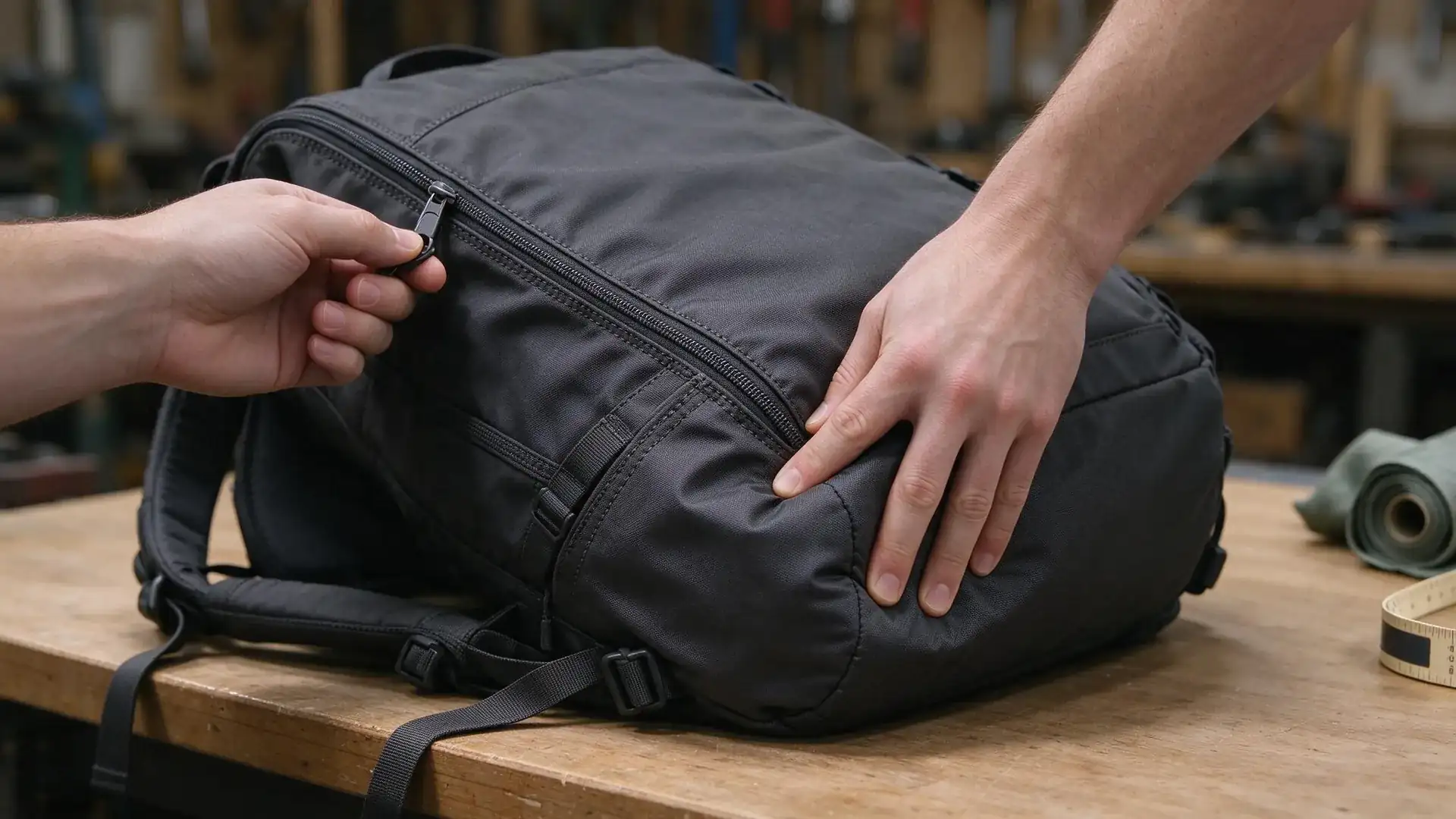
When you inspect samples, don't just run the zipper up and down an empty bag. Look at the areas where bag structure and zipper meet. Those are the places where approved samples pass and field units fail.
The highest-risk zones are:
- Zipper ends: this is where the chain is anchored into the seam, and where a stitch line or missing bar-tack creates a peel point.
- Bottom corners: on backpacks and duffels, the bottom curve often receives the most packed weight and bending tension.
- Expansion seams: on suitcases, the expansion gusset presses the zipper outward along its entire length.
- Puller attachment: a cheap or loose puller can snap off or create sideways leverage that damages the slider.
- Slider junction: where the loaded zipper halves meet the slider is often the point of maximum chain separation force.
For a failure-side explanation of how material, stitching, slider, and design problems interact, see Why Zippers Break: Material, Design, Stitching & Quality Issues Explained.
Heavy-Duty Zipper Testing Buyers Should Request Before Bulk Production
A supplier saying the zipper is durable is not the same as a test with a defined method and acceptance level. Before bulk production, ask for a combination of standard zipper tests and buyer-defined use-condition tests.
ASTM and similar standards give you a common language. The important point is not to assume that "tested" means "passed your conditions." Ask the supplier to confirm which method they used, the sample size, the measured result, and the pass/fail limit they applied. If the result is a marketing phrase rather than data, treat it as unverified.
| Test category | What it checks | Why it matters for heavy-duty bags | What to request from the supplier |
|---|---|---|---|
| Crosswise chain strength | Resistance of teeth to separating across the chain | Predicts burst-type failure from overpacking or internal pressure | A defined test method, result, and sample orientation |
| Slider pull-off / retention | Whether the slider detaches under force | Prevents a common failure where the slider body spreads or leaves the chain | A physical or photo record of the slider after test |
| Operability / cycling | Smooth slider movement after repeated open/close cycles | Screens jam, skipping, and early wear | A buyer-defined cycle count and inspection point |
| Seam slippage | Whether the zipper tape shifts under load at the stitch line | Catches weakness that has nothing to do with tooth material | A seam test on the same fabric stack as production |
| Loaded-bag opening test | Whether the zipper can close on a realistically packed bag | Reveals curve stress, corner load, and internal pressure | A protocol using the buyer's own packing list |
| Corrosion / moisture aging | Whether coating or plating degrades in expected environment | Critical for coastal, outdoor, or humid storage use | A supplier- or buyer-defined exposure method, not a generic claim |
Why Empty-Bag Testing Often Misses Real Failure Modes
An empty bag zipper test is nearly worthless for heavy-duty products. The zipper may move smoothly and look correct because there is no load trying to separate the chain. Real failure begins when the bag is stuffed, bent, compressed, or carried by the handle.
Two frequent false-positive situations are:
- The sample passes a hand-zip test on an empty bag but fails when the packed bag is squeezed into a luggage tester or overhead bin.
- The zipper passes a straight pull test but fails at the curved corner of a fully loaded backpack because the sewing line begins to peel.
So require a use-condition test on a packed bag during pre-production or pilot sampling. Define the packing contents, the closure method, and the point at which the zipper should still operate without resistance. Also require a shipping compression check, because carton stacking during transit can pre-load suitcase and backpack zippers before the customer ever touches them.
For broader inspection planning around zipper, stitching, packaging, and shipment checks, see Common QC Mistakes Buyers Ignore: A B2B Bag Inspection Guide Before Bulk Shipment.
RFQ Checklist for Heavy Duty Bag Zipper Selection
The RFQ is where many zipper mistakes become locked into production. If the RFQ says only "heavy duty zipper," the supplier often chooses the most available option, which may not match your load or channel risks.
Use this checklist as a starting structure. Where a field depends on your product, write the actual expected value or the confirmation you need before quoting.
| Field | What to specify or confirm with the supplier |
|---|---|
| Bag type | Backpack, soft luggage, hard luggage, tool bag, duffel, equipment case |
| Estimated loaded weight | The target use load or the pack-out volume your buyer will test |
| Packing behavior | Overpacked soft load, rigid framed load, uniform flat load, point load |
| Opening geometry | Straight path, gentle curve, semi-circle, expansion gusset |
| Load direction | Uniform burst pressure, corner concentration, zipper-end peel |
| Zipper chain size | Request the supplier's size category proposal and the reason for it |
| Zipper material | Coil, resin, or metal; and the specific film, resin, or coating if relevant |
| Slider type | Locking or non-locking, material finish, thickness, and puller attachment |
| Zipper tape | Tape width, fabric content, color, and compatibility with shell and lining |
| End reinforcement | Bar-tack, folded end stop, webbing tab, or metal C-stop at zipper ends |
| Environment exposure | Humidity, salt air, cold, UV, chemical contact, rough abrasion |
| Testing expectation | Crosswise strength, cycling, loaded-bag opening, seam slippage, corrosion if applicable |
| Sampling evidence | Pre-production sample, loaded-use photos, golden sample approval |
| Packaging and shipping concern | Carton compression, flat-pack orientation, or load that may pre-stress zippers |
| Replacement sourcing | Whether the zipper supplier must remain consistent in later reorders |
For the full sourcing workflow around zipper types, gauges, and cost logic, see Zippers for Backpacks & Luggage: The Ultimate B2B Sourcing & Cost Guide. Keep the RFQ tied to acceptance criteria, not just bill-of-materials lines.
Common Heavy-Duty Zipper Specification Mistakes
The recurring failure I see is not that buyers choose the wrong zipper brand. It is that they under-specify the closure system and then approve a sample without loading it.
- Specifying by "heavy duty" only: there is no engineering value in the phrase. Ask for chain size, slider type, tape width, and sewing detail.
- Assuming a larger gauge fixes everything: a larger chain in a mismatched slider or weak seam can still fail because the failure point moves to the tape or stitch line.
- Specifying metal purely for appearance: metal adds weight, corrosion risk, and scratch risk. If the bag is fashion-positioned and never sees industrial load, metal may create more returns than it prevents.
- Ignoring the slider: many zipper failures trace back to the slider. Ask what slider material, thickness, and puller attachment are proposed.
- No sealed approval sample: without a golden sample with the exact zipper, the next production run can receive an acceptable-looking substitute.
- Inconsistent reorder sourcing: if the zipper source changes without a new approval, earlier test data becomes irrelevant.
- No use-condition test: an empty-bag sample approval does not represent how the buyer will use the product.
One additional risk: the zipper may be fine, but the surrounding hardware system is out of balance. If the zipper is heavy-duty but the handle, wheels, or frame are weaker, the product can still fail. Cross-check the zipper choice with the rest of the bag's load-bearing hardware using Hardware Selection Mistakes: Wheels, Handles, and Zippers in Luggage and Bags.
FAQ About Heavy Duty Bag Zippers
These questions cover the decisions buyers ask most often when they move from zipper type selection to sampling and bulk production. Every answer assumes the final zipper spec must be confirmed against the actual bag structure, use environment, and buyer acceptance standard.
What zipper size is commonly used for heavy luggage?
A common starting reference for heavy luggage is a #8 or #10 size category, but this is not a fixed guarantee. The correct size depends on the panel size, expansion load, slider strength, and whether the zipper runs through a curved corner or a straight panel. Ask the supplier to propose a size and justify it with the bag's loaded opening condition, then verify it on a packed sample rather than selecting by number alone.
Are reverse zippers durable enough for backpacks?
Reverse zippers can be durable because the sewn position can protect the chain from surface abrasion, but the sewing quality matters more than normal. A reverse zipper installed on a thick shell with insufficient tape width can create a tight seam that stresses the coil or resin teeth. If the backpack will be heavily loaded, specify the tape width, seam allowance, and end reinforcement, and test the zipper with the bag packed near its target load.
Can metal zippers rust in humid environments?
Yes, metal zippers can corrode in humid, coastal, or salt-exposure environments if the tooth surface, slider, or cut edge is not properly coated or plated. The risk increases when the coating is scratched or worn during use. If the bag is intended for outdoor or marine-adjacent use, ask the supplier to confirm the corrosion protection method and whether a buyer-defined humidity or salt-spray test is applicable.
Should buyers request branded zipper suppliers?
Branded zipper suppliers can reduce variability because the chain, slider, and tape are often matched as a system, but the brand itself does not guarantee that the selected gauge or installation is correct. Requiring a named zipper system is useful when the buyer needs consistency and easier reorder sourcing. The supplier should still confirm the model, size, slider, and sewing specification in writing; otherwise a brand name can hide an under-spec component.
How many test cycles should buyers require?
There is no universal cycle count for every bag. The meaningful approach is to set a buyer-defined cycle count and inspection point, then compare results only under the same packing and loading conditions. A smaller cycle count on a heavily loaded pack may be more severe than a larger count on an empty bag. Confirm the method and the failure definition with the supplier before quoting.
What should be included in a zipper approval sample?
The sample should include the actual zipper chain, slider, puller, tape color, fabric stack, and end-reinforcement method intended for bulk production. It should be tested on a packed product, not as a loose component. The buyer should also receive photos or video of the loaded opening test, a record of the zipper position after cycling, and a signed or physically sealed sample that becomes the production reference.
Official Sources and Compliance References
This guide references test methods and sizing standards only as buyer-facing decision tools. They do not prove "heavy-duty" unless the buyer defines a pass/fail limit and the supplier records the result.
- ASTM D2061: zipper strength test methods. Use it to ask the supplier which strength test they run, how the sample is held, and what measured value they report.
- ASTM D2062: zipper operability test methods. Use it to check slider movement, cycling behavior, and the point at which the zipper becomes difficult to operate.
- ASTM D3657: zipper dimensional specification. Use it to confirm chain width, tape width, and size matching when comparing zipper systems.
- Buyer-defined acceptance method: the most important reference is the one you write into the RFQ. A loaded-bag opening test, seam slippage test, and shipping compression check should be described with a defined method and limit.
Before using any test reference in a compliance claim, confirm with the supplier or a third-party lab which method is applicable to your bag structure and target market. Standards may apply differently to soft bags, rigid luggage, children's products, or specific retail requirements.
Conclusion
The safest procurement approach is to treat heavy duty bag zippers as an engineering system, not as a material label. Start with the bag's real load pattern and opening geometry. Choose the zipper construction that matches those conditions, then verify the chain, slider, tape, sewing reinforcement, and end construction as one sealed sample.
If the opening is curved and flexible, coil is often the most forgiving choice. If the opening is wide, straight, and structurally loaded, resin or metal may be justified depending on weight, environment, and abrasion. If the product is sold through marketplace channels, the zipper acceptance test should include a packed-bag cycle and a compression check, because the return risk is driven by real use, not by an empty sample test.
Before bulk production, lock the specification into an RFQ and a signed approval sample. If your supplier cannot explain the slider, tape width, load path, or test method, that is the signal to ask better questions before committing to the order.
Get A Quote

Get A Quote
0 Comments