
Medical Organizer Bag: Non-Sterile Materials, Layout & Wipe-Clean Linings
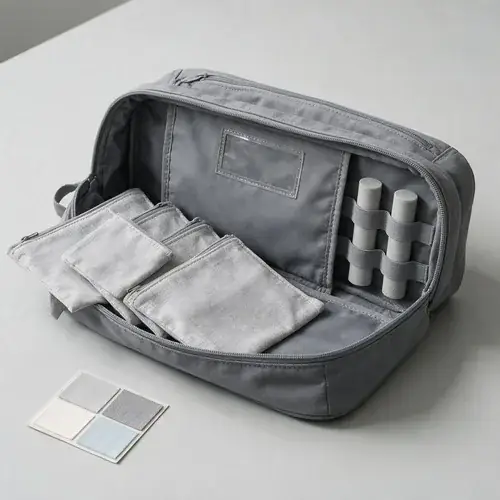
A medical organizer bag should be sourced by evaluating three supply-side controls, not by judging exterior styling: the non-sterile terminology and intended-use boundary, the internal compartment plan driven by real medical contents, and the wipe-clean lining construction and seam finish. This guide gives healthcare product brands, EMS suppliers, first aid kit builders, and marketplace sellers the supplier-facing questions, material trade-offs, QC checkpoints, and RFQ structure to use before sample approval.
The commercial risk sits in the details buyers usually skip. A bag that looks right in a catalog but can't hold the actual kit contents, cracks at the lining corners after disinfection, or ships with barcode labels in the wrong carton position can trigger returns, listing claims problems, distributor rejection, or a costly rework order. Most of those failures start before fabric cutting, not after production.
Treat the next step as a spec freeze, not a quotation request. Your job is to turn cleaning expectations, pouch arrangement, labeling limits, zipper access, and packaging constraints into supplier-confirmed documents. If a supplier can't answer the questions in this guide, the medical organizer bag isn't ready to sample yet.
Quick Answer / 30-Second Buyer Decision
For a non-sterile medical organizer bag, the sourcing decision should follow this order:
- Define the bag as a carrying, storage, and organization system. Don't call it sterile, leak-proof, waterproof, or antimicrobial unless your buyer has documented test evidence for that exact construction.
- Build the layout around kit contents and access priority, not around a sample photo the supplier already had in stock.
- Specify the wipe-clean lining by material, coating, seam finish, corner treatment, and cleaning chemical exposure. A "wipe-clean" label alone is not a specification.
- Require a pre-production sample signed off with actual contents, label placement, pouch fit, zipper movement under load, and handle reinforcement.
- Put carton marks, barcode position, and pack-out logic into the RFQ before shipping.
If you only remember one rule: sample approval is where the medical organizer bag program is won or lost, because bulk production follows the approved sample, not the mockup image.
What Is a Non-Sterile Medical Organizer Bag?
A non-sterile medical organizer bag is a carrying or storage system for healthcare, first aid, EMS, or emergency-response supplies. It is not a sterile barrier system, not a device that maintains sterility, and not automatically a regulated medical device. The term "medical organizer bag" describes the application and organizational function, not a sterile performance claim.
The distinction matters because B2B buyers often write supplier briefs with wording that the bag factory cannot legally or technically verify. A bag made from coated polyester, PEVA, or wipe-clean film can carry bandages, gloves, instruments, and pouches. That fact does not make the bag sterile, antimicrobial, or FDA-cleared. The correct positioning is normally "non-sterile healthcare organizer" or "EMS organizer bag," with the intended use limited to transport, organization, and access support.
Before sending an RFQ, review every label and listing phrase below. The table separates buyer-safe wording from wording that usually creates compliance or quality dispute risk. Confirm final wording with your own regulatory or compliance review for the target market.
| Acceptable label or RFQ wording | Risky wording and why |
|---|---|
| Non-sterile medical organizer bag | Sterile medical bag — implies a validated sterile barrier system that the bag usually is not |
| Healthcare organizer bag | Medical device bag — may imply a different regulatory classification |
| EMS organizer bag / jump bag organizer | Hospital-grade organizer — ambiguous unless the buyer defines a specific standard |
| First aid bag / first response organizer | Antimicrobial organizer — requires documented antimicrobial performance and compatibility |
| Wipe-clean medical bag | Leak-proof or waterproof medical bag — needs specific seam, coating, and immersion testing |
| Supply carrying case | Contamination-proof organizer — overstates a passive storage bag's capability |
| Modular nurse bag organizer | FDA-approved bag — a bag alone is typically not FDA-approved; the intended-use pathway must be confirmed |
This terminology boundary is not just legal caution. It also keeps the supplier from building the wrong product. A factory that hears "sterile bag" may assume sealed packaging, cleanroom assembly, or medical-device documentation requirements that change the entire quotation path, sample plan, and QC protocol.
How Healthcare and EMS Bag Layouts Should Be Planned
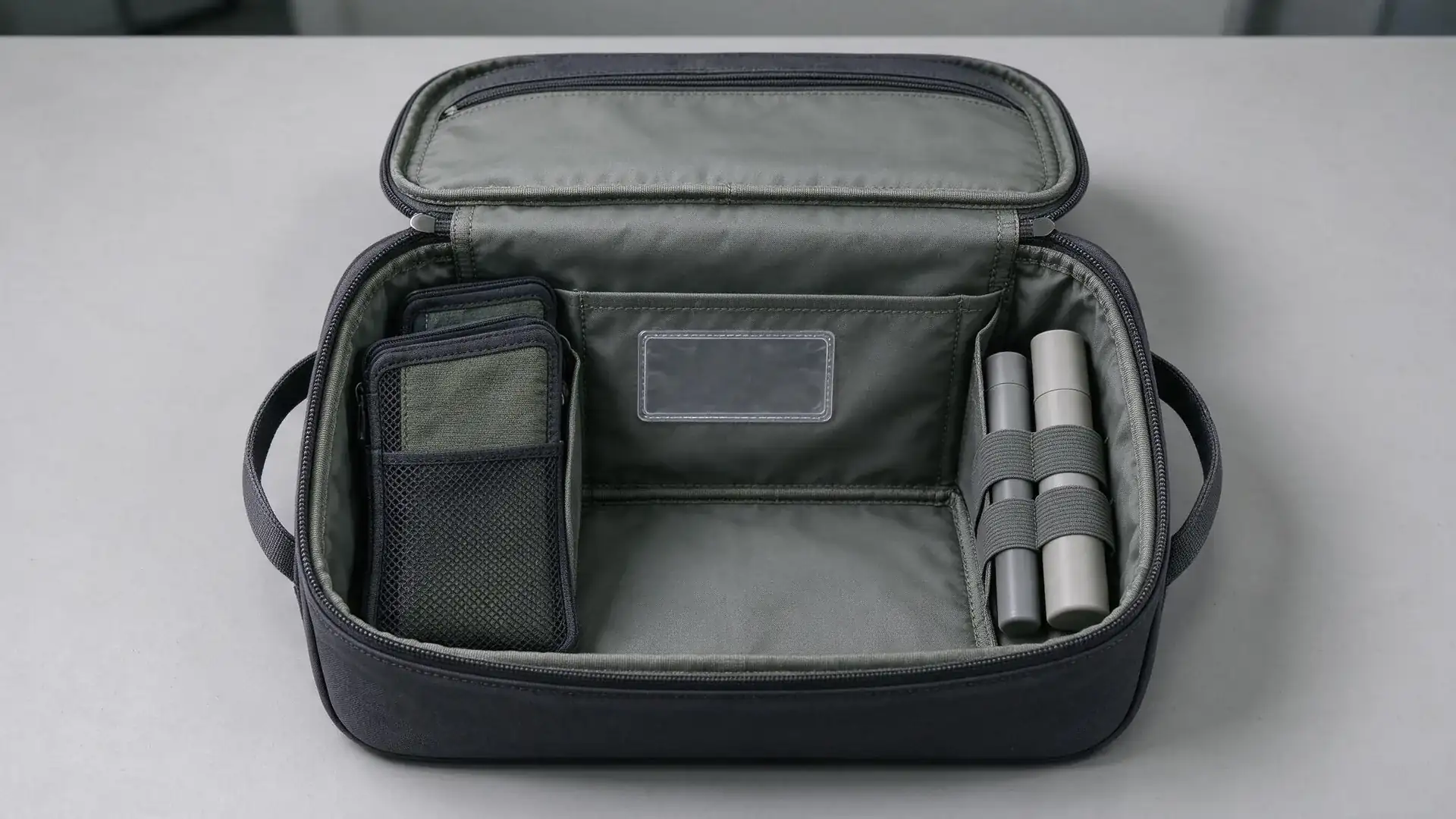
Healthcare organizer bag layouts should start from the contents and the person's access workflow, not from the exterior shape. A nurse bag used daily on a ward, an EMS jump bag accessed under time pressure, and a first aid restocking pouch all need different compartment logic. The exterior is the last thing to approve.
The practical method is to ask the end user or product manager one question: "Which items must be reachable without moving anything else, and which items can wait?" That answer creates the fast-access zone, the bulk storage zone, the label zone, and the replacement-pouch zone. If the bag designer has never seen the real contents, sample approval will fail no matter how good the stitching looks.
Once the content map exists, choose the bag format around it. A flat pouch works for a small replenishment kit. A shoulder bag works for mobile clinic or home-care visits. A backpack-style EMS organizer works for hands-free response. A larger structured organizer works for cart-based or vehicle-based storage. Format choice affects interior dimensions, zipper opening angle, and how easily a user can see all compartments at once.
| Use scenario | Access priority | Typical organization approach | Buyer risk to confirm |
|---|---|---|---|
| EMS jump bag | Very fast one-hand access to priority items | Large open main cavity, outer fast-access pocket, color-coded removable pouches | Confirm pouch attachment survives repeated hard pulls |
| Nurse shift/home-care bag | Frequent but calmer access | Fixed divider sections, label windows, elastic loops for small items | Confirm labels remain legible after repeated cleaning |
| First aid restocking kit | Replenishment, not emergency access | Removable labeled pouches, simple outer shell, minimal fixed dividers | Confirm replacement pouch SKU and barcode mapping |
| Clinical cart or shelf organizer | Low movement, maximum visibility | Structured divider panels, clear pockets, upright storage | Confirm divider fit and shape retention under load |
| Patient transfer/document bag | Light contents, quick handoff | Flat document sleeve, one zipper pocket, small pouch loop | Confirm closure durability and label placement |
The biggest buyer mistake is copying a cosmetic bag layout and adding a red cross. A healthcare organizer bag that doesn't fit the actual kit contents becomes a return, a bad marketplace review, or an expensive rework program.
Fixed Compartments vs Removable Pouch Systems
Fixed compartments are the cheaper and simpler construction for medical pouch organizer designs where the kit contents are stable and the end user rarely reconfigures the bag. The factory sews dividers, pockets, and elastic loops directly into the liner. Unit cost and assembly variables drop, and there are fewer loose parts to lose. The downside is rigidity: when the kit list changes, the whole bag may need redevelopment.
Removable pouch systems support restocking and modular replacement, which matters in EMS and first aid kit programs where certain categories expire or deplete faster than others. A removable color-coded pouch can be reordered separately without replacing the entire bag. The trade-off is higher sewing complexity, more attachment points to inspect, and the risk that pouch snap buttons, hook-and-loop, or elastic retainers fail after repeated removal. Buyers who need replacement pouches should lock the attachment system, pouch dimensions, label wording, and material handfeel before fabric cutting.
The decision framework is simple. If the program ships sealed pre-filled kits that are discarded as a unit, fixed compartments are usually sufficient. If the program expects restocking, partial replacement, or separate pouch reorders, specify a removable pouch system and require a repeat-removal test rather than a one-time fit check.
Color Coding, Label Windows, and Replacement Planning
Color coding only works when the buyer locks the reference before bulk cutting. A red pouch for airway supplies or a blue pouch for wound care must have the same material color, zipper puller, and label position across every carton. Otherwise the end user learns a color system that changes from shipment to shipment. Suppliers cannot reliably match a screenshot color; they need a physical approved swatch or an established textile color reference.
Label windows are useful for card inserts, but they create their own failure mode. A clear film window that is too thin wrinkles after cleaning, a film that is too stiff cracks at the corners, and a window sewn under tension bends the label card and makes it unreadable. Buyers should request close-up photos of the label window seam and insert a real label card into the pre-production sample.
Replacement planning is often skipped because it adds SKUs. The buyer should decide in advance whether replacement pouches ship as spare parts, as separately barcoded reorder units, or not at all. That decision changes the carton pack-out, the barcode layout, and the supplier's final QC checklist. It's far easier to include one extra pouch line in the first order than to renegotiate a custom pouch run later.
Empty-Bag Shipping vs Pre-Filled Kit Programs
The responsibility map changes sharply between these two programs. In an empty-bag shipping program, the bag supplier controls the bag dimensions, zippers, labeling, material, and carton count. The buyer or distributor fills the contents later. QC focuses on the bag itself, and the supplier is not expected to validate medical supplies.
In a pre-filled or partially pre-filled program, someone must assemble the contents into the bag. That may be the bag factory, a third-party packer, the buyer's warehouse, or a distributor. The bag supplier should not be assumed responsible for kit accuracy, expiry date placement, product inserts, or final content-level QC unless that responsibility is explicitly written into the contract. Document who fills the bags, who applies the final kit label, and who performs the final carton check. This is the part where most healthcare bag programs have disputes, not the fabric.
Wipe-Clean Lining Materials and Construction Trade-Offs
Wipe-clean medical bag performance depends on the lining material, coating system, seam finish, and cleaning chemical exposure. A smooth-looking lining can delaminate after repeated alcohol-based disinfectant use, and a fabric lining with exposed stitch holes can collect residue in the seams. Buyers should evaluate wipe-clean as a construction system, not just a surface texture.
Before selecting a lining, ask the end user what cleaning chemicals and frequency are realistic. Alcohol wipes, quaternary ammonium disinfectants, soap and water, and diluted bleach all behave differently on coated polyester, PEVA, and TPU film. The supplier should be told the cleaning expectation in the RFQ, not after the first bulk shipment arrives.
The table below is a comparison matrix for initial direction. It is not a substitute for supplier material data sheets or a physical seam swatch.
| Material type | Cleanability expectation | Seam compatibility | Flexibility | Visual appearance | Buyer risk notes |
|---|---|---|---|---|---|
| Coated polyester | Usually easy to wipe with mild cleaners; depends on coating and cleaning exposure | Sews well around corners and dividers | Medium; keeps a textile hand | Fabric-like with a smooth finish | Confirm coating compatibility with actual cleaning chemicals and repeated flexing |
| PEVA-based film | Often easiest to wipe because the surface is less porous | May be heat-sealed, welded, or bound; can be stiffer | Lower; may wrinkle at folded corners | Smooth, plastic-like | Confirm film gauge and corner reinforcement; not automatically waterproof |
| PVC-free wipe-clean film | Cleanability depends on film chemistry | Heat-sealed or welded options possible | Varies; confirm handfeel | Smooth film or matte finish | Need supplier material sheet; verify seam strength and chemical resistance |
| Buyer-specified lining | Must be defined by buyer | Confirm supplier capability | Confirm | Confirm | Lock material sheet and cleaning test before cutting |
Coated Polyester vs PEVA-Based Linings
Coated polyester keeps a textile hand and sews well around corners and dividers. A PU or water-based coating adds wipe-down smoothness without making the bag feel like a plastic box. The failure mode is coating delamination or cracking after repeated flexing and chemical contact. If the buyer plans frequent alcohol or harsh disinfectant exposure, the coating type must be supplier-confirmed and ideally tested with the actual cleaning agent.
PEVA-based lining is smoother and often easier to wipe because the surface is less porous. It is sometimes specified when distributors want a PVC-free narrative. The trade-off is that film linings can be stiffer, wrinkle at folded corners, and tear at stitch holes if the film gauge is too thin or the seam design is poor. PEVA is not automatically waterproof; the seams and zipper still decide whether liquids penetrate. Buyers should ask for film gauge, corner reinforcement method, and whether the supplier can heat-seal or bind the seams rather than leaving raw stitch holes.
Seam Finish Options for Wipe-Clean Interiors
The seam finish is usually more important than the lining material. A bound seam wraps the raw edge with tape or fabric, improving visible cleanliness and reducing fraying. It adds bulk at corners, which can make a structured organizer stiff. A turned or covered seam hides the raw edge but may still leave needle holes along the stitching line. A heat-sealed or welded seam on film linings is smooth and has no exposed needle holes, but it only works with compatible film materials and requires different tooling.
For healthcare cleaning environments, buyers should ask the supplier to provide a close-up photo of each proposed seam finish and a physical seam swatch. If the seam is the weak point, the lining choice doesn't matter. Sample approval should include a buyer-defined wipe test on the actual seam and corner, using the same cleaning product the end user will use. A paper towel swipe under normal pressure is usually enough for routine residue checks on most non-sterile organizer bags; do not translate this into a watertight claim.
Why "Wipe-Clean" Does Not Mean Sterile or Waterproof
Wipe-clean means the exposed surface can be cleaned with a defined method for normal soiling and surface contamination. It doesn't mean the bag creates or maintains a sterile environment. It doesn't mean the bag can be submerged, and it doesn't mean liquids cannot pass through zippers, seams, or needle holes. A medical organizer bag can be easy to clean and still leak at the zipper.
For B2B buyers, this is a commercial decision as much as a technical one. If the listing says "waterproof medical bag," a buyer may return it after one liquid spill. If it says "sterile bag," the seller may face a compliance claim or platform enforcement action. The safer product position is normally "wipe-clean, non-sterile healthcare organizer bag" with buyer-defined cleaning instructions and no waterproof guarantee. Compare additional liner options in the bag lining materials comparison guide before finalizing the spec.
Zippers, Handles, and Reinforcement Areas That Affect Field Durability
Medical organizer bags fail less often from fabric than from zippers, handle anchors, pouch attachments, and seam stress points. That is where repeated access and field use concentrate damage. A healthcare bag that sits in a vehicle or clinic shelf may look fine after a year; an EMS bag pulled open daily with half-filled pouches will expose weak hardware quickly.
During sampling, buyers should not just unzip and close the bag once. They should load the bag with representative contents and test opening angle, slider movement, handle grip, and pouch removal under the same conditions the end user will create. This is not a destructive test; it is the most direct way to catch field failures before bulk production.
Zipper Selection for Frequent Access Environments
For frequent one-hand access, a double-pull zipper is usually more practical than a single puller because the user can create a larger opening from either side. The zipper should be sized for the panel thickness and expected load. A lightweight coil zipper on an overstuffed EMS organizer will separate or stick, even if the fabric looks durable. Buyers should specify the zipper gauge and ask for a cycle or repeated open/close test with filled pouches.
Moisture exposure matters less for sterility and more for corrosion. Metal zipper sliders can corrode if the bag is cleaned with liquids frequently or stored in humid vehicle compartments. A supplier-specified coated, molded, or corrosion-resistant zipper may be more appropriate, but "water-resistant zipper" is not automatically watertight. The zipper tape and slider should be evaluated together with the panel construction. For a deeper hardware decision framework, use the zipper sourcing and durability guide.
Reinforcement Areas Buyers Should Inspect During Sampling
The physical sample should be inspected under tension in these areas:
- Carry handle anchor: box-and-cross stitching or reinforced webbing with sufficient fold-back length.
- Shoulder strap or D-ring attachments: bartacks, reinforced backing fabric, and hardware that survives repeated load.
- Bottom panel and side seams: double stitching or piping if the bag will carry dense supplies.
- Pouch attachment points: snap buttons, hook-and-loop, and elastic loops that hold after repeated removal.
- Zipper terminals and zipper ends: stitching stops and folded zipper tape that do not unravel under slider pressure.
- Divider and lining seams: no exposed raw edges that catch residue or tear at corners.
If the supplier sends only a photo, ask them to load the bag and record the critical points under hand tension. A pre-production sample signed off without these checks is the main reason bulk production differs from the approved mockup.
QC Requirements for Medical Organizer Bag Programs
Healthcare and EMS organizer bag QC is not a single final check. It runs from pre-production sample signoff through inline inspection to final functional and packaging review. The buyer's QC checklist should be tied to the failures that actually create rework: wrong pouch placement, missing label, delaminated lining, stiff zipper, weak handle, or unreadable barcode.
A supplier can pass a generic final inspection and still ship a program that fails in distribution because the packaging wasn't checked. Build the QC plan around your most expensive failure, not around a standard bag template. For a more detailed manufacturing walk-through, see the medical organizer bag manufacturing and QC guide.
| Production stage | Key checkpoints | Risk if skipped | Proof or record |
|---|---|---|---|
| Pre-production sample | Pouch fit with real contents, label position, zipper under load, seam finish, handle reinforcement, color coding, logo method, carton marks | Bulk sewn to wrong layout or weak assembly | Signed sample record with photos |
| Inline / early batch | Pouch attachment, label insertion, zipper installation, color consistency against approved reference | Same defect repeated across full run | First-batch inspection report |
| Final inspection / AQL | Visual defects, functional zipper/handle/pouch tests, barcode readability, carton count | Finished goods shipped with function or packaging defects | Final inspection report and packing photos |
| Pre-shipment packaging | Carton marks, barcode position, polybag warning, window and corner protection | Marketplace rejection or distribution delay | Packaging approval proof |
Sample Approval Checks Before Fabric Cutting
Before fabric cutting, the pre-production sample should be approved against this checklist:
- Pouch fit: insert and remove real or representative kit contents, not empty pouches.
- Label placement: confirm label wording, position, and window alignment.
- Zipper movement: open and close the bag with representative weight inside.
- Wipe-clean seam finish: check corners, stitch lines, and lining attachment.
- Handle reinforcement: confirm stitching pattern and fold-back construction.
- Color coding: compare pouches, pullers, and labels against the approved reference.
- Logo method and placement: confirm artwork, position, and scale.
- Carton marks and barcode position: verify on the actual carton or an approved proof.
The sample record should include photographs and a signed approval. Bulk cutting starts only after this record is complete. A verbal "looks fine" is not enough.
Inline and Final Inspection Priorities
Inline inspection catches drift before a full run is finished. The buyer or a designated inspector should check the first small batch against the approved sample, especially pouch attachment, label insertion, zipper installation, and color consistency. Catching a wrong label after 500 pieces are sewn is far costlier than after 20.
Final inspection typically combines visual AQL sampling with functional checks. Often, buyers define AQL 2.5 for major defects and AQL 4.0 for minor defects, but the exact AQL should be buyer-defined in the contract. Functional checks include zipper open/close, handle load, pouch removal, seam tension, and barcode readability. The buyer should also confirm carton count, carton strength, and whether the bags are packed in a way that protects label windows and structured corners.
Marketplace and Healthcare Distribution Packaging Risks
Packaging failures are predictable and avoidable. If the bag ships to a marketplace or e-commerce fulfillment route, the carton needs a scannable barcode in the required position, not just a barcode somewhere on the box. If polybags are used, suffocation warning and opening-direction requirements may apply. If the bag has label windows or structured corners, packing pressure can scratch the film or crease the corners.
For healthcare distribution programs, carton marks may need lot numbers, product codes, or internal warehouse codes. These should be discussed before shipment release, not after the container is packed. The packaging artwork approval should be part of the same signoff as the bag sample.
Supplier Verification Checks Before You Commit to Sampling
A supplier can present a strong catalog and still fail on the specific medical organizer bag program if it subcontracts the lining, pouches, or label work without telling you. Verification should focus on responsibility mapping and evidence, not on facility size claims.
Ask the supplier these questions in writing before authorizing a sampling fee or pre-production sample:
- Who cuts, sews, marks, and packs the bag? Are pouches, label windows, and film welding done in-house or outsourced?
- Can the supplier provide a material specification sheet for the outer shell and lining, including coating type or film composition?
- Does the factory have previous production pieces with similar bound seam, PEVA film, or label-window construction?
- Who approves label wording and placement? Who controls the master sample used for bulk production?
- If the program includes pre-filled kits or separate replacement pouches, who fills, labels, and inspects the final carton?
- What is the supplier's documented QC checkpoint for zipper function, handle load, and barcode readability?
The supplier's answer structure matters as much as the answer. A strong supplier will ask about cleaning chemicals, content dimensions, access priority, and barcode routing. A weak supplier will only ask for quantity and logo. If the supplier cannot discuss seam finish implications of PEVA versus coated polyester, treat that as a risk signal.
RFQ Checklist for a Medical Organizer Bag Supplier
Use this two-column RFQ table as the minimum information set. The more fields you complete before quoting, the fewer revision cycles you'll pay for later. Quantity, timeline, and cost remain quote-dependent, but the technical fields below should be buyer-defined.
| RFQ field | Your input / options |
|---|---|
| Bag format | Pouch, shoulder bag, backpack, structured organizer, cart/shelf organizer |
| Intended market / use | Healthcare, EMS, first aid, nurse/home-care, marketplace retail, distributor kit program |
| Quantity band | Estimated order quantity and order frequency |
| Internal dimensions | Target internal width, height, depth, or content volume |
| External dimensions | Maximum shipping or carry size constraints |
| Compartment map | Number of main cavities, fast-access zones, pouch positions, divider layout |
| Pouch system | Fixed compartments, removable pouches, elastic loops, or mixed system |
| Outer material | High-denier nylon, ballistic nylon, polyester, ripstop, or alternative |
| Wipe-clean lining | Coated polyester, PEVA-based, PVC-free film, or buyer-specified material |
| Seam finish | Bound, turned, covered, welded, or buyer-defined finish |
| Zipper type | Gauge, coil or molded, single or double pull, corrosion-resistance requirements |
| Handle / reinforcement | Carry handle, shoulder strap, bottom panel, stress-point stitching requirements |
| Color coding | Approved color reference, pouch colors, puller colors, label zones |
| Labeling | Wording, position, label window requirements, compliance notes |
| Logo method | Embroidery, screen print, heat transfer, label, or other |
| Cleaning expectation | Chemicals, frequency, and buyer-defined wipe test |
| Packaging | Polybag, carton marks, barcode position, pack count, label protection |
| Shipping / destination | Shipment mode and destination market |
| Sample deadline | Buyer-defined pre-production sample date |
| Bulk delivery deadline | Buyer-defined production completion and shipment date |
| Inspection requirement | AQL level, functional tests, inline inspection, final inspection scope |
| Replacement pouches | Spare pouch SKU, separate barcode, or no replacement program |
| Documentation | Material sheets, QC checklists, sample approval photos, packaging proofs |
This doesn't guarantee a perfect quote. It is a test of whether the supplier actually reads requirements or just sends a catalog price.
Common Sourcing Mistakes in Healthcare Organizer Bag Projects
Most medical organizer bag failures are not mysterious. They come from skipped definitions and late changes. The following mistakes show up repeatedly on rework and return projects:
- Calling the bag "sterile" or "medical-grade" without a defined controlled process.
- Selecting a layout from a supplier's existing cosmetic bag photo instead of drawing a content-first compartment map.
- Choosing the lining by handfeel alone and ignoring seam finish, cleaning chemicals, and corner stress.
- Changing logo, color coding, or label wording after fabric cutting has started.
- Failing to define whether the program ships empty bags or pre-filled kits, and who is responsible for contents.
- Checking zipper function only on empty bags, then discovering it jams under real kit load.
- Forgetting to approve carton barcode position and pack count before shipment.
- Under-planning replacement pouches, then struggling to reorder a small custom SKU later.
Each of these is preventable with the sample approval and RFQ structure above. If you're moving from research to supplier shortlisting, review the broader common sourcing mistakes for bag buyers guide.
FAQ: Medical Organizer Bag Sourcing
These questions cover the terminology, lining, sample testing, visibility, and packaging points B2B buyers ask most before contacting a medical organizer bag supplier.
Can a medical organizer bag be marketed as sterile?
Not without documented, buyer-reviewed evidence that the bag is manufactured and validated as a sterile barrier system. A normal carrying or organization bag is non-sterile. Safer wording is "non-sterile medical organizer bag" or "healthcare organizer bag," with the intended use limited to transport, organization, and access support.
What lining materials are commonly used in wipe-clean healthcare bags?
Common options include coated polyester, PEVA-based film, PVC-free wipe-clean film, and buyer-specified linings. The material alone doesn't determine cleanability. The seam finish, corner treatment, and cleaning chemical exposure matter just as much. Buyers should request a physical seam swatch and run a wipe test with the actual cleaning product.
What should buyers test during sample approval?
Load the bag with representative contents and check pouch fit, label placement, zipper movement under load, wipe-clean seam finish, handle reinforcement, color coding, logo position, and carton barcode placement. Sign off the pre-production sample with photos and a written record before fabric cutting.
Are reflective strips and red pullers required for EMS bags?
Not universally. Some EMS programs require reflective piping or red pullers for visibility and fast access, but those are buyer-defined branding or operational requirements, not automatic medical bag features. Confirm the color, reflective-grade material, and placement with the buyer before adding them.
What packaging details matter for marketplace healthcare bag sales?
Scannable barcode position, carton strength, polybag suffocation warning requirements, pack count, and protection for label windows and structured corners. If the bag is sold through a fulfillment or marketplace route, confirm the platform's barcode and label placement rules before final carton approval.
Official Sources and Compliance References
For non-sterile medical organizer bags, buyers should review the following reference areas rather than treat the bag as a certified medical device:
- FDA guidance on medical device accessories and intended use: helps confirm whether a bag that only carries or organizes supplies falls into a regulated device category. This is an intended-use question, not a bag-material certificate.
- ISO 11607 principles for packaging terminally sterilized medical devices: useful as background only when someone claims the bag is a sterile barrier system. A non-sterile organizer is not an ISO 11607 sterile packaging solution.
- Material supplier technical data sheets for coated polyester, PEVA, and PVC-free films: the source for coating chemistry, cleaning compatibility, and handling limits.
These references support terminology and scope. They do not replace buyer-side regulatory review for the final product, label, or intended market.
Conclusion
A reliable medical organizer bag supplier is not the one that agrees with everything. It is the one that asks you to define cleaning chemicals, content dimensions, access priority, replacement pouch strategy, label wording, and barcode placement before quoting. The bag that reaches production is the one you spec, sample, and sign off on—not the one in the catalog image.
If you have a healthcare, EMS, or first aid organizer bag project, start with the RFQ table and sample approval checklist above. Send it to a supplier—including OMASKA—and compare the answers. The supplier who responds with a material swatch, a seam finish question, and a packaging check is the one worth sampling. The supplier who only asks for a logo and quantity is more likely to build a bag that misses your actual spec.
Get A Quote

Get A Quote
0 Comments