
HVAC Tool Bag vs Technician Backpack: Which Design Fits Field Service Programs?
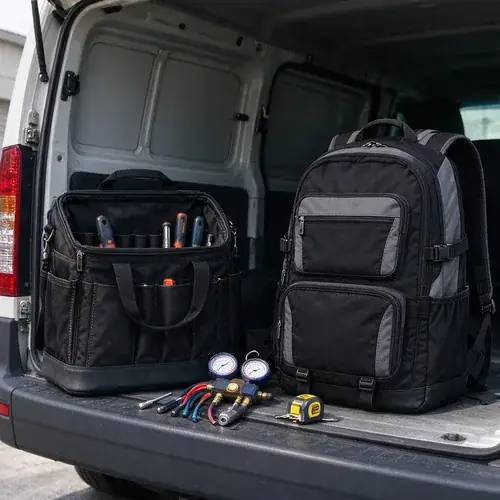
The HVAC tool bag vs technician backpack decision comes down to access speed versus mobility. An open-top HVAC tool bag makes tools visible and the bag easy to set down on a van tailgate or jobsite floor. A technician backpack keeps both hands free, spreads the load across both shoulders, and works better on stairs, rooftops, and long walking routes. The right choice depends on how the technician moves, how much the loaded kit weighs, and which tools are reached first.
Get this wrong, and a service director ends up with thirty technicians complaining about the same bag, plus replacement orders piling up because handles, straps, or bases failed under real tool loads. For distributors and private-label brands, the bigger risk is sampling a design that looks organized in catalog photos but doesn't fit actual HVAC tools: the bulk order then becomes slow inventory or a return problem.
This guide walks through workflow-first comparison, structure verification, materials, private-label lineup logic, QC checks, and an RFQ checklist. The goal is simple: move you from format debate to a sourcing-ready specification. Use the comparison as a decision framework, not as a "winner" list. Start with route profile, loaded weight, and access order. Then confirm construction details with your supplier before you approve a sample.
Quick Answer: When Should Field Teams Use an HVAC Tool Bag vs a Technician Backpack?
The short rule: open-top HVAC tool bags usually win when the truck is close, calls are repetitive, and technicians need to see everything immediately. Technician backpacks usually work better when routes involve walking, stairs, ladders, or multiple buildings. That answer sounds simple, but most suppliers and catalogs blur it with pocket count and fabric claims. Decide the format on movement pattern first.
| Decision Factor | Open-Top HVAC Tool Bag | Technician Backpack |
|---|---|---|
| Mobility | Carry configuration varies; may include top handle, one-shoulder, or detachable shoulder strap depending on supplier spec—confirm actual carry mode in the RFQ | Better on long routes; both hands free |
| Tool Visibility | High; wide opening reveals the main cavity quickly | Medium; panels and zippered compartments slow access |
| Weight Distribution | Concentrated on one hand or shoulder, but easy to set down | Spreads load across both shoulders and closer to the body |
| Ladder Suitability | Works when set at the base or carried briefly by handle; less controlled on climbs | Better when both hands are needed for railings or equipment |
| Vehicle Access Workflow | Fast grab-and-go from van shelf or tailgate | Slightly more setup, but wearable while moving through parking, hallways, roofs |
| Base Stability | Can be built with rigid or molded base that stands upright | Depends on back panel structure and load placement; can tip if overloaded front |
| Maintenance | Simpler; fewer zippered seams, open cavity easier to wipe | More seams, harness padding, back panel layers; harder to clean |
| Best-Fit Service Environment | Residential replacement calls, repetitive diagnostics, jobs within sight of the van | Apartment and campus routes, commercial buildings, rooftop access, no-elevator work |
This table is not a universal rule. Many field-service programs carry both formats because a technician's Tuesday looks different from their Thursday. The sourcing question is which format becomes the core SKU, and which is the add-on once field feedback justifies it.
Scope of This Guide: What Buyers Should Actually Compare
This page covers the procurement decision behind field-service bag formats. It is written for HVAC distributors, industrial bag importers, private-label brands, and service companies standardizing technician kits. The focus is not consumer EDC backpacks, not generic "best HVAC bag" rankings, and not brand-by-brand product reviews.
What matters here is whether a bag survives the actual work sequence: van to jobsite, set down on concrete, opened and closed repeatedly, loaded with manifold gauge, meters, screwdrivers, bits, tape, and small parts, then thrown back into a service vehicle. Every material, pocket, zipper, and reinforcement choice should be evaluated against that sequence.
How Technician Workflow Changes the Best Bag Format
A reliable predictor of whether a bag gets adopted is not the bag itself; it's how the technician works. Two identical-looking field service bags can perform differently because one was designed around a residential replacement route and the other around a large commercial campus. Before writing an RFQ, you need to know the dominant movement pattern.
Short-Distance Service Calls and Fast Tool Visibility
For short residential routes where the van stays close to the unit, the open-top HVAC tool bag usually earns its place. The tech sets the bag near the condenser or furnace, opens the wide mouth, and sees the manifold gauge, screwdrivers, meter, bits, and tape without unzipping four separate panels. That direct access can save small amounts of time per call, and over a day those minutes may add up.
The failure mode here is not the opening; it's pocket depth. A wide mouth gives visibility, but if the internal loops are too shallow for screwdriver handles or too narrow for a meter, the bag becomes a pile instead of an organized kit. When you sample, insert the actual HVAC tools the team uses. Don't evaluate an empty bag.
Long Walking Routes and Hands-Free Carry
A technician backpack makes more sense when walking distance becomes a real part of the job. Apartment complexes, parking structures, hospital corridors, campus buildings, and rooftop equipment often require a tech to walk long distances with a kit. At that point, a single-shoulder or top-handle carry becomes a complaint generator.
The backpack format distributes load across both shoulders and keeps hands free for doors, railings, ladders, and replacement parts. But the backpack is not automatically better for heavy tools. If the loaded kit is on the lighter side and the route is short, a backpack may feel like overkill. Once you define a loaded-weight target and walking distance with the service team, the format choice becomes obvious.
Ladder Access, Tight Mechanical Rooms, and Mobility Constraints
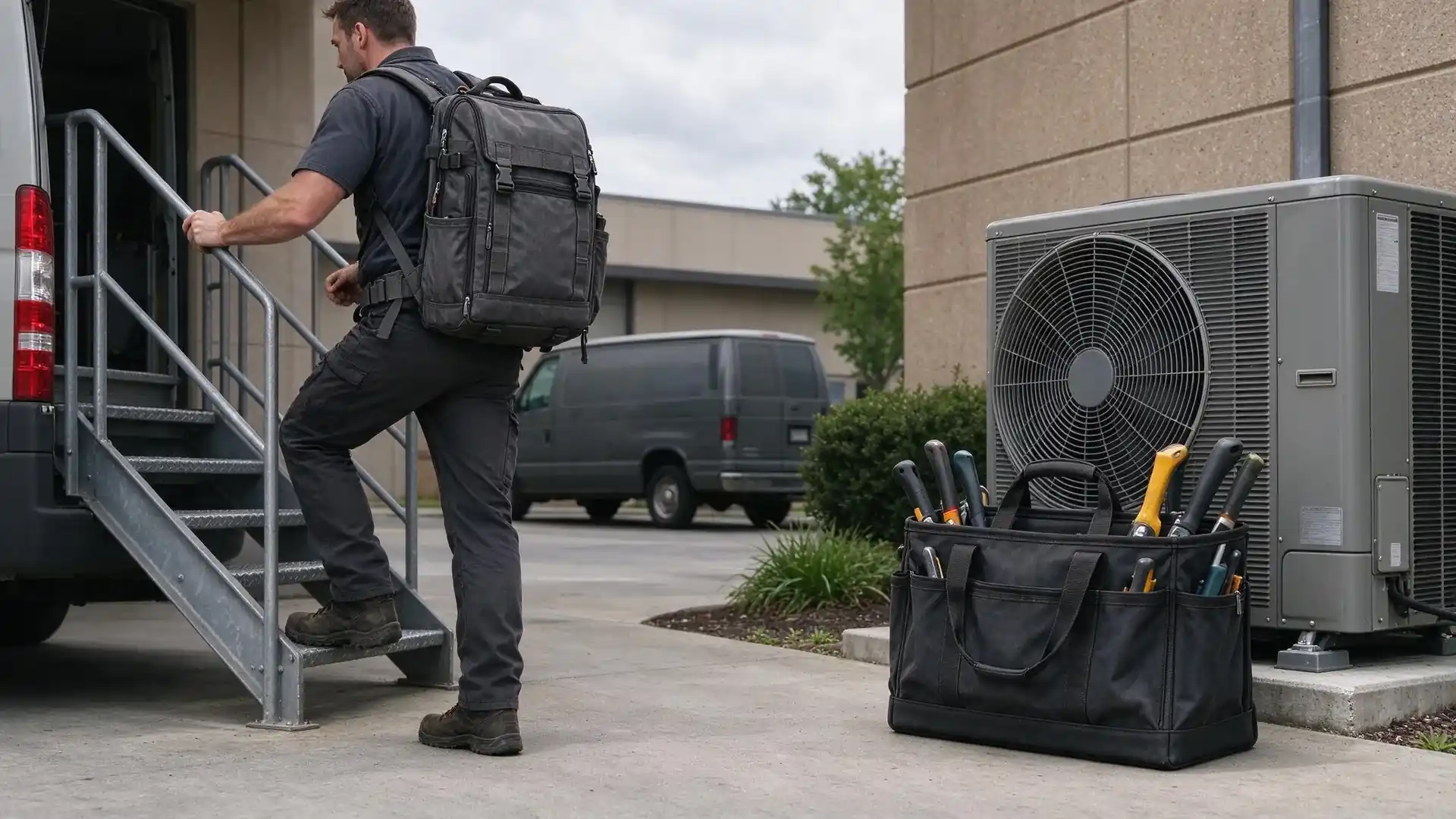
Ladder work changes the decision again. A technician backpack may support hands-free movement when the loaded weight is stable, the harness is fitted and secured, and the site or company safety policy does not prohibit the method. The key advantage is that the loaded kit can stay close to the body while both hands remain free for the ladder, railing, or equipment. An open-top bag can be carried by the top handle, but the bag may swing and shift, especially when the tech needs one hand for a railing or tool belt. Final format selection should be reviewed against the buyer's safety rules, actual loaded weight, and technician procedure rather than treating either bag as an independent safety solution.
Tight mechanical rooms add another constraint. Open-top bags can be set down in a corner and opened, which is useful when floor space exists. Backpacks may keep the floor clear and may be worn while the tech leans, kneels, or reaches behind an air handler, but that use only works when harness fit, loaded-weight balance, bag profile, and the company's site safety and carry-policy rules allow it. Do not treat it as a universal solution. The best approach is to map the actual jobsite and validate the proposed carry method with the service team; do not assume one format covers all mechanical-room access.
Comparing Structure and Durability Requirements
Structure failures often drive replacement cost more than fabric choice does. A service bag can look thick and heavy in photos but still fail early in field use because the handle anchor seam slips or the base edge delaminates. In B2B field-service programs, you are buying the carry structure, not just the container. For deeper reinforcement and sourcing evaluation logic, see HVAC Tool Bag vs Technician Backpack: Sourcing Guide for Field Service Programs.
Open-Top Bag Base and Handle Reinforcement
The base and top handle carry most of the long-term abuse. Open-top HVAC tool bags need a base that can stand on concrete, tailgates, and scuffed truck shelving without collapsing. Factories typically use a PE/PP board, reinforced fabric with a rigid insert, or a molded rubber/TPR base. Each option has a different cost, weight, tooling requirement, and standing shape.
Ask the supplier to confirm board thickness, edge finishing, and how the bottom seam is protected. A rigid board can crack at the corners if the edge is not bound properly; a molded rubber base can increase durability but may also require tooling and a longer sample cycle. The handle anchor is another silent failure point. Top handles should be sewn through webbing that wraps under the bag rather than only bartacked to the top fabric seam. During sample approval, pull the loaded bag by the handle and inspect whether the seam opens or distorts.
Technician Backpack Harness and Weight Distribution
A technician backpack only works as well as its harness. The shoulder straps, back panel, and upper anchor points must transfer load without pulling the top seam apart. Poor harness design is easy to hide in photos and obvious in the field: the straps dig in, the bag sags backward, or the top fabric tears away from the body.
Ask for the reinforcement specification at strap anchors. A better bag uses webbing that runs into the top shoulder area with multiple bar-tacks or box-stitch patterns. Ask the supplier to specify the back panel padding material, foam type, density, thickness, and compression-set resistance. These are buyer-checkable details, unlike generic terms such as "padded" or "heavy duty." If the loaded kit is expected to be on the heavier side, confirm whether the specified foam resists compression over repeated service cycles, and verify that claim against your actual loaded-weight target. Do not accept "padded straps" as a verification. Ask how the straps are attached to the back panel and what stitch type is used.
Pocket Layouts Based on Actual HVAC Tools
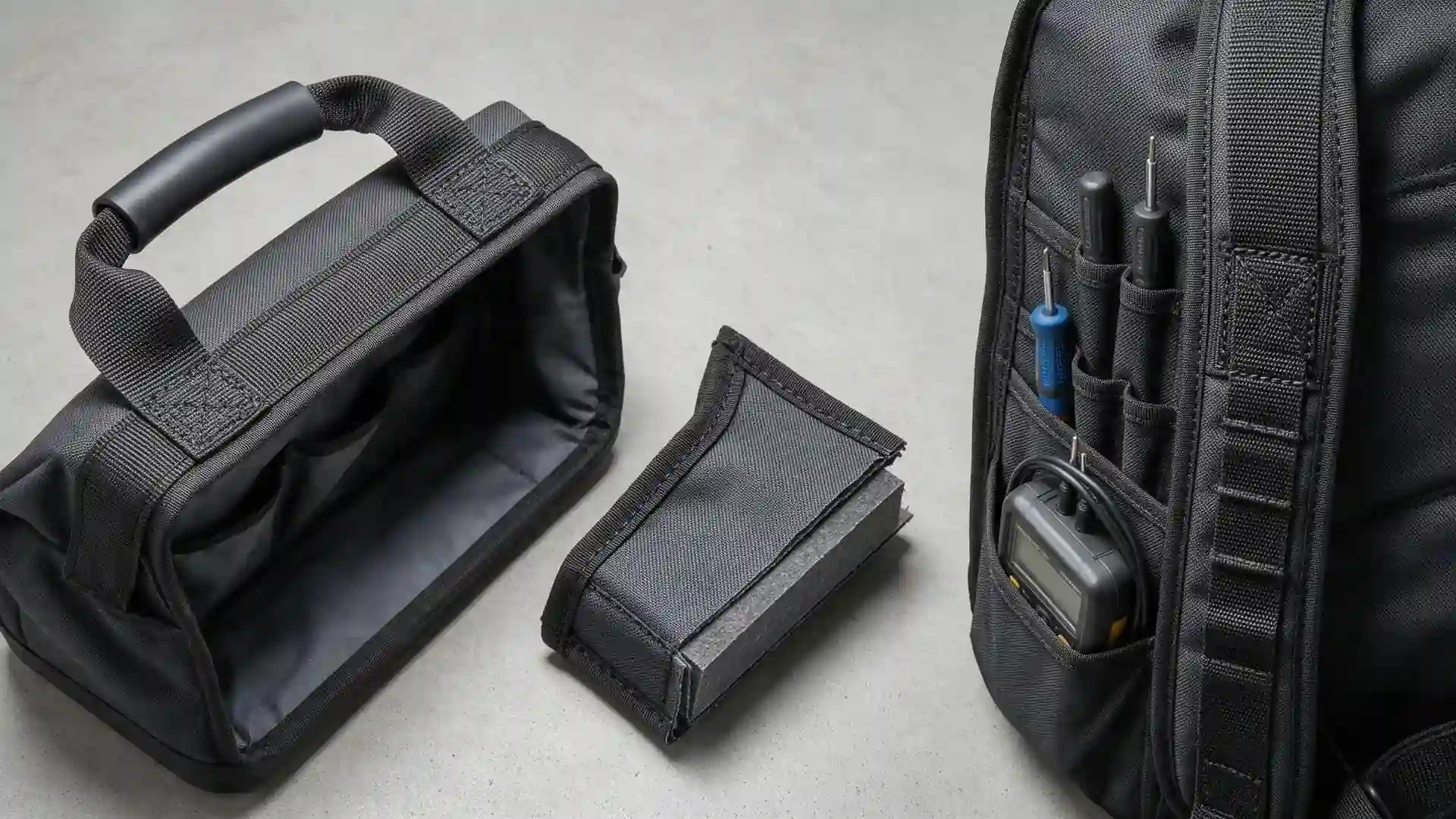
More pockets do not improve organization if the pocket depth does not match real HVAC tools. HVAC kits usually include manifold gauge sets, screwdrivers, nut drivers, a multimeter, drill bits, tape, jumpers, and small plastic fittings. Those items have completely different lengths, diameters, and handling patterns.
A screwdriver pocket must be deep enough to keep the handle accessible but not so deep that the tool disappears. A meter zone needs enough clearance and maybe a padded divider. Small bits and fittings belong in a visible pouch row or a removable insert, not scattered in a deep dark cavity. During sample evaluation, bring the actual tool list and test every intended position. If a supplier tells you a pocket fits "standard tools," ask them to define standard, because HVAC, electrician, telecom, and MRO kits are not the same.
| Component | Failure Risk | Why It Matters | Buyer Verification Method |
|---|---|---|---|
| Base/bottom panel | Delamination, corner cracking, edge wear | Bag loses upright stability; bottom seam opens | Request base material and edge finishing; load sample and set on concrete |
| Top handle anchor | Seam slippage, webbing tear under top carry | Primary carry point fails first | Inspect bar-tack or box-stitch pattern; pull loaded handle during sample check |
| Backpack strap anchor | Separation at shoulder/top seam | Visible failure early in service; creates return risk | Confirm webbing-to-panel attachment; inspect after loaded wear test |
| Zipper and puller | Coil slip, slider break, stuck puller | Slows service access; techs avoid the bag | Open/close zipper under loaded panel tension; test with gloves on |
| Pocket interiors | Wrong depth, weak elastic, torn dividers | Tool loss and poor technician adoption | Insert actual HVAC tools during sample approval; measure pocket depths |
| Internal dividers | Seam opening from sharp or heavy tools | Kit becomes a pile; small parts migrate | Load with manifold gauge and sharp bits; shake/carry test |
Material and Component Choices for Field Service Bags
Material spec is where buyers either overpay for marketing or under-spec for the jobsite. Field service bags are not hiking packs. They get tossed, dragged across concrete, rubbed against sheet metal, and exposed to refrigerant oil, grease, and weather. The material selection must match that abuse.
Polyester and nylon are the two main shell options. Polyester tends to be more cost-stable and prints cleanly; nylon often offers better abrasion resistance at a given denier. Field-service shells are often specified in lighter to heavier denier ranges, but higher denier alone does not guarantee durability. The coating, weave, and seam construction matter as much as the yarn, and the exact denier should be confirmed with the supplier against your target market and loaded-weight target. For a deeper comparison, see Nylon vs Polyester Bags: How B2B Buyers Should Compare Fabric Durability, Coatings, Canvas Options & Cost.
Coated fabrics add moisture resistance but create tradeoffs. A light PU coating can delaminate or wear away in high-abrasion zones. A heavier PVC coating may improve chemical and water resistance under defined exposure conditions, but compatibility depends on the refrigerant oils, cleaners, and site chemicals the bag is likely to contact. Add the target jobsite exposure list to the RFQ and ask the supplier to confirm coating compatibility in writing before specifying PVC. PVC also adds weight and stiffness. If the target market involves rooftop exposure or wet mechanical rooms, ask the supplier to specify the coating type and which panels get the extra layer. Do not call the bag waterproof unless the seams and zippers are also sealed and tested.
Zippers need more attention than most RFQs give them. Field-service bags should use a supplier-specified coil or molded zipper that is sized for gloved use. The puller should be easy to grip with damp or greasy hands. Storm flaps or rain guards are functional, not decorative, when the bag rides in an open truck bed or near a condenser.
Padding, lining, and base materials should be chosen for maintenance too. Backpack back panels and harnesses absorb sweat and grime; open-top cavities are easier to wipe but need a durable inner lining. If the bag will be cleaned by service teams rather than replaced, ask about wipe-down surfaces and whether the bottom material resists oil penetration.
Private-Label and Distributor Program Considerations
Once you have chosen the format, the product line decision is a separate sourcing problem. A distributor often should not launch a backpack, an open-top tote, and a small pouch in five colors each on day one. That multiplies SKU complexity, sample approvals, carton labels, and after-sales parts. Start with one core format built around your largest customer's technician profile, then add the second format only when field feedback confirms a gap.
Private-label field-service programs often work better with shared trims. Use the same zipper style, webbing, lining color, and logo placement across formats. That reduces the number of components a factory must stock and simplifies reorders when one format sells faster than expected. Packaging consistency matters too. If the product feeds marketplace fulfillment or distributor warehouses, confirm polybag size, hangtag position, carton label, barcode format, and any channel-specific labels before sampling. For broader private-label backpack planning, review Private Label Backpacks: A Sourcing Guide for marketplace and Online B2B Sellers.
Mixed-format programs can work when the bag series shares a modular internal organization system, such as removable pouch sets or the same vertical loop layout. That lets technicians stay in one hot zone for speed and gives distributors a coherent product story. Replacement parts are another consideration. Harness straps, zipper pulls, and buckles are wear items; ask the supplier whether these components can be supplied separately for after-sales support.
Quality Control Checks Before Bulk Production
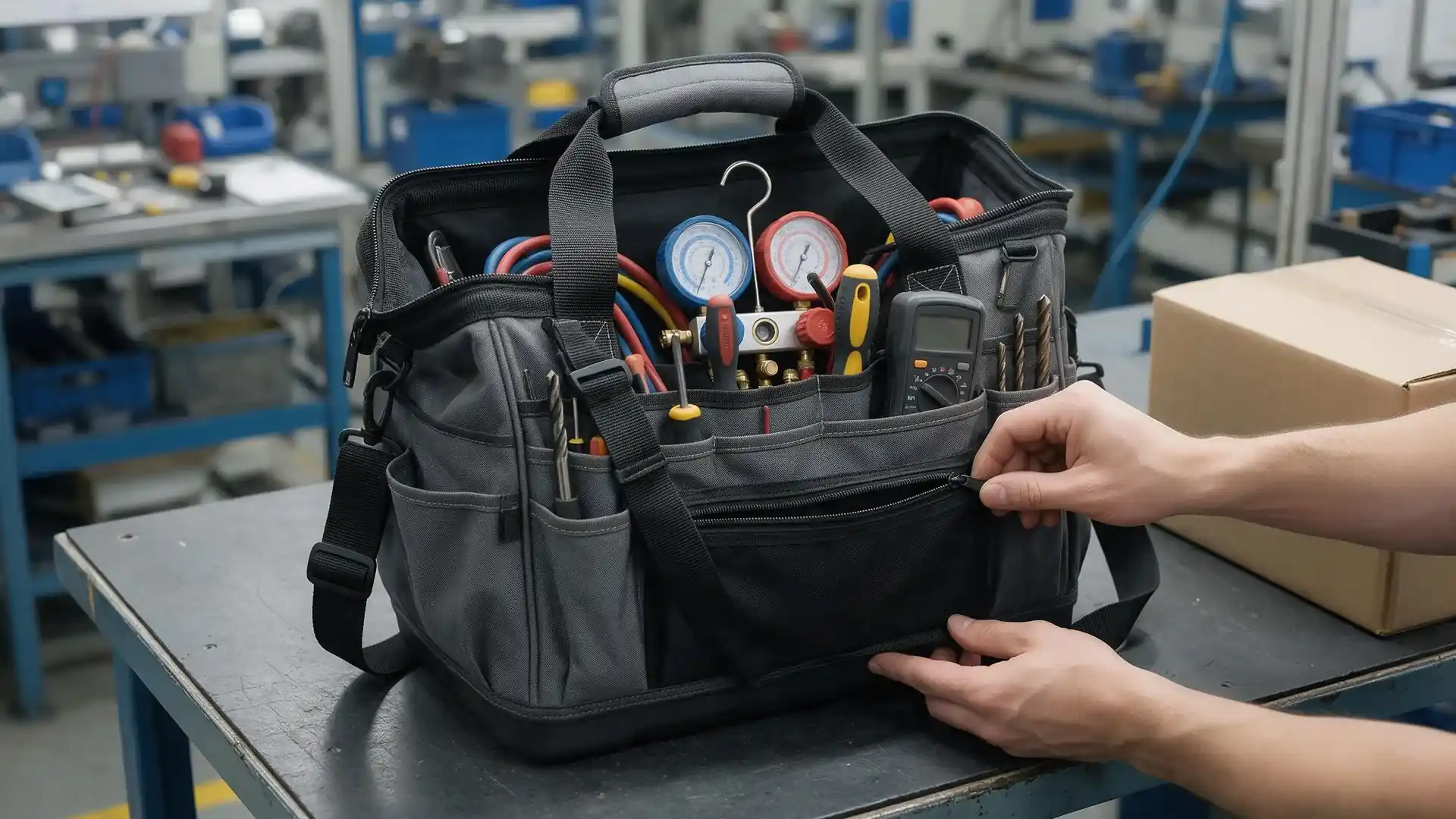
Sampling is where buyers catch field-service failures before they become field complaints. The rule is simple: reject drawings-only evaluation. Load the sample with the actual tools a technician carries, in the order a technician reaches for them. A bag that looks right when empty can fail when one manifold gauge forces the divider seam to open.
Use this pre-production sample checklist before approving bulk production:
- Load the sample with the exact HVAC tool list from your RFQ. Do not approximate with generic weights.
- Check pocket depth and retention by inserting screwdrivers, meters, drill bits, tape, and manifold gauge in the intended positions.
- Place the loaded bag on concrete or a hard floor and confirm it stands without collapsing or tipping.
- Pull the top handle and shoulder straps with the loaded sample. Inspect stitch lines and webbing anchors for separation.
- Open and close all zippers under loaded panel tension. Run the pullers with work gloves on.
- Ask a technician to wear the backpack through a simulated service route, not just for a 30-second photo fit.
- Review carton pack-out: bag shape after compression, carton strength, interior protection, barcode or label placement, and whether the bag arrives ready for shelf or platform scanning.
These checks overlap with the sourcing risk controls covered in Top 12 Mistakes to Avoid When Sourcing Bags from China: A Decision-Maker's Guide to Quality and Risk Control. Do them yourself or have a third-party inspector follow a buyer-defined acceptance list. The important part is that the acceptance list exists before the sample ships.
Supplier Verification: Questions to Settle Before You Sample
Before you spend time on samples, make the supplier prove it can control the details that fail in field service. The questions below separate a real bag manufacturer or experienced trading partner from a general supplier that quotes any shape.
Ask who controls pattern development. If the supplier is a trading company, find out which factory owns the pattern and whether the production team will remain the same on repeat orders. Pattern ownership affects future consistency when you reorder the same SKU next season.
Ask the supplier to confirm reinforcement construction in writing. The answer should include the stitch type at handle and strap anchors, the base material and approximate thickness, and the zipper or puller specification. A vague reply like "heavy duty" is not a spec. Reject it politely and ask for details.
Ask how the supplier ensures sample-to-bulk consistency. The pre-production sample should use the same shell fabric, coating, zipper, webbing, and foam as bulk production. If the factory plans to substitute a material because of stock shortage, you need to hear that before production, not after the container lands.
Ask who owns logo, packaging, and carton label coordination. There should be one responsible party. If logo artwork is handled by a decorating subcontractor and packaging by another supplier, the gap between those steps creates delay and miscommunication.
RFQ Checklist for HVAC Tool Bags and Technician Backpacks
A complete RFQ prevents two expensive outcomes: redesign after sampling and bulk mismatch with approvals. The more you define before quoting, the fewer assumptions the supplier must make, and the faster the factory can quote a realistic project rather than a placeholder.
| Field | Buyer Input / Options |
|---|---|
| Bag format | Open-top HVAC tool bag / technician backpack / both formats |
| Target user | HVAC technician, telecom technician, general maintenance, route driver |
| Estimated loaded weight | Confirm from actual kit, not a guess |
| Actual tool list | Manifold gauge, meters, screwdrivers, bits, tape, jumpers, fittings |
| Target market | Country or region; usage environment and return expectations |
| Quantity band | Buyer-defined; confirm supplier feasibility |
| Shell material | Polyester or nylon; denier and coating if known |
| Bottom structure | PE/PP board / molded rubber or TPR base / reinforced fabric |
| Logo method | Embroidery / woven label / rubber patch / print |
| Branding placement | Front lid, back panel, shoulder strap webbing |
| Packaging | Polybag, hangtag, carton, barcode or channel label if required |
| Inspection requirement | Pre-production sample, inline inspection, final inspection |
| Sample deadline | Buyer-defined |
| Bulk delivery deadline | Buyer-defined |
For reusable specification blocks, send the RFQ as a table or an itemized list, not as a long paragraph. Suppliers can quote faster when each field is visible and blank spaces are intentional. If the first quotation comes back with a large unexplained cost in one line, ask the supplier to map that cost to a specific material, reinforcement, or packaging choice. Then you can adjust the spec without weakening the carry points.
FAQ: HVAC Tool Bag vs Technician Backpack
Field-service bag failures usually come from a mismatch between technician workflow and construction, not from material quality alone. These are the questions buyers ask most often before sampling.
Is a technician backpack better for heavy HVAC tools?
A technician backpack spreads heavy loads across both shoulders, which usually makes it more comfortable on long walking routes. But heavy loads also concentrate stress on strap anchors, back panel seams, and zippers. If the loaded kit is heavy, the backpack should be specified with reinforced strap webbing and stress-point stitching. For heavy tools used mostly within sight of the service van, an open-top bag with a rigid or molded base may be easier to set down and use repeatedly.
When does an open-top HVAC tool bag make more sense?
An open-top HVAC tool bag makes more sense when the route involves short, repetitive service calls, the van stays close to the unit, and the technician needs immediate visual access to manifold gauges, screwdrivers, meters, and bits. The wide opening and upright base usually work well on floors, tailgates, and mechanical-room corners. It is less suitable when the tech must walk long distances or climb several flights of stairs with both hands occupied.
What usually fails first in field-service bags?
The early failures buyers see most often occur at the top handle anchor, the backpack shoulder strap attachment, the bottom edge and corners, and the zipper. Pocket elastic and internal dividers can also fail when sharp or heavy tools overload them. These failures usually happen because the bag was sampled empty or with generic weights, not with the actual HVAC kit. A loaded pull test, base set-down check, and zipper test can expose most of these problems before bulk production.
Should distributors offer both tote and backpack formats?
Distributors should not offer both formats automatically. Start with one core format based on the largest customer's technician route profile, then add the second format when field feedback or customer requests justify the extra SKU. If both formats are offered, keep zipper, lining, logo placement, and packaging consistent across the series. That shared-trim approach reduces sample approvals, labeling complexity, and after-sales parts.
What should buyers test during sample approval?
Buyers should test the sample with the exact HVAC tool list, not approximate weights. Check pocket depth and retention, standing stability on a hard floor, handle and strap pull strength, zipper movement under loaded tension, and carton pack-out. For backpacks, have a technician wear the loaded sample through a simulated service route. The goal is to find fit and structure problems in sample stage, not after field crews start using the bags daily.
Conclusion
The HVAC tool bag vs technician backpack decision is a workflow decision first, then a sourcing spec. Match the format to the technician's route, loaded weight, and access order. Then make the supplier prove the reinforcement and pocket details will hold up under real tools.
Your next step is to write the RFQ with the actual tool list, estimated loaded weight, route profile, bottom structure preference, and packaging requirement. Request a pre-production sample and load it with the tools before approving bulk. OMASKA can provide project-dependent OEM/ODM sourcing assistance once the workflow requirements are defined; pattern development, reinforcement, sample approval, and packaging feasibility should be confirmed against your specifications during RFQ and sampling rather than assumed from a general capability statement.
Get A Quote

Get A Quote
0 Comments