
Drone Backpack Design Guide: EVA Protection, Divider Systems & Fit Testing

A drone backpack is not a photo bag with a drone printed on it. It is an equipment carrying case that must be specified around three failure points: high-frequency vibration reaching the IMU (inertial measurement unit) and gimbal, crush forces on folded rotor arms and camera housings, and heavy LiPo batteries moving against sensitive components. The core buying decision is not "how much padding" but whether the shell, foam density, divider layout, and loaded fit test work as one system before bulk production.
When this is wrong, the cost shows up in returns, online marketplace reviews, and batch-level rework — not in the unit price. A supplier can deliver a perfectly sewn bag with the right logo and still produce a product that does not protect the drone. The most reliable way to prevent that is to define protection requirements at the RFQ and pre-production sample stage, then verify them with loaded fit photos, divider stability checks, and zipper route tests.
This guide walks electronics and accessory brands through that decision path. You will compare molded EVA and soft-shell construction, set density targets, plan the interior divider map, specify battery isolation, and build a fit-test checklist that separates a real drone backpack manufacturer from a supplier decorating stock camera-style bags.
Quick Answer / 30-Second Buyer Decision
If you take only one decision from this page, make it this: choose the shell and divider system from the heaviest accessory and the most vibration-sensitive component, not from the exterior look.
The 30-second decision flow:
- If the drone has an exposed gimbal, inertial sensors, folding rotor arms, or multiple LiPo packs: start with a molded EVA drone case plan.
- If the kit includes a heavy controller, charger, or multiple batteries: plan the divider map before locking the shell type.
- If the product ships through parcel networks or marketplace fulfillment: add lid compression and crush checks.
- If the supplier cannot show a loaded pre-production sample with top, side, and lid-closed photos: stop and fix the sampling gate before bulk.
A lightweight travel accessory with one battery may work in a structured soft-shell. A high-value camera drone with four batteries usually will not, but that determination should be settled by loaded fit and shake testing rather than product class alone. The difference is whether you can verify internal movement.
Scope of This Guide
This guide covers the specification and sourcing of drone backpacks and related electronics carrying cases for brands, wholesalers, distributors, online sellers, and importing teams. It is written for product managers, sourcing staff, and buyers who need to prepare an RFQ or approve a pre-production sample, not for consumers comparing retail backpacks.
It focuses on:
- Molded EVA vs. soft-shell drone backpack construction
- Foam density and Shore C hardness targets
- Modular divider engineering and accessory zone planning
- LiPo battery isolation and transport-boundary checks
- Loaded fit testing and pre-production QC evidence
- RFQ fields that reduce quote ambiguity
- Supplier responsibility mapping before deposit
It deliberately does not cover drone flying performance, consumer drone model reviews, or generic bag manufacturing unrelated to electronics protection.
Why Drone Backpack Design Requires Specialized Protection
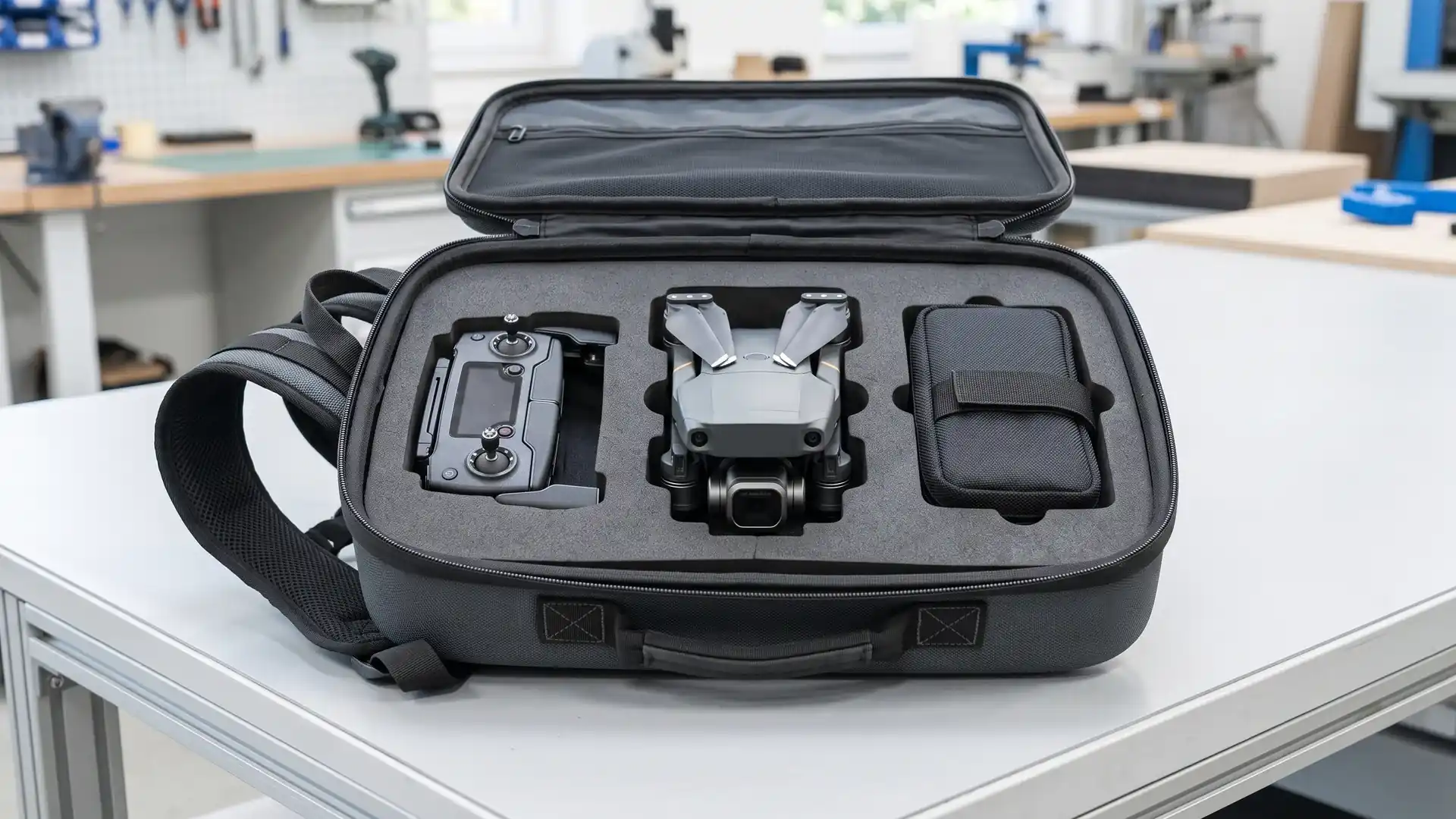
A standard camera or laptop backpack is usually optimized for impact absorption rather than drone-specific vibration isolation. Whether repeated small-amplitude shaking creates a real failure risk depends on the drone design, the presence of a gimbal lock or guard, and the actual test evidence for the model and loaded condition. Some drone configurations may be sensitive to sustained transport vibration, but that should be treated as a conditional risk to verify, not a universal failure mode. That means the drone backpack design should solve two separate problems at once: static crush protection and vibration dampening where required.
The second problem is mass distribution. A drone kit commonly includes a controller, multiple LiPo batteries, spare propellers, cables, and sometimes a charger. Batteries and controller are dense objects. If they sit in a loose accessory pocket, they can act like hammers inside the bag when the customer walks, sets the bag down, or ships it through a parcel network. They move, strike the gimbal or gimbal cover, and create exactly the kind of shock the outer foam was meant to prevent.
Specialized protection therefore has three jobs:
- Keep vibration from reaching the drone core.
- Prevent crush from distorting folded arms and camera housings.
- Lock batteries and controller in fixed positions so they cannot transfer load into delicate parts.
Once those three jobs are written into the brief, shell and divider decisions become much less subjective.
Molded EVA vs. Soft-Shell Drone Backpacks
The first structural decision is whether the outer shell is thermoformed EVA (ethylene-vinyl acetate) or a conventional padded soft-shell fabric backpack. Both can be legitimate, but they solve different problems and carry different commercial risks.
A molded EVA drone backpack uses thermoformed EVA foam to provide rigid, shock-absorbing protection for sensitive electronics like gimbals and IMUs. It relies on a thermoformed closed-cell foam shell that gives shape, dimensional stability, and a predictable cavity. Whether it resists collapse under other luggage or parcel stacking depends on specified wall thickness, foam density, cavity support, and a buyer-defined compression or pack-out test with clear pass criteria. It also allows the buyer to define a cavity around the actual drone silhouette — but only if the mold is approved. Tooling is a meaningful upfront cost, and the per-unit economics depend on order volume, mold complexity, cavity count, and material thickness. No responsible supplier should confirm tooling cost or minimum order quantity without seeing the exact 3D reference or component list.
A soft-shell drone backpack uses padded nylon or polyester panels, often with PE foam or EVA reinforcement at the base and back. It is lighter, more flexible for mixed accessories, and usually faster to prototype from stock materials. But it depends more heavily on divider quality and packing discipline. The exterior can compress against the drone during lid closure or courier handling, and the interior needs to work harder to keep batteries and controller in place.
| Feature | Molded EVA (Thermoformed) | Soft-Shell (Padded Nylon/Polyester) | Best Use Case | Tooling Cost Impact |
|---|---|---|---|---|
| Crush resistance | Depends on specified wall thickness, density, and cavity support; requires buyer-defined compression test | Moderate; depends on foam panel density and packed load | Rugged/outdoor transport, parcel network | Higher upfront, quote-dependent |
| Vibration dampening | Predictable if density and wall thickness are confirmed | Less predictable; depends on interior padding | Lighter domestic use | Low tooling, higher QC variance |
| Weight | Usually heavier for the same cavity volume | Lighter and more collapsible | Carry-on/travel use with limited batteries | Limited because most parts are cut-and-sew |
| Cavity control | Strong, shape-stable | Softer cavity that shifts as contents shift | Consumer-friendly open interior | Requires mold maintenance |
| Typical failure mode | Wrong cavity clearance or hard shell pressing on protrusion | Batteries shifting, lid compressing gimbal | Not a use case; both designs need a loaded fit test | Loaded fit test required in both cases |
While soft-shell camera backpacks offer flexibility for general photography, a molded EVA drone case generally offers more predictable crush resistance and vibration dampening for delicate drone rotors and sensors. The decision should not be "which one is better." It should be "which failure mode can my customer tolerate, and which can I verify in production?" If the drone is a high-value camera platform or the product is sold as rugged protection, start with thermoformed EVA. If the product is a lightweight travel accessory with one battery, a structured soft-shell can work — but only if the divider map and loaded fit test are enforced.
Before committing to a molded shell, understand the cavity, draft angle, and density trade-offs in the EVA camera case manufacturing guide. The same mold-engineering logic applies to a molded EVA drone case, but with extra attention to folded-arm clearance and battery cavity depth.
Designing Internal Divider Systems for Drones and Accessories
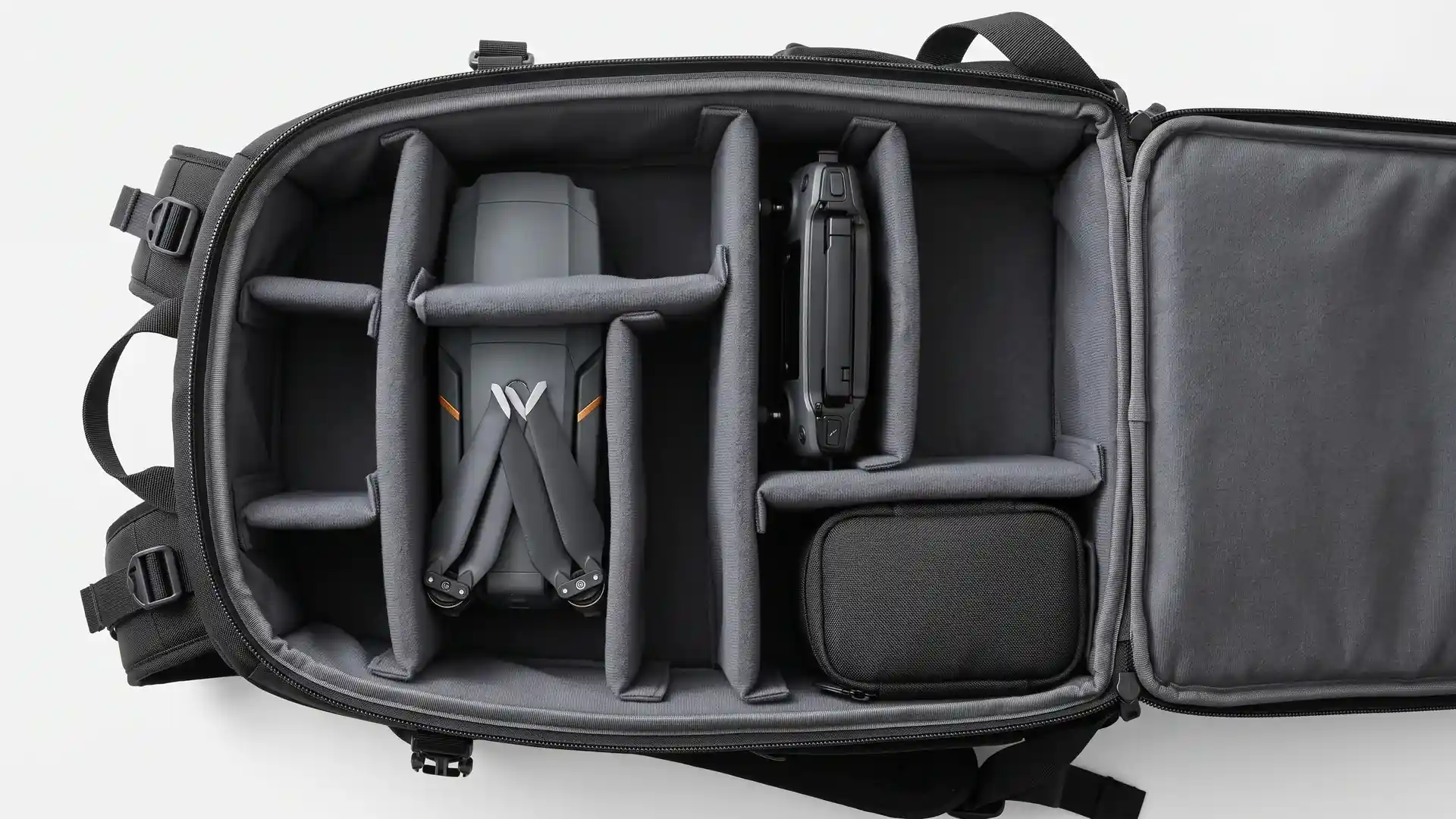
The best shell cannot fix a bad divider plan. In a drone backpack, the divider system is the mechanism that keeps the drone body, controller, and battery packs from meeting each other. Do not start with an empty bag and ask the factory to "add some dividers." Start with a zone map that names each object, its mass class, crush sensitivity, and required position.
Do not copy a generic camera divider backpack layout. A drone is not a DSLR. The folded arms, landing gear, gimbal, and battery stack create protrusions and weight concentrations that a camera insert was never designed to manage.
A usable zone map includes:
- Drone body: largest cavity, deepest, with clearance around folded arms and protrusions.
- Camera/gimbal area: separated from controller; gimbal guard or padded sleeve if required.
- Controller: firm partition, no direct pressure on sticks or screen.
- Batteries: lowest possible level, isolated from metal pulls and conductive items.
- Cables and propellers: can share a shallow pocket, but must not sit under the drone in the lid-close path.
Divider quality matters as much as the map. Ask the supplier whether the dividers are structural padded panels with firm hook-and-loop attachment or thin trapdoor cloth pieces. Thin dividers fold under a heavy controller and stop doing their job. Structured dividers cost more and weigh slightly more, but they hold position when the bag is flexed.
Battery Safety and Component Isolation
LiPo battery packs are one of the biggest hidden risks in a drone backpack program. They are heavy, relatively hard, and can press into a gimbal or lens under ordinary load. LiPo transport rules are not generic; requirements change by shipping mode, destination market, cell capacity, packaging, and carrier classification. Buyers should confirm the current carrier and market requirements in writing before the first battery-included or battery-separated shipment. Battery storage should be treated as a separate engineering problem, not as one more mesh pocket.
Start with the physical problem. A battery pouch should be sized to the actual cell and connector, not to a generic accessory pocket. It should close securely. It should be placed so the battery cannot slide into the drone cavity or bow the zipper route. If the pack has exposed terminals, the design should prevent them from contacting zipper pulls, metal hooks, or other conductive hardware during movement.
If the brief requires a fire-resistant or flame-retardant battery pouch, require the supplier to confirm the specific material, test basis, and acceptable use conditions. Do not accept "fireproof" as a standalone marketing claim. Different materials behave differently under thermal runaway, and many are intended to delay ignition or insulate adjacent compartments, not contain a battery fire. The correct requirement depends on transport mode, battery chemistry, and the buyer's safety policy.
Battery placement should also keep mass low and close to the wearer's back where possible. A high-mounted battery changes how the bag carries and increases the chance the customer sets it down hard on a load-bearing seam. That becomes a customer-experience and return issue, not just a safety issue.
Confirm four things in writing before approving the battery area:
- The pouch material and closure method.
- The actual cell dimensions versus pouch cavity.
- The failure mode if the pouch opens or tears under repeated loading.
- Any transport documentation the buyer must supply for battery-included or battery-separated orders.
Equipment Fit Testing and Pre-Production Quality Control
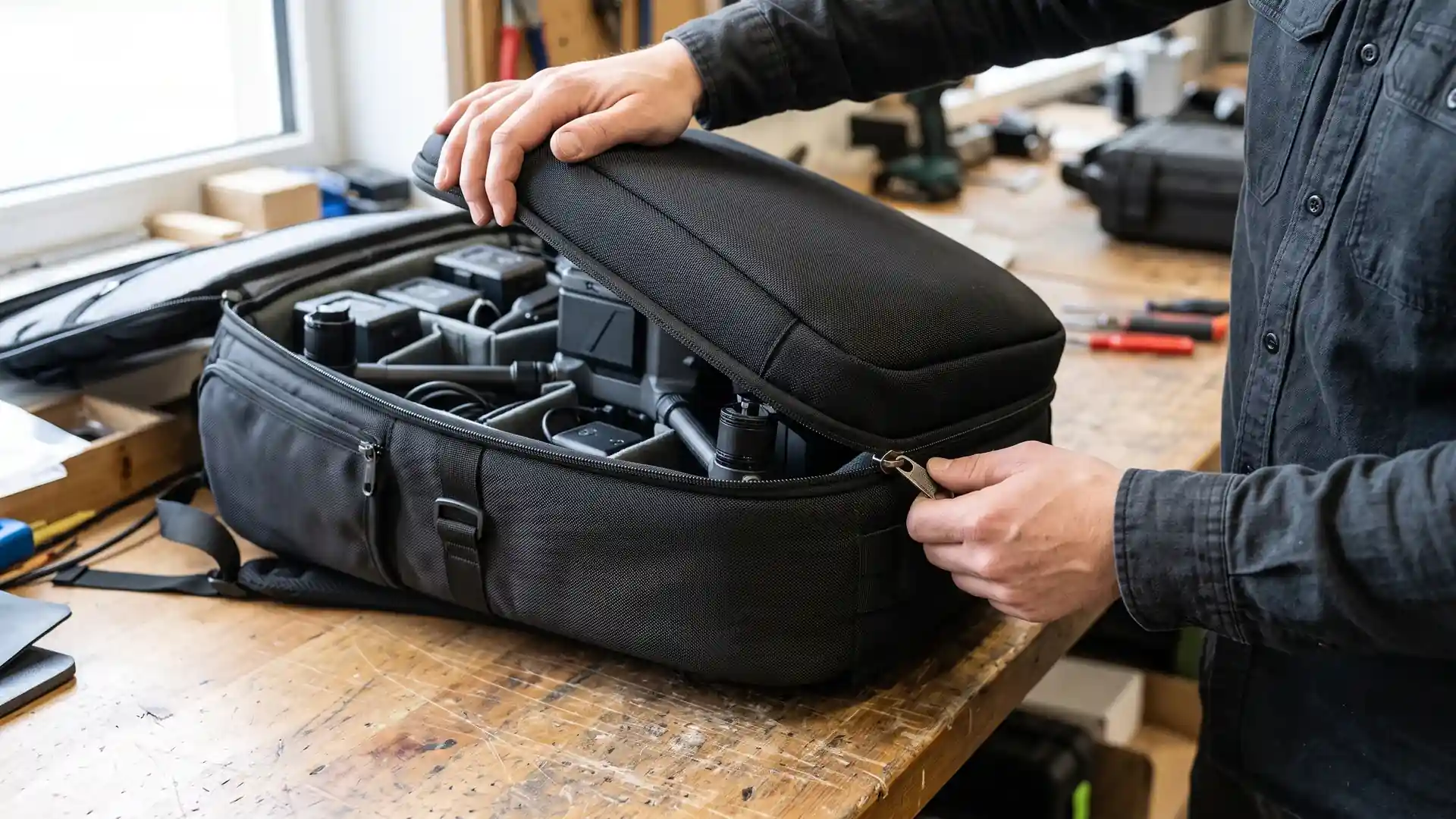
Equipment fit testing is the process of verifying that a loaded drone, controller, and accessories fit securely within the backpack's dividers without stressing the zipper route or allowing internal movement. Once the shell and divider plan are defined, the pre-production sample becomes the real decision gate. The purpose is not to see whether the bag looks like the render. It is to prove the loaded system works: the drone sits inside without the lid forcing the gimbal down, the controller does not press against the drone, the dividers stay where they are placed, and the zipper route closes without dragging.
The most useful evidence is loaded fit photos taken from top, side, and lid-closed views. Use the actual drone, controller, and battery set, or an approved dimensional dummy with matching protrusions and mass; a visually similar drone is not enough. Do not approve a sample from a photo of an empty bag. An empty drone backpack often looks well-made because there is nothing inside it to reveal clearance or movement problems.
Use the broader bag quality inspection checklist for stitching, hardware, lining, and general workmanship. That checklist complements this fit-test section; neither replaces the other.
The fit-test checklist should be written into the QC agreement before PPS. It does not need to be long, but it needs to be specific:
- Record the exact loaded items used for the test: drone, controller, battery count, charger, cables. If a dummy is used, confirm it matches the production device dimensions, protrusions, and mass.
- Take top, side, and lid-closed photos with the bag fully loaded.
- Close the lid slowly and note any resistance, clicking, or pinching over the gimbal or protrusion area.
- Check the zipper route at both corners and confirm the puller clears without jamming.
- Perform a loaded shake and lift test with the bag closed; define the duration and movement in the QC instruction rather than leaving it to "the factory will test."
- Reopen the bag and check whether dividers moved, battery pouch opened, or the drone shifted.
- Take a loaded lift photo by the top handle and by the backpack straps if the launch brief includes both.
- Confirm foam edge finish, divider seams, and lining cleanliness before releasing the sample.
Do not accept a PPS approved by the supplier alone. The buyer should review the evidence. If the supplier cannot or will not produce loaded top, side, and lid-closed photos, the program is not ready for bulk.
RFQ Checklist: Sourcing Drone Backpacks from a Manufacturer
A drone backpack manufacturer cannot quote accurately if the RFQ only says "custom drone backpack, similar to a camera bag." The quote will be either inflated, vague, or based on a stock item that does not match the final product. A professional RFQ gives the supplier enough data to choose materials, divider construction, cavity logic, zipper routing, and packaging method — and enough constraints to make the quote comparable across factories.
Before writing the RFQ, decide whether you are asking for stock-model decoration, semi-custom development from an existing shell, or full mold-based OEM development. That distinction changes tooling, sample method, MOQ, and supplier selection. A factory that only decorates stock camera backpacks is not the same as a supplier that can develop or manage mold tooling and run a loaded fit test. The mold itself may be produced by a thermoforming partner, but the supplier must be able to coordinate the tooling, cavity verification, and production sample gate. The backpack manufacturer selection guide helps you separate real production capability from sales language.
| Category | What Buyer Must Provide | Why It Matters |
|---|---|---|
| Device data | Actual drone dimensions, folded dimensions, protrusions, weight, controller dimensions, battery dimensions/capacity | Drives cavity size, lid clearance, and divider wall height |
| Shell preference | Molded EVA vs. soft-shell; target density/hardness; desired weight class | Changes tooling, freight volume, and unit cost |
| Interior plan | Zone map for drone, gimbal, controller, batteries, cables, propellers | Prevents cavity conflicts and accessory migration |
| Carrying system | Backpack straps, top handle, sternum/waist strap, load-bearing padding target | Determines strap construction, foam density, reinforcement |
| Closure/hardware | Zipper type, puller finish, water-resistance target, corrosion requirements | Affects zipper strength, water resistance, and inspection method |
| Branding | Logo method, placement, color target, Pantone/dye references | Affects sampling, mockup, and color approval |
| Packaging | Polybag, barcode needs, carton pack-out, retail box/pallet plan | Affects landed cost, warehouse handling, and return risk |
| Compliance | Target market, battery-included vs. battery-separated freight, age group if any, restricted material requirements | Must be confirmed because transport and market rules vary |
| QC gates | PPS, loaded fit photos, AQL plan, final/random inspection | Defines the approval standard before money is released |
| Timeline | Buyer-defined sample deadline, bulk delivery window, shipment mode | Links order to production planning and freight without false promises |
If you put those fields into a structured RFQ rather than an email paragraph, the supplier's questions will come back faster and will be technical, not "can you send more photos?" That alone is a useful supplier filter.
Supplier Verification and Responsibility Mapping
Before you send a deposit, verify who is actually responsible for each part of the production chain. A sales company can present a quote using terminology from three different factories and still not know whether the EVA mold will clear your drone's folded arm. You want a documented responsibility map, not a single "we control quality" sentence.
Ask the supplier to confirm in writing:
- Who owns or manages the mold if molded EVA is involved.
- Who cuts and sews the soft components.
- Who makes or sources the divider foam and hook-and-loop system.
- Who performs the loaded fit test and whether photos will be supplied at each gate.
- Who is responsible if bulk production does not match the approved PPS.
- How revised dimensions or accessory changes are fed into tooling or pattern updates.
- Who controls carton pack-out and barcode placement.
If the answer is "our factory team handles everything," ask for the actual sample documentation and the fit-test photos. If they cannot produce them, treat the claim as unverified. For a deeper explanation of these roles, see backpack manufacturer vs supplier vs factory.
Common Mistakes That Delay Drone Backpack Programs
Many failed drone backpack programs do not fail because the factory is bad. They fail because the buyer approved an empty sample, changed dimensions after tooling, or ignored battery mass until the first returned unit. These are avoidable.
- Approving the exterior render and not the loaded pre-production sample.
- Copying a generic camera divider backpack layout without measuring the actual drone battery stack.
- Sending a photo to the supplier with no dimensions or accessory list, then holding them responsible for fit.
- Treating "fire-resistant" as a complete battery safety plan without documenting the test basis and usage limit.
- Comparing quotes only on unit price without accounting for tooling, carton cube, MOQ, and return risk.
- Leaving the zipper route and lid compression out of the QC checklist.
- Assuming a no-minimum stock bag decorated with a logo is the same as a mold-based OEM drone backpack.
Each of those has a simple fix: write the spec, load the sample, verify the closure, and map responsibility before paying the balance.
FAQ: Drone Backpack Protection and Sourcing Questions
These are the questions brands and sourcing teams ask before they finalize a drone backpack RFQ. The answers assume a B2B production context, so each one gives you the verification step to push back to the supplier rather than a vague "it depends."
What is the recommended EVA foam density for a drone backpack strap?
A useful working reference band for backpack strap padding is around 50–63 kg/m³, but this is a supplier-confirmed reference target only, not a specification. It should be confirmed with the foam supplier for your loaded weight, strap width, wearer profile, test method, and tolerance. Density alone does not decide comfort — hardness, thickness, and construction do.
What EVA hardness target should we specify for the shell?
Many equipment-case buyers ask suppliers to target roughly 45–55 Shore C for the shell foam, but this is a supplier-confirmed reference target only, not a guarantee or QC pass. The supplier should confirm the foam grade, wall thickness, cavity depth, test method, tolerance, and how the shell behaves with your drone and battery load. Hardness matters for shape stability; density and thickness matter for crush and vibration response.
How do we test zipper strength on a fully loaded drone backpack?
Do not rely on a single "zipper strength" label. Run a buyer-defined loaded fit test: close the bag over the actual loaded kit, check both zipper corners, confirm the puller clears without excessive force, and inspect for pinching or lid bow over the gimbal. Then include a loaded shake and lift test and a puller route check in the PPS acceptance criteria. If the bag passes empty but not loaded, the divider or lid clearance is the problem.
Can a drone backpack manufacturer customize the EVA mold shape?
Yes, custom mold development is possible, but it is quote-dependent in cost and MOQ. The supplier needs the actual device profile, folded dimensions, protrusion points, and accessory layout to assess cavity design and tooling feasibility. Ask whether the mold is buyer-owned or factory-owned, and what happens if the drone model changes.
How do we verify divider stability before bulk production?
Load the pre-production sample with the exact drone, controller, battery pack, and accessories. Close the bag, perform a defined shake and lift test, then open it and compare the divider positions with the approved zone map. Photograph the top, side, and lid-closed views. If any divider moves enough to let a heavy part contact a delicate part, reject the sample and adjust the divider wall height, hook-and-loop placement, or closure method.
Compliance Boundaries and Documentation to Confirm
Compliance in a drone backpack project does not come from one universal certificate. It comes from confirming which rules apply to the specific product-market combination. For most adult drone-carrying equipment, the outer bag itself is not a toy or child-care item, so child-product rules do not automatically apply. But the battery-included package, the airline or courier shipping mode, the target market's restricted-chemical rules for foam, lining, and finishes, and any retailer-specific material declarations still need to be checked with the supplier and freight provider.
Because rules change, the buyer's job is to request the latest carrier and market requirements in writing, not to assume a past shipment sets the rule. For any battery-included or battery-separated offer, confirm:
- Battery capacity, quantity, and packaging classification for the chosen shipping mode.
- Whether terminals must be insulated or batteries shipped uninstalled.
- Whether the inner lining or foam has any market-specific restricted substance requirement.
- Whether the final carton mark, barcode, or warning label must follow marketplace or carrier format.
This is not legal advice; it is the responsibility boundary a sourcing team should push into the RFQ.
Conclusion: Lock the Spec Before the Sample
The cheapest place to fix a drone backpack is on paper before the first sample, not after the bulk cartons leave. If you define the shell type, foam density target, divider map, battery isolation, and loaded fit-test rules first, the supplier's sample becomes evidence. If you do not, the sample becomes decoration.
For the next step, put the RFQ table, zone map, and PPS checklist into one document. Include actual drone and accessory measurements, loaded fit-photo requirements, and a clear responsibility map for molds, sewing, QC, and packaging. Then compare suppliers against that document, not against "we can match the photo."
OMASKA works with brands and sourcing teams on custom bag and luggage programs. If you are preparing a drone backpack RFQ, bring the loaded data and the fit-test requirements; that starts the conversation at production feasibility instead of visual sampling.
Get A Quote

Get A Quote
0 Comments