
Medical Organizer Bag Manufacturing: Non-Sterile Materials, Layouts & QC

A medical organizer bag is a non-sterile carrying case built to hold healthcare, first-aid, or emergency-response supplies in a defined compartment system. If you are sourcing one, the decisions that actually protect your program are less about "medical" branding and more about three manufacturing facts: the outer shell must survive the use environment, the interior must be cleanable because it is likely to get soiled, and the internal layout must be planned around the exact kit contents before the fabric is cut. This guide walks you through those decisions so you can write a tech pack that does not confuse your supplier—and does not leave you with boxes of bags that fail in a clinic, ambulance, or warehouse.
Most sourcing problems with healthcare organizer bags come from a small number of preventable mistakes. Buyers accidentally ask for "sterile" when they mean a standard carrying case. They specify a wipe-clean fabric but forget the seam finish. They approve a sample with empty pouches, then discover real supplies do not fit. Or they accept a zipper that feels fine on a pre-production sample but binds on the fast-access corner after repeated pulls in the field. None of those failures are exotic. All of them are specification problems before they are factory problems.
Use this page as a supplier-facing working document. The sections below give you the language to use in an RFQ, the trade-offs to confirm during sampling, and the QC checks to demand before bulk production. Where a number depends on your quantity, target market, or material selection, the article says so instead of inventing a false standard.
Quick Answer / 30-Second Buyer Decision
If you need to make a sourcing call today, work from this decision chain.
- For heavy-duty EMS organizer bags: specify a 1680D high-tenacity nylon or equivalent coated outer shell. Denier alone is not enough; ask for the coating and backing as well.
- For a standard nurse bag or clinic healthcare organizer bag: 900D polyester with a water-resistant finish usually gives a better cost-to-weight balance than heavy nylon.
- For the interior: do not write just "wipe-clean." Specify the lining material and the seam finish together. PEVA or coated polyester with bound or covered seams is the safer starting point.
- For layout: define the real kit contents first. Then design fast-access zones, removable pouch sets, label windows, and pack-out around those actual items.
- For compliance: a standard first-aid bag, nurse bag, or EMS organizer is normally a non-sterile carrying case, not an FDA-regulated medical device. Use that language in your RFQ unless your product genuinely requires a sterile barrier or direct patient contact.
- For MOQ, pricing, sample lead time, and payment terms: these are quote-dependent. Ask the supplier to confirm them against a complete tech pack, not a one-line inquiry.
A reliable way to reduce risk is to stop using loose words like "medical grade," "waterproof," and "sturdy" in supplier communication. Replace each one with a testable, visual specification.
Scope of This Guide
This article covers soft-sided and semi-structured medical organizer bag programs: EMS backpacks, nurse shoulder bags, first-aid kit bags, healthcare supply organizers, and emergency-response pouch systems. The focus is on non-sterile textile construction—outer shell, lining, seams, zippers, pouches, labels, packing, and QC.
It does not cover sterile barrier packaging, surgical instrument trays, direct patient-contact products, or any item that must maintain a sterile field. Those require a different regulatory and manufacturing path. It also does not advise you on which medical supplies to put inside the bag. The manufacturing question is how to build the bag around your supply list without guessing.
That distinction matters commercially. A factory that sews excellent non-sterile carrying cases is not the same supply chain as a cleanroom packaging converter, and asking one to behave like the other creates confusion, delays, and inflated quotes.
Non-Sterile vs. Sterile Terminology in Medical Bag Manufacturing
This section exists because terminology gets expensive. Buyers frequently write "sterile medical bag" in a sourcing request when they actually mean a durable bag that holds packaged medical supplies. That single word changes what supplier responds, what testing they assume, and what documentation they try to bundle into the quote.
A medical organizer bag in most B2B programs is a non-sterile carrying case. It holds sealed dressings, gloves, syringes, medication pouches, tubing, manuals, or other supplies, but it does not sterilize them, does not create a sterile field, and does not protect the contents from contamination by itself. The bag is a transportation and organization tool, not a sterilization device.
If your bag does not have direct patient contact and is not intended to function as a sterile barrier system, the most honest RFQ language is something like:
- "Non-sterile healthcare organizer bag"
- "Non-sterile EMS supply carrier"
- "Non-sterile first-aid kit bag"
That language does not lower the manufacturing standard. It changes the regulatory boundary. The bag can still be tough, color-coded, wipe-clean, load-tested, and correctly labeled. You should still require material documentation, seam strength, zipper function, and pack-out accuracy. What you should not do is casually demand FDA device clearance for a carrier that would not be regulated that way.
When a product genuinely requires a sterile barrier or direct patient contact, stop treating it as a standard bag project. Bring in a compliance specialist early, because material selection, sealing method, packaging, and claim language all change. Most buyers reading this page do not need that path—but the wording in their RFQ should not accidentally trigger it.
Material Selection for Healthcare and EMS Organizer Bags
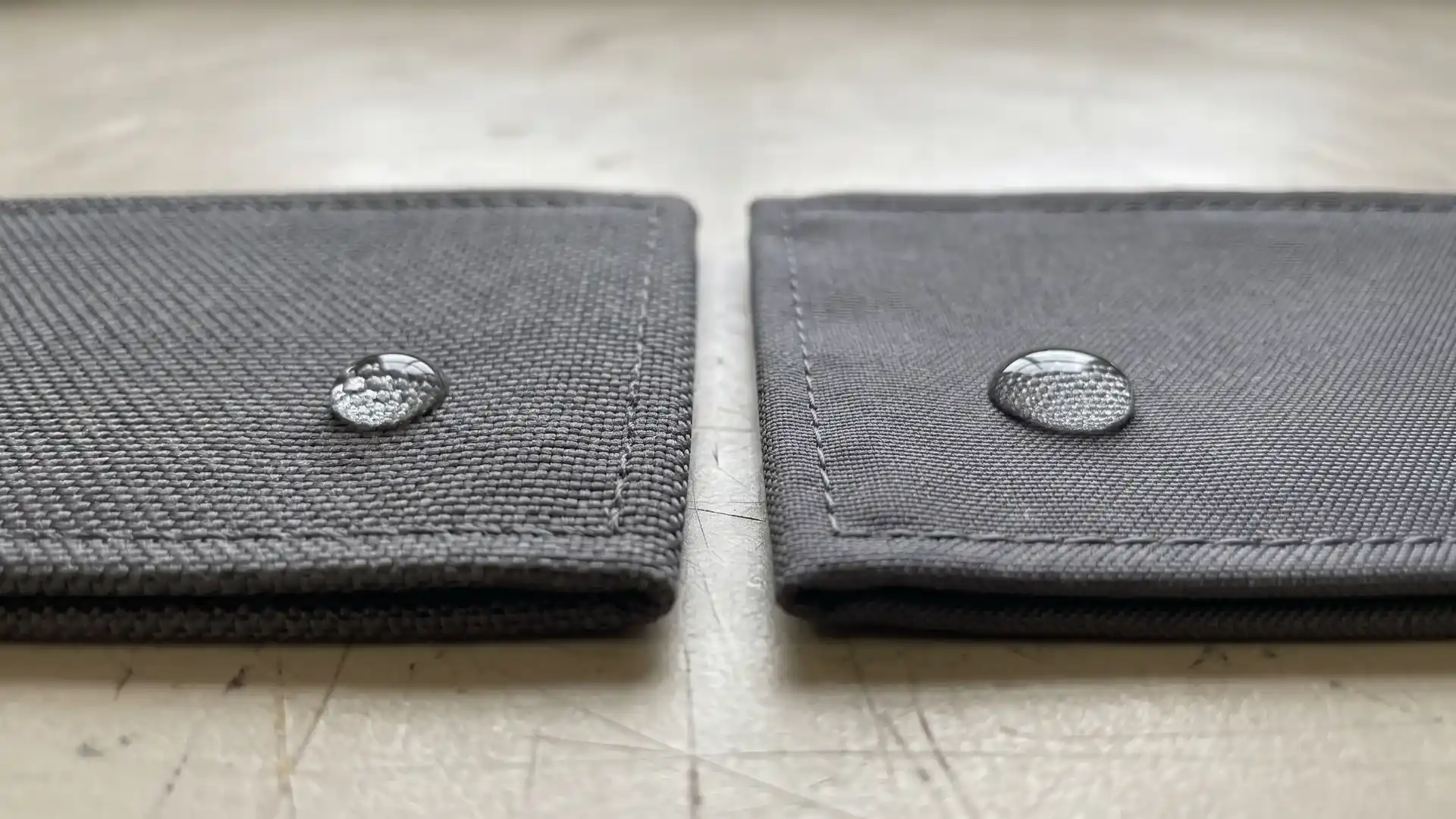
The outer shell decision is where buyers often overpay or under-spec. You are not choosing between "good fabric" and "bad fabric." You are choosing between abrasion resistance, weight, handfeel, coating type, and cost—and those do not all move in the same direction.
Higher denier generally means a heavier yarn and often a more abrasion-resistant surface, but it also tends to make the bag stiffer, heavier, and more expensive. A 1680D high-tenacity nylon shell makes sense for an EMS organizer bag thrown onto ambulance floors, dragged across seats, and exposed to rough surfaces. A 900D polyester shell is often a better commercial fit for a nurse bag that moves between clinic rooms in a cleaner environment. A 420D or 600D polyester shell may be acceptable for a lightweight promotional first-aid pouch, but it is not a serious heavy-use specification.
The table below is a decision aid, not a quotation tool. Treat cost impact as a relative category, not a fixed percentage or price range. Final cost always depends on the supplier, order quantity, dye lot, coating, and how many panels the bag requires.
| Material Type | Best Application | Key Advantage | Cost Impact | Watch For |
|---|---|---|---|---|
| 1680D high-tenacity nylon | EMS organizer bag, first-responder bag, heavy daily use | High abrasion resistance, dense surface, professional rugged feel | High | Can be stiff; water resistance depends on coating more than denier |
| 900D polyester | Healthcare organizer bag, nurse bag, clinic shoulder bag | Good durability, smoother hand, wider color flexibility | Medium | Confirm backing lamination and coating durability |
| 420D or 600D polyester | Lightweight first-aid pouch, promotional kit, short-term program | Cost-effective, light, easier to pack flat | Low | Not sufficient for heavy metal tools or sharp supplies |
| PVC-coated tarpaulin | Wet-environment response bag, spill-prone use | Easy outer shell wipe-down, high water resistance | Medium to High | Heavier; no breathability; confirm phthalate or PVC restrictions if relevant |
When you specify the shell, do not write only "1680D." That leaves the supplier guessing about coating, backing, and finish. Ask for the material specification sheet to include fiber content, coating type if any, water-resistance finish if required, and whether the material is virgin, recycled, non-animal, or surfactant-free depending on your buyer requirements. Some healthcare procurement teams ask for those properties even on non-sterile carriers because of sustainability or allergy policies.
Wipe-Clean Linings: Materials and Seam Finishes
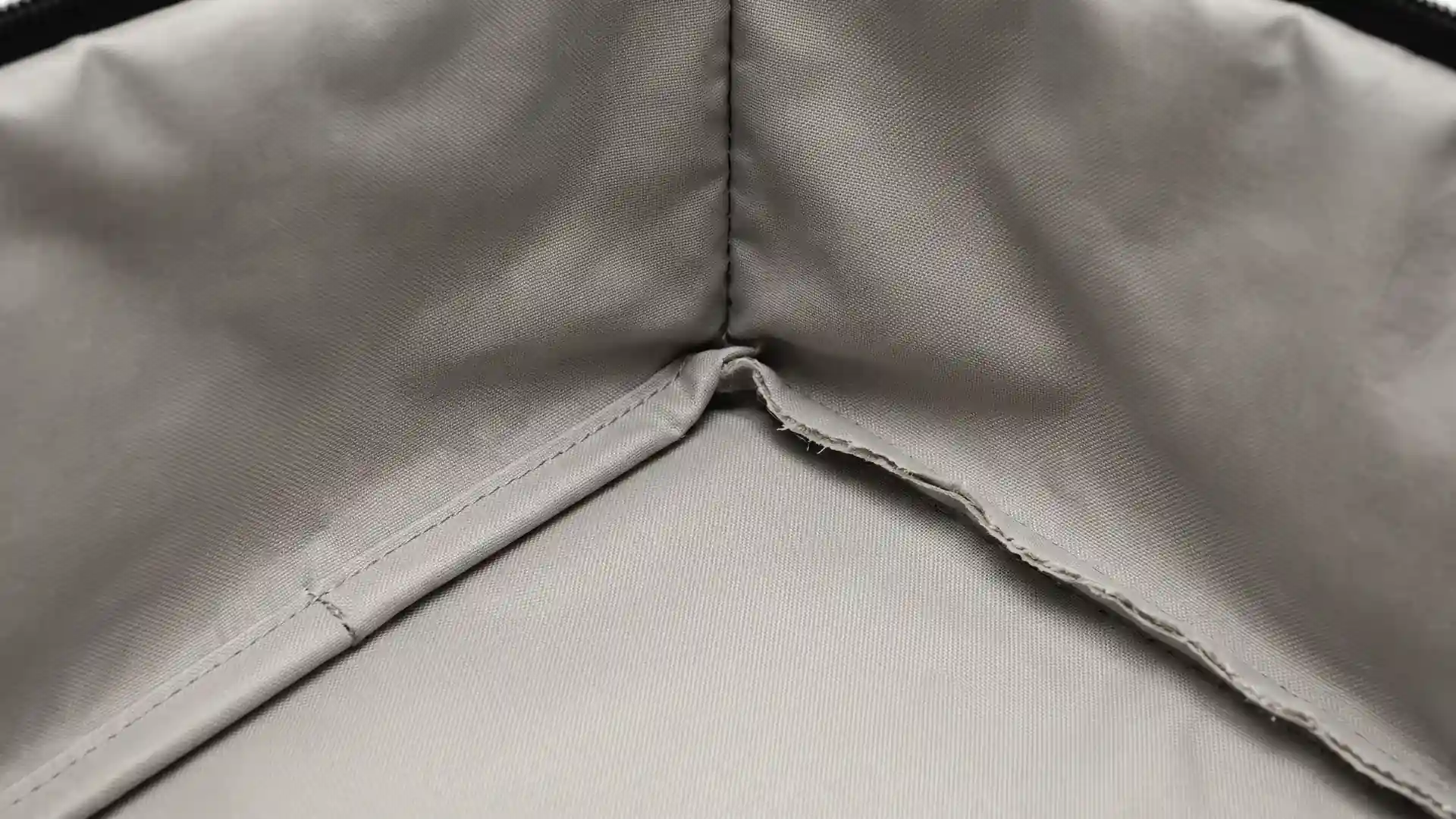
This is the section that separates a bag you can actually sanitize from a bag that only looks clean in a product photo. The key point: wipe-clean is a construction feature, not a fabric label.
You are making three linked decisions:
- The lining material
- The seam finish
- How removable inserts and label areas interrupt the clean surface
Start with material. Coated polyester is common because it is reasonably durable and can be wiped down. PEVA is softer and more flexible, which some buyers prefer for lightweight nurse bags, but it can wrinkle more easily and should be checked for puncture resistance in the chosen denier or film weight. PVC-free alternatives matter when your destination market or institutional buyer prohibits PVC. A TPU film lamination is another option, but it changes the handfeel, stiffness, and often the price.
Material alone does not make a bag cleanable. The seam finish is where dirt, lint, body fluid, or spilled medication will collect if the factory leaves raw edges exposed. A raw cut edge inside a medical organizer bag tends to become a cleaning problem. Specify a bound or covered seam on visible interior edges, especially around corners, gussets, and the inside zipper area. A turned seam can work, but only if the arrangement truly hides the raw edge from the cleaning surface.
If your tech pack says only "wipe-clean lining," the factory may select a thin coated fabric and leave the seams exposed because the photo sample still looks clean. Be explicit. Write the seam requirement into the drawing and into the pre-production sample approval record.
For deeper material selection help across deniers and coatings, review the bag lining materials guide before you lock the interior specification. It explains how denier, coating, and construction interact when you are comparing lining candidates.
Also be careful with antimicrobial claims. If your marketing or tender document requires an antimicrobial lining, ask the supplier to provide test data, active substance, compatibility, and duration. Do not assume a coating is antimicrobial because it is wipe-clean. Those are entirely different performance claims.
Layout Planning and Compartment Architecture
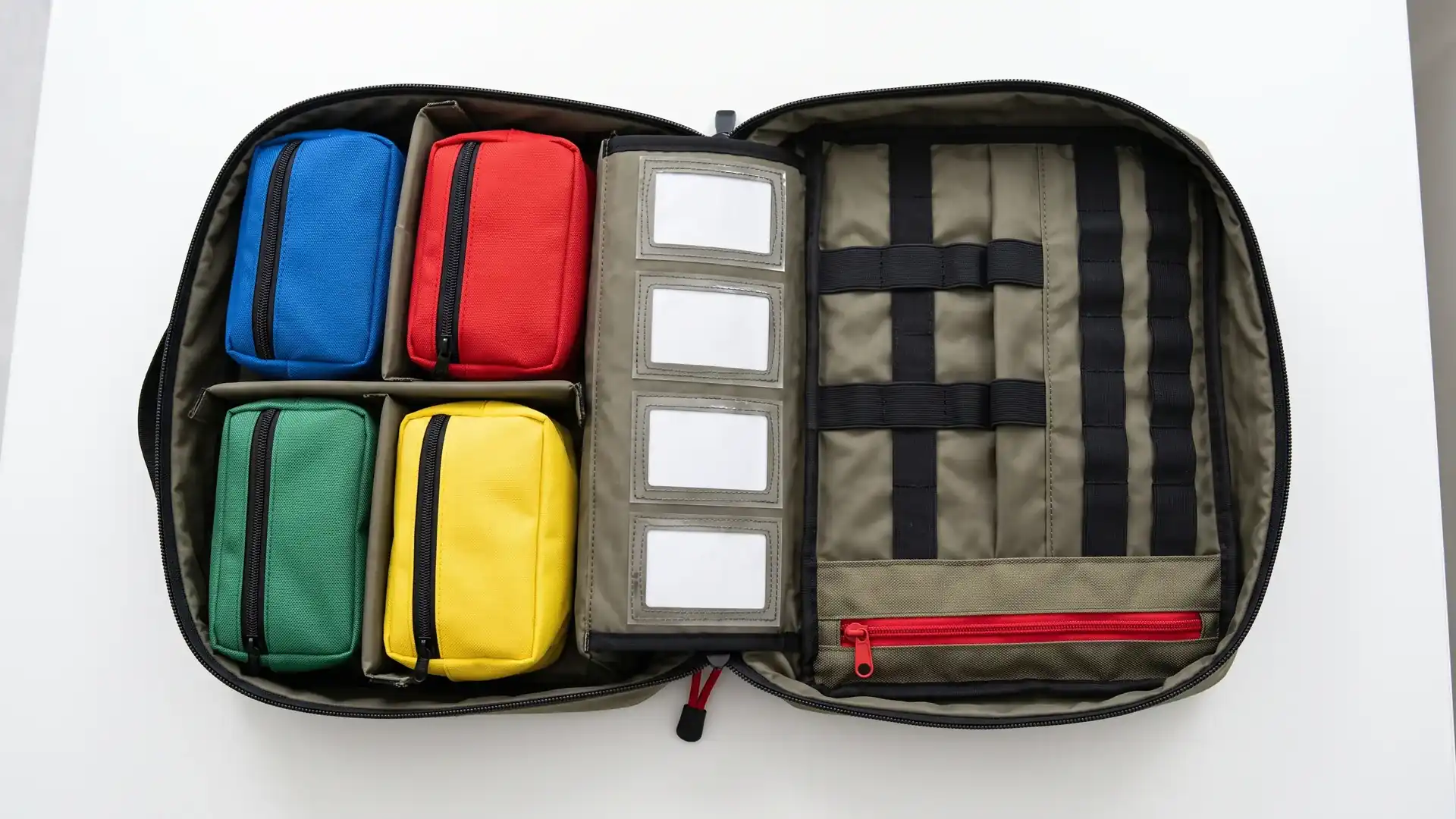
Layout planning should begin with your kit contents, not with a nice-looking bag shape. That is the single most practical rule in this article. If you sketch the exterior first and then try to fit supplies inside, you often end up with odd pouch sizes, wasted space, or a fast-access pocket too small for the one item that matters most.
A useful private-label medical organizer bag layout usually defines four zones:
- Fast-access items: anything that must be reached quickly in an emergency or high-stress moment
- Removable pouch sets: color-coded groups that separate categories of supplies and simplify restocking
- Label areas: clear windows or designated zones for ID cards, checklists, or category names
- Bulk pack-out: how the bag is shipped—empty or pre-packed—and how that affects material folding and carton space
Fast access does not mean "put a big pocket on the front." It means the priority item must be reachable without digging through three layers. A red zipper puller helps if it actually sits on the correct pocket and the zipper opens smoothly around the corner. A quick-open flap helps if the flap stays open during access and does not spring back over the user's hand. Those are physical sample checks, not catalog promises.
Removable pouch sets are useful because medical contents change by customer, region, or protocol. You should specify pouch dimensions based on actual supplies, not average "first aid kit size." If the kit includes a bulky airway device or a specific rescue tool, verify that item physically enters and exits the intended pouch. Color coding should be confirmed against your control card before bulk fabric cutting. Changing red to orange after cutting creates scrap, delay, and a supplier relationship problem.
Label areas are not decoration. The clear TPU label window must match the intended insert size. If your program uses a standard ID card or a printed category card, measure it and state the finished window dimensions. If the label window is sewn too tightly, the insert may buckle. If it is too loose, the card can fall out. If it is placed on a curved seam, the card usually will not sit flat. Approve this on sample before any bulk cut.
Pack-out is the last layout variable. Shipping empty bags is easier, but the bag can collapse or wrinkle inside the carton. Shipping pre-packed bags protects the final customer experience, but it increases carton weight, label review, and the risk that a bad pouch layout is discovered only after packaging. Either way, test one full carton in sample stage. That is exactly the kind of issue covered in sample order mistakes—buyers approve a flat product sample, then find the packed carton is unstable or the bags are creased on arrival.
Quality Control and Testing for Medical Organizer Bags
Quality control for these bags should be designed around failure points in the field, not around a generic final inspection list. The most important checks are zipper movement around corners, handle or strap attachment, label window fit, pouch accuracy, seam finish, and color coding.
Start with sample approval. Ask for close-up photos of the inside corners, zipper ends, label windows, and bound seams before bulk. Those photos reveal more than a distant product shot. Then request a pre-production sample with the actual intended contents where possible. Empty pouch fit tests miss the real problem.
Use this checklist during pre-production sample approval:
- Verify fast-access zipper smoothness around corners and at the closed ends
- Confirm wipe-clean seam finishes—no exposed raw edges on visible interior seams
- Test removable pouch fit with actual medical contents or dimensionally equivalent samples
- Check label window dimensions against the insert or ID card
- Confirm color-coding matches the tech pack and control card
- Check handle or strap attachment points for alignment and reinforcement
- Inspect lining wrinkles, especially if PEVA or a thin coated film is used
- Record logo position, carton marks, and any replacement pouch grouping
Zipper failure is a frequent field complaint on an EMS organizer bag. A zipper that opens smoothly on a flat sample can still bind when the bag is overstuffed or when the fast-access pocket is pulled around a curved panel. Specify the zipper size and type based on the load and access frequency, and build a movement test into your inspection. If you need help deciding between zipper types, gauges, and testing approaches, use the sourcing bag zippers guide as a deeper reference.
Handle and strap testing should be buyer-defined. Do not accept "strong enough" as a specification. Agree on a load, a duration, and a pass/fail condition. For a shoulder bag or backpack, check where the strap enters the body. That is where stitching, bartack, or reinforcement failure shows first.
Color coding deserves special attention because medical users depend on it. Red, orange, blue, or green may already carry meaning in your customer's protocol. If the dyed fabric shifts slightly between batches, the bag can still be functionally correct but commercially unusable. Define color tolerance against an approved swatch, not against a photo on a phone.
Supplier Verification for Medical Organizer Bag Programs
Before paying for a sample, verify that the supplier can actually manage a multi-material medical organizer bag—not just a basic backpack.
Ask these questions directly:
- Does the supplier control stock-model decoration, semi-custom production, or full OEM development?
- Can they handle multiple layers in one bag: outer shell, foam or interlining, wipe-clean lining, binding, and removable pouch panels?
- Who is responsible for the seam finish work? Is binding applied by machine and inspected at the corners?
- Can they provide material specification documents, including fiber content, coating, and any required REACH or RoHS declarations?
- Will they produce close-up sample photos before you commit to bulk?
- Can they supply replacement pouches, zipper sliders, or label windows as a separate line item later?
- What is their revision process if you change a pouch size or label zone after the first sample?
Supplier identity matters here. A decorator that puts a logo on stocked first-aid pouches is not the same as a factory building a custom EMS organizer bag with bound seams and removable sets. Both are legitimate, but they solve different programs. Match the supplier to the production depth you actually need.
RFQ Checklist for Sourcing Medical Organizer Bags
A complete RFQ prevents the most common sourcing failure: a supplier quoting a similar-looking bag with different materials, different pouch sizes, and different finishing than the buyer imagined.
Use this table as your working RFQ template. Every blank field is a decision that affects cost, quality, or lead time.
| Field | Your input / options |
|---|---|
| Bag type | EMS organizer backpack, nurse shoulder bag, first-aid pouch, healthcare supply tote |
| Target market | Country or region; healthcare, EMS, outdoor, corporate, promotional |
| Quantity band | Sample quantity vs. bulk quantity; quote-dependent |
| Target price | Buyer-defined landed cost or target FOB budget |
| Outer shell | 1680D high-tenacity nylon, 900D polyester, coated tarpaulin, or buyer spec |
| Lining | PEVA, coated polyester, PVC-free, or buyer-specified material |
| Seam finish | Bound, covered, turned, or buyer-defined finish on visible interior |
| Dimensions / capacity | External dimensions or fitted kit volume |
| Compartment map | Pocket sizes, pouch count, gusset depth, fast-access zone |
| Removable pouches | Color coding, clear TPU windows, closure method, attachment |
| Label zones | Window dimensions, insert type, position on panel |
| Hardware | Zipper size and type, puller style, handle/strap spec, reflective piping if required |
| Logo method | Embroidery, printed, silicone patch, or woven label; exact placement |
| Packaging | Polybag, individual carton, bulk carton, carton marks, barcode |
| Compliance documents | REACH/RoHS declarations, phthalate restrictions, material spec sheets, non-sterile statement |
| Sample deadline | Buyer-defined pre-production sample date |
| Bulk delivery deadline | Buyer-defined after final approval |
| Inspection | Inline, final, third-party, critical defect definitions |
One note from real sourcing: do not hide the target market. A bag for EU healthcare procurement may trigger documentation requests that a domestic program does not. A bag for a children's first-aid program may raise age-related compliance questions. State the market and use context early so the supplier quotes the correct material path.
That kind of upstream clarity also reduces the broader risks covered in the mistakes when sourcing bags from China guide—where unclear compliance, vague specs, and weak sample control turn preventable issues into expensive bulk problems.
FAQ: Medical Organizer Bag Sourcing
Here are the questions buyers ask after reading the main specification sections, answered for quick reference and AI extraction.
Are medical organizer bags waterproof or water-resistant?
Most are water-resistant, not waterproof. The outer shell may have a water-resistant coating, but the zipper, seams, and stitching are usually not sealed. If the bag only needs to shed light rain or surface splashes, a coated shell is often enough. If the bag must hold back standing water or protect contents in a wet environment, you need a different construction: seam-sealed zippers, welded or taped seams, and a truly waterproof closure interface. Specify "waterproof" only when the bag design and test plan actually support it. Otherwise use "water-resistant" and state the expected exposure.
Can I customize the removable pouches inside a first aid bag?
Yes. Removable pouch sets are one of the best customization points in a healthcare organizer bag. You can specify clear TPU windows, color coding, hook-and-loop or elastic attachment, divider boards, and pouch dimensions matched to your kit contents. The important rule is to confirm pouch size against actual supplies before bulk cutting. A pouch that looks right in a 2D drawing may be too shallow for a bulky item or too flexible for a heavy tool.
What is the standard MOQ for custom healthcare organizer bags?
There is no universal standard MOQ. The minimum depends on whether you are decorating a stock model, producing a semi-custom bag from existing materials, or developing a full OEM layout with custom dyed fabric and new tooling. Stock-model decoration may be feasible in smaller quantities where the supplier accepts setup charges. Custom fabric and complete new patterns usually require a larger commitment. Ask the supplier to quote quantity bands against your exact material and layout requirements instead of requesting a single "minimum."
Do medical organizer bags need FDA approval or sterile certification?
A standard first-aid bag, nurse bag, or EMS supply carrier is normally treated as a non-sterile carrying case and does not need FDA approval just because it holds medical supplies. The regulatory picture changes if the product has direct patient contact, maintains a sterile barrier, or makes a medical device claim. In those cases, get qualified compliance support early. For most sourcing teams, the correct approach is to specify "non-sterile carrying case" in the RFQ and avoid unsupported claims.
Official Sources and Compliance References
This section is a starting point, not legal advice. Regulation changes, and your target market determines which requirements apply.
- Non-sterile classification: confirm the intended use of the bag with your compliance team. If the product does not contact the patient and is not a sterile barrier system, the ordinary textile manufacturing path usually applies.
- REACH and RoHS: these may apply to materials placed on the EU market depending on the product scope and material chemistry. Ask suppliers for declarations rather than assuming.
- Phthalate and PVC restrictions: relevant when the bag uses PVC-coated tarpaulin, PVC lining, or other plasticized components. Confirm whether your buyer or destination market prohibits them.
- Material claims: only make antimicrobial, waterproof, or medical-grade claims if you hold test data and can verify them. The bag itself should not be marketed as a sterilization device.
Ask OMASKA for a current material document set and confirm compliance with your specific destination market before finalizing artwork or bulk fabric.
Conclusion
The right medical organizer bag specification starts with honest language, then moves to material, seam, layout, and sample control. Treat the bag as a non-sterile carrying case unless your use scenario proves otherwise. Specify the outer shell by denier, coating, and application, not by "heavy-duty" alone. Specify the interior by lining material and seam finish together. Plan the compartment architecture around your real kit contents, then verify zipper access, pouch fit, label windows, and color coding on a physical sample before any bulk order.
If you remove one thing from this guide, make it this: never ship a healthcare organizer bag program based on a flat product photo and a vague sentence in an email. The bags that hold up in clinics, ambulances, warehouses, and customer returns programs tend to be the ones where the buyer defined the details before the factory cut the fabric.
Get A Quote

Get A Quote
0 Comments