
Pizza Delivery Bag Design Guide: Heat Retention, Capacity & Sourcing Specs

A commercial pizza delivery bag is not a cooler bag shaped like a box. Its real job is to help hold stacked pizza boxes above the FDA Food Code hot-holding threshold of 135°F (57°C) for your delivery window, while releasing enough moisture that the crust does not steam into a soggy mess. That means you're specifying a three-layer thermal system — durable outer shell, closed-cell foam core, reflective or wipeable liner — plus deliberate ventilation and a closure that survives a long shift's worth of one-hand open-and-go use.
Procurement teams often write "16-inch insulated delivery bag" and stop there. That generic spec leaves the supplier to decide foam type, liner, venting, handle anchoring, internal clearance, and cleaning tolerance. The result is predictable: a bag that holds heat on the first bench test but generates condensation complaints once real routes begin, or a flap that will not close over a real three-box stack.
This guide walks through the decisions in the order a sourcing manager actually makes them: baseline design, moisture versus retention, dimensional stack planning, durability, sanitation, supplier verification, and RFQ preparation. Use it to turn a vague purchase request into a defensible specification and acceptance test.
Quick Answer / 30-Second Buyer Decision
For a commercial chain, specify a flat, stack-friendly pizza delivery bag with these buyer-defined points:
- A closed-cell PE or EPE foam core, chosen at around 1 inch for short-radius or lighter-weight use, or around 2 inches for longer hold windows and heavier stacks. Confirm thickness and density, not just the word "insulated."
- A reflective aluminum or food-contact-suitable wipeable liner. The foam provides most of the thermal resistance; the liner manages radiant transfer, grease resistance, and cleaning.
- A supplier-confirmed ventilation plan, often metal grommets near the top or upper side panels, so steam can escape without reducing hold time too far. Validate the vent type, position, and count on the first sample. A completely sealed bag can leave the crust soggy even when raw thermal retention looks strong.
- Internal dimensions built from your actual folded box footprint plus clearance, not from the nominal pizza diameter.
- Load-bearing webbing handles anchored with X-box stitching, and a deliberate closure choice: hook-and-loop for fast one-hand driver access, or heavy zipper where a tighter seal matters more.
Hold the supplier to a layer-by-layer material build, not marketing terminology. A sample heat-retention test with real hot food will tell you more than any catalog chart.
Scope of This Guide
This guide is written for restaurant chain buyers, food-service distributors, OEM program managers, and delivery-only restaurant brands who need to standardize a hot pizza transport fleet. It covers the engineering and sourcing decisions that affect performance, sanitation, and total cost of ownership.
It does not cover consumer lunch totes, picnic coolers, or generic takeaway bags. The assumptions here are commercial: high opening frequency, daily cleaning, route time, multiple stacked corrugated boxes, and real financial consequences from soggy or cold food. The topic is hot dry-goods pizza transport, not liquid soup or catering pan carriers.
Core Design Principles of Commercial Pizza Delivery Bags
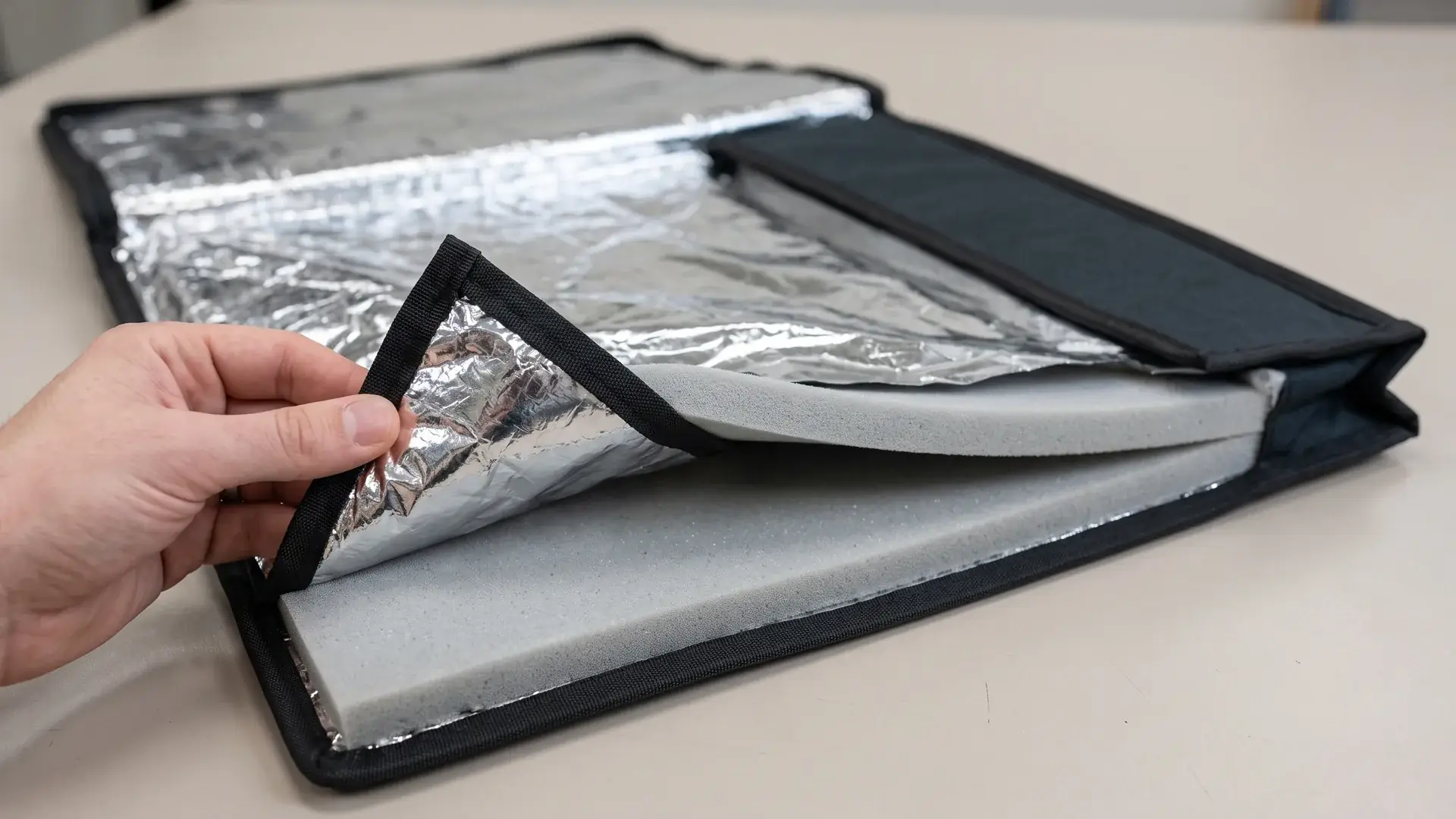
A professional pizza thermal bag differs from a general cooler bag in two ways: it carries dry, hot, stacked corrugated boxes, and it gets opened and closed far more often per shift. That changes the engineering priorities. The goal is not maximum insulation in a laboratory setting; it is stable hold time under real route conditions. That means you are buying a layer stack that has to survive repeated opening, wiping, folding, and box-corner wear.
The three layers work differently:
- Outer shell: usually 600D or 1680D polyester, sometimes coated nylon. It carries abrasion, weather, and the weight of the stack through the handle anchors.
- Insulation core: closed-cell PE or EPE foam. This is the thermal workhorse because it reduces conduction through the bag wall. Thicker foam slows temperature loss but adds bulk, reduces internal height for the same outer footprint, and adds weight for drivers who carry bags vertically.
- Inner lining: aluminum foil, metalized film, or a food-contact-suitable PEVA or PE-coated fabric. The reflective surface returns some radiant heat. Just as important, it creates a smooth, wipeable surface that doesn't absorb grease or odor.
When I evaluate a supplier sample for a restaurant program, the first thing I check is whether the builder can name the actual foam type, density, and measured thickness. If the catalog only says "insulated," that usually fails under a buyer-defined retention test. The same logic applies to any insulated carry product: the foam fill, liner, and seam have to survive the same abuse as the visible fabric. That is the same engineering principle behind cooler bag manufacturing principles, where the hidden layer stack matters more than the outer appearance.
Food safety reference matters here. The U.S. FDA Food Code recommends holding hot food at 135°F (57°C) or above in current editions, while some state and local codes still cite 140°F. The FDA Food Code's temperature danger zone runs from 41°F to 135°F (5°C to 57°C). By comparison, USDA FSIS consumer guidance often uses 40°F to 140°F (4°C to 60°C). Restaurant programs should follow the standard that the local health authority actually enforces. A delivery bag doesn't sterilize food and doesn't rescue a pizza that left the oven too cool — it slows heat loss. Specify a bag that keeps the topmost box above your target temperature for the route length, and prove it with a controlled test.
Foam thickness changes the entire bag design, not just the warmth. Use this comparison when choosing between a thinner and thicker core:
| Factor | 1-inch closed-cell foam core | 2-inch closed-cell foam core |
|---|---|---|
| Thermal hold | Lower; better for short routes or hot climates | Higher; slower temperature loss over time |
| Weight and bulk | Lighter, less bulky for drivers | Heavier; may require a larger external bag |
| Internal usable height | More internal room for the same outer size | Less room; stack fit must be rechecked |
| Cleaning and drying | Generally faster to dry through | More foam mass can hold moisture longer if wet |
| Cost | Generally lower, but quote-dependent | Generally higher, but quote-dependent |
The right choice depends on delivery radius, pizza mass, ambient temperature, driver preference, and the buyer's landed-cost target. Treat 1 inch and 2 inches as planning options to confirm on a sample, not as universal standards.
Thermal Retention vs. Moisture Control: Preventing Soggy Crusts
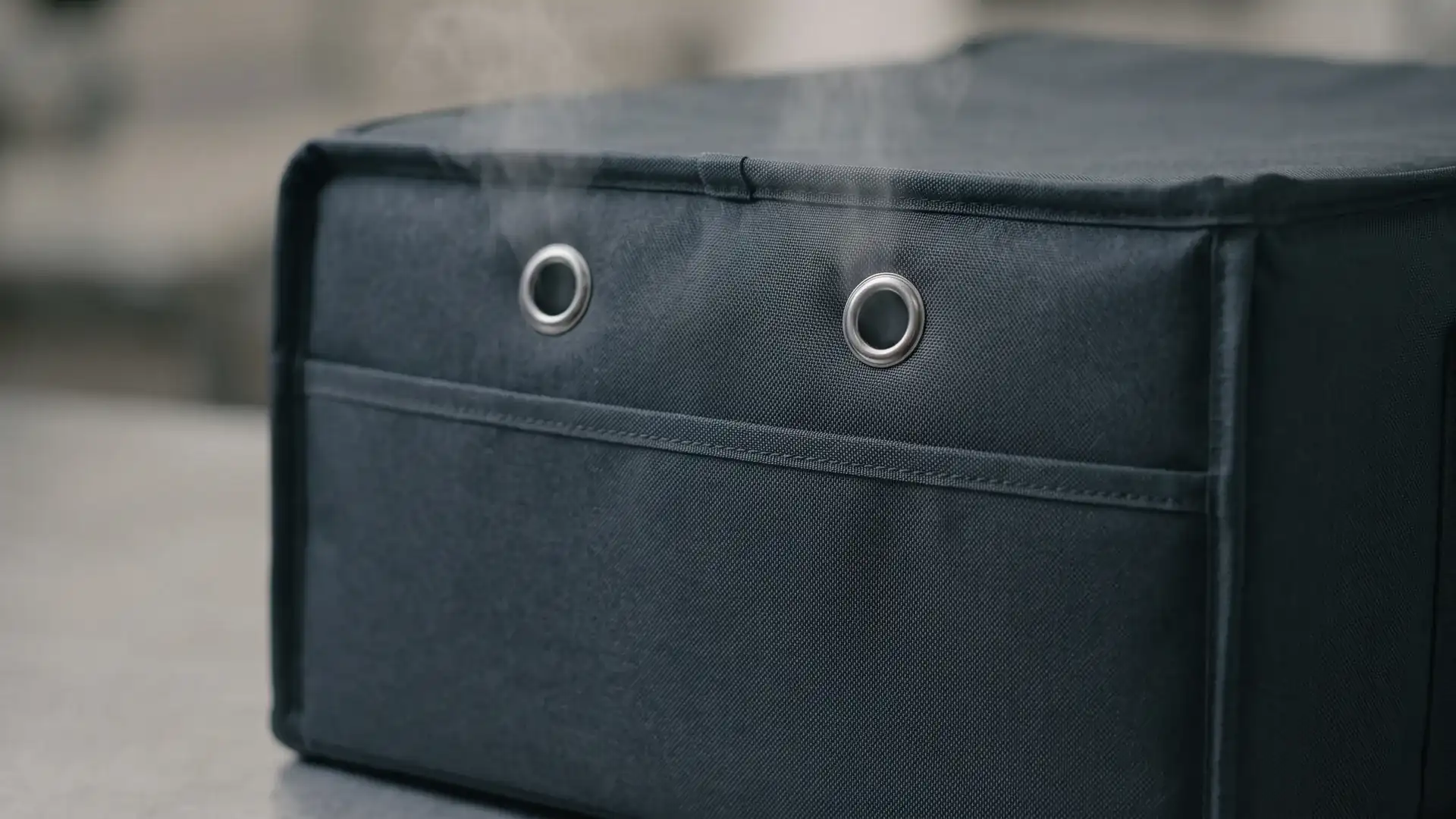
The most common amateur specification error is asking for "maximum insulation, fully sealed" and expecting great pizza. A completely sealed, heavily insulated bag can show excellent raw heat retention in a short test, but it traps steam. Hot pizza releases water vapor; when that vapor meets the cooler interior surfaces, it condenses. The crust wicks it up. The bag is not failing thermally — it is failing on moisture management.
So the bag has to be designed as a heat-and-steam system. A small number of metal grommets, usually placed near the upper side panel or top corners, can let moist air escape while the hotter air column remains mostly inside. Vent type, position, and count should be a supplier-confirmed option for the specific bag size, heat load, and closure, then validated on a real product sample before fleet purchase. Too many vents, or large open slits, can reduce hold time too aggressively, so the pattern must be tested rather than assumed as a universal default.
Liner choice also affects condensation. Aluminum foil reflects radiant heat well and resists grease, but it can crease and crack after repeated bending and box insertion. A PEVA or PE-coated wipeable liner may handle folding better, but it must be confirmed as food-contact-suitable at the intended hot-holding temperature. The phrase food-contact suitable is not the same as "the whole bag is FDA approved." It means the liner material carries documentation from the material supplier for direct food contact. Ask for that evidence. Do not accept "safe for pizza" in a sales email.
The practical takeaway: specify enough insulation to meet the hot-holding target, then add controlled ventilation so the pizza does not turn gummy. You optimize both variables against each other, not one in isolation.
Sizing and Stack Capacity Planning
Stack capacity means the number of pizza boxes you can load and unload repeatedly, with the flap fully closed, without compressing the corrugated box, tearing the liner, or stressing the seams. The common failure comes from spec'ing a bag to the pizza's nominal circle size instead of the box's external dimensions. A 16-inch pizza ships in a box that is often slightly larger in one or both directions, and box lip thickness varies by carton supplier.
The correct workflow:
- Measure the folded, taped, production pizza box in all three directions — length, width, and lip height.
- Add side clearance so a driver wearing gloves can slide the box in and out without scraping the liner.
- Add top clearance for the full stack plus the flap closing without pressing the top box.
- Test the first sample with your own boxes before approving bulk production.
Use this as a planning worksheet rather than a fixed chart:
| Planning factor | What to specify | Buyer verification |
|---|---|---|
| Pizza box footprint | Use the fold-assembled external length and width, never the pizza diameter | Measure 3 production boxes from your actual carton vendor |
| Side clearance | Add roughly 1 to 1.5 inches across the two loading directions | Driver loads and removes a box wearing gloves without dragging the liner |
| Stack height | Record the actual height of the target stack with lids closed | Full stack sits inside; flap closes without pressing the top box |
| Load balance | Add a rigid bottom board or reinforced floor for taller stacks | Lift by handles; bag holds shape instead of folding into the boxes |
For a quick reference, a 12-inch, 14-inch, 16-inch, or 18-inch nominal pizza box should be planned the same way: actual measured box plus clearance, not a memorized internal size. A 16-inch bag built to exactly 16 × 16 inches inside often fails on the production box. That single error is one of the more expensive recurring mistakes in restaurant delivery procurement.
Durability Specs: Outer Shells, Seams, and Closures
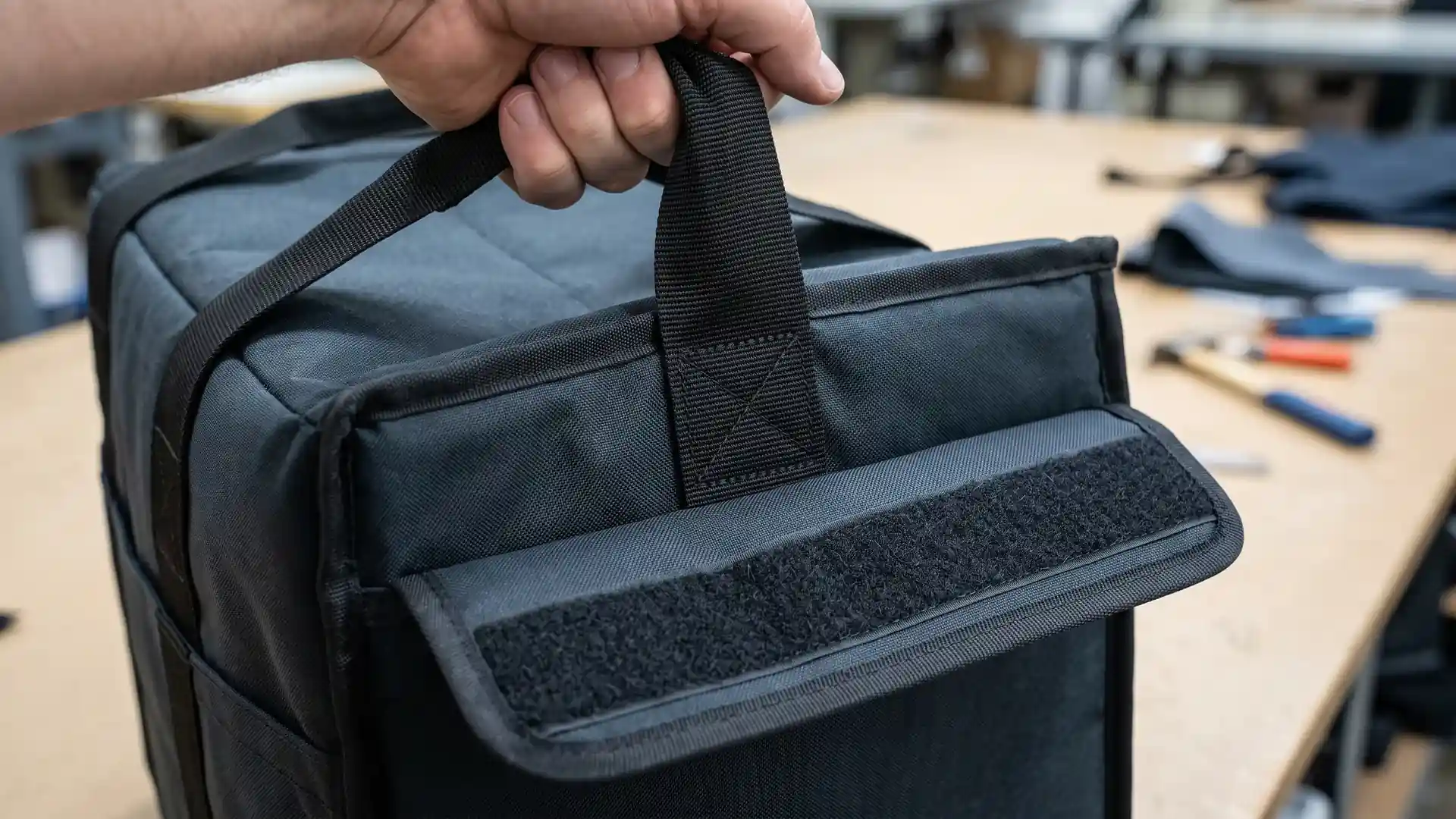
Pizza delivery bags do not die from heat. They die from handle pull-out failure, flap closure edge fraying, liner punctures from box corners, and seam separation at the bottom. If a fleet bag dies early in its service life, the problem is often a missing load-bearing detail, not a material defect.
Shell fabric: 600D polyester is adequate for lighter or shorter-route bags; 1680D polyester is heavier, more abrasion resistant, and stiffer, which helps a tall stack hold its shape. Nylon is lighter but often more expensive. Ask for a coated shell, not a raw weave, so grease and road moisture stay on the surface.
Handle anchoring: this is one of the top retirement points. The webbing handle should be anchored into or across a structural seam, not merely top-stitched onto the outer fabric. Request an X-box cross-stitch pattern or bar-tack pattern at each handle anchor, and ask whether the thread is a bonded nylon or equivalent high-strength style. Thread choice matters at load-bearing anchors as much as the stitch pattern. Ask to see the back side of the seam in the sample. Treat a single clean stitch line as a red flag. The same logic applies to reinforcement at stress points on any loaded bag: thread angle and anchor count matter more than thread color.
Closures: hook-and-loop fastening tends to be the go-to closure for many high-volume delivery programs because a driver can close it with one hand. The trade-off is that grease, flour, and debris gradually reduce grip, so specify a wide loop landing zone and ask for a closure cycle test. A heavy zipper gives a tighter thermal seal but often needs two hands, and a jammed slider can take the bag out of service. Some programs use a zipper behind a hook-and-loop flap: tighter plus fast. That combination adds cost and bulk, so choose it only when longer hold time is the dominant requirement.
Bottom support: a removable rigid board or reinforced floor prevents sag, distributes stack weight, and protects the liner corners from box punctures. It should slide out for cleaning. If the board is fixed, confirm the bottom seam is sealed well enough that wash water cannot pool behind it.
Cleaning Cycles and Sanitation Standards
How easy a restaurant delivery bag is to clean is a hidden procurement cost. Most staff won't spend ten minutes scrubbing each bag between shifts. If the interior is absorbent, it will trap grease and odor, and the bag will be retired early no matter how good the insulation looked on day one.
Spec a non-absorbent, wipeable liner, sealed edges, and a removable bottom board. These three choices shorten cleaning time and extend usable life. A raw fabric or exposed foam inner surface is a rejection signal for commercial food use.
A practical daily SOP looks like this:
- Empty the bag and remove any loose crumbs or debris.
- Wipe the interior and exterior with warm water and a food-service detergent.
- Use a food-service sanitizer compatible with the liner, following the manufacturer's contact time.
- Wipe dry and leave the flap open until the interior is fully air-dried.
- Remove and clean the bottom board separately, then reinsert it only when dry.
Weekly inspection should check liner cracks, grommets set firmly in place, closure grip, handle stitching, and any signs of odor or staining. The safest procedure is wipe-only; machine washing and submerging structured insulated bags can crush the foam, delaminate the liner, and pull load-bearing seams. High-pressure washing can drive water behind the foam and fabric. Chlorine bleach and harsh solvents should be avoided unless the supplier confirms compatibility in writing.
Sanitizer compatibility is a real TCO factor. The wrong sanitizer can make a liner brittle, discolor it, or leave an odor that transfers to the box. Ask the supplier which sanitizer chemistry the liner accepts. Then test it on the pre-production sample before the fleet order.
OEM Sourcing & RFQ Checklist for Restaurant Chains
A good RFQ for a custom pizza delivery bag reads like a test plan, not a one-line product name. Send measured box dimensions plus your performance target. If you want an accurate quotation and a useful sample, the supplier needs the layer build, closure, branding, and packaging requirements — not just "hot bags for pizza."
If this is your first bulk import, also review the typical mistakes when sourcing bags. The recurring problem in food-service bag programs is treating the order as a logo project while ignoring material verification and pre-production samples. Keep the bag spec ahead of the branding spec.
Copy this into your RFQ and fill in the right column:
| RFQ field | What to specify or confirm |
|---|---|
| Bag type | Hot pizza delivery bag, flat stack style |
| Target market | Country or region, local health code, ambient temperature range |
| Quantity | Projected pieces, then split by size and branding version |
| Target price | Optional; state as a landed-cost target if the buyer has one |
| Internal L × W × H | Based on measured actual folded box external dimensions plus clearance |
| Outer shell | Material, denier, coating, color |
| Foam core | Closed-cell PE or EPE, thickness, density request |
| Liner | Aluminum, metalized, or food-contact PEVA/PE; wipeable; documentation |
| Ventilation | Grommet count, position, size, steam-release requirement |
| Closure | Hook-and-loop flap, zipper, or combination; tape width |
| Handles | Webbing width, flat or folded, anchor type and stitching pattern |
| Bottom support | Removable rigid board or reinforced floor |
| Logo and branding | Size, placement, method, artwork file |
| Packaging | Folded flat or pre-formed, polybag, carton marking, barcode |
| Sample deadline | Date the pre-production sample must arrive |
| Bulk delivery date | Required in-market date, not only factory completion date |
| QC and inspection | AQL level, buyer-defined test plan, report requirements |
| Compliance documents | Food-contact liner evidence, target market requirements |
One line of this table matters more than it looks: internal L × W × H. If the buyer sends only nominal pizza size, the supplier is forced to guess. That guess becomes the sample; the sample becomes the fleet. Measure first, quote second.
Supplier Verification Steps Before You Approve a Pre-Production Sample
The supplier quote is only as good as your acceptance test. Ask for a physical layer-stack breakdown before production: shell swatch, foam swatch, liner swatch, plus the exact foam type and thickness. If the manufacturer cannot name the foam density or provide liner documentation, that is the moment to stop and challenge the quote.
A practical pre-production sample validation for a restaurant chain should include these buyer-defined checks:
- Layer verification: compare the sample's shell, foam thickness, and liner against the approved material swatches.
- Heat-retention test: preheat or temperature-stabilize the bag, place actual hot pizza or a controlled hot food load inside, close the flap, and record temperature at 0, 15, 30, and 45 minutes. Define pass/fail for the top box at the target route time. The top box often cools faster; do not only measure the bottom.
- Moisture and condensation check: after the heat test, inspect the crust and interior liner for pooled condensation. Adjust grommet count or position if needed.
- Stack fit and closure test: place the full target stack inside, close the flap, and lift by the handles repeatedly. The top box should not be compressed and the closure should not strain.
- Handle load test: apply a consistent pulling force on the handle with the full stack loaded, then inspect the anchor thread for gap or pull. Use a force value your team defines; do not rely on "feels strong."
- Wipe-down test: apply tomato sauce or cooking oil to a small liner area, wipe with the approved sanitizer, and check residue, staining, peel, and odor.
- Closure cycle test: open and close the flap or zipper at a realistic daily cycle count for your fleet, then check grip or slider movement.
These are buyer-defined acceptance tests, not the supplier's internal standard. You can still request the supplier's inline and final inspection reports at your chosen AQL level, but the sample test is what confirms whether the spec is realistic for actual route conditions.
Common Mistakes When Specifying Pizza Delivery Bags
Most failed pizza delivery bag programs share a short list of avoidable mistakes:
- Specifying nominal pizza size instead of internal bag size. The production box determines the spec.
- Sealing the bag completely to maximize hold time. You gain retention and lose the crust.
- Buying "insulated" without foam thickness. Insulation performance is not brand magic; it is a measurable layer.
- Accepting decorative handle stitching. Handles need X-box or bar-tack anchoring tied into the structure.
- Choosing the liner by appearance. A shiny liner that cracks after repeated box insertion is worse than a matte wipeable liner that survives.
- Writing "leakproof" when the real requirement is condensation control. For dry hot pizza boxes, the operative term is usually moisture-resistant liner and seams, not a claimed leakproof envelope.
- Writing a machine-wash SOP for a structured insulated bag. That cleaning method can retire the fleet early.
- Ignoring sanitizer compatibility. A liner that cannot handle the approved sanitizer creates odor and inspection risk.
FAQ: Pizza Delivery Bag Sourcing Questions
These are the questions restaurant chain buyers and distributors ask before they finalize a bulk order.
How long should a pizza delivery bag keep food hot?
There is no universal guaranteed time because hold time depends on starting food temperature, stack height, ambient temperature, insulation thickness, ventilation, and how often the flap opens. You can use a 30- to 45-minute acceptance target above 135°F (57°C) as a starting point for a standard route, then adjust for your actual delivery radius and hot-food test results. Longer windows may be possible with thicker foam and tighter ventilation, but only a real hot-food test should set that number for your fleet.
Do pizza delivery bags need FDA approval?
The whole bag typically does not carry an FDA approval. What matters is any liner or material that can directly touch exposed food; that material should be food-contact suitable, and the material supplier should provide supporting documentation. For sealed pizzas inside closed boxes, direct food-contact exposure is limited, but restaurant operators should still check local health department requirements and the buyer's own compliance rules.
What is the best insulation for a pizza delivery bag?
For most commercial fleets, closed-cell PE or EPE foam is a practical choice because it resists moisture absorption and keeps its shape better than open-cell foam. The best thickness is project-specific: around 1 inch for short routes and lighter weight, around 2 inches for longer distances or stricter hold targets. Confirm thickness and density with the supplier instead of relying on product names.
How do you clean a commercial pizza delivery bag?
Wipe the interior and exterior with warm water plus a food-service detergent and an approved sanitizer after each shift, remove the bottom board, and air-dry with the flap open. Avoid machine washing and submerging structured insulated bags because the mechanical action and heat can crush the foam and delaminate the liner. Confirm sanitizer compatibility with the supplier before writing the SOP.
What size pizza delivery bag do I need for a 16-inch box?
Measure the actual folded external dimensions of the 16-inch production box, not the pizza diameter. Inside the bag, plan the largest measured direction plus roughly 1 to 1.5 inches of side clearance. Internal height should be the full stack height plus enough room to close the flap without pressing the top box. Test the first sample with your own box and gloved loading before approving bulk.
Are leakproof pizza delivery bags the same as waterproof?
Not for this use case. A pizza bag carries dry, closed boxes, so the critical issue is condensation control, not free liquid. Ask for a wipeable, moisture-resistant liner and sound seam finish instead of a claimed leakproof envelope. Leakproof construction only becomes the real requirement if the bag must hold free liquid, which is a different product use than typical pizza box delivery.
Official Sources and Compliance References
These public references support the sourcing logic in this article. They do not replace your product testing or supplier compliance documents.
- U.S. FDA Food Code: the recommended hot food holding temperature; current editions commonly use 135°F (57°C), while some state or local codes still reference 140°F.
- USDA Food Safety and Inspection Service: the general 40°F to 140°F (4°C to 60°C) temperature zone where bacterial growth accelerates.
- Local health department rules: delivery transport, hot holding, and sanitation requirements take precedence over the federal references in this guide and must be confirmed for each operating market.
- Material suppliers' food-contact documentation: for the bag liner or any surface that can reasonably touch exposed food. Request this from the bag manufacturer before bulk production.
Conclusion
A better pizza delivery bag program does not start with a lower unit cost. It starts with a tighter specification. Specify layers, not marketing words. Measure the real production box. Put in controlled ventilation. Anchor the handles. Test with hot pizza and a full stack. Document cleaning so the bag survives the fleet's real use pattern.
When you're ready to move into sourcing, ask OMASKA to evaluate your custom pizza delivery bag project. Send the RFQ fields above with measured box dimensions, target stack height, and a clear acceptance test. This is an evaluation request, not a confirmed product-line quote; whether the project fits OMASKA's current insulated bag manufacturing scope still needs to be confirmed at inquiry stage. A structured RFQ will produce a much more useful conversation than a phone call that starts with "how much is a pizza bag?" — and, if the scope is approved, a sample worth testing.
Get A Quote

Get A Quote
0 Comments