
HVAC Tool Bag vs Technician Backpack: Sourcing Guide for Field Service Programs
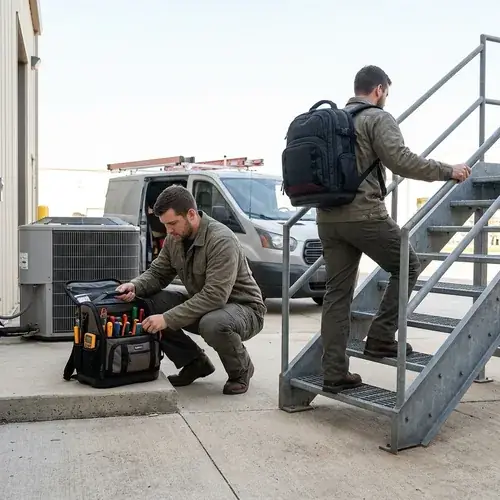
If you're outfitting HVAC, electrical, or telecom teams, the HVAC tool bag vs technician backpack decision comes down to one thing: how far and how often technicians carry a loaded kit away from the van. Choose an open-top HVAC tool bag when routes are short — van to equipment, ground-level unit, maybe one flight of stairs — and when fast tool visibility matters most. Choose a technician backpack when technicians climb ladders, cross hospital floors, walk campuses, or need both hands free for gauges, parts, and doors.
This is a buying decision, not a product review. The wrong format can do more than annoy a field tech — it can turn into durability failures, fatigue complaints, warranty claims, and a reason your private-label program looks underengineered in front of a service manager. If you're a distributor, brand owner, fleet buyer, or procurement manager, this guide walks you through the two formats, the structure that matters, and the sample tests that separate a field tool carrier from a promotional-looking bag.
By the end, you'll have a two-format decision framework, ergonomic load planning, pocket engineering rules, base construction options, an RFQ table, and a sample evaluation checklist you can send to a bag manufacturer like OMASKA.
Quick Answer: Which Design Fits Your Field Service Program?
If I had one call with a fleet manager, I'd give this rule: choose the open-top HVAC tool bag for short-carry, high-access work; choose the technician backpack for long walks, stairs, ladders, or any route where the technician needs two free hands.
Not because one format is better. Because they solve different workflow problems.
Open-top bags win on visibility. The technician sets the bag down near the condenser or air handler, sees the meter, screwdrivers, bits, and fittings at a glance, and grabs without digging. The hard or reinforced bottom keeps the kit upright on floors, truck beds, and equipment pads. The weakness appears on the walk: when someone carries it by the handle for a long walk through a high-rise, the load hangs off one side and the spine twists.
Technician backpacks win on transport. The load sits on two shoulders, often with a chest strap or waist belt, and the technician can carry a manifold gauge set, open doors, or climb a fixed ladder without setting anything down. The trade-off is access speed: a backpack usually needs to be set down and opened, and access quality depends entirely on how the layers are built.
So the decision starts with your service routes, not the catalog photo. Watch one technician for a morning. If the bag stays near the van or the equipment pad for most calls, buy the open-top. If the route includes two floors, three hallways, or a rooftop access ladder before the unit is even touched, buy the backpack.
Scope of This Guide
This page is for B2B buyers sourcing field service bags in volume: OEM/ODM development, semi-custom stock programs, distributor lines, Amazon/online retail, and corporate service-fleet programs. It covers open-top HVAC tool bags, technician backpacks, and the structural decisions that make a field tool carrier survive real work.
It does not cover consumer school bags, fashion backpacks, rolling luggage, or soft tool pouches beyond where those formats naturally come into the decision. Rolling tool cases and pouches appear only as alternatives.
The examples focus on HVAC service because that trade has demanding tool sets and mixed mobility. The logic transfers to electrical, telecom, refrigeration, facilities maintenance, and industrial MRO.
Workflow and Mobility: When to Choose Which Design
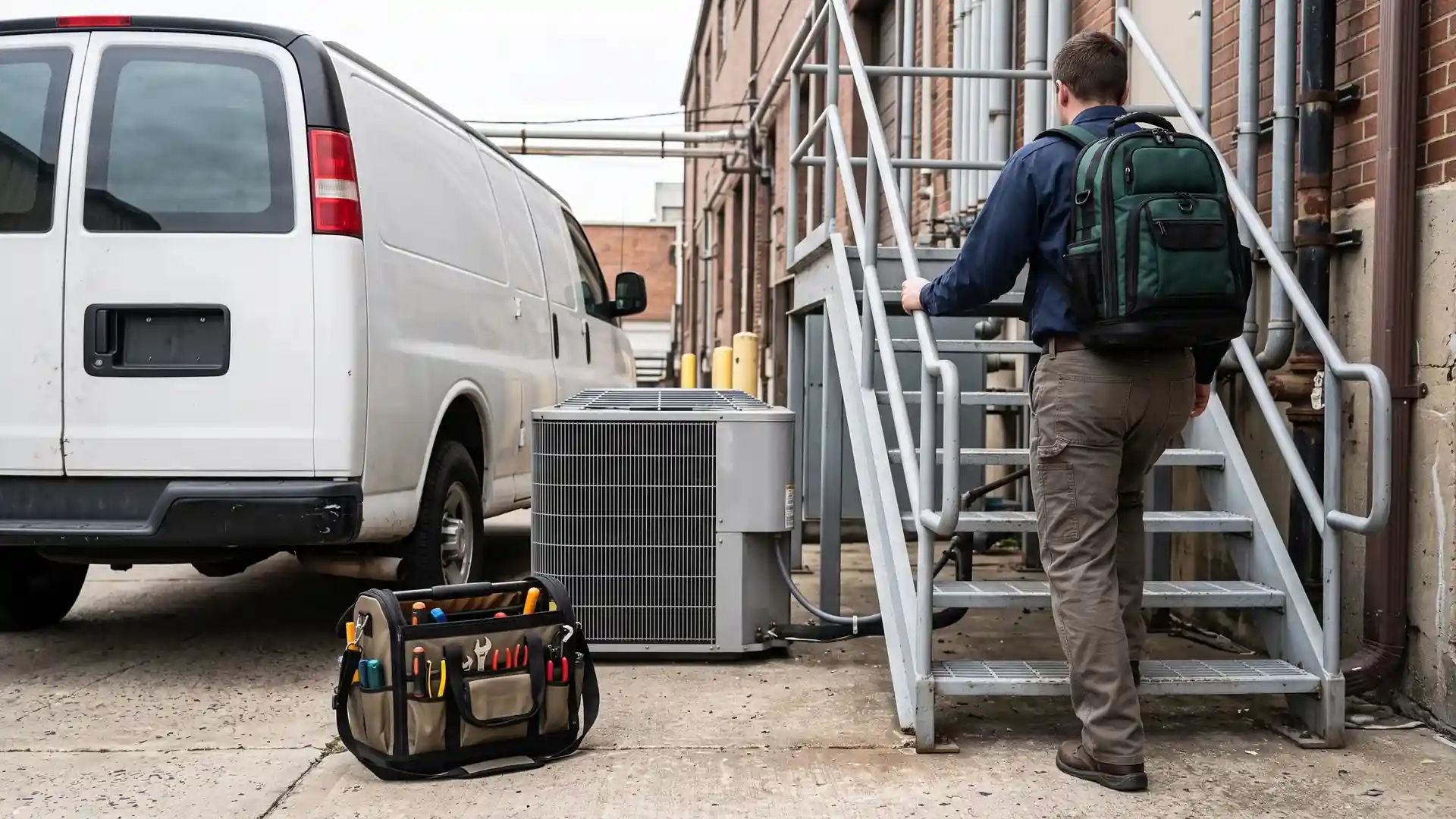
Most buyers start backwards — pocket count, then color, then price — before mapping the actual service call. Pocket count doesn't matter if the technician can't safely move the loaded bag to the job.
An open-top HVAC tool bag works best when the bag functions as a mobile work surface. The technician places it near the unit, keeps it open, and works out of it. The environment is usually flat enough: van floor, curb, mechanical-room concrete, rooftop walkway. Short van-to-site distances mean the handle-carry limitation barely shows up.
A technician backpack works best when the bag is a transport system first and a tool kit second. Campus facilities, hospitals, commercial high-rises, rooftop access, and any site mixing stairs and corridors favor a backpack because hands stay free and the load moves with the body.
Don't ignore the return trip. On a refrigeration call, the technician may carry spare parts, a leak detector, a scale, a recovery bag, and a new filter-drier inside, plus the tool kit outside. If the route means walking back to the van twice for forgotten parts, the open-top bag's short-carry advantage disappears — and a backpack with internal part pockets starts paying for itself. If the job is rooftop work with a ladder cage, the backpack is almost self-selecting.
The table below is the comparison I'd use when a sales team asks which format should lead a catalog.
| Feature | Open-Top HVAC Tool Bag | Technician Backpack |
|---|---|---|
| Primary use case | Van-to-equipment, mechanical-room work, unit-side diagnosis | Campus, hospital, high-rise, rooftop, long parking distance, ladder access |
| Tool visibility | Fast, horizontal, one-glance layout | Vertical panels; may need fold-down opening or layered access |
| Carry style | Hand/arm carry, one-side load without shoulder strap | Two-shoulder carry; optional chest or waist belt |
| Ideal travel distance | Short, flat, repeated van-to-site trips | Medium to long; stairs, corridors, uneven paths |
| Footprint and stability | Large flat footprint; sits on floor or truck bed | Narrower standing profile; stands or leans against a surface |
| Hidden risk | One-arm fatigue and torso twist on long carries; handle stress | Overstuffed vertical pockets making layer access slow |
Neither row is a defect. The problem is selling an open-top bag to technicians who climb three floors every call, or a backpack to techs who work on the pad next to the van and want drawer-style access all day.
Ergonomics and Weight Distribution: Safety Guidelines
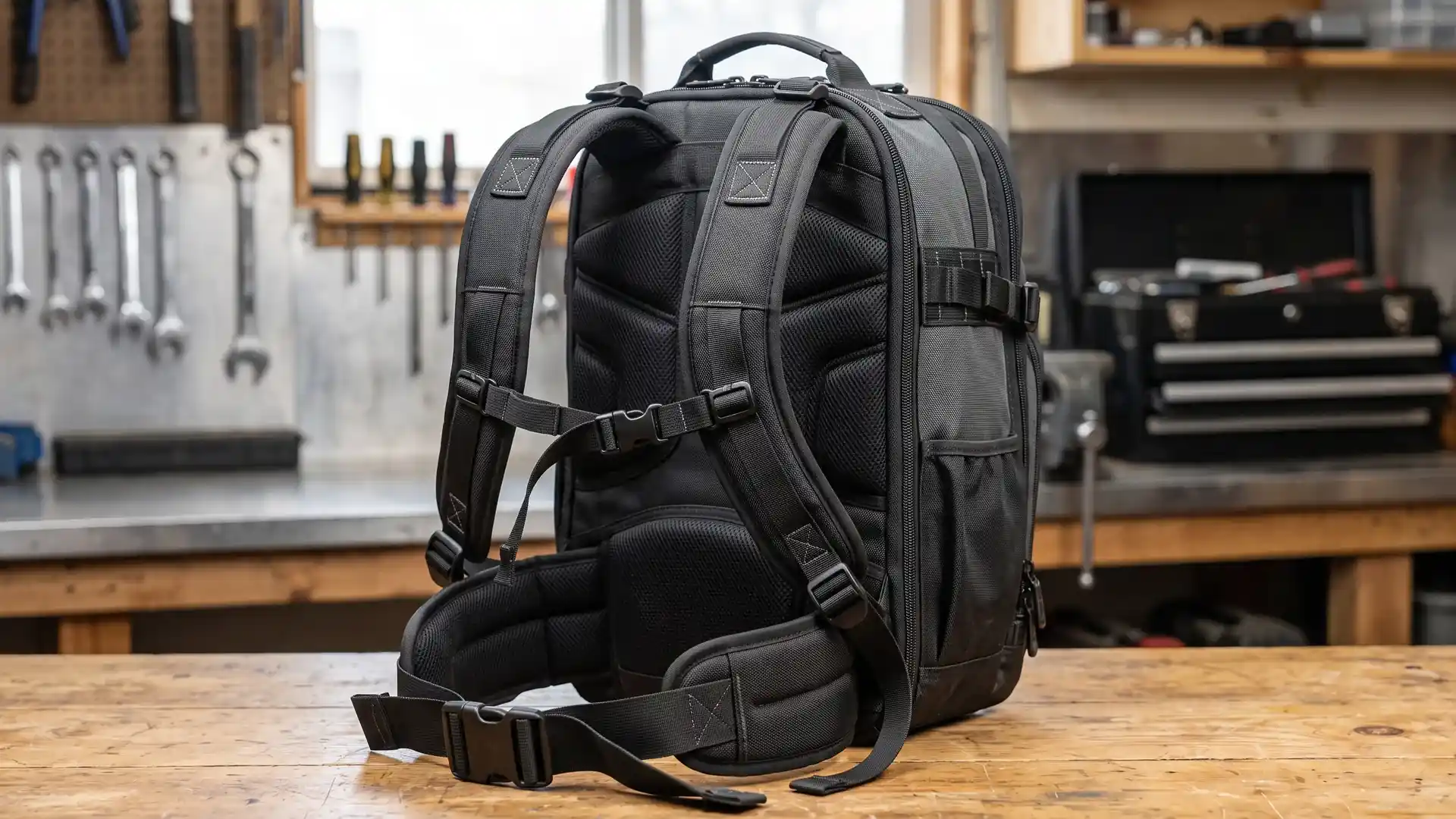
Heavy field service bags often fail at the body before the zipper. That's why this section comes before pocket layout. You can spec a perfect pocket grid and still get complaints if a heavy kit slams onto one shoulder several times a day.
One misconception I want to clear up immediately: there is no such thing as an OSHA-certified tool bag. OSHA, the U.S. Occupational Safety and Health Administration, regulates workplace conditions under the General Duty Clause — employers must address recognized hazards likely to cause serious harm. A bag itself doesn't get an OSHA certificate. Safety teams use OSHA's duty standard and NIOSH research to assess whether a carrying task is reasonable, not to approve a SKU.
NIOSH's Recommended Weight Limit (RWL) approach starts at 51 pounds under idealized conditions and reduces that number through factors for horizontal distance, lift height, travel distance, frequency, and asymmetry. That's for short defined lifting tasks. Carrying a bag across a job site adds distance, duration, and usually one-sided loading — which is why many ergonomics programs set a prolonged carry target well below the lift number, commonly around 25 pounds, with 35 pounds used as a practical manual-lift reference for shorter, less frequent lifts. In rounded metric terms, that's a target of about 11 kg for all-day carry and around 16 kg for occasional lifts. Treat those as fleet planning thresholds, not OSHA-mandated bag weights — and confirm with your own occupational health lead, because body weight, age, ladder work, and PPE change the real risk.
What does that mean for the two formats?
A technician backpack is the more conservative choice once a loaded kit regularly exceeds your carry target. Two wide padded straps spread the load across both shoulders, a sternum strap controls outward pull, and a waist belt — when usable with a tool belt — transfers some load toward the hips. The pack also holds weight close to the torso and reduces horizontal distance on the spine. The weak point is usually harness attachment: thin strap anchors, single-row stitching, or foam that collapses after a summer in a hot truck.
An open-top HVAC tool bag relies on a reinforced handle and a short carry. A moderately loaded kit walked a short distance is usually fine. A heavy kit carried down a long hotel corridor late in the day becomes a twisting load on the spine and the handle becomes a single stress point. If the real filled weight regularly exceeds your carry budget, move to a backpack, a rolling bag, or split the kit. Don't solve it by buying a thicker handle.
Buyer action: weigh the loaded kit, not the empty bag. Put the actual meter, bits, screwdrivers, spare fasteners, and hand tools in a sample and read the total on a luggage scale. That number determines harness requirements, base spec, and handle construction — and it's the first line of an honest RFQ.
Tool Organization: Pocket Layouts and Accessibility
Pocket count is the most misleading number in this category. A 35-pocket layout is useless if 20 pockets are sized for pens. A 22-pocket layout can be excellent if every pocket fits one step of the service routine.
For HVAC work, layout should follow job sequence: arrive, diagnose with meter, pull panels with bit driver and screwdrivers, check pressure with gauges, adjust wiring with pliers or strippers, replace small parts, close up, document. Diagnosis and panel-access tools belong in the fastest zone. Gauge fittings, bits, and small parts sit in second-tier zones. Heavier seldom-used tools drop to the bottom or back.
Open-top tool bags use wide, shallow horizontal pockets because the technician works from above. The best layouts put a dedicated meter pocket where the multimeter slides in without cable strain, vertical screwdriver loops on one side, a row for nut drivers, and a low-profile zone for bits. The meter pocket matters more than any other single pocket: if the multimeter sits under six screwdrivers, the technician digs constantly and the screen takes damage over months.
Technician backpacks use vertical panel organization because the bag opens away from the body or folds flat. The same priorities apply, but the structure also has to keep tools in place when the panel tilts. Retention — elastic loops, webbing bands, zippered windows — does the real work. Without it, a stair climb turns into a jumble.
The sourcing lesson: specify pocket depth, width, and retention from your actual tool list, not "more pockets." List the tools and approximate sizes — a common digital multimeter may be around 180 mm tall; long screwdrivers can reach 280 mm or more; a refrigerant gauge manifold is bulky and may need its own zippered chamber rather than a slim loop. Then ask the supplier for a pocket-layout drawing showing which zone each tool will sit in. If the drawing can't place your four largest tools cleanly, request a pattern change before sampling.
That's the difference between a private-label product service managers respect and a promotional bag a tech throws in the truck bed.
Empty weight matters too. A tall backpack with dense internal layers can weigh noticeably more empty than a lean open-top tote — and that empty weight rides on the technician all shift. Don't chase pocket count without checking it against carried weight and comfort.
Base Construction and Durability Requirements
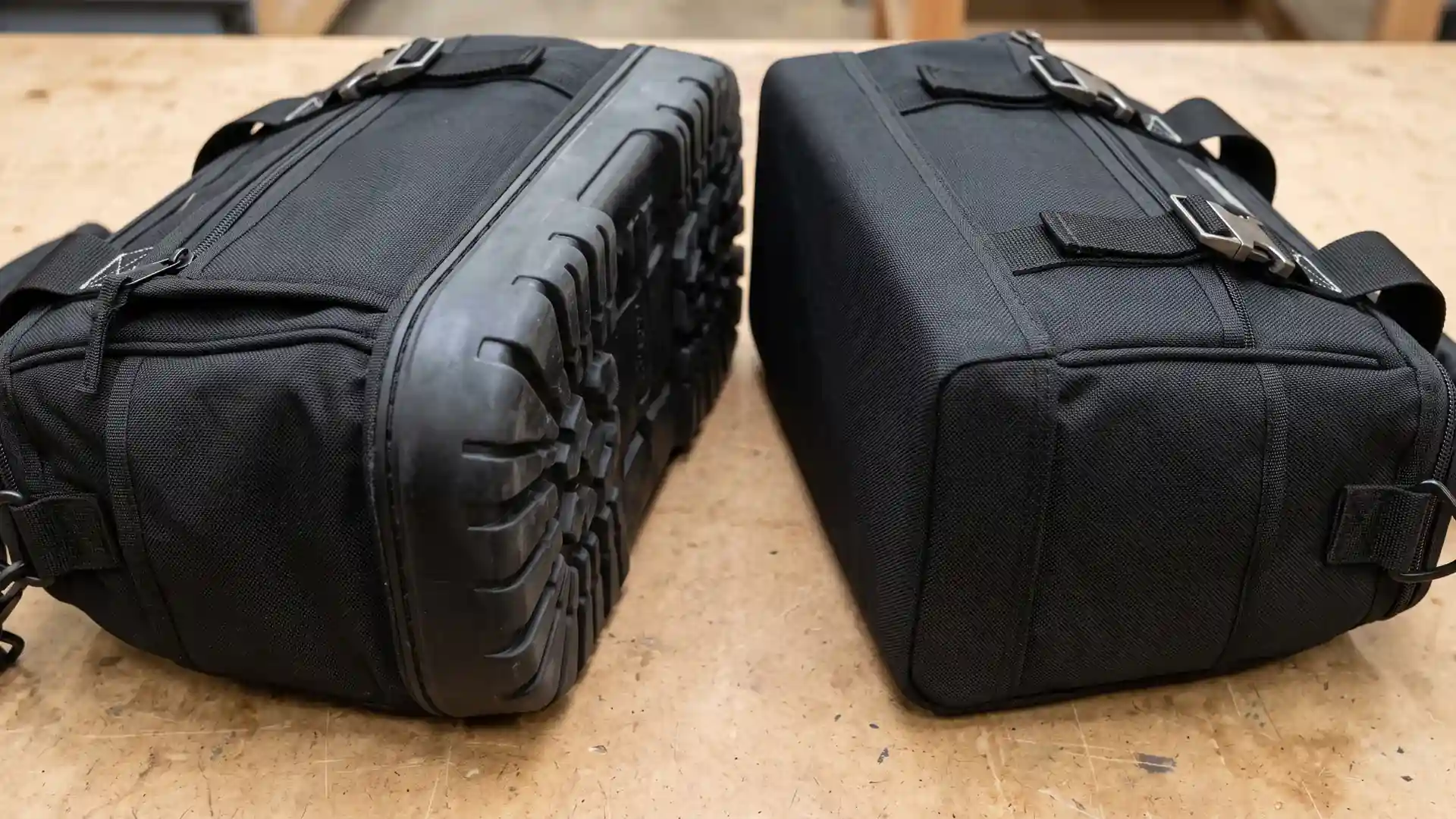
The bottom of a field service bag is where unrealistic claims die. A tech sets the bag on wet concrete, drags it across asphalt, kicks it under a rooftop ladder, or parks it next to a condensing unit that drips. A thin fabric bottom collapses, tools flop, and the corners wear through in months.
There are three practical bottom structures. The right one depends on load, surface exposure, and your program's price-quality position.
PE/PP board bottoms use a cut panel of polyethylene or polypropylene sheet wrapped in lining or visible fabric. They hold a clean, structured retail shape and keep the bag upright on even surfaces. They suit moderate loads and technician bags that won't be dragged across rough concrete daily. When specifying board bottoms, confirm board thickness, whether the board is wrapped, and how the bottom seam is finished — an exposed raw edge can cut the outer fabric over time.
Molded rubber bases are the heavy-duty option. A thick rubber or TPR bottom with a tread pattern resists abrasion, stands on wet surfaces, and protects the lower perimeter far better than a flat board. This is the base I'd spec first for open-top HVAC bags that live on concrete and rooftop aggregate. The trade-off is commercial: a custom mold requires tooling, and the supplier must confirm mold availability, cost, and order quantity. Buyers can reduce that by using a supplier's existing mold shape instead of paying for new tooling. Always ask whether the quoted rubber base is an existing mold or a new tooling project.
Soft reinforced bottoms — fabric with a stiffener or abrasion patch — are fine for lightweight organizers and pouch kits, but I wouldn't rely on them for a heavily loaded field kit unless the factory confirms the load test in writing.
The upper shell fabric matters at the same point. Fabric that can't handle job-site scuffs will fail around the corners even if the base is solid. For heavy field use, pair the selected base with a fabric that has real abrasion performance. If you're choosing between nylon and polyester shells, compare fabric durability and coatings before locking the spec.
One detail most buyers miss: the base seam. Many bags stop water at the bottom panel, but the seam between base and shell still lets moisture creep in when the bag sits in a puddle. The safest RFQ language asks for a base-seam leak-resistance statement, not a "waterproof bag" claim. Test it with a brief set-down on wet concrete — don't fill the bag with water, because most tool bags are not built to hold free liquid.
Private Label Customization, Sample Evaluation, and RFQ Checklist
Now for the part that decides whether your project ships on spec or turns into avoidable sample revisions.
When I spec a private-label field service bag, I start with five pre-sampling inputs:
- Trade user: HVAC, electrical, telecom, facilities, or MRO. This changes pocket depth, meter-zone size, and the tool set the bag must hold.
- Loaded-weight target: the real filled weight in kilograms or pounds, measured with tools inside, not an empty-bag estimate.
- Tool list: the meters, screwdrivers, pliers, bits, gauges, and spares the bag must hold, with approximate dimensions.
- Bottom structure: PE/PP board, molded rubber base, or soft reinforced bottom, plus the abrasion and wet-surface conditions it will face.
- Carton plan: how finished bags will be packed — flat or upright — to control shipping damage and warehouse handling.
Five inputs. If the sample request goes out without them, the supplier has to guess, and the pocket layout or base spec comes back wrong. That's where buyers lose time to sample resets.
Customization extends beyond pockets. You'll usually need to confirm:
- Logo method and placement: woven label, embroidery, screen print, PVC patch, heat transfer, or a combination. Each has a different look, wear profile, and setup requirement. No logo method has a universal MOQ — the decorator or supplier must confirm feasibility on the selected fabric and panel.
- Fabric and color: shell denier, coating, accent colors on pocket mouths or zipper tape.
- Hardware: zipper type and size, pulls, D-rings for ID tags, and whether hardware needs a corrosion-resistant or matte finish.
- Packaging: polybag, barcode, hangtag, carton mark, and insertion of buyer-provided labels or UPC codes.
Amazon and online retail buyers should also make sure listing photography matches the final pocket layout. If the listing shows a 30-pocket open layout and production ships 24 pockets, the vanity photo becomes a source of returns and negative reviews — not because the bag failed structurally, but because the expectation did. Same rule for "holds X tools" claims: never print a capacity the production sample can't demonstrate.
The RFQ table below is what I'd send to OMASKA or any qualified bag manufacturer. The right column is what the factory should return in writing.
| Specification category | Buyer input or option | Factory should confirm |
|---|---|---|
| Target user or trade | HVAC / electrical / telecom / facilities | Whether existing patterns fit that trade's tool profile |
| Quantity band | Target volume range for first order | MOQ, price breaks, and what changes at lower volumes |
| Loaded-weight target | Weigh the actual filled kit and state the number | Harness, base, board, and handle construction matched to that weight |
| Tool list | Meters, drivers, bits, gauges, spares with approximate sizes | Pocket-layout drawing, retention points, and tool placement |
| Bottom structure | PE/PP board / molded rubber / soft reinforced | Board thickness, existing mold or new tooling, seam finish |
| Shell fabric | Denier, coating, color | Fabric spec and available swatch or lab-draft |
| Logo method | Embroidery / print / woven / PVC / heat transfer | Decorator MOQ, setup, placement limits, material compatibility |
| Packaging | Carton plan, individual packing, barcode, UPC | Carton dimensions, weight, and damage-risk packing notes |
| Inspection requirement | AQL, pre-shipment photos, loaded sample test | Whether factory can arrange inspection or accept third-party QC |
| Sample deadline and bulk delivery | Buyer-defined dates | Feasible schedule after artwork and deposit timing confirmed |
After the sample arrives, evaluate it against your tool list, not the brochure. The sample evaluation checklist:
- Load the bag to the real target weight and carry it for several minutes by handle and straps.
- Check that the meter sits fully in its pocket without pressing against zipper teeth.
- Check that long screwdrivers don't poke top seams or catch the flap.
- Set the bag on a flat surface and confirm it stands without tipping when loaded.
- Pull the handle, strap anchors, and bartacks hard enough to demonstrate reinforcement.
- Run every zipper through its full length with the bag packed.
- Inspect bottom seams, board edge wrap, and rubber base perimeter for gaps.
- Compare hardware finish and logo position to the approved pre-production reference.
One sample is rarely enough for a fleet program. Ask for a pre-production sample after tooling corrections, then a production sample you can benchmark against the approved golden sample. If this is your first bag order, check the common sample order mistakes before signing off — most bulk problems trace back to what wasn't verified on the prototype.
If the bigger goal is a full private-label line around field service — not just one bag — the positioning and product-line choices in private label program planning help before you spread the same fabric, color, and packaging across multiple SKUs.
Supplier Verification and Common Sourcing Mistakes
A good spec only works if the factory actually builds to it. That's where sourcing judgment comes in.
When you talk to a supplier, ask to see field-service bags they've already made — not fashion backpacks or gym bags. A factory can be excellent at school bags and still misjudge a bartack point on an industrial tool bag. Look for evidence that they understand stress stitching: bar-tacking at shoulder strap anchors, reinforced bottom seams, webbing through the handle base, and extra stitching where a heavy tool bag flexes most.
Ask the supplier to confirm in writing:
- Which base structure they can produce and whether the rubber base is an existing mold.
- What board thickness and wrapping method they'll use for PE/PP bottoms.
- Which zipper they intend to use, with a note that "moisture-resistant" zipper tape does not make a bag watertight.
- Whether the sample is made with the same seam allowances as bulk production.
- Whether the factory can provide load-test photos or video before bulk.
Then test the factory's honesty in the quote. A solid quote for a heavy-duty field bag usually names the structure — for example, a specified high-abrasion shell, a defined PE board bottom, bartacked strap anchors, and a specified coil or molded zipper. A weak quote just says "heavy duty tool bag." If you can't see the engineering in the quote, don't expect the engineering in the bag.
Common sourcing mistakes I see in this exact category:
- Buying soft-bottom bags to hit a low unit cost, then eating returns when bases tear.
- Specifying 30 pockets without a tool list, so the factory fills the bag with pen sleeves.
- Asking for the lowest MOQ instead of the smallest quantity the factory can maintain quality.
- Approving an unloaded sample that sags on-site once tools go in.
- Changing fabric after sample approval without re-testing abrasion and color.
- Skipping production sample inspection because "the pre-production sample was fine."
These are the same failure patterns covered in costly sourcing mistakes when buyers fail to connect tooling, material control, and inspection into one documented process.
For volume programs, plan the inspection method before production starts. A simple AQL-based final inspection covering visible defects, sewing, and hardware is the baseline. Add a loaded test on a small number of pulled samples if the bag will routinely carry 10 kg or more. That's a buyer-defined acceptance test — you set the target weight, carry method, and pass condition — because no universal industry test applies to every trade's tool set.
FAQ: HVAC Tool Bag vs Technician Backpack
Here are the questions service managers and private-label buyers most often ask before sending an RFQ.
Can a technician backpack hold as many tools as an open-top HVAC bag?
Yes, but it depends on vertical organization rather than open floor space. Both formats can be built with 30 to over 50 pockets, so raw pocket count is not the decision. A backpack tends to stack tools in layered panels and zippered chambers, which works when retention is strong. An open-top bag spreads tools in visible rows near the opening. The real limit is usually weight and harness comfort, not pocket volume — so compare loaded weight before pocket count.
What is the standard weight limit for a field service tool bag?
There is no universal standard. A well-built industrial bag can be engineered to carry 15 kg to 20 kg or more, but that doesn't make 20 kg a safe all-day carry. Ergonomics planning commonly targets prolonged carrying below about 11 kg, with manual lifting around 16 kg as a shorter-task reference. For your program, weigh the actual filled kit and ask the supplier to confirm handle, harness, and base construction for that specific target weight.
Do custom molded rubber bases require higher MOQs?
They often do, but the answer is project-specific. A new rubber mold usually means tooling cost and a higher order quantity to justify the mold. Using a supplier's existing mold can reduce or avoid new-tooling fees, though the shape and logo area may be limited. Ask the manufacturer to separate "existing mold" from "new tooling" in the quote so you can compare total cost instead of unit price alone.
Can the pocket layout be built around a specific HVAC tool kit?
Yes, and that's the strongest reason to use OEM/ODM instead of buying a fixed retail design. You give the factory the tool list and approximate dimensions, and the supplier returns a pocket drawing with depth, width, and retention points. Keep the tool list stable from pre-production sample through bulk order — changing a meter or driver model after pattern confirmation can force avoidable rework.
Official Sources and Compliance References
This section exists because fleet managers buying field service bags often ask about ergonomic claims and compliance. Here's what the official sources actually support.
- OSHA General Duty Clause: U.S. employers must provide a workplace free from recognized hazards likely to cause serious harm. This supports ergonomic risk planning for repetitive or heavy carrying tasks. It does not mean any bag can be called "OSHA certified." Treat the bag as one control inside a broader job-safety review.
- NIOSH Recommended Weight Limit and lifting equation: provides a research-based method for evaluating lifting tasks and reducing acceptable load based on distance, height, frequency, and asymmetry. It's useful for deciding whether a team's loaded bag weight demands a backpack harness, rolling carrier, or tool-kit split. NIOSH guidance is a reference, not a product specification.
Other compliance issues — chemical restrictions, labeling, and any age-based thresholds — depend on target market and intended user. They're not automatic for adult industrial tool bags, but the buyer should confirm destination-market requirements with the supplier before art and carton approval.
Conclusion
No single bag wins the HVAC tool bag vs technician backpack debate. The real answer is a routing decision: open-top bags reward short, flat, van-adjacent calls with fast access; backpacks reward stairs, ladders, long walks, and hands-free work.
The commercial failure happens when a buyer stops at "looks durable" and skips the three details that determine field performance: loaded-weight target, tool-list pocket engineering, and bottom structure. Those three lines in your RFQ — plus a sample test with the real kit — do more for brand reputation than any denier claim on a catalog page.
Here's a practical path forward: weigh a technician's loaded kit, map the worst daily route, send the factory the tool list, weight, route, and bottom-structure choice, then test the pre-production sample the way your hardest-working technician would use it. If it survives that, you have a field-service program worth scaling.
Get A Quote

Get A Quote
0 Comments