
Top Branding Mistakes New Bag Brands Must Avoid: Positioning, Design, Cost & Communication
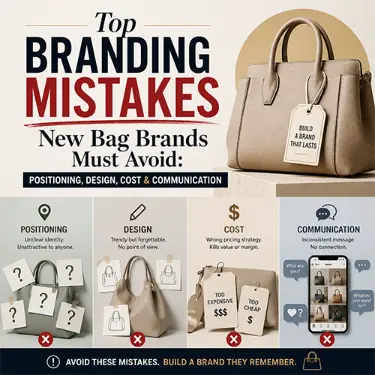
Launching a new bag brand is an exhilarating journey, but the transition from a creative concept to a profitable market staple is fraught with invisible traps. In the global luggage and fashion industry, branding is not just a logo on a fabric; it is the cohesive sum of your supply chain choices, material integrity, and consumer psychology. This guide identifies the critical branding mistakes that drain start-up capital and provides a roadmap for building a resilient, high-equity brand from day one.
Why Branding Mistakes Destroy New Brands
For a new entrant, the market does not offer a second chance to make a first impression. Branding mistakes are particularly lethal because they create Cognitive Dissonance—a state where the consumer’s perception of your price does not match the reality of your product.
-
Financial Erosion: Marketing a poorly positioned brand is like pouring water into a leaky bucket. You spend more on customer acquisition because your “brand promise” fails to convert.
-
Supply Chain Friction: When branding is vague, your manufacturer cannot provide accurate solutions. This leads to wasted samples, production delays, and costly re-runs.
-
Loss of Retailer Trust: B2B buyers and distributors look for consistency. If your brand looks “amateur,” professional retailers will not risk their shelf space on your inventory.
Mistake 1 — No Clear Target Customer
Many new brand owners fall into the “Everyone Trap,” believing that a versatile backpack or suitcase should appeal to everyone from students to CEOs. In reality, a product for everyone is a product for no one.
-
The Error: Designing a bag with “general features” that fail to solve a specific pain point.
-
The Impact: Your marketing message becomes diluted, and your ad spend is wasted on broad audiences who have no emotional connection to the design.
-
Terminology – Market Segmentation: The process of dividing a broad consumer or business market into sub-groups of consumers based on shared characteristics.
| Target Segment | Core Requirement | Pricing Strategy | Key Branding Elements |
| Digital Nomads | Tech protection, organization | Mid-to-High | Rugged, minimalist, functional |
| Luxury Travelers | Aesthetics, exclusivity | Premium | Heritage, rare materials, heavy hardware |
| Budget Students | Durability, low cost | Economy | Bright colors, washable fabrics, high volume |
Mistake 2 — Copying Competitor Designs Blindly
While it is tempting to “borrow” the aesthetics of a best-selling brand like Samsonite or Tumi, blind copying is a recipe for brand invisibility and legal headaches.
-
The Error: Using the same silhouettes, color palettes, and even marketing slogans as established leaders.
-
The Impact: You position yourself as a “cheap alternative” rather than a unique brand. Furthermore, you risk IP Infringement which can result in your stock being seized at customs.
-
Terminology – IP Infringement: The unauthorized use of intellectual property, such as patents, trademarks, or copyrighted designs, belonging to another entity.
Mistake 3 — Inconsistent Branding Across Products
Inconsistency is the silent killer of brand trust. If your 20-inch carry-on looks premium but your matching tech pouch looks like a budget promotional item, the customer feels cheated.
-
The Error: Using different shades of “Navy Blue” or varying font weights across different product lines.
-
The Impact: It suggests a lack of professional oversight and makes the collection look like a random assortment of items rather than a curated brand experience.
-
Terminology – Brand Equity: The commercial value that derives from consumer perception of the brand name of a particular product, rather than from the product itself.
Mistake 4 — Wrong Logo Process Choice
The logo is the “handshake” of your brand. New brands often choose the cheapest logo method to save on MOQ (Minimum Order Quantity), but this often results in a product that looks like a corporate giveaway rather than a retail brand.
-
The Error: Using a silk-screen print on a bag intended to sell for $150.
-
The Impact: The logo may peel or fade, destroying the brand’s perceived value before the bag even wears out. Choosing the right
customization service
Logo Process Comparison Table
| Method | Visual Perception | Durability | Best For | Cost Impact |
| Silk Screen Print | Casual / Sporty | Moderate | Promotional / Budget | Low |
| Embroidery | Classic / Rugged | High | Backpacks / Canvas | Moderate |
| Rubber Patch (PVC) | Modern / Tech | Very High | Outdoor / Tactical | Moderate |
| Metal Plate | Luxury / Premium | Maximum | Hardside Luggage / Handbags | High |
-
Terminology – PVD Plating: Physical Vapor Deposition; a vacuum coating process that produces a brilliant decorative and functional finish on metal hardware, making it highly resistant to scratches.
Mistake 5 — Choosing Cheap Materials for Premium Brand
You cannot build a “Premium” brand on a “Budget” Bill of Materials. Consumers are increasingly educated about fabrics and hardware; they can feel the difference between high-tenacity nylon and cheap polyester.
-
The Error: Marketing a “Luxury Travel” experience while using #5 generic zippers and 150D lining.
-
The Impact: High return rates and negative reviews. If the material fails, the branding—no matter how beautiful—becomes a lie. To ensure your materials match your brand promise, always consult
verified manufacturing standards
Material Quality vs. Brand Positioning
| Material Component | Economy Tier | Mid-Range Tier | Premium/Luxury Tier |
| Exterior Fabric | 600D Polyester | 1680D Ballistic Nylon | Full-grain Leather / 100% PC |
| Main Zipper | Standard Coil | YKK / Water-resistant | Anti-theft Double Zipper |
| Inner Lining | 150D Polyester | 210D Twill | Peach-skin / RPET Fabric |
| Wheels | Single Plastic | TPE Spinner | Dual-bearing Silent Spinners |
-
Terminology – Ballistic Nylon: A thick, tough, synthetic nylon fabric originally designed for military body armor, known for its extreme tear and abrasion resistance.
Mistake 6 — Wrong Size or Function for Target Users
Branding is about empathy. If your “Urban Commuter” bag cannot fit a standard 16-inch MacBook Pro, you have failed your brand’s core mission.
-
The Error: Designing for aesthetics while ignoring Ergonomics and modern hardware dimensions.
-
The Impact: The product becomes useless to the target audience, leading to “functional irrelevance.”
-
Terminology – Ergonomics: The study of people’s efficiency in their working environment, specifically designing products to minimize physical discomfort and maximize usability.
Mistake 7 — Ignoring Packaging and User Experience
For DTC (Direct-to-Consumer) brands, the “Unboxing Experience” is the only physical interaction you have with the customer during the sale. Shipping a $200 suitcase in a thin, damaged brown box with no protective sleeve is a branding disaster.
-
The Error: Treating packaging as a shipping cost rather than a marketing opportunity.
-
The Impact: Increased “Buyer’s Remorse.” Good packaging justifies the price and encourages social media “unboxing” shares, which is free marketing.
Packaging Tiers for Bag Brands
| Tier | Components | Brand Signal |
| Basic | Polybag + Single-wall Carton | "I am a commodity." |
| Standard | Non-woven Dust Bag + 5-layer Carton | "I am a reliable product." |
| Premium | Branded Dust Bag + Gift Box + Thank You Card | "I am an experience/investment." |
Mistake 8 — Lack of Quality Standards
Branding is a promise of consistency. If the first 100 customers get a perfect bag but the next 100 get bags with misaligned seams, your brand is built on sand.
-
The Error: Not establishing a formal Quality Manual or AQL standard with your factory.
-
The Impact: Brand dilution. Customers don’t blame the factory; they blame your brand.
-
Terminology – AQL (Acceptable Quality Limit): A statistical tool used to determine the maximum number of defective units permitted in a sample size before the entire batch is rejected.
Mistake 9 — Poor Color & Material Consistency
Color is the most immediate visual identifier of a brand. If your “Signature Red” looks orange on your backpack and maroon on your cross-body bag, your brand identity is fragmented.
-
The Error: Relying on “factory-stock” colors without using Pantone matching.
-
The Impact: The collection looks mismatched, making it impossible to upsell customers on a “complete set.”
-
Terminology – Pantone Matching System / PMS: A standardized color reproduction system that ensures manufacturers in different locations can produce exactly the same color.
Mistake 10 — No Branding Guidelines
A brand is not just a logo; it is a “vibe” and a voice. Without a Brand Book, your social media, website, and physical products will feel like they were made by three different companies.
-
The Error: Having no fixed rules for logo placement, font usage, or photography style.
-
The Impact: A disjointed online presence that fails to build a “mental map” in the consumer’s mind.
Mistake 11 — Bad Communication with Factory
A factory can only build what you clearly define. Vague branding leads to “Factory-Led Design,” where the manufacturer makes choices based on their convenience, not your brand’s soul.
-
The Error: Using verbal descriptions instead of a professional Tech Pack.
-
The Impact: You receive 500 units of a product that is “technically correct” but “brand-wrong”—wrong zipper puller shape, wrong lining texture, or wrong handle feel.
-
Terminology – Tech Pack: A comprehensive document created by designers that contains all the technical specifications and design details that make a product, including BOM, graded measurements, and stitch details.
Mistake 12 — No Feedback Loop After Launch
The biggest branding mistake is believing your brand is “finished” once the first order arrives. Markets evolve, and so must your branding.
-
The Error: Ignoring customer reviews and failing to perform Product Iteration.
-
The Impact: Your brand becomes a “One-Hit Wonder.” Successful brands like OMASKA have thrived for decades by constantly listening to B2B feedback and updating their structural designs.
How to Fix Each Branding Mistake
Building a world-class bag brand requires moving from “Guesswork” to “Framework.” Use the following table to audit your brand and implement corrections immediately.
The Brand Correction Roadmap
| Mistake | Immediate Fix / Action Step | Professional Tool to Use |
| No Target User | Conduct 20 customer interviews or build a detailed "Persona." | Customer Persona Template |
| Copying Designs | Identify one "Hero Feature" that no competitor has. | Product USP Matrix |
| Logo Choice | Upgrade to Metal or Molded Rubber for mid-tier+ brands. | 3D Mockup Design |
| Material Mismatch | Audit your BOM and replace one "cheap" component with a "signature" one. | Fabric Swatch Book |
| Packaging | Add a branded "Thank You" card and a high-quality non-woven dust bag. | Unboxing Flowchart |
| Factory Communication | Convert your sketches into a detailed, multi-page Tech Pack. | Adobe Illustrator / PLM Software |
| Consistency | Create a 10-page "Brand Guideline" for all future designs. | Brand Book / Style Guide |
Final Checklist for New Bag Brands
-
Define your Niche: Who is the one person who needs this bag more than anyone else?
-
Verify the BOM: Does the hardware feel heavy and premium? Does the zipper slide without effort?
-
Standardize the Logo: Is the logo placement consistent within 2mm across all units?
-
Protect the Experience: If the box was dropped 5 feet, would the product (and the branding) survive?
-
Build the Tech Pack: Does the factory have a “Bible” for your product that leaves zero room for interpretation?
Conclusion
Branding is the bridge between a factory’s output and a customer’s loyalty. By avoiding these 12 mistakes, you ensure that every dollar spent on manufacturing and marketing contributes to a long-term asset. A great bag brand is not built in a day, but it is built through the disciplined application of quality, consistency, and a deep understanding of the human being who will eventually carry your product through the world.
Get A Quote

Get A Quote
0 Comments