
ABS vs PC vs Aluminum Mistakes: Shell Thickness, Wheels, Handle Tubes & QC Issues
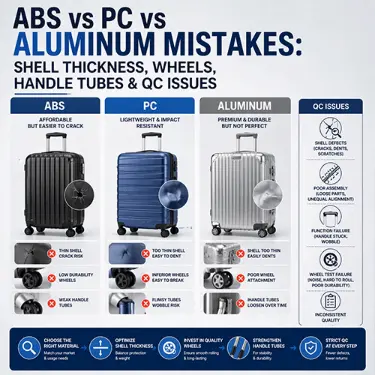
Selecting the wrong material or structural specification can lead to catastrophic product failures, high return rates, and permanent damage to a retail brand’s reputation, especially when sourcing in bulk for the global market where consumer expectations for durability are at an all-time high.
Why Shell Material Decisions Affect 80% of Luggage Durability
The shell of a suitcase acts as its chassis; if the chassis fails, the internal components and the contents are immediately compromised. In professional luggage manufacturing, the shell material dictates the bag’s ability to absorb energy during impact. High-quality materials like Virgin Polycarbonate flex under pressure and return to their original shape, whereas inferior materials shatter.
-
Terminology – Energy Absorption: The capacity of a material to deform and dissipate the kinetic energy from a fall or strike without structural failure.
-
Terminology – Flexural Modulus: A physical property that describes the ratio of stress to strain in flexural deformation, essentially measuring how much a material will bend when a force is applied.
-
Terminology – Virgin Resin: Plastic material that has never been processed or recycled before, maintaining its full molecular chain length and structural integrity.
Core Material Properties Comparison Matrix
| Feature | ABS (Acrylonitrile Butadiene Styrene) | PC (Polycarbonate) | Aluminum-Magnesium Alloy |
| Impact Resistance | Low. Brittle, especially in cold weather. | Very High. Highly flexible and "unbreakable." | High. Rigid, but can dent under heavy force. |
| Tensile Strength | Moderate. Breaks under high stress. | Extremely High. Resists tearing and cracking. | Maximum. Highest structural rigidity. |
| Weight Profile | Medium. | Lightest (when used in pure form). | Heaviest. |
| Surface Finish | Matte or Textured only. | High-gloss, Mirror, or Matte. | Metallic, Premium Anodized. |
| Typical Lifespan | 1–2 years of frequent travel. | 5–10 years of frequent travel. | 10+ years (Heirloom quality). |
| Production Cost | Low (Economy/Promotional). | Medium to High. | Very High (Luxury/Professional). |
Mistake 1 — Choosing ABS for Mid-High Market
One of the most common mistakes in B2B sourcing is attempting to push ABS luggage into the mid-to-high-end market segments. While ABS is cost-effective, it lacks the molecular resilience required for frequent flyers. ABS is a “stiff” polymer. While it feels “strong” to the touch in a showroom, stiffness is the enemy of durability in air travel. When an ABS suitcase is thrown onto a luggage carousel, the impact energy has nowhere to go, causing the plastic to crack rather than deform.
-
The Trap: Retailers often choose ABS because it is easier to emboss with complex textures and carries a lower price point. However, the high return merchandise authorization (RMA) rate usually eats into the initial profit margins.
-
The Solution: For mid-market segments, buyers should opt for ABS+PC Composites (a blend) or 100% Pure Polycarbonate. Pure Polycarbonate provides the premium “flex” that high-end customers expect, significantly reducing the likelihood of shell breakage during transit.
Mistake 2 — Ignoring Shell Thickness Variations
Buyers often focus solely on the material type while ignoring the “Sheet Thickness” or “Gauge.” In the manufacturing world, the thickness of the plastic sheet before it is vacuum-formed is critical.
-
Terminology – Gauge: The measured thickness of the plastic sheet before it is vacuum-formed into a suitcase shell.
-
Terminology – Draw Ratio: The ratio between the surface area of the finished shell and the original flat sheet. During vacuum forming, corners are stretched the most, making them the thinnest and most vulnerable points.
A 100% PC bag with a 2.0mm shell may actually be weaker than a well-engineered ABS+PC bag with a 3.5mm shell. If the shell is too thin, the bag will “cave in” when stacked under other luggage, potentially damaging the internal laptop compartment or fragile belongings.
Thickness vs. Market Positioning Matrix
| Target Market Segment | Recommended Shell Thickness | Performance Expected |
| Budget/Promotional | 2.5mm - 2.8mm | Low shipping weight, minimum cost, but high breakage risk. |
| Standard Retail | 3.0mm - 3.2mm | Balanced weight-to-strength ratio; standard for 24-inch bags. |
| Premium/Industrial | 3.5mm - 4.0mm | Maximum protection; used for heavy-duty check-in luggage. |
Mistake 3 — Underestimating Wheel Quality Differences
Wheels are the most frequent point of mechanical failure in luggage. Using cheap PVC wheels instead of TPE-coated wheels results in excessive noise, vibrations that loosen internal screws, and eventual wheel “melting” due to friction heat generated during long walks through airports.
-
Terminology – TPE (Thermoplastic Elastomer): A rubber-like material that offers silent rolling, high abrasion resistance, and excellent shock absorption.
-
Terminology – Durometer: A scale used to measure the hardness of the wheel material. Softer wheels (lower durometer) are quieter but wear out faster; harder wheels are louder.
-
Terminology – Kingpin: The central bolt or rivet that holds the wheel assembly to the suitcase shell.
Wheel Component Quality Standards
| Component | Low-Grade (Common Sourcing Mistake) | High-Grade (Professional Standard) |
| Outer Tire | Hard PVC (Noisy, cracks easily, vibrates). | Soft TPE or TPU (Silent, shock-absorbing). |
| Bearings | Plastic bushings or no bearings at all. | Dual Stainless Steel ball bearings (Sealed). |
| Housing | Recycled Polypropylene (PP). | Virgin Nylon (PA66) for high impact resistance. |
| Rotation | Single-axis (hard to maneuver). | 360-degree dual-caster (Spinner wheels). |
Mistake 4 — Wrong Handle Tube Thickness
The telescopic handle is a precision instrument that must withstand both vertical and lateral forces. A common mistake is using 0.6mm thin-walled iron tubes to save costs. This leads to handles that jam, bend, or snap under the weight of a heavy laptop bag placed on top of the suitcase.
-
Terminology – Wall Thickness: The thickness of the metal tubing used in the telescopic handle.
-
Terminology – Structural Deflection: The degree to which a structural element is displaced under a load. High deflection means a “wobbly” handle.
-
Terminology – Anodization: An electrolytic process that increases the thickness of the natural oxide layer on the surface of aluminum parts for better corrosion resistance.
Handle Tube Material Comparison
| Material Type | Wall Thickness Recommendation | Performance Analysis |
| Carbon Steel (Iron) | 0.8mm+ | Strong but very heavy. Susceptible to internal rust. |
| Aluminum Alloy (6063) | 1.0mm - 1.2mm | Best strength-to-weight ratio. The industry standard. |
| Reinforced Alloy (6061) | 1.5mm | Professional-grade. Used for heavy-duty XL bags. |
Mistake 5 — Using Low-Grade PC Mix (Recycled Content)
To lower prices, some factories mix Virgin Polycarbonate with Recycled PC. Recycled PC has shorter molecular chains, which makes the shell significantly more brittle and prone to “stress whitening.”
-
The Problem: Recycled material often contains impurities that reduce the shell’s transparency and color vibrancy. Over time, these impurities react with UV light, leading to premature yellowing and cracking.
-
The Identification: High-quality
luggage manufacturing standards
Mistake 6 — Not Checking Impact Resistance
B2B buyers often skip the technical impact test reports, relying instead on visual aesthetics. Without a “Charpy Impact Test,” you have no data-driven way to know how the material will behave under the stress of an airport baggage handling system.
-
Terminology – Charpy Impact Test: A standardized high-strain-rate test which determines the amount of energy absorbed by a material during fracture.
-
Terminology – Low-Temperature Brittleness: The temperature at which a plastic material becomes prone to shattering rather than flexing. For ABS, this can be as high as 0°C, while for pure PC, it remains flexible down to -30°C.
Mistake 7 — No Drop Testing
A suitcase might look perfect on a shelf, but its structural integrity is only proven during a “Loaded Drop Test.” This test simulates a bag being thrown from a cargo hold onto the tarmac.
-
The Test Protocol: The bag is loaded with 20kg to 30kg of dead weight (usually sandbags).
-
The Drop: It is released by a pneumatic drop tester from a height of 90cm to 120cm onto all eight corners and four sides.
-
Failure Criteria: Any cracking in the shell, wheel housing detachment, or handle failure constitutes a structural failure.
Professional buyers should always request a video or a certified lab report of the drop test for their specific production batch. For more on how internal components affect these outcomes, see our guide on
Mistake 8 — Choosing Cheap Zippers
Zippers are the only thing keeping the customer’s belongings inside the bag. Using a standard #5 coil zipper on a large 28-inch check-in bag is a recipe for disaster. The “Lateral Strength” of a zipper is its ability to stay together when the bag is overpacked.
-
Terminology – Burst Strength: The amount of internal pressure a zipper can withstand before the teeth separate.
-
Terminology – Reversed Coil Zipper: A zipper where the teeth are hidden on the inside, providing a sleek look and better protection from the sharp edges of airport conveyor belts.
Zipper Specification Guide
| Case Size | Recommended Zipper Size | Feature Requirement |
| 20" Cabin Bag | #8 Coil | Smooth glide, standard single layer. |
| 24" - 28" Check-in | #10 Coil | Double-layer Anti-theft (Explosion-proof). |
| Business Bags | #8 or #10 RC | Water-resistant coating and ergonomic pullers. |
Mistake 9 — Overlooking Screw & Rivet Strength
The wheels and handles are attached to the shell via screws or rivets. If the factory uses low-carbon steel screws without a “Threadlocker” (an adhesive applied to screw threads), the vibrations from rolling on cobblestones will cause the screws to back out over time.
-
Terminology – Threadlocker: A thin, single-component adhesive, applied to the threads of fasteners such as screws and bolts to prevent loosening, leakage, and corrosion.
-
Terminology – Salt Spray Test: A standardized and popular corrosion test method, used to check corrosion resistance of materials and surface coatings.
Mistake 10 — Wrong Surface Treatment Choices
The surface treatment is not just about aesthetics; it’s about “Scratch Resistance.” This is a major factor in customer satisfaction.
-
Mirror/High-Gloss Finish: While visually stunning, these surfaces show scratches immediately. They are best reserved for high-end users who use luggage protectors.
-
Matte/Frosted Finish: Offers a sophisticated look and hides minor scuffs well.
-
Diamond/Micro-Texture: The most durable option for budget and mid-range bags as it provides a structural “rib” that hides deep scratches and maintains the “new” look for years.
Mistake 11 — Poor Packaging Causing Cracks
It is a tragedy when a high-quality PC suitcase survives a 10-hour flight but arrives at the retailer’s warehouse cracked because of poor master carton packaging. This is a “logistics mistake” that many buyers overlook until they see the damage.
-
Terminology – Corrugated Fiberboard: A material consisting of a fluted corrugated sheet and one or two flat linerboards. 5-layer (Double Wall) is required for heavy luggage.
-
The Standard: Use 5-layer corrugated boxes and ensure each suitcase is nested within a protective PE bag with foam corner buffers to prevent surface friction and impact damage during sea freight stacking.
Shipping Packaging Requirements
| Packaging Element | Requirement for Bulk Sourcing |
| Master Carton | 5-Layer Double Wall Corrugated (BC Flute). |
| Internal Protection | Corner foam buffers or honeycomb cardboard. |
| Unit Protection | Non-woven or PE dust bag to prevent scratches. |
| Stacking Limit | Clearly marked "Do Not Stack Above 5 Layers." |
Mistake 12 — Not Matching Material with Target Market
Materials behave differently in different climates. This is a “geographic mistake” that can lead to 100% failure rates in specific regions.
-
Cold Climates (Canada, Scandinavia, Russia): ABS should be strictly avoided. In temperatures below -10°C, ABS loses its flexibility and becomes like glass. Pure Polycarbonate is the only reliable choice for these markets.
-
High-Humidity Climates (Southeast Asia, Middle East): Glue-based linings and PU (Polyurethane) handles are prone to “Hydrolysis”—a chemical breakdown caused by moisture and heat that makes handles feel “sticky” and linings peel off. For these markets, mechanical fasteners and high-grade TPU handles are recommended.
How Buyers Can Avoid Luggage Material Mistakes
To ensure a successful sourcing campaign and minimize the risk of high return rates, B2B buyers should implement a technical verification protocol before placing a deposit:
-
Request Raw Material Certifications: Ensure the factory is using Virgin Resin (Polycarbonate) from reputable global suppliers and not a “factory blend” of recycled scraps.
-
Verify Tube Gauge: Use a digital caliper to measure the handle tube wall thickness. Do not accept anything under 1.0mm for Aluminum handles.
-
Inspect the Wheel Housing: Ensure the wheel housing is made of Virgin Nylon (PA66) and not brittle PP. Pull the wheel sideways; it should have minimal “play” (wobble).
-
Perform a “Squeeze Test”: Press the corners of the shell inward with significant force. A high-quality PC shell should pop back out instantly without leaving a white “stress mark” or permanent deformation.
-
Mandate TSA007 Locks: Ensure the locking mechanism is a genuine TSA-approved model (Red Diamond logo) to prevent damage during customs inspections.
By focusing on these deep technical details rather than just the “per-unit cost,” B2B buyers can build a product line that offers genuine value, long-term reliability, and a significant competitive advantage in the global travel market. Focusing on engineering excellence is the only way to build a sustainable luggage brand in the modern era.
Get A Quote

Get A Quote
0 Comments